
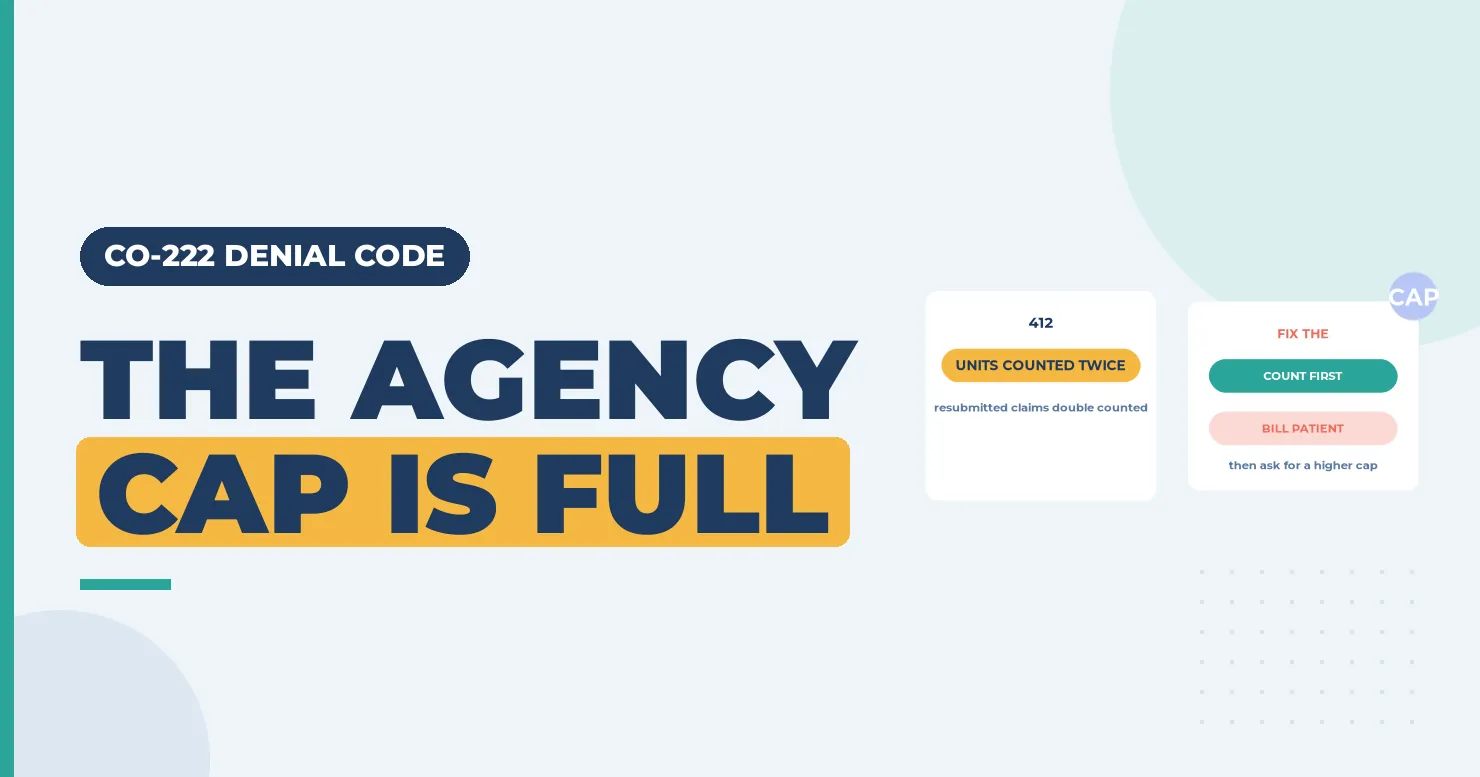
Most unit denials are about one patient. CO-222 is different. It says your organization, across all of its patients, has used up the hours, days or units its contract allows for the period. The patient on the denied claim did nothing unusual; the provider’s bucket was simply empty when the claim arrived. (Primary source: X12 Claim Adjustment Reason Codes)
In brief: CARC 222 reads “Exceeds the contracted maximum number of hours/days/units by this provider for this period. This is not patient specific.” Check the payer’s running count against your own, remove voided or duplicate claims from the count, and ask the payer or contract manager to raise the cap or approve an exception.
Part of our denial codes library. Written by Manikandan J, CPC, CRCR, who has reconciled capped Medicaid contracts for home care and behavioral health agencies. Published 23 October 2026. Last updated: 23 October 2026. Code wording quoted word for word from X12.
Example scenario (fictional names), part 1
CO-222 Denial Example: What Happened
Rosa Delgado runs billing for Sunrise Home Care, a personal care agency. Its Medicaid managed care contract allows a fixed number of T1019 personal care units each month for the whole agency.
On the 27th of the month, every new T1019 claim started coming back CAS*CO*222. Different patients, different aides, same code. Rosa’s own log showed the agency had about 400 units left.
Why would the payer think the agency was out of units? Keep reading, or jump to how the CO-222 denial was resolved.
The official text
| Field | Value |
|---|---|
| Code | 222 |
| Description | “Exceeds the contracted maximum number of hours/days/units by this provider for this period. This is not patient specific.” |
| Usage | “Refer to the 835 Healthcare Policy Identification Segment (loop 2110 Service Payment Information REF), if present.” |
| Start | 06/01/2008 |
| Last modified | 07/01/2017 |
Source: X12 Claim Adjustment Reason Codes, checked 23 October 2026.
Key terms
A contract cap is a ceiling in a provider agreement on total services for a period, such as a month or a contract year. A unit of service is the billing measure, for example 15 minutes for many home care codes. A utilization report is the payer’s running count of what has been used against the cap.
How CO-222 differs from a patient limit
| CO-222 | Patient-level limits | |
|---|---|---|
| Who hit the limit | The provider, across all patients | One patient |
| Example | Agency monthly unit cap | Yearly therapy visit limit |
| Related codes | CO-222 | CO-151 |
| Fix | Recount, raise cap, timing | Auth or necessity appeal |
Working the denial

- Pull the payer’s count. Ask for the utilization report behind the denial, plus any REF policy number on the 835.
- Reconcile it. Match it to your claims. Look for voided claims, duplicates and denied claims that were still counted.
- Dispute counting errors. Send the list of claims that should not count, with claim numbers.
- Ask for a cap change. If demand really exceeded the cap, request an amendment or a one-time exception from the contract manager.
- Hold and rebill. If the cap resets next period, check whether the contract lets you rebill denied units. Do not bill the patient under group code CO.
No claim form field is wrong in a CO-222 case, so the fix is contract and count work, not a corrected claim.
Example scenario (fictional names), part 2
How the CO-222 Denial Was Resolved
Rosa asked the plan for its utilization report. It counted 412 units twice, from a batch of claims that had been rejected and resubmitted earlier in the month.
Fix: Rosa sent the plan the list of original and resubmitted claim numbers and asked it to remove the duplicates from the count, then to reprocess the denied claims.
Outcome: The plan corrected the count and paid the late-month claims. Sunrise also asked for a higher cap for the winter months, when hours rise.
Names and details are illustrative; no real patient data.
Tips for capped contracts
- Track usage weekly. For instance, a simple sheet of units billed against the cap shows trouble early.
- Know the period. Some caps are monthly, others follow the contract year.
- Read the contract. The language on rebilling, exceptions and overage is what decides your options.
Our claim denial statistics page covers how denial rates are tracked, and the appeal letter generator gives you a starting letter for a count dispute.
FAQ
What does CO-222 mean?
The provider has exceeded its contracted maximum hours, days or units for the period, across all patients.
Is CO-222 the patient’s fault?
No. X12 says it is not patient specific.
Can I bill the patient?
No. Group code CO keeps the amount with the provider.
Can I appeal CO-222?
Yes, if the payer’s count is wrong. If the cap was truly reached, the path is a contract change or exception.
Where do I find the rule?
Check the 835 REF segment at the service line, if the payer sent one, and your contract.
Sources
How we checked: each code quote on this page was matched word for word with the X12 CARC list on 23 October 2026.
- X12, Claim Adjustment Reason Codes (CARC 222). Accessed 23 Oct 2026.
- CMS, Healthcare Common Procedure Coding System (HCPCS). Accessed 23 Oct 2026.
- CMS, Internet-Only Manuals. Accessed 23 Oct 2026.
Last updated: 23 October 2026 · Educational content; not legal advice.