
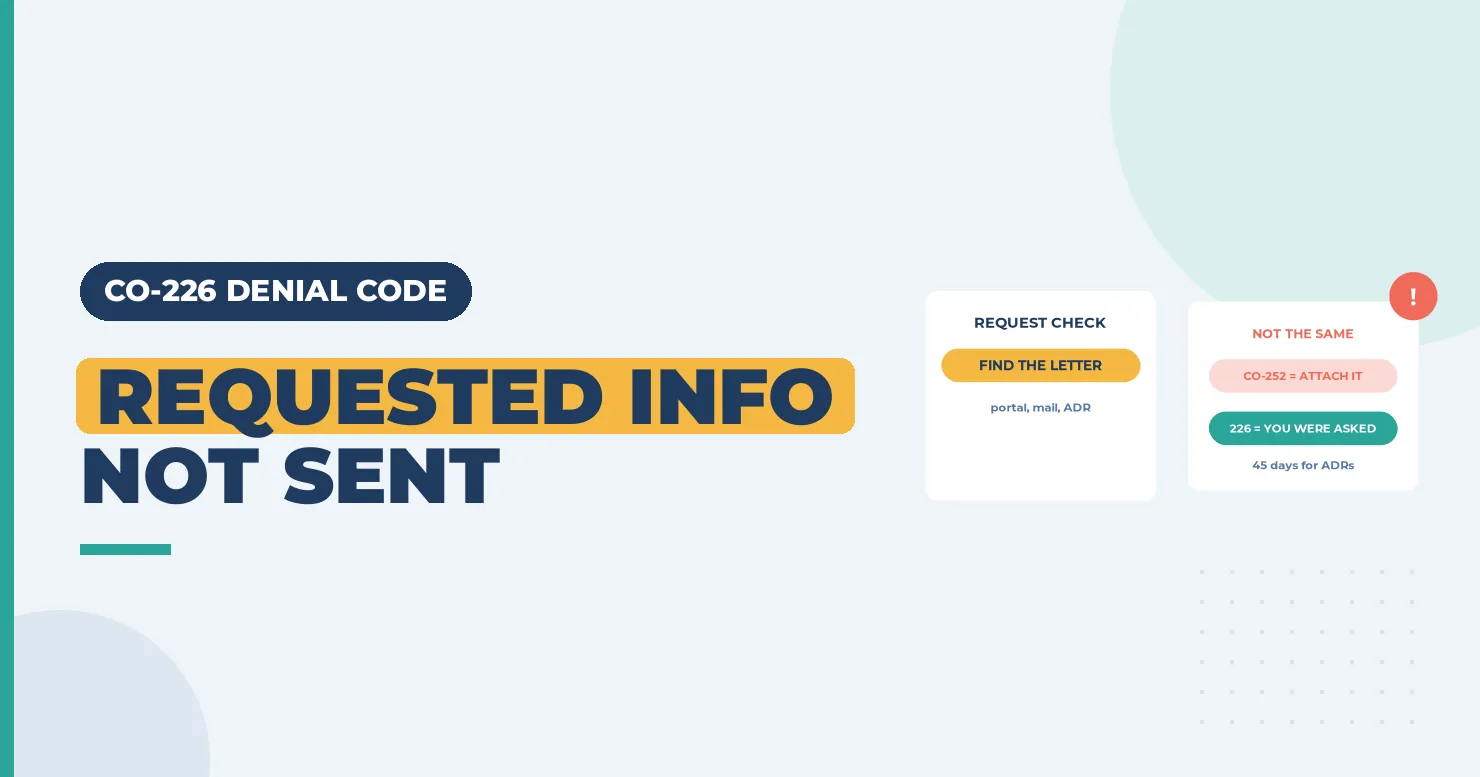
CO-226 is a follow-up denial. It lands after a conversation you may not know you were part of. At some point the payer sent the billing or rendering provider a request for records or details. The remit now says that request went unanswered, arrived late, or came back incomplete, so the claim was denied. The fix starts with finding that original request, because it tells you exactly what was missing and where to send it. (Primary sources: X12 Claim Adjustment Reason Codes · X12 Remittance Advice Remark Codes · CMS Medicare Program Integrity Manual, Ch. 3).
In brief: CO-226 means the payer asked the provider for information that “was not provided or not provided timely or was insufficient/incomplete.” Find the request letter or portal message, read the remark code, gather exactly what was asked for, and send it through the channel the payer named. Ask whether the claim can be reopened or must be appealed. Under CO, the patient isn’t billed.
Part of our denial codes library. Written by Manikandan J, CPC, CRCR, who has more than 10 years of US medical billing and revenue cycle experience. Published 20 October 2026. Last updated: 20 October 2026. Code wording is quoted word for word from X12.
Official X12 text for CARC 226
| Field | Official X12 text |
|---|---|
| Description | “Information requested from the Billing/Rendering Provider was not provided or not provided timely or was insufficient/incomplete. At least one Remark Code must be provided (may be comprised of either the NCPDP Reject Reason Code, or Remittance Advice Remark Code that is not an ALERT.)” |
| Start | 09/21/2008 |
| Last modified | 07/01/2013 |
Source: X12 Claim Adjustment Reason Codes, checked 20 October 2026.
The text covers three failures: nothing sent, sent too late, or sent but not enough. X12 also requires a remark code, so the remit should tell you what the payer still wants.
Denial code 226, CARC 226 and reason code 226
These names all mean the same X12 code. Denial code 226 is the common shorthand, CARC 226 the formal name, and reason code 226 the label many payer portals use. The group code in front, almost always CO, makes it the provider’s balance.
CO-226 vs CO-252 vs CO-16
These three get mixed up often, and the hub’s lookup table warns about it too.
| Code | Plain meaning | Who was asked | First move |
|---|---|---|---|
| CO-226 | Information the payer requested from the provider wasn’t sent, was late or was incomplete | Billing or rendering provider | Find the request and answer it |
| CO-252 | An attachment is required to process the claim | Usually no prior request. The claim needed it from the start | Send the attachment named in the remark |
| CO-16 | The claim itself lacks information or has an error | Nobody. The claim data is wrong | Correct the claim |
Group code table
| Group + CARC | Who carries it | What to do |
|---|---|---|
| CO-226 | Provider | Send the information or appeal. Don’t bill the patient. |
| PR-226 | Patient | Unusual. The patient may have been asked for information. Confirm with the payer. |
| OA-226 | Not assigned | Read the remark and check the request history. |
Common causes and the remark codes that come with them
RARC wording is quoted from the X12 RARC list. Payers pick their own pairings.
| Cause | Typical RARC | Fix |
|---|---|---|
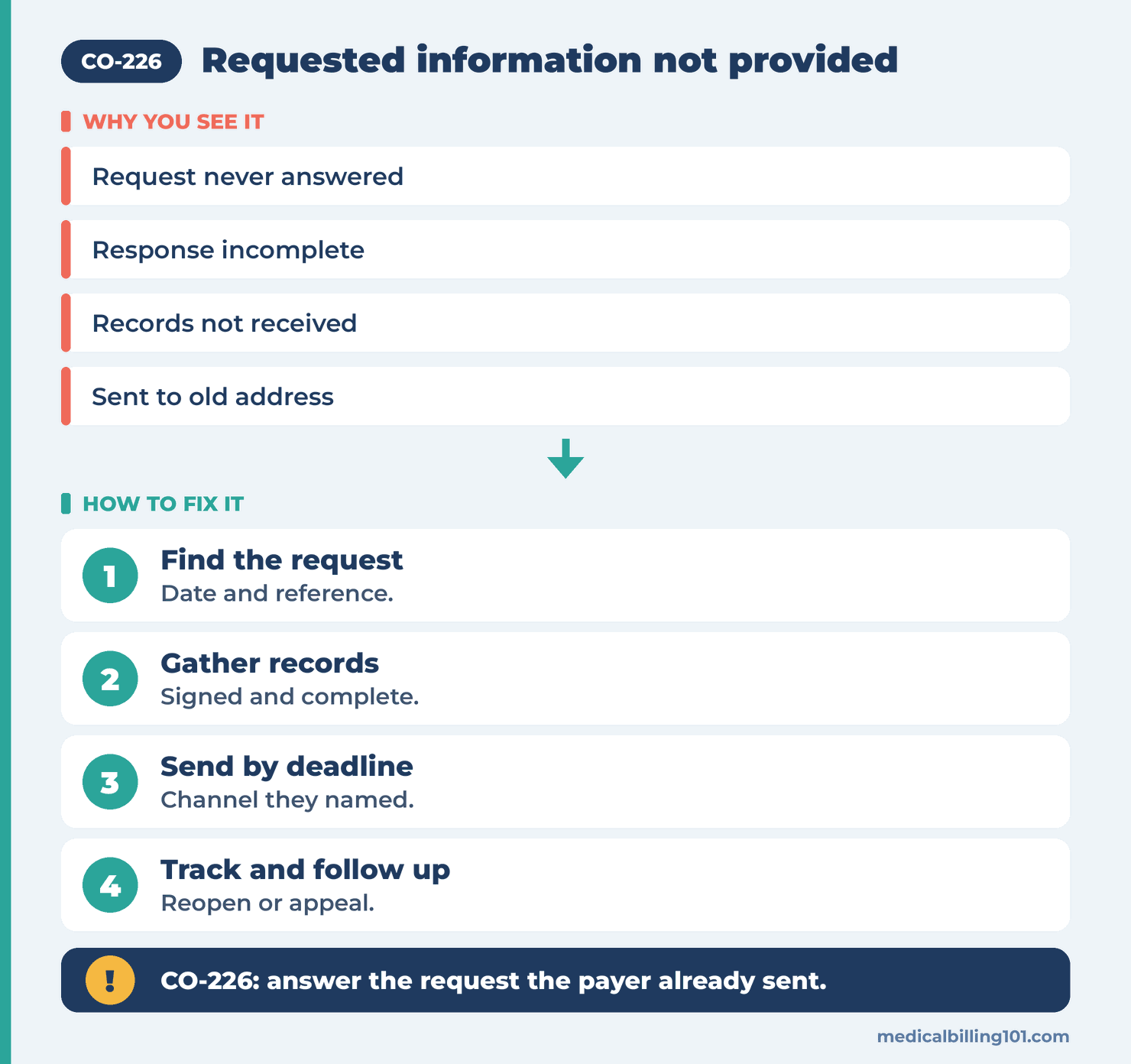
| Records request never answered | N366 | Send the records. The remark says the claim can be reopened if they arrive within one year. |
| Response sent but missing pieces | N705 | Send what was missing, such as signatures, dates or the full note. |
| Documents never received by the payer | N706 | Resend with proof of delivery and the request reference number. |
| Medical record for the service missing | M127 | Send the complete record for that date of service. |
| Operative report missing | M29 | Send the signed operative note. |
| Payer wants a new claim, not a reopening | N517 | Submit a new claim with the information attached. |
Fixing a CO-226 denial
An ADR is an additional documentation request, the formal letter asking for records.
- Find the request. Check mail, the payer portal and your clearinghouse for an additional documentation request (ADR) or records letter. Note its date and reference number.
- Read the remark code on the remit to confirm what’s still missing.
- Gather exactly what was asked for. Include signatures, dates and provider credentials. Missing signatures are a common reason a response counts as incomplete.
- Send it the way the payer asked, such as the portal upload, fax cover sheet or the esMD gateway for Medicare.
- Ask about reopening. Some payers reopen the claim once records arrive. Others need a formal appeal or a new claim.
- Track it. Log the date sent, the method and the confirmation number. Follow up if nothing changes in 30 days.
Medicare: the ADR clock
When a Medicare contractor sends an ADR, the Program Integrity Manual gives the provider 45 calendar days to submit the documentation (42 CFR § 405.929). If nothing arrives, the claim is denied. Late records can still help: send them with a redetermination request, the first level of Medicare appeal, which is generally due within 120 days of the initial determination.
Appeal approach
If you missed the deadline, the appeal is your second chance. Lead with the records, not with an explanation. Include:
- the original request letter and its reference number;
- the complete records asked for, with signatures;
- a short cover letter listing each item and where it appears;
- proof of any earlier submission, if you did send something.
Questions to ask the payer about a CO-226
- What was requested, on what date, and where was the request sent?
- What is the reference number for that request?
- Can the claim be reopened if I send the records now, or do I need to appeal?
- Which method should I use to send them?
- What was missing from my earlier response, if I sent one?
Worked example (illustrative)
A cardiology group gets a remit with CAS*CO*226*640.00 and remark N366. Nobody remembers a request. The billing lead checks the payer portal and finds a records request posted six weeks earlier, sent to an old practice address. She gathers the signed procedure note, the order and the test report, uploads them with the request reference number, and updates the practice address with the payer. The claim is reopened and paid. The team then sets up a daily check of the portal’s correspondence inbox.
Prevention checklist
- [ ] Keep the payer’s mailing and portal contact details current.
- [ ] Assign one person to check payer correspondence every day.
- [ ] Log each request with its due date in a shared tracker.
- [ ] Use a checklist for records packets: signatures, dates, orders, notes.
- [ ] Track CO-226 by payer to find where requests are getting lost.
Related denial codes
- CO-252: an attachment or other documentation is required.
- CO-16: the claim lacks information or has billing errors.
- CO-50: not deemed medically necessary, often after records are reviewed.
- N290: missing or invalid rendering provider identifier.
- MA130: unprocessable claim with no appeal rights.
- Denial codes hub for the full library.
Key takeaways
CO-226 means a payer request for information went unanswered, was late or was incomplete. Find the original request, send exactly what it asked for through the right channel, and ask whether the claim can be reopened or needs an appeal. Fix the correspondence gap so it doesn’t happen again.
FAQ
What does denial code CO-226 mean?
It means information the payer requested from the billing or rendering provider wasn’t sent, wasn’t sent on time, or was incomplete. The provider carries the amount under CO.
How is CO-226 different from CO-252?
CO-226 follows a request the payer already made. CO-252 says the claim needed an attachment to be processed, usually without an earlier request.
How long do I have to answer a Medicare ADR?
The Medicare Program Integrity Manual gives providers 45 calendar days to respond to an additional documentation request.
Can a CO-226 claim be reopened?
Often, yes. Remark N366 says the claim will be reopened if the requested information is sent within one year of the denial notice.
Can I bill the patient for CO-226?
No. The provider was asked for the information, and the CO group keeps the balance with the provider.
What if I never received the request?
Ask the payer for a copy and the address it used. Send the records with a note, and update your contact details.
Sources
How we checked: every code quote on this page was compared word for word with the X12 CARC and RARC lists on 20 October 2026.
- X12, Claim Adjustment Reason Codes (CARC 226, 252, 16). Accessed 20 Oct 2026.
- X12, Remittance Advice Remark Codes (N366, N705, N706, M127, M29, N517). Accessed 20 Oct 2026.
- CMS, Medicare Program Integrity Manual, Ch. 3. Accessed 20 Oct 2026.
- CMS, Medicare Claims Processing Manual, Ch. 22, §60.1 Group Codes. Accessed 20 Oct 2026.
Last updated: 20 October 2026 · This page is educational and doesn’t replace payer contracts or coding rules.