
CO-272 is a broad code. It says a coverage rule or program rule tied to the service was not met, but it doesn’t say which one. The real work is finding the rule. Once you know it, the fix is usually proof that the patient met it, or a plan to meet it before the next claim. (Primary source: X12 Claim Adjustment Reason Codes)
In brief: CARC 272 reads “Coverage/program guidelines were not met.” Read the RARC and any policy ID on the remit, pull that policy, and send records that show each rule was met.
Part of our denial codes library. Written by Manikandan J, CPC, CRCR, who has worked program-rule denials for durable medical equipment and specialty practices. Published 26 October 2026. Last updated: 26 October 2026. Code wording quoted word for word from X12. Read about the author and our editorial policy, or contact us to report an error.
Official text
| Field | Value |
|---|---|
| Code | 272 |
| Description | “Coverage/program guidelines were not met.” |
| Start | 11/01/2015 |
Source: X12 Claim Adjustment Reason Codes, checked 26 October 2026.
Key terms: A CARC is a Claim Adjustment Reason Code from the X12 list, and it says why a line was paid differently than billed. A RARC is a Remittance Advice Remark Code that adds detail to the CARC. The group code is the two-letter prefix on the adjustment; CO means contractual obligation: the provider owns the balance and it cannot be billed to the patient. An electronic remittance advice (ERA) is the ANSI X12 835 transaction that carries these codes from the payer to the provider; its paper equivalent is the remittance notice or explanation of benefits.
Methodology: the code wording above is copied from the X12 list, and each fix step below links to the payer or CMS page it comes from.
Example scenario (fictional names), part 1
CO-272 Denial Example: What Happened
Marcus Bell bills for ClearAir Supply, a fictional medical equipment company in Ohio. Dr. Nadia Reyes, a sleep physician, ordered a CPAP device for an adult with obstructive sleep apnea (G4733). ClearAir billed the rental each month to Brookfield Health Plan, a fictional commercial payer, as E0601 with modifier RR.
Months one to three paid. The month-four claim came back on the 835 with CAS*CO*272 and remark LQ*HE*N130. That is a CO-272 denial code, and the remit named no rule beyond the plan’s guidelines.
Which program rule did the month-four claim miss? Keep reading, or jump to how the CO-272 denial was resolved.
The usual rules behind CO-272
- Use or adherence rules. For example, the Medicare CPAP coverage policy (LCD L33718) defines adherence as use of 4 hours per night on 70% of nights during a consecutive 30-day period in the first three months (LCD L33718 text). Many commercial plans copy this rule.
- Follow-up visit rules. The same LCD needs a clinical re-evaluation no sooner than day 31 and no later than day 91 of therapy, with a note that the patient is benefiting.
- Step or program steps. A plan may want a supervised program or trial before it covers the next step.
- Enrollment rules. Some services are covered only inside a care program the patient must join.
Finding and fixing the rule
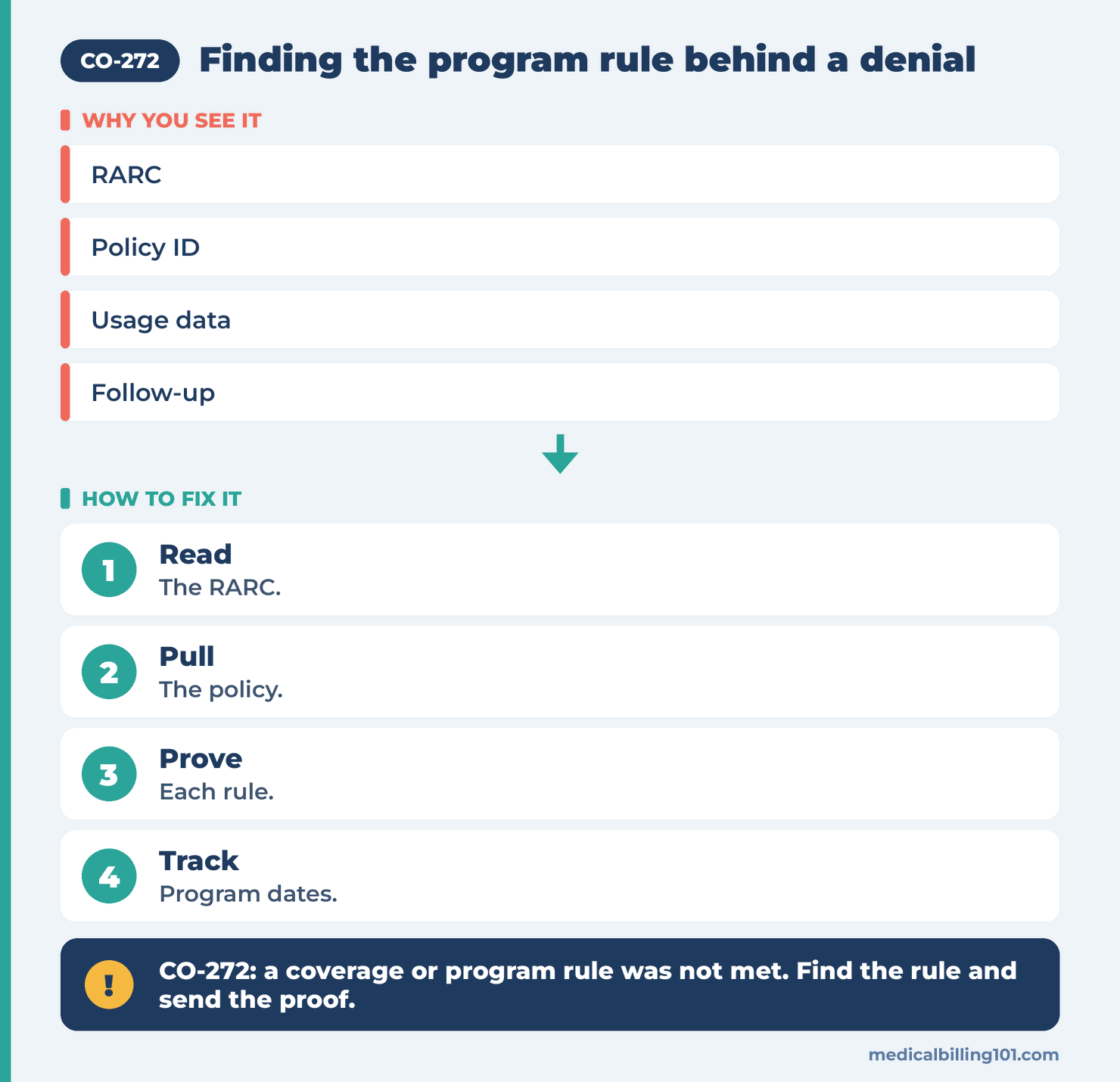
- Read the remark codes. A RARC on the same line often names the missing item. N130, for example, points you to the plan’s benefit documents (X12 RARC list).
- Pull the policy. Use the policy ID on the remit or the payer’s medical policy list.
- Line up the proof. For CPAP, that means the device’s usage download and the follow-up visit note.
- Send it the right way. Use a reopening or appeal with the records, as the payer asks.
- Track the rule going forward. Set reminders for program dates, so the next claim isn’t sent before the rule is met.
Records rules decide most of these cases. Our guide on medical necessity documentation covers what a reviewer expects to see.
Claim form note
No claim form visual here. CO-272 is fixed with program proof, not by editing a CMS-1500 box or a UB-04 locator.
Example scenario (fictional names), part 2
How the CO-272 Denial Was Resolved
Marcus read N130, “Consult plan benefit documents/guidelines for information about restrictions for this service.” So CARC 272 pointed to a written rule, and he opened Brookfield’s CPAP policy. It asked for adherence proof and a follow-up visit between day 31 and day 91.
- The device download showed the patient met the hours rule in the second month.
- The file had no follow-up note from Dr. Reyes, so the plan saw no proof of benefit.
Fix: Marcus got the signed day-58 follow-up note from the sleep clinic. He filed a written appeal with the note and the usage report. The claim data was correct, so no field changed.
Outcome: Brookfield overturned the denial and paid month four in 24 days. ClearAir now holds month-four claims until the follow-up note is scanned in.
Names and details are illustrative; no real patient data.
Close cousins
| Code | Meaning | What to send |
|---|---|---|
| CO-272 | Program rule not met | Proof of each rule |
| CO-273 | Program limit exceeded | Limit and exception proof |
| CO-50 | Not medically necessary | Records of need |
| CO-16 | Claim data missing | The missing item |
FAQ
What does CO-272 mean?
A coverage or program rule linked to the service was not met when the claim was processed.
How do I know which rule?
Check the RARC and policy ID on the remit, then read that policy.
Can CO-272 be appealed?
Yes, if records show the rule was met. If it wasn’t, meet the rule before billing again.
Is CO-272 the same as CO-50?
No. CO-50 is about medical need. CO-272 is about a stated program rule, such as use, visits or steps.
Can the patient be billed?
Usually not for a CO amount, unless the contract allows it and a valid waiver is on file.
Sources
How we checked: the code quote on this page was matched word for word with the X12 CARC list on 26 October 2026, the N130 remark with the X12 RARC list, and the CPAP rules with the CMS coverage database.
- X12, Claim Adjustment Reason Codes (CARC 272). Accessed 25 Oct 2026.
- CMS, LCD L33718 Positive Airway Pressure Devices. Accessed 25 Oct 2026.
- X12, Remittance Advice Remark Codes (RARC N130). Accessed 25 Oct 2026.
Last updated: 26 October 2026 · Educational content; not legal advice.