
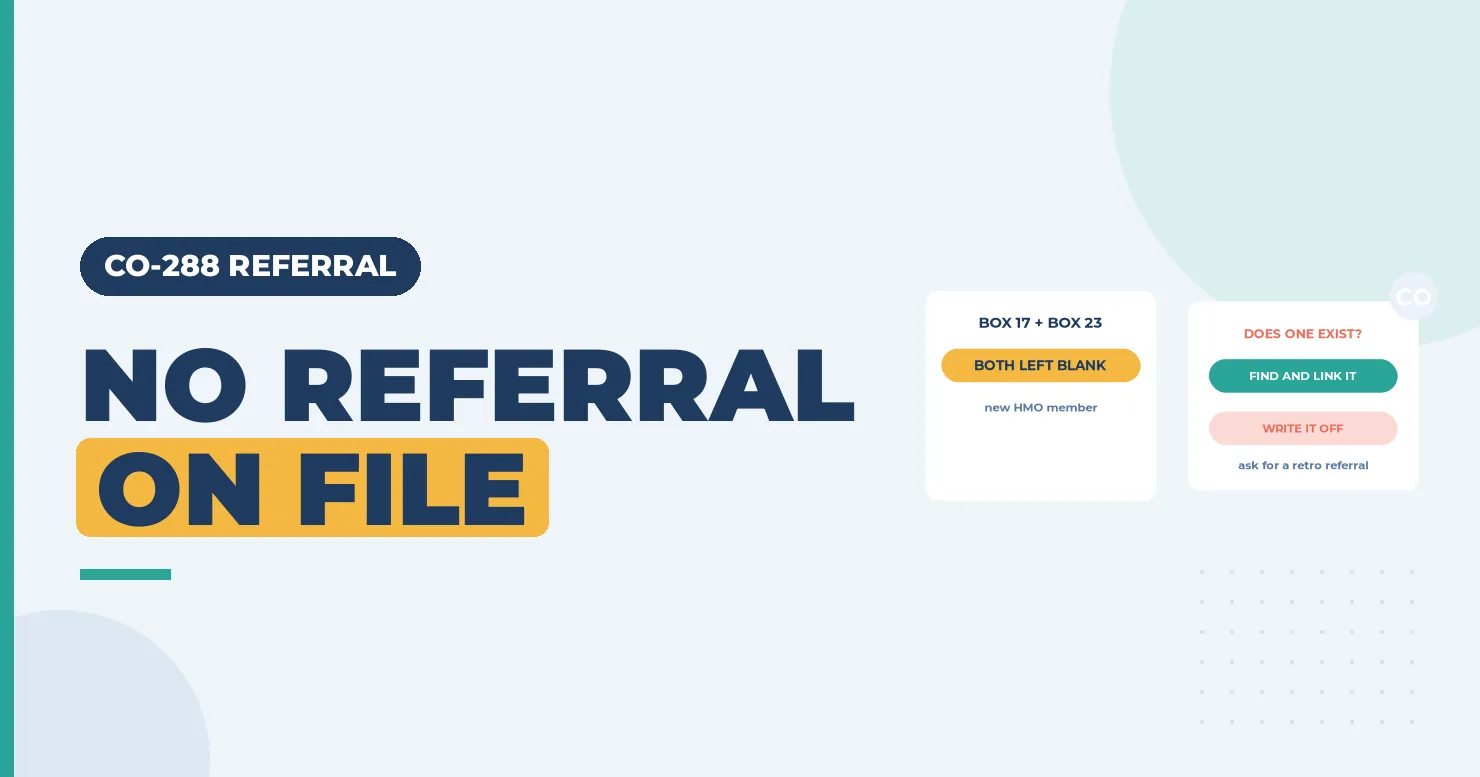
The CO-288 denial code means the patient’s plan needed a referral for this service, and none was on file. It shows up most on specialist visits under HMO and similar plans. The fix is to get the referral from the primary care office, link it to the claim, and send a corrected claim. (Primary source: X12 Claim Adjustment Reason Codes)
In brief: CARC 288 is the “no referral” code. It is different from CARC 197, which means no prior authorization. A plan may require one, the other or both. With CO, the provider cannot bill the patient for the denied visit.
Part of our denial codes library. Written by Manikandan J, CPC, CRCR, who has fixed referral denials for cardiology, dermatology and hospital outpatient clinics. Published 13 November 2026. Last updated: 13 November 2026. Code wording quoted word for word from X12. Read about the author and our editorial policy, or contact us to report an error.
What does denial code CO-288 mean?
Denial code CO-288 means the plan checked for a primary care referral and could not find one for this patient, provider and date. Reason code 288 often appears even when a referral exists. The plan simply could not match it to the claim.
| Field | Value |
|---|---|
| Code | 288 |
| Description | “Referral absent” |
| Group codes | No X12 group restriction; CO is the most common |
| Start | 11/01/2017 |
| Common remarks | N489, “Missing referral form.” and N630, “Referral not authorized by attending physician.” |
Source: X12 Claim Adjustment Reason Codes, checked 13 November 2026.
Methodology: the code wording is copied from the X12 list, and the claim form fields follow the NUCC instructions and the CMS UB-04 manual cited below.
Key terms: A referral is written approval from the primary care provider for specialist care. The referring provider is the clinician who sent the patient, reported in CMS-1500 Box 17 with qualifier DN. CO means contractual obligation.
CO-288 vs OA-288: what is the difference?
CO-288 means your network contract with the plan makes the referral check your job, so the loss is yours until fixed. OA-288 reports the same missing referral with no contract basis, such as from a non-contracted plan. Neither version tells you to bill the patient.
| Question | CO-288 | OA-288 |
|---|---|---|
| Who usually carries it? | The in-network provider | Not assigned by the group code |
| Where to look first | Your HMO contract and the plan portal | The plan’s member rules and remark codes |
| Can a retro referral help? | Often, if the plan allows it | Sometimes, ask the plan |
A PR-288 is a different case. There the plan puts the missing referral on the member.
Why was no referral found?
No referral is found for three common reasons. The primary care office never sent one. The office sent it, but under a different provider or date range. Or the claim lacked the referring provider and referral number the plan uses to match it.
Front-desk checks miss this when a patient switches to an HMO mid-year. Eligibility shows active coverage, but the visit now needs a referral. Self-referred specialist visits are another source. For example, a patient may book a dermatologist directly after seeing an online listing.
Example scenario (fictional names), part 1
CO-288 Denial Example: What Happened
Gavin Shore bills for Riverbend Heart Associates. Cardiologist Dr. Priya Natarajan saw a new patient for palpitations, R00.2, entered as R002, and billed 99204 with an ECG, 93000.
The patient had changed to a fictional HMO plan that month. The claim left Box 17 and Box 23 blank.
The 835 returned CAS*CO*288 with N489 on both lines. The patient insisted the family doctor, Dr. Mara Keane, had sent a referral.
Did a referral exist, and why could the plan not see it? Keep reading, or jump to how it was resolved. Keep reading, or jump to how the CO-288 denial was resolved.
How do I fix a CO-288 denial?
To fix a CO-288 denial, find out whether a referral exists. If it does, add the referring provider and referral number and send a corrected claim. If it does not, ask the primary care office for a retro referral. Appeal only if the plan refuses and the rules allow it.
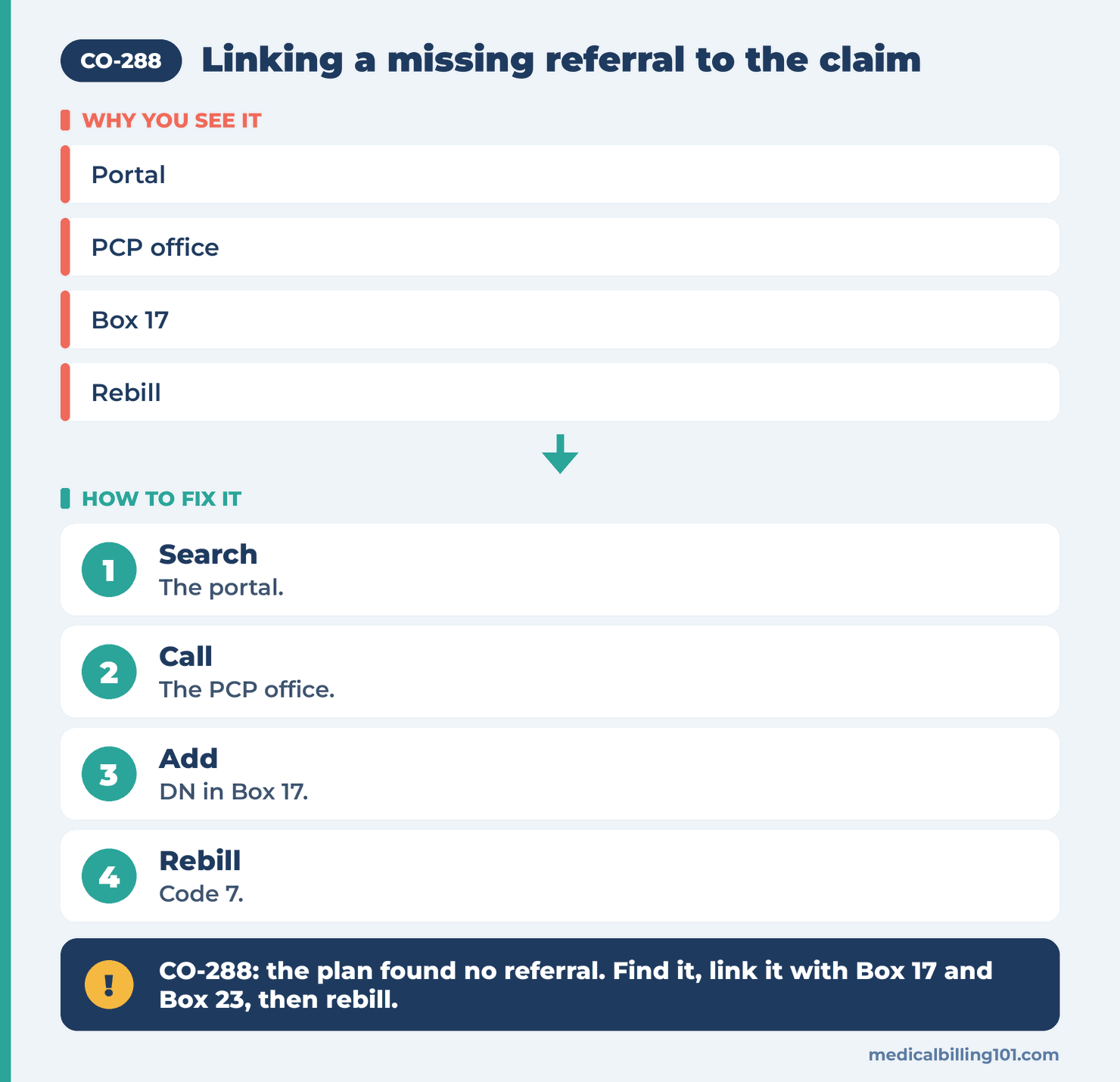
| Step | What to do | Where it goes |
|---|---|---|
| 1. Search | Check the plan portal for a referral by patient and date | Notes on the account |
| 2. Call | Ask the primary care office for the referral number | Box 23 / FL 63 |
| 3. Name | Add the referring provider with qualifier DN | Box 17 and 17b / FL 78 |
| 4. Rebill | Send frequency code 7 with the original claim number | Box 22 / FL 4 and FL 64 |
| 5. Appeal | Use it only if the plan refuses a retro referral | Plan appeal route |
Example scenario (fictional names), part 2
How the CO-288 Denial Was Resolved
Gavin called Dr. Keane’s office. The referral existed, but it was entered two days after the visit and listed the practice’s group NPI, not Dr. Natarajan.
Fix: the primary care office asked the plan to correct the referral to the visit date and the cardiologist. Gavin then sent a corrected claim with frequency code 7. Box 17 named Dr. Keane with qualifier DN, Box 17b had her NPI, and Box 23 had the referral number.
Outcome: the plan matched the referral and paid both lines. Gavin now runs a referral check for every new HMO patient at scheduling.
Names and details are illustrative; no real patient data.
Names and details are illustrative; no real patient data.
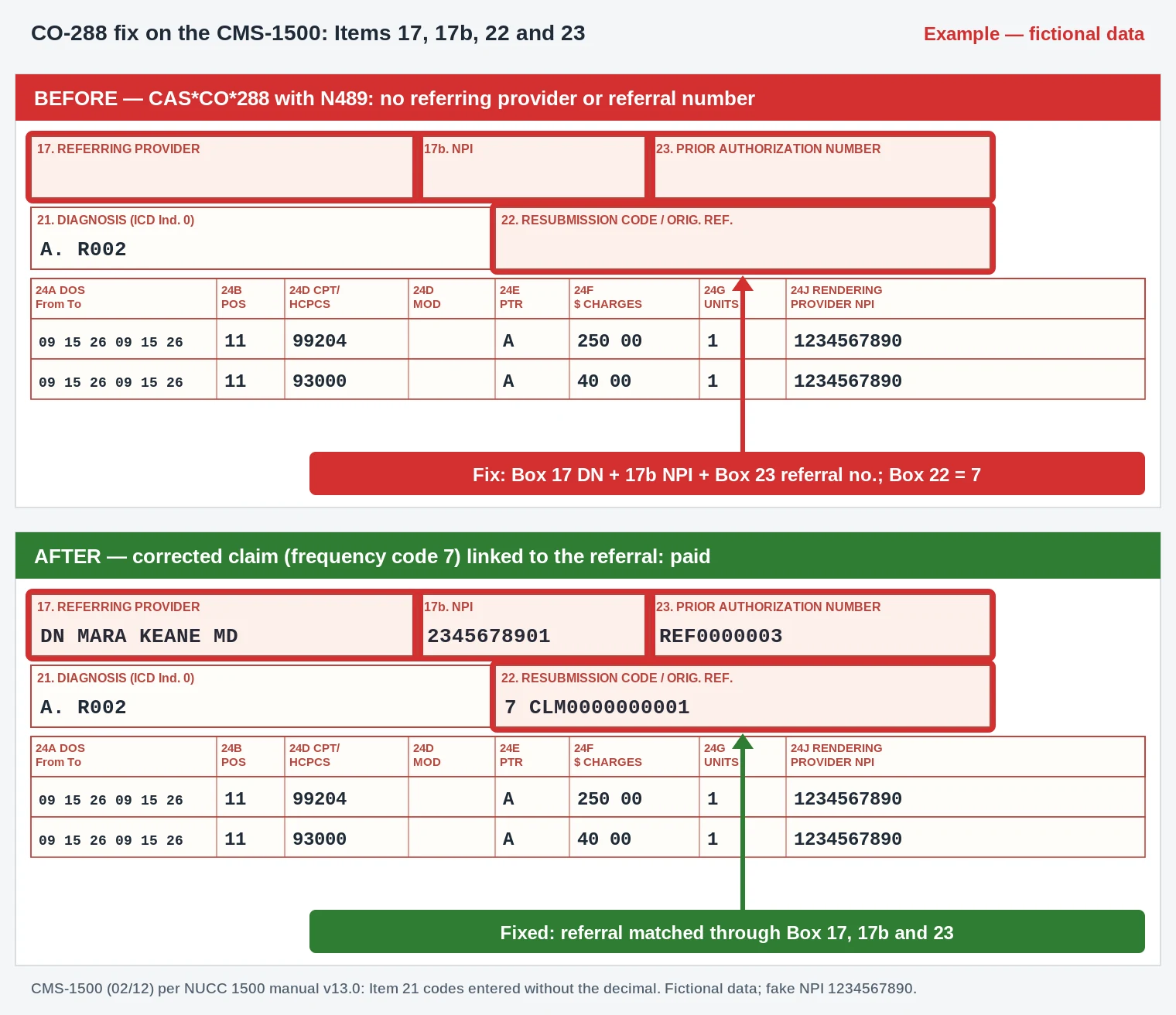
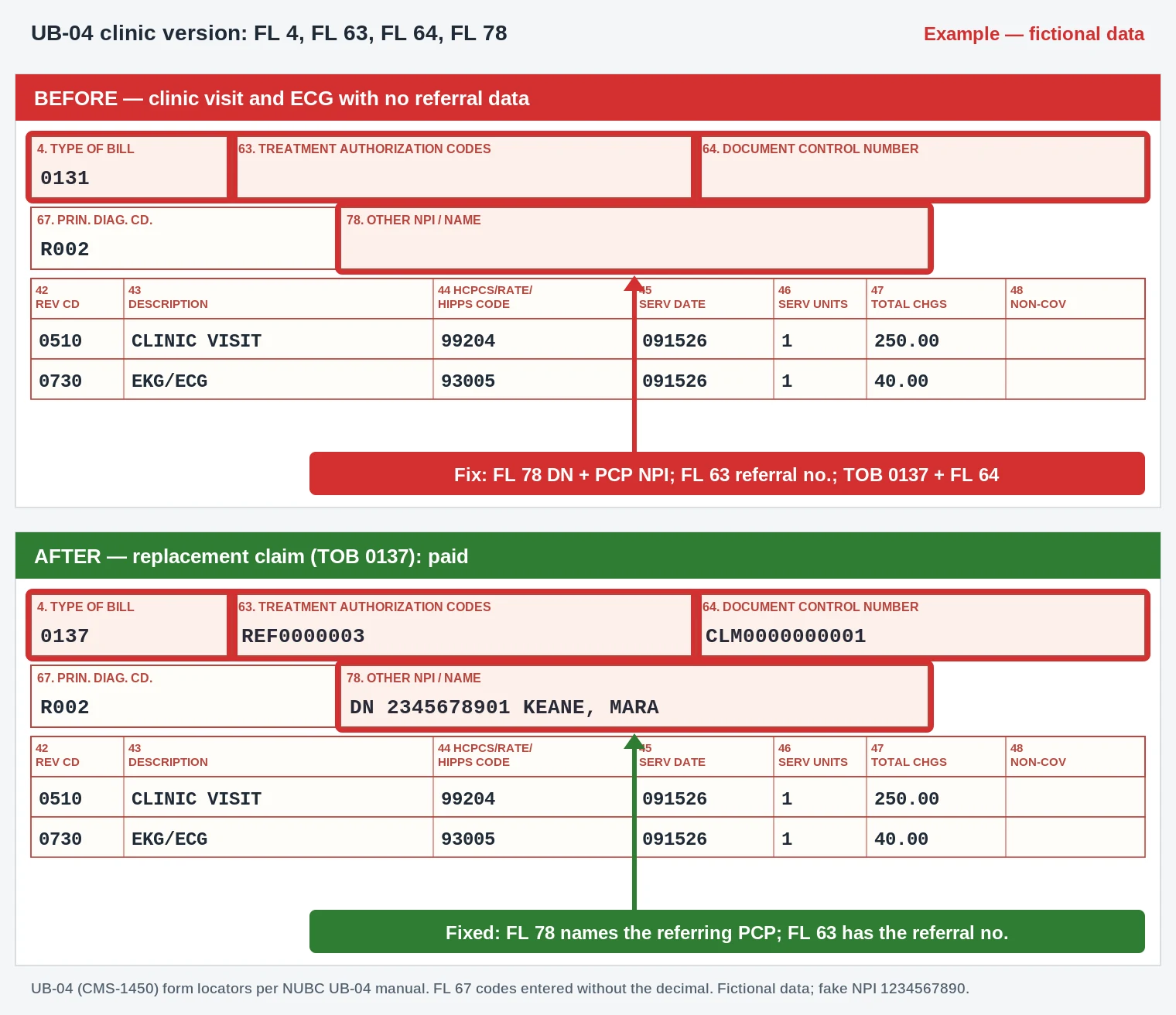
- Box 17 + 17b / FL 78: Dr. Mara Keane added as referring provider with qualifier DN and her NPI.
- Box 23 / FL 63: the referral number the plan corrected to the visit date and the cardiologist.
- Box 22 / FL 4 + FL 64: frequency code 7 with the original claim number (bill type 0137 on the UB-04).
- Box 21 / FL 67: R00.2 (entered as R002) is unchanged; the facility bills the ECG tracing as 93005.
Does CARC 288 apply to hospital outpatient claims?
Yes, CARC 288 can apply to hospital outpatient claims when the plan requires a referral for that service. On the UB-04, the referring provider goes in FL 78 or 79 with qualifier DN. The referral or authorization number goes in FL 63. Some plans ask for it in remarks, so check the manual.
Can I bill the patient for CO-288?
No, you cannot bill the patient for a CO-288 denial. CO puts the amount on the provider under the contract. If the plan used PR-288 instead, the member may owe it, but only if your contract and state rules allow it. Tell the patient before any future visit.
Related codes
| Code | Meaning |
|---|---|
| CO-197 | Precertification or authorization absent |
| CO-243 | Services not authorized by network or primary care providers |
| CO-284 | Authorization valid but does not apply to the billed service |
| CO-16 | Claim lacks information needed for adjudication |
FAQ
What does CO-288 mean?
The plan required a referral for the service and found none on file.
Is CO-288 the same as CO-197?
No. CO-197 means no prior authorization. CO-288 means no referral from the primary care provider.
Is CO-288 the same as CO-287?
No. CO-287 means the referral existed but was used up. CO-288 means none was found.
Where does the referring provider go on the CMS-1500?
Box 17 with qualifier DN, and the NPI in Box 17b.
Does the patient owe a CO-288 amount?
No. CO keeps the denied amount with the provider.
Sources
How we checked: the CARC 288 quote was matched word for word with the X12 CARC list on 13 November 2026, and N489 and N630 with the X12 RARC list.
- X12, Claim Adjustment Reason Codes (CARC 288, 287, 197). Accessed 13 Nov 2026.
- X12, Remittance Advice Remark Codes (N489, N630). Accessed 13 Nov 2026.
- NUCC, 1500 claim form instructions (Items 17, 17b, 22, 23). Accessed 13 Nov 2026.
- CMS, Medicare Claims Processing Manual, Chapter 25 (UB-04 form locators). Accessed 13 Nov 2026.
- HealthCare.gov, referral definition. Accessed 13 Nov 2026.
Last updated: 13 November 2026 · Educational content; not legal advice.