
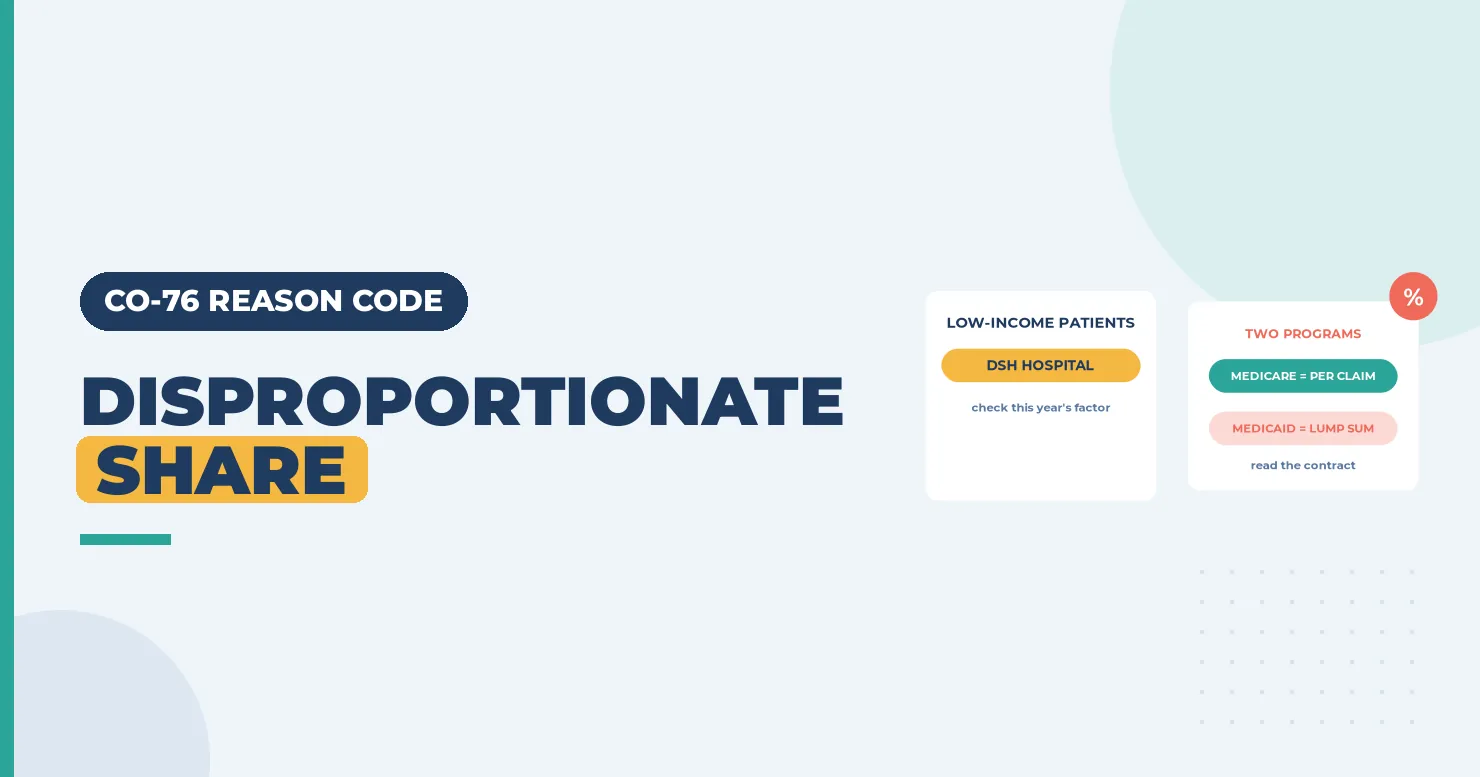
CO-76 is a disproportionate share hospital adjustment. A hospital sees it when a payer adds or removes the DSH part of an inpatient payment. Medicare pays DSH to hospitals that serve a large share of low-income patients. Some plans base their rates on Medicare’s and then take DSH out, because the contract says so. CO-76 is not a denial and never a patient balance, but it can hide real money if the contract doesn’t allow the cut. (Primary sources: X12 Claim Adjustment Reason Codes · CMS Disproportionate Share Hospital).
In brief: CO-76 means “Disproportionate Share Adjustment.” It’s a contract-driven change to the DSH part of a hospital payment. Confirm your hospital qualifies for DSH, read the payer contract to see if DSH is paid or carved out, make sure Medicare Advantage stays are sent to your Medicare contractor as information-only claims, and dispute any cut the contract doesn’t support.
Part of our denial codes library. Written by Manikandan J, CPC, CRCR, who has reconciled hospital inpatient payments for payers and billing companies. Published 20 October 2026. Last updated: 20 October 2026. Code wording is quoted word for word from X12.
CARC 76 official wording
| Field | Official X12 text |
|---|---|
| Description | “Disproportionate Share Adjustment.” |
| Start | 01/01/1995 |
Source: X12 Claim Adjustment Reason Codes, checked 20 October 2026.
Denial code 76, CARC 76 and reason code 76
Denial code 76, CARC 76 and reason code 76 are one X12 code. The CO group marks it as a contract item.
What DSH means
A disproportionate share hospital is a hospital that treats a large share of low-income patients and gets extra payments for it. Medicare DSH is an add-on to inpatient payments for these hospitals, based on a formula that counts low-income Medicare and Medicaid days. Medicaid DSH is a separate state program that pays hospitals in lump sums for care to Medicaid and uninsured patients.
DSH in three payment systems
| System | How DSH is paid | Will you see CARC 76? |
|---|---|---|
| Original Medicare | Add-on to each inpatient claim, plus separate uncompensated care payments | Rarely as a cut |
| Medicare Advantage | By contract; many plans pay Medicare rates with or without DSH | Yes, when the plan carves DSH out |
| Medicaid DSH | State lump-sum payments, not claim by claim | Usually not on claims |
| Commercial | Only if the contract builds DSH into the rate | Yes, if the contract excludes it |
CMS explains how hospitals qualify for Medicare DSH and how it’s calculated.
Why MA shadow claims matter for DSH
Even when an MA plan pays the stay, the hospital still sends an information-only claim to its Medicare contractor. The claim uses type of bill 11X and condition code 04, as Noridian explains. These claims let Medicare count MA days in the hospital’s DSH calculations. If they’re missing, the hospital’s future DSH can be understated. So a CO-76 from an MA plan is a good reminder to check that the shadow claim went out.
When a CO-76 deserves a dispute
- The contract includes DSH. For example, the rate exhibit says the plan pays 100 percent of Medicare, with no exclusions.
- Wrong DSH factor. The plan used last year’s DSH adjustment.
- Hospital doesn’t get DSH. The plan removed DSH from a hospital that never had it, which double-cuts the rate.
- Carved out twice. DSH was removed both in the base rate and as a CARC 76 line.
- Outpatient claim. Medicare DSH is an inpatient add-on, so a CARC 76 cut on an outpatient claim needs a reason.
How to review a CO-76 line

- Confirm DSH status and the DSH factor for the federal fiscal year of the discharge.
- Read the contract. Look for words such as ‘excluding DSH’ or ‘including all add-ons’.
- File shadow claims for MA stays with condition code 04.
- Recalculate the plan’s DSH cut with your current factor.
- Reconcile plan payments against your contract model.
- Dispute cuts the contract doesn’t allow, with the rate exhibit attached.
Worked example (illustrative)
A hospital that qualifies for Medicare DSH treats an MA patient. The plan pays the DRG and reports CAS*CO*76*910.00. The contract rate exhibit says the plan pays the Medicare rate ‘including DSH and IME’. The contract team files a payment dispute with the exhibit. The plan agrees the carve-out was a setup error, pays the 910.00 and fixes its pricing for the hospital. The billing team also checks that the shadow claim with condition code 04 went to the Medicare contractor.
Prevention checklist
- [ ] Load DSH terms for every Medicare-based contract into your model.
- [ ] Update the hospital’s DSH factor each federal fiscal year.
- [ ] Send a condition code 04 shadow claim for every MA inpatient stay.
- [ ] Review CO-74, CO-75 and CO-76 lines together.
- [ ] Track CARC 76 cuts by plan each month.
Related codes
- CO-74: indirect medical education adjustment.
- CO-75: direct medical education adjustment.
- CO-69: day outlier amount.
- CO-45: charge exceeds fee schedule or contracted amount.
- Full CARC and RARC list for code lookups.
- Denial codes hub for every code we cover.
Key takeaways
CO-76 is a contract change to the DSH part of a hospital payment. It isn’t a patient balance. Confirm DSH status, read the contract, keep MA shadow claims flowing so DSH counts stay right, and dispute any carve-out the contract doesn’t allow.
FAQ
What does CO-76 mean?
It means the payer made a disproportionate share adjustment, adding or removing the DSH part of the payment.
What is a DSH hospital?
A hospital that serves a large share of low-income patients and gets extra payments for it.
Is CO-76 a denial?
No. It’s a payment adjustment based on the contract.
Why do MA plans carve out DSH?
Their contracts may pay Medicare rates without add-ons. Check the rate exhibit to see if that’s allowed.
Why do shadow claims matter for DSH?
Medicare uses MA information-only claims to count days in the hospital’s DSH calculations.
Can I bill the patient for CO-76?
No. It’s a contract adjustment, never a patient share.
Sources
How we checked: every code quote on this page was compared word for word with the X12 CARC list on 20 October 2026.
- X12, Claim Adjustment Reason Codes (CARC 74, 75, 76). Accessed 20 Oct 2026.
- CMS, Disproportionate Share Hospital (DSH). Accessed 20 Oct 2026.
- Noridian JE Part A, Medicare Advantage inpatient claim shadow billing. Accessed 20 Oct 2026.
Last updated: 20 October 2026 · This page is educational and doesn’t replace payer contracts or coding rules.