
The CO-P26 denial code means a Property and Casualty payer paid you a network rate because it says you take part in a Voluntary Provider Network (VPN). The network’s contract set a price lower than your charge. A VPN is a network the insured person can choose to use but does not have to. If you never agreed to that rate for that payer, the cut can be challenged. (Primary source: X12 Claim Adjustment Reason Codes)
In brief: reason code P26 is a contract rate through a voluntary network. Ask the network for the list of payers entitled to your rate. If your payer is on the list and the service matches, post the cut. If not, dispute it and ask for repricing.
Part of our denial codes library. Written by Manikandan J, CPC, CRCR, who has checked network discounts on auto injury remits for imaging and therapy clients and asks for rate sheets before posting. Published 26 November 2026. Last updated: 26 November 2026. Code wording quoted word for word from X12. Read about the author and our editorial policy, or contact us to report an error.
What does denial code CO-P26 mean?
Denial code CO-P26 reports a payment change based on a VPN. X12 limits it to Property and Casualty and allows only group code CO. At the claim level the payer must send the class of contract code segment. At the line level it must send the healthcare policy identification segment when the regulations apply.
| Field | Value |
|---|---|
| Code | P26 |
| Description | “Payment adjusted based on Voluntary Provider network (VPN).” |
| Use | Property and Casualty only |
| Group codes | CO only, per the X12 usage note |
| Start | 11/01/2017 |
| Remark codes | Vary by payer; read the line-level remark |
Source: X12 Claim Adjustment Reason Codes, checked 26 November 2026.
Methodology: the code wording is copied from the X12 list. The example follows New Jersey’s PIP rule for voluntary networks, read on the Cornell Legal Information Institute site. Other states have different rules.
Key terms: A voluntary network is one the insured may use or skip. PIP is Personal Injury Protection, the no-fault medical cover in some auto policies. A client list is the set of payers that may use a network’s rates.
CO-P26 vs OA-P26: only one group applies
The group code gives no room here. X12 says P26 goes with CO only, so an OA or PR version signals a payer coding slip. The patient has no balance from a CO-P26 cut. What matters is the network’s contract and whether it reaches your claim.
| Group | Allowed with P26? | What it tells you |
|---|---|---|
| CO-P26 | Yes | A contract rate was applied; nothing is owed by the patient |
| OA-P26 | No, per X12 | Ask the payer to correct the group |
| PR-P26 | No, per X12 | Ask the payer to correct the group |
Example scenario (fictional names), part 1
CO-P26 Denial Example: What Happened
Priya Nair handles billing for Meadow Open MRI, an imaging center in New Jersey. A driver hurt in a rear-end crash had a lumbar MRI, 72148, under his auto policy’s PIP cover. The center billed its usual charge to a fictional carrier, Garden State Mutual.
The payment was about 40 percent below the center’s normal rate. Each line had CAS*CO*P26. The remark pointed to a network called Tristate Imaging Partners, and Priya had no contract with that name in her files.
What can an imaging center do when it has no record of the network? Keep reading, or jump to how the CO-P26 denial was resolved.
What causes a CARC P26 voluntary network cut?
A VPN cut can be fair or not. Walk through these points to tell which one you have.
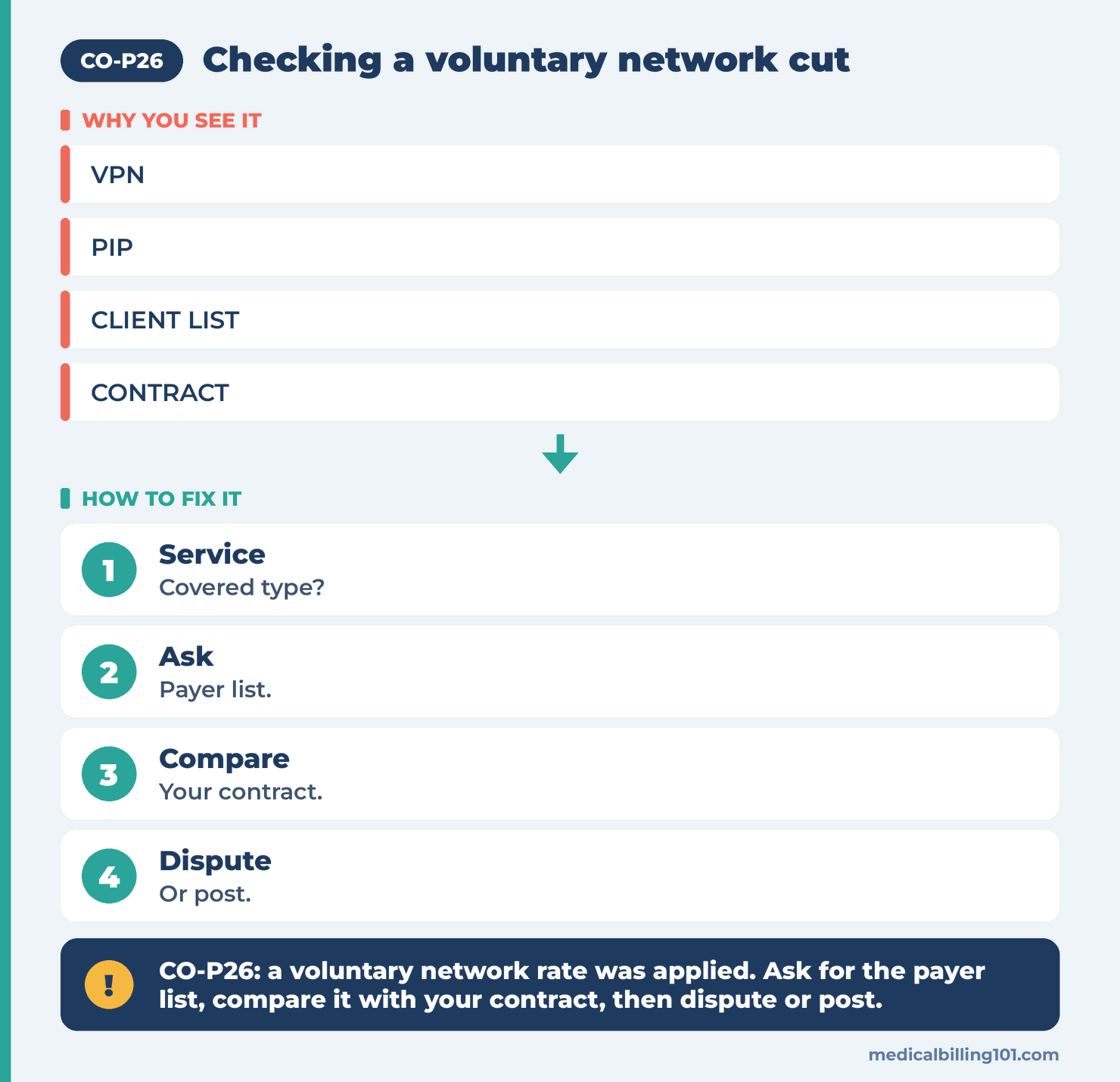
- Service type. In New Jersey, voluntary networks may be offered only for certain non-emergency benefits: MRI, CT, some electrodiagnostic tests, durable medical equipment above a cost threshold, prescription drugs and ambulatory surgery services. A VPN rate on any other service deserves a question.
- Network type. The rule limits which kinds of network an insurer may use, such as a licensed HMO or an approved organized delivery system.
- Your agreement. The rate stands only if you or your group signed with the network or with a network that leases to it.
- The payer list. A network must disclose to a participating provider, on written request, all clients or payers entitled to a rate under that provider’s contract.
- Insured choice. Using the network is the insured’s option. Care outside it can carry a penalty deductible for the insured, which is separate from your rate.
Read the rule in N.J.A.C. 11:3-4.8, Voluntary networks. Also see the deductible and co-pay rule.
How do I fix a CO-P26 denial?
To fix CO-P26, check the claim facts first, then the contract. The claim is usually fine, so the work is a records request and a dispute, not a corrected form. Keep each request in writing.
| Step | Action | Where to check |
|---|---|---|
| 1 | Confirm the service is a type a voluntary network may cover | The state rule and your CPT code |
| 2 | Note the network name on the remit | Line-level remark or contract segment |
| 3 | Ask the network in writing for the payer list under your contract | Network provider relations |
| 4 | Compare the list with the payer on the claim | Your contract and rate sheet |
| 5 | If the payer is not listed, send a dispute with the letter | Payer’s reconsideration address |
| 6 | If it is listed, post the contract cut | Posting rules |
Do not hold other accounts waiting for the answer. Flag every claim with the same network name so you can reprice them together.
Example scenario (fictional names), part 2
How the CO-P26 Denial Was Resolved
Priya wrote to Tristate Imaging Partners and asked for the list of payers entitled to Meadow’s rate. The reply named three carriers. Garden State Mutual was not one of them.
Fix: she sent Garden State Mutual a dispute with the network’s reply, the contract page and a request to reprice the 72148 line at the full allowed amount.
Outcome: the carrier removed the network adjustment and paid the remaining balance. Priya added the network name to a tracking sheet and checked two more claims with the same cut.
Names and details are illustrative; no real patient data.
Names and details are illustrative; no real patient data.
Can I bill the patient for the VPN discount?
No. A CO group code puts the cut on the provider, not the insured. If the insured skipped the network, the penalty deductible is a matter between the insured and the carrier, so ask the payer what it shows as patient responsibility before you send a statement.
Related codes
| Code | Meaning |
|---|---|
| CO-P24 | Payment adjusted based on a PPO |
| CO-P25 | Payment adjusted based on a Medical Provider Network |
| CO-P23 | PIP fee schedule adjustment |
| CO-P22 | Payment adjusted under MedPay or PIP rules |
| CO-45 | Charge exceeds the fee schedule or contracted amount |
FAQ
What does CO-P26 mean?
A payer used a Voluntary Provider Network contract to set the payment, so the allowed amount is a network rate.
Is CARC P26 the same as CARC P25?
No. P25 is a Medical Provider Network, often tied to workers’ comp rules. P26 is a voluntary network that the insured may choose.
Can I appeal a P26 adjustment?
Yes, when your contract does not cover that payer or that service. Ask for the payer list first, then send a dispute.
Can a network refuse to tell me which payers use my rate?
In New Jersey, a network used for PIP must disclose the client list to a participating provider on written request.
Can a PR-P26 or OA-P26 appear?
X12 says to use P26 only with group code CO. Another group is a coding error worth reporting to the payer.
Sources
How we checked: the CARC P26 quote was matched word for word with the X12 CARC list on 26 November 2026. The voluntary network rule was read in the New Jersey Administrative Code text on the Cornell Legal Information Institute site.
- X12, Claim Adjustment Reason Codes (CARC P26, P24, P25, P23, P22, 45). Accessed 26 Nov 2026.
- Cornell LII, N.J.A.C. 11:3-4.8, Voluntary networks. Accessed 26 Nov 2026.
- Cornell LII, N.J.A.C. 11:3-4.4, Deductibles and co-pays. Accessed 26 Nov 2026.
Last updated: 26 November 2026 · Educational content; not legal advice.