
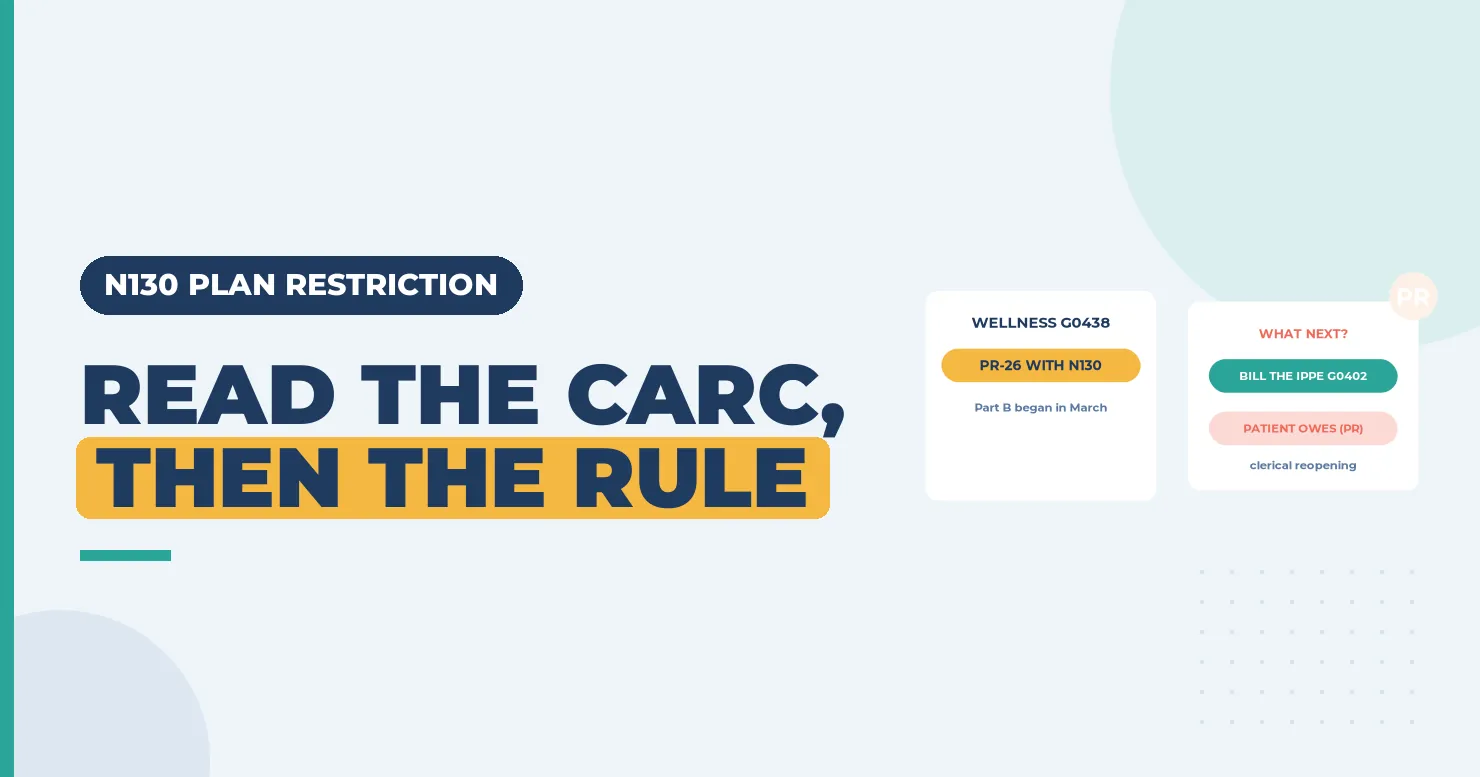
The N130 denial code is a remark that sends you to the plan’s benefit rules, because a restriction on the service stopped payment. It never appears alone, because a remark code only explains an adjustment reason code. The CARC next to it tells you which kind of limit applied, such as a frequency limit or a coverage start date. Read that combination first, then check the specific plan rule before you rebill the claim or send a statement to the patient. (Primary source: X12 Remittance Advice Remark Codes)
In brief: remark code N130 means look up the plan rule. Medicare uses it with CARC 119 when a wellness visit came too soon, and with CARC 26 when it fell before the coverage window. Often the fix is billing the visit the patient was eligible for.
Part of our denial codes library. Written by Manikandan J, CPC, CRCR, who has worked Medicare wellness visit denials for primary care clients and built eligibility checks that flag new Part B members. Published 28 November 2026. Last updated: 28 November 2026. Code wording quoted word for word from X12. Read about the author and our editorial policy, or contact us to report an error.
What does remark code N130 mean?
Remark code N130 says a plan restriction applies, and the details are in the plan’s benefit documents. On a Medicare remittance, those documents are the national coverage rules for the service. On a commercial remittance, they are the member’s plan booklet or summary of benefits and coverage. The CARC beside N130 names the type of limit.
| Field | Value |
|---|---|
| Code | RARC N130 |
| N130 wording | “Consult plan benefit documents/guidelines for information about restrictions for this service.” |
| Type | Remittance Advice Remark Code |
| Start | 10/31/2002 |
| Last modified | 11/01/2009 |
| Paired with | A CARC, such as 119 or 26, and a group code |
Source: X12 Remittance Advice Remark Codes, checked 28 November 2026.
Methodology: the code wording is copied from the X12 list. The Medicare pairings come from the CMS claims manual, chapter 18, section 140.7, which lists the codes for wellness visit denials.
Key terms: A RARC is a remark code that adds detail to the CARC. The IPPE (G0402) is the one-time Welcome to Medicare visit in the first 12 months of Part B. The AWV (G0438 first, G0439 later) is the yearly wellness visit.
Which CARC and group code come with N130?
N130 has no group code of its own; it borrows the group from the CARC line. On Medicare wellness visits, CMS lists group PR with both pairs below. PR means the patient may owe the balance, but check whether a different visit code was the right one first.
| Pair | When Medicare sends it | First move |
|---|---|---|
| PR-119 with N130 | AWV within 12 months of an earlier AWV or an IPPE | Check the date of the last visit |
| PR-26 with N130 | AWV in the first 12 months of Part B | Check the Part B start date |
| Other CARC with N130 | A commercial plan limit | Read the plan booklet for that service |
Example scenario (fictional names), part 1
N130 Denial Example: What Happened
Rosa Delgado bills for Maple Street Family Medicine. Dr. Kevin Hart saw a new Medicare patient for a full wellness visit. The patient’s Part B coverage began on March 1, 2026.
Rosa billed G0438, the first AWV, with Z00.00 (entered as Z0000). The remit came back with CAS*PR*26 and remark N130. The entire visit was denied, and the practice received no payment.
Why would Medicare refuse a first wellness visit for a brand new patient? Keep reading, or jump to how the N130 denial was resolved.
What causes an N130 denial?
An N130 denial usually comes from a plan rule about timing, frequency or the scope of coverage. For example, Medicare will not pay an AWV in the first year of Part B. Here are the usual causes.
| Cause | What it looks like |
|---|---|
| AWV in the first 12 months of Part B | CARC 26 with N130 |
| AWV within 12 months of the last AWV | CARC 119 with N130 |
| AWV within 12 months of an IPPE | CARC 119 with N130 |
| Commercial visit or therapy limit reached | CARC 119 or a plan-specific CARC |
| Benefit not in the member’s plan | Coverage CARC with N130 |
CMS chapter 18 says the Common Working File rejects an AWV billed within 12 months after the start of a patient’s first Part B coverage. The Welcome to Medicare visit page explains that this one-time visit is the one covered in that first year.
How do I fix an N130 denial?
To fix an N130 denial, read the CARC, then find the exact plan rule. If the patient was eligible for a different covered visit, and the record supports it, change the code. If no covered option fits, the PR balance can go to the patient.
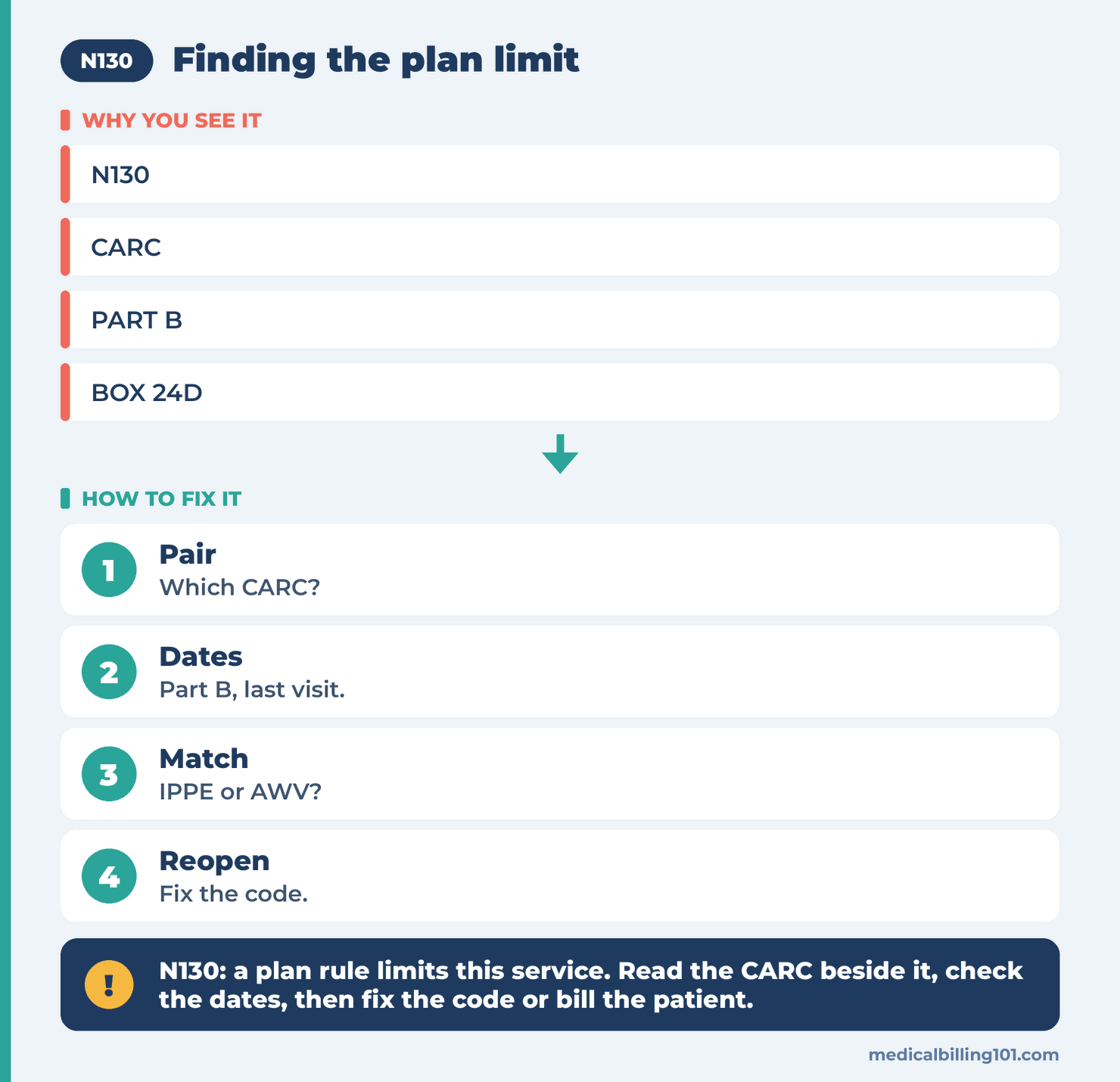
| Step | Action | Where to check |
|---|---|---|
| 1 | Read the CARC paired with N130 | 835 line or remit |
| 2 | Check the Part B start date and visit history | Eligibility response |
| 3 | Match the note to the right visit type | IPPE or AWV elements |
| 4 | Change the code if the record supports it | Box 24D |
| 5 | Ask the MAC for a clerical reopening | Phone, portal or written request |
| 6 | If nothing fits, bill the patient under PR | Patient statement |
Clerical errors such as inaccurate data entry are fixed by reopening, not appeal, under the CMS reopening chapter. Medicare does not use Box 22 on the CMS-1500. The yearly wellness visit page confirms the AWV starts after the first 12 months.
Example scenario (fictional names), part 2
How the N130 Denial Was Resolved
Rosa checked the eligibility response. The Part B start date was seven months before the visit, so an AWV was not payable yet. But Dr. Hart’s note had every IPPE element, including the simple vision test, the depression risk review and a written screening plan.
Fix: Rosa called the MAC and asked for a clerical reopening. She changed Box 24D from G0438 to G0402, the IPPE. Z00.00 stayed in Box 21, and Box 22 stayed blank for Medicare.
Outcome: Medicare paid the IPPE, and the patient owed nothing for it. Rosa added a Part B start date check to new patient intake, so first-year visits get the right code.
Names and details are illustrative; no real patient data.
Names and details are illustrative; no real patient data.
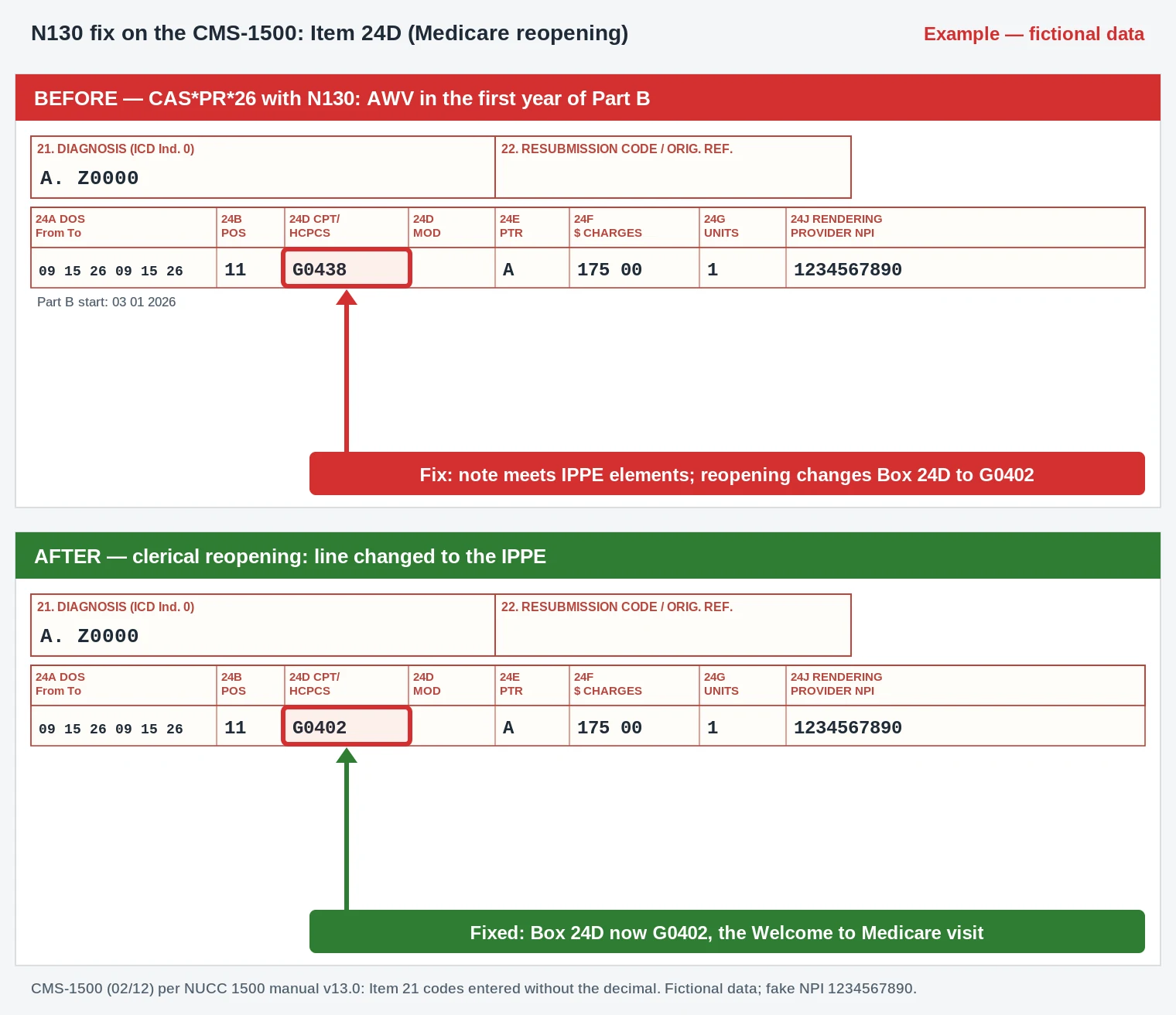
- Box 24D: G0438 (first AWV) changed to G0402 (IPPE), because the visit fell in the first 12 months of Part B and the note has every IPPE element.
- Box 21: Z00.00 (entered as Z0000) is unchanged.
- Box 22: left blank; Medicare does not use it, so the change goes through a clerical error reopening.
- UB-04: not shown; the practice bills wellness visits only on the CMS-1500.
Can I bill the patient for an N130 denial?
Sometimes. N130 itself does not determine financial responsibility; the group code does. With PR, the patient may owe it. Still, check for a covered alternative before sending any statement. In the Medicare case above, the IPPE was covered with no cost share, so billing the patient would have been wrong.
Related codes
| Code | Meaning |
|---|---|
| PR-119 | Benefit maximum reached for the period |
| PR-204 | Service not covered under the current plan |
| CO-96 | Non-covered charge |
| CO-50 | Not medically necessary |
| MA130 | Claim unprocessable; incomplete information |
FAQ
What does N130 mean on a remit?
It means a plan rule restricts the service. Read the adjustment reason code on the same line to see which limitation applied.
Is N130 a denial by itself?
No. It is a remark code, so it explains a CARC. The adjustment reason code and the group code determine the result.
Why did Medicare deny my AWV with N130?
Usually the AWV came within 12 months of the previous AWV or IPPE, or within the first year of the patient’s Part B enrollment.
Can I change G0438 to G0402?
Yes, if the visit was in the first 12 months of Part B and the note has all IPPE elements.
Does N130 appear on commercial claims?
Yes. Commercial plans use it for visit limits, exclusions and other restrictions described in the member’s benefit booklet.
Sources
How we checked: the N130 quote was matched word for word with the X12 RARC list on 28 November 2026. The Medicare rules come from CMS manual chapters 18 and 34 and Medicare.gov.
- X12, Remittance Advice Remark Codes (RARC N130, MA130). Accessed 28 Nov 2026.
- X12, Claim Adjustment Reason Codes (CARC 119, 26, 204, 96, 50). Accessed 28 Nov 2026.
- CMS, Medicare Claims Processing Manual, chapter 18, preventive services. Accessed 28 Nov 2026.
- CMS, Medicare Claims Processing Manual, chapter 34, reopening and revision. Accessed 28 Nov 2026.
- Medicare.gov, Welcome to Medicare preventive visit. Accessed 28 Nov 2026.
- Medicare.gov, Yearly wellness visits. Accessed 28 Nov 2026.
Last updated: 28 November 2026 · Educational content; not legal advice.