
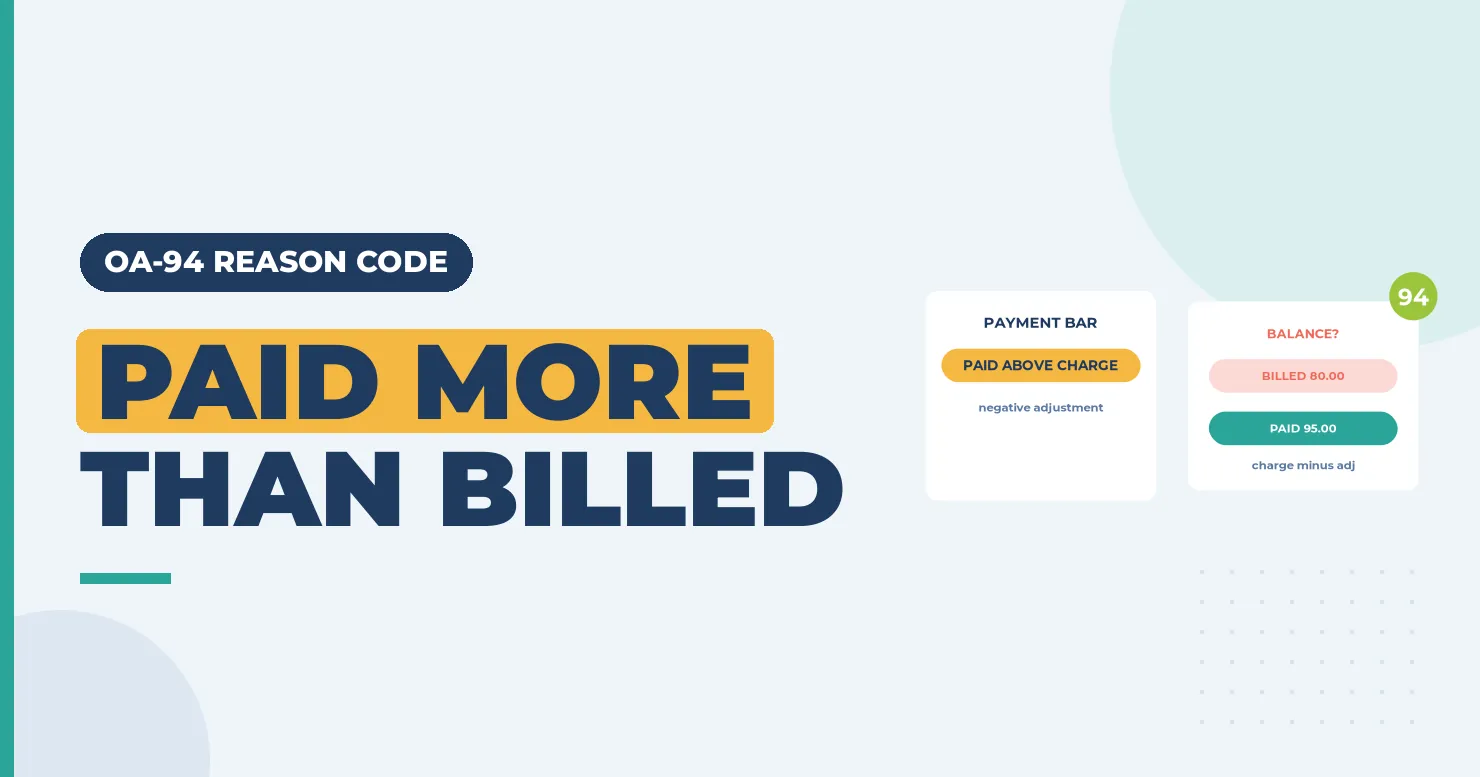
OA-94 isn’t a denial at all. It means the payer reimbursed you more than you billed for a particular service. Because the 835 has to balance, the payer reports the additional amount as a negative adjustment with reason code 94, which explains the minus sign. The main correction happens in payment posting, not appeals. But if you see OA-94 often, it’s a strong sign your charges are set below what payers will pay. (Primary source: X12 Claim Adjustment Reason Codes).
In brief: OA-94 means “Processed in Excess of charges.” The payer’s allowed amount, such as a fee schedule, per diem or DRG, was higher than your charge. The negative CARC 94 amount makes the claim balance. Post it so the account doesn’t show a credit. Then check your charge list, since charges below the fee schedule can cost you money with payers that pay the lower of charge or fee.
Part of our denial codes library. Written by Manikandan J, CPC, CRCR, who has posted remittances and reviewed charge levels for payers and billing companies. Published 20 October 2026. Last updated: 20 October 2026. Code wording is quoted word for word from X12.
CARC 94 in the X12 list
| Field | Official X12 text |
|---|---|
| Description | “Processed in Excess of charges.” |
| Start | 01/01/1995 |
Source: X12 Claim Adjustment Reason Codes, checked 20 October 2026.
Denial code 94, CARC 94 and reason code 94
People search for denial code 94, CARC 94 or reason code 94. All three describe the same situation: the reimbursement exceeded the charge. Payers may pair it with OA or CO. The group doesn’t change the posting, since the amount is extra money to you, not a balance anyone owes.
Why the adjustment is negative
The 835 follows a simple rule: the charge minus all adjustments equals the payment. A negative adjustment is an adjustment entered with a minus sign, which adds to the payment instead of taking away. When the payer pays more than the charge, the only way to balance is a negative CARC 94.
| Line | Amount |
|---|---|
| Billed charge | 80.00 |
| CARC 94 adjustment | -15.00 |
| Payment | 95.00 |
| Check: 80.00 minus -15.00 | 95.00 |
Maine’s Medicaid program told providers the same thing in a 2017 notice. When its payment beats the billed charge, the extra is reported with CARC 94, not CARC 45. See the MaineCare CARC 94 bulletin.
When payers pay more than you bill
- Fee schedule above your charge. Your charge for a visit is lower than the payer’s established fee for that procedure.
- Case rates. A DRG is a fixed hospital payment for a stay based on the diagnosis group, and it can be higher than the charges for a short stay. A per diem is a fixed daily rate, and it can beat a low daily charge.
- Outlier or add-on payments that push the total above the charge.
- Interest or bonus amounts added at the line level by some payers.
How to post an OA-94 line
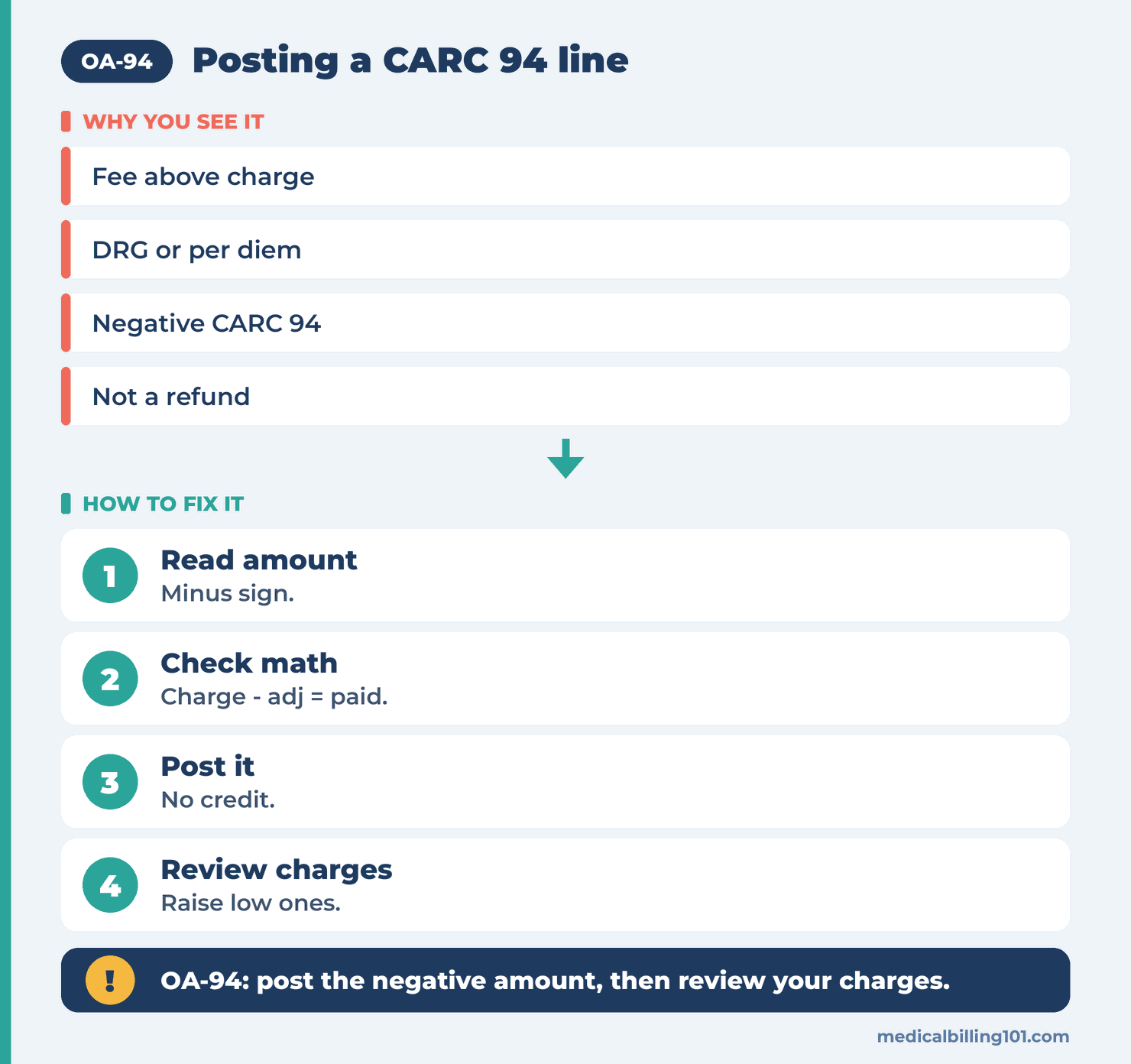
- Read the negative amount. CARC 94 should be a minus number on the CAS segment.
- Check the balance math. Charge minus adjustments should equal the payment.
- Post the adjustment so the extra payment doesn’t sit as a patient credit or overpayment.
- Don’t refund automatically. A payment above charge isn’t an overpayment if it follows the contract or the applicable fee schedule.
- Review your charge levels for the codes that keep showing OA-94.
What frequent OA-94 lines tell you
If CARC 94 shows up often for the same codes, your charges are probably below what payers allow. That’s a quiet revenue leak, because many commercial plans reimburse the lower of your charge or their fee, so an artificially low charge caps what they pay you. For example, a practice that charges 80 for a visit that one plan pays at 95 is likely being paid only 80 by plans that use the lower-of rule. A yearly charge review against your top payers’ fee schedules fixes this.
Worked example (illustrative)
A small clinic sees CAS*OA*94*-15.00 on a Medicaid remit. The visit was billed at 80 and paid at 95. The poster’s system flags a 15.00 credit, so she posts the CARC 94 line as a negative adjustment and the account clears to zero. The office manager then runs a report and finds 12 codes with OA-94 in the last quarter. She raises those charges to at least the highest fee among the top payers.
Consider a hospital case. A one-day stay is paid under a DRG that’s higher than the total charges. The remit shows a negative CARC 94 for the difference. The poster records it as additional reimbursement, not a refund obligation.
Checklist
- [ ] Set your posting system to accept negative CARC 94 amounts.
- [ ] Never treat a CARC 94 credit as a patient refund.
- [ ] Report OA-94 lines by code each quarter.
- [ ] Compare charges to your top payers’ fee schedules each year.
- [ ] Check contracts before refunding any payment above charge.
Related codes
- CO-45: charge exceeds fee schedule or contracted amount, the opposite case.
- OA-23: impact of prior payer adjudication.
- CO-44: prompt-pay discount.
- PR-85: patient interest adjustment.
- Full CARC and RARC list for code lookups.
- Denial codes hub for every code we cover.
Key takeaways
OA-94 means the payment was higher than the charge, and the negative CARC 94 amount balances the claim. Post it as extra payment, not a refund or patient credit. If it shows up often, raise the affected charges so you don’t lose money with payers that pay the lower of charge or fee.
FAQ
What does OA-94 mean?
It means the payer processed the claim for more than the billed charge.
Why is the CARC 94 amount negative?
Because the 835 must balance. A negative adjustment adds to the payment so charge minus adjustments equals what was paid.
Do I have to refund an OA-94 payment?
Not if the payment follows the contract or fee schedule. Check before refunding.
Is OA-94 a denial?
No. It’s an informational adjustment showing extra payment.
Why does OA-94 keep showing up?
Your charges are probably below the payer’s fee schedule for those codes.
What is the difference between CARC 94 and CARC 45?
CARC 45 reduces a charge that’s above the allowed amount. CARC 94 reports a payment that’s above the charge.
Sources
How we checked: every code quote on this page was compared word for word with the X12 CARC list on 20 October 2026.
- X12, Claim Adjustment Reason Codes (CARC 94). Accessed 20 Oct 2026.
- MaineCare, CARC 94 reporting on RA and 835, TR 63097. Accessed 20 Oct 2026.
- CMS, Medicare Claims Processing Manual, Ch. 22, Remittance Advice. Accessed 20 Oct 2026.
Last updated: 20 October 2026 · This page is educational and doesn’t replace payer contracts or coding rules.