
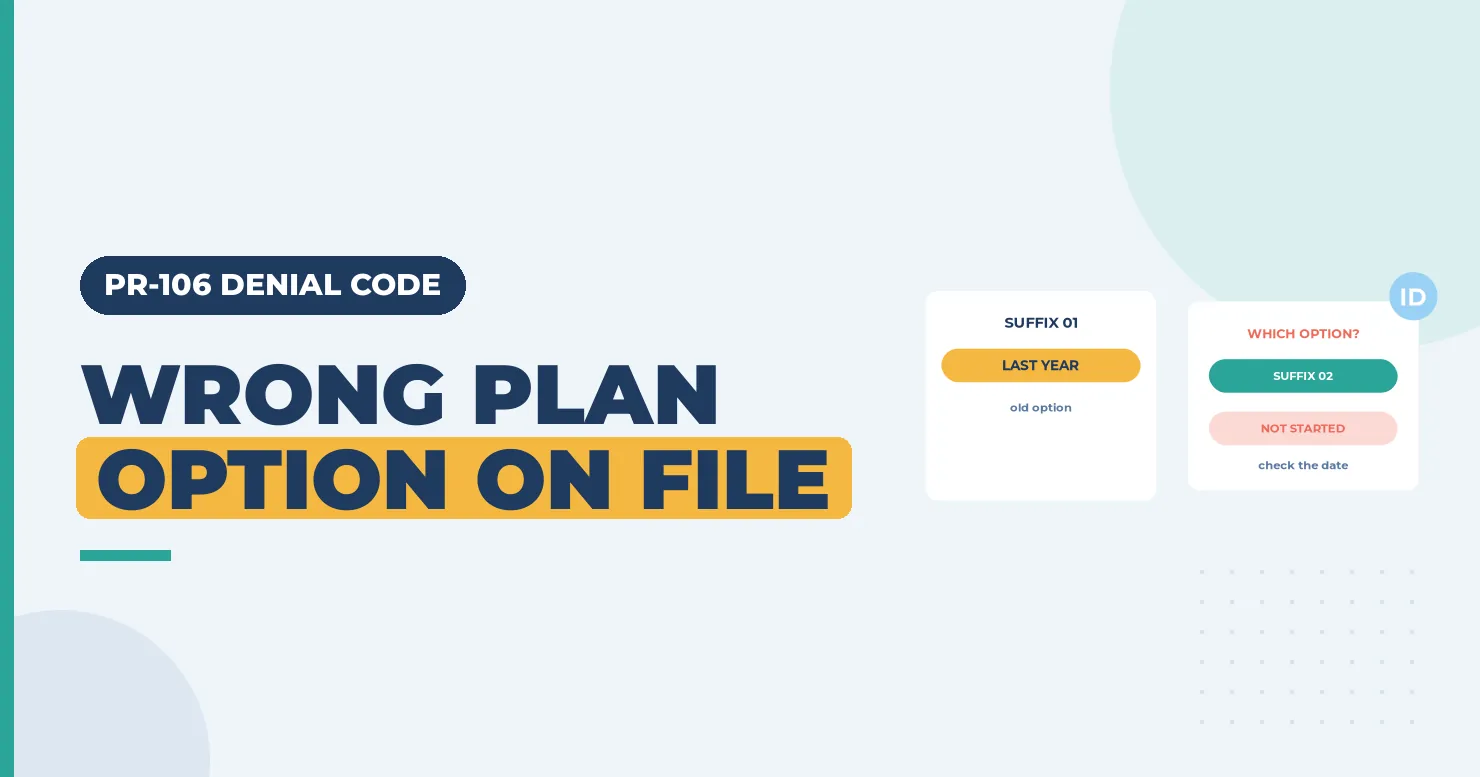
PR-106 tells you the payer looked for a payment option the patient chose, and that choice wasn’t active on the date of service. Think of a plan option picked at open enrollment, a point-of-service tier, a rider or a member election that starts on a set date. The claim landed in a gap between the old choice and the new one. The PR group puts the amount on the patient for now, but many of these are fixable before anyone sends a bill. (Primary source: X12 Claim Adjustment Reason Codes)
In brief: CARC 106 reads “Patient payment option/election not in effect.” Check which plan option the patient had on the date of service, and whether the claim used the right member ID for it. Fix the claim if the ID or plan was wrong. Bill the patient only when the election truly wasn’t in force.
Part of our denial codes library. Written by Manikandan J, CPC, CRCR, who has worked eligibility and registration denials for multi-specialty groups. Published 22 October 2026. Last updated: 22 October 2026. Code wording quoted word for word from X12.
Official CARC 106 description
| Field | X12 text |
|---|---|
| Code | 106 |
| Description | “Patient payment option/election not in effect.” |
| Start | 01/01/1995 |
| Typical group | PR (patient responsibility), sometimes OA |
Source: X12 Claim Adjustment Reason Codes, checked 22 October 2026.
Key terms behind CARC 106
A plan option is one of the benefit choices inside an employer’s plan, such as a base tier, a buy-up tier or a point-of-service tier. An election is the member’s choice of option, made at open enrollment or after a qualifying life event. A coverage effective date is the first day that choice applies to claims.
HealthCare.gov explains the open enrollment period and the special enrollment period that follows life events such as marriage or a new baby. Both are moments when the option on file can change.
What a payment option or election means in practice
Most members don’t just have one flat plan. They pick an option inside it. An employer may offer a base tier and a buy-up tier, an in-network only option and a point-of-service option, or a separate rider for vision or hearing. Each option can carry its own member ID suffix, group number and start date.
CARC 106 shows up when the payer finds the member but not the option the claim relies on. Common triggers:
- The patient changed options at open enrollment or after a life event, and the new option starts later than the visit.
- Registration kept the old ID suffix, so the claim points at an option that has ended.
- The employer sent the election late, and the payer’s file still shows the prior choice.
- For example, the patient chose a rider, such as out-of-network coverage, but never finished the paperwork.
Example scenario (fictional names), part 1
PR-106 Denial Example: What Happened
Priya Natarajan runs front-desk checks at Cedar Bend Family Medicine. On 15 September a returning patient came in for a diabetes follow-up and an A1c test (E11.9). Billing sent 99214 and 83036 to Harborline Health, a fictional commercial plan, using the member ID on file from last year.
The 835 came back with CAS*PR*106 on both lines and remark LQ*HE*N130, “Consult plan benefit documents/guidelines for information about restrictions for this service.” The patient had a card in her wallet with a different suffix.
Was the patient’s coverage really off, or was the claim pointing at the wrong option? Keep reading, or jump to how the PR-106 denial was resolved.
Remark codes often paired with CARC 106
| RARC | X12 wording | What it tells you |
|---|---|---|
| N130 | “Consult plan benefit documents/guidelines for information about restrictions for this service.” | Read the option’s benefit rules |
| N52 | “Patient not enrolled in the billing provider’s managed care plan on the date of service.” | The managed care election didn’t cover your office |
| N191 | “The provider must update insurance information directly with payer.” | The payer wants the corrected coverage from you |
See the X12 RARC list for the full set.
How to fix a PR-106 denial
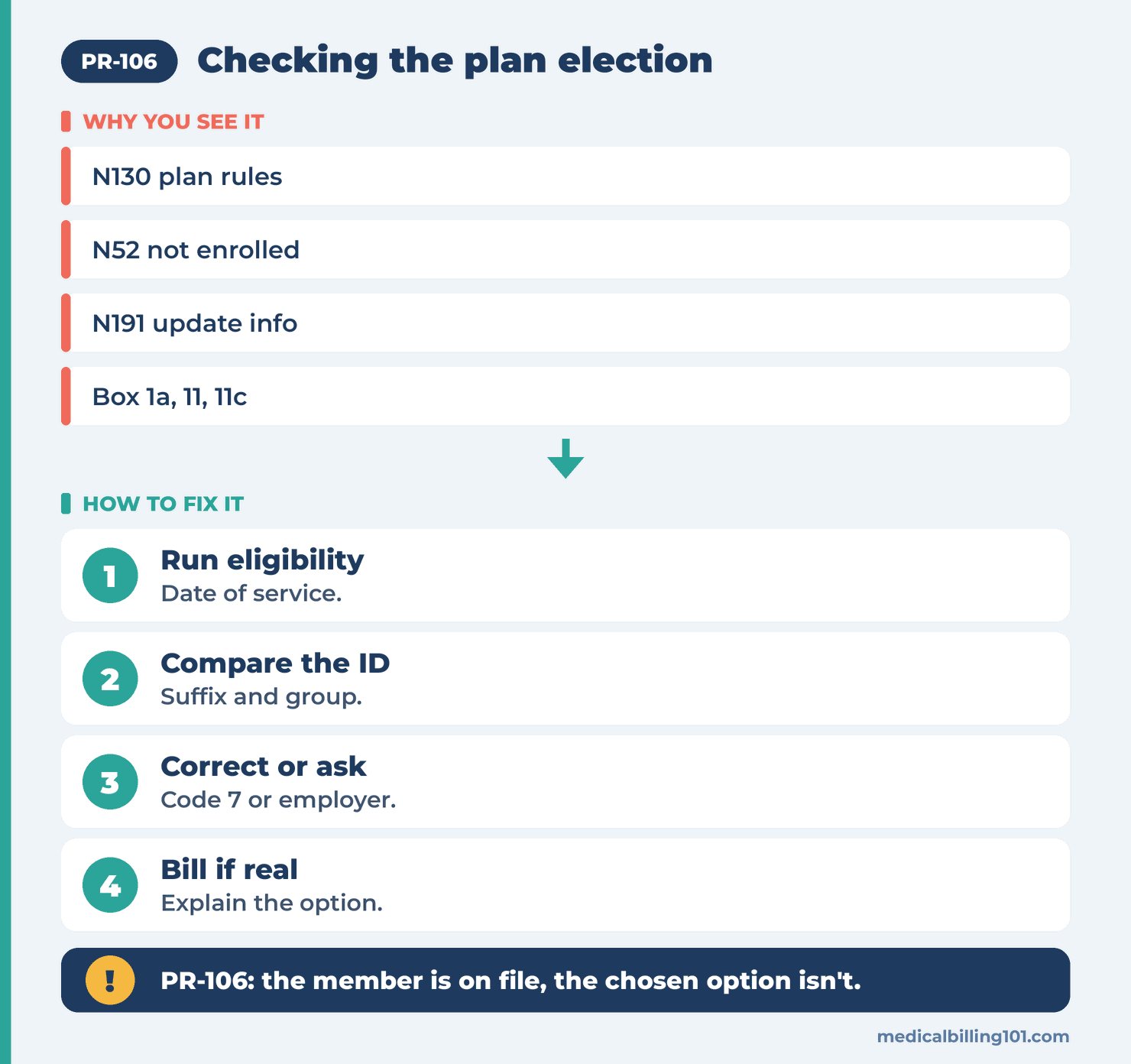
- Run eligibility for the exact date of service. Ask for the plan option, the coverage start date and the member ID suffix. A 270/271 check or the payer portal both work.
- Compare the claim with the response. Look at the subscriber ID (Box 1a), the plan name (Box 11c) and the group number (Box 11). One wrong suffix is enough to trigger CARC 106.
- If the claim used the wrong option, fix registration and send a corrected claim with frequency code 7 and the original claim number.
- If the payer’s file is wrong, ask the patient or the employer’s benefits team to send the election to the payer. Then request reprocessing.
- If the election truly started later, the amount is the patient’s to pay. Explain it plainly, and check whether an older option or another plan covered the date.
- Prevent repeats. Scan new cards at every visit in the first months of the plan year, when option changes are common.
Example scenario (fictional names), part 2
How the PR-106 Denial Was Resolved
Priya ran eligibility for 15 September. Harborline showed the patient had moved from the base option to the buy-up option on 1 January. The new option used suffix 02, and registration still had suffix 01 from last year’s card. The buy-up option was active on the date of service.
Fix: she updated registration and sent a corrected claim with Box 22 resubmission code 7, the original claim number and the 02 member ID in Box 1a. Box 11c now named the buy-up option.
Outcome: Harborline reprocessed both lines and paid under the buy-up benefits. The patient never got a bill. Priya added a new-card-this-year question to the check-in script for the first quarter.
Names and details are illustrative; no real patient data.

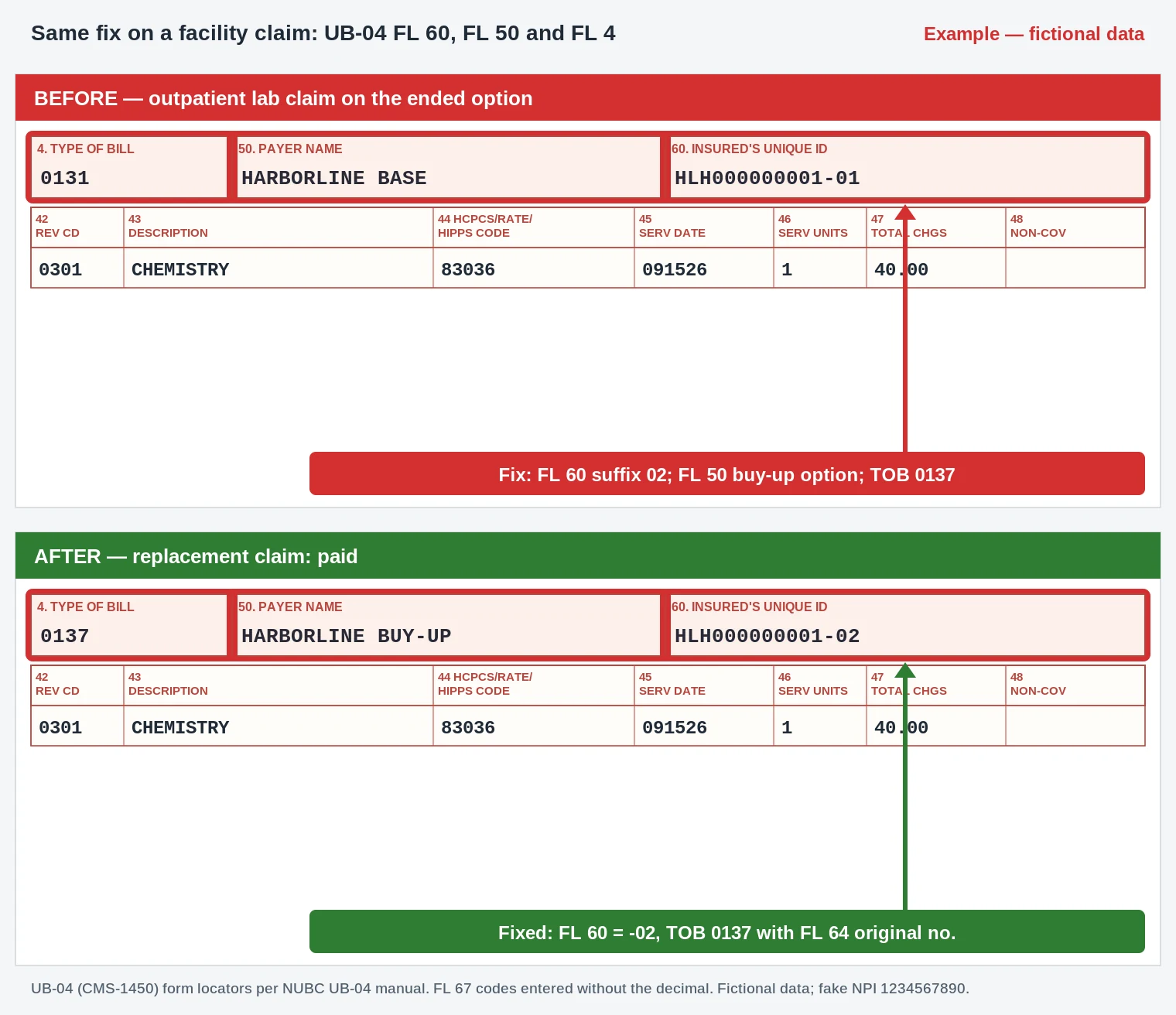
- Box 1a / FL 60: member ID suffix 01 (last year’s base option) replaced with suffix 02 for the buy-up option active on the date of service.
- Box 11c / FL 50: plan name updated to the buy-up option shown on the eligibility response.
- Box 22 / FL 4 + FL 64: resubmission code 7 with the original claim number (type of bill 0137 on the UB-04).
- Box 24D / FL 44: 99214 and 83036 with E11.9 (entered as E119) are unchanged.
Worked example (illustrative)
A physical therapy clinic sees a patient on 3 March. The patient chose a point-of-service option at open enrollment, but the employer’s file reached the payer on 20 March with a 1 April start. The claim gets CARC 106 because on 3 March only the in-network option was active and the clinic is out of network for it. Nothing on the claim is wrong. The clinic can ask the employer whether the start date was meant to be 1 January. If not, the visit is the patient’s responsibility under the old option’s rules.
PR-106 vs similar codes
| Code | What it means | Main difference |
|---|---|---|
| PR-106 | Payment option or election not in effect | The member exists, the chosen option doesn’t apply on that date |
| CO-27 | Expenses incurred after coverage terminated | Coverage ended altogether |
| CO-26 | Expenses incurred prior to coverage | Coverage hadn’t started yet |
| CO-31 | Patient cannot be identified as our insured | The payer can’t find the member at all |
Checklist before you bill the patient
- Eligibility printout or 271 for the date of service is saved to the account.
- Member ID, suffix and group match the card the patient actually used that day.
- The employer or patient was asked about a late or missing election.
- Any other active coverage on that date has been billed.
- The patient statement says which plan option was in force and why.
Recap
PR-106 means the payment option or election the claim depends on wasn’t in effect on the date of service. Before you bill the patient, run eligibility for that date and check the member ID suffix, plan name and group. Most fixes are a corrected claim with the right option, or a late election the employer needs to send to the payer.
FAQ
What does denial code PR-106 mean?
The payer says the patient’s chosen payment option or plan election wasn’t in effect on the date of service, so it assigned the amount to the patient.
Can I bill the patient for PR-106?
Only after you confirm the claim used the right plan option and no other coverage applies. Many PR-106 denials come from an old member ID suffix.
Is PR-106 the same as terminated coverage?
No. With PR-106 the member is on file. The specific option or election the claim relies on isn’t active on that date.
How do I fix a PR-106 caused by an old member ID?
Update registration with the current ID and option, then send a corrected claim with frequency code 7 and the original claim number.
Who fixes a late employer election?
The employer’s benefits team or the patient sends the election to the payer. You then ask the payer to reprocess the claim.
Which group codes appear with CARC 106?
Most often PR. Some payers use OA when no one is billed yet.
Sources
How we checked: each code quote on this page was matched word for word with the X12 CARC and RARC lists on 22 October 2026.
- X12, Claim Adjustment Reason Codes (CARC 106, 26, 27, 31). Accessed 22 Oct 2026.
- X12, Remittance Advice Remark Codes (N130, N52, N191). Accessed 22 Oct 2026.
- HealthCare.gov, Open enrollment period and Special enrollment period (glossary). Accessed 22 Oct 2026.
- NUCC, 1500 Health Insurance Claim Form reference instruction manual. Accessed 22 Oct 2026.
Last updated: 22 October 2026 · Educational content; not legal advice.