
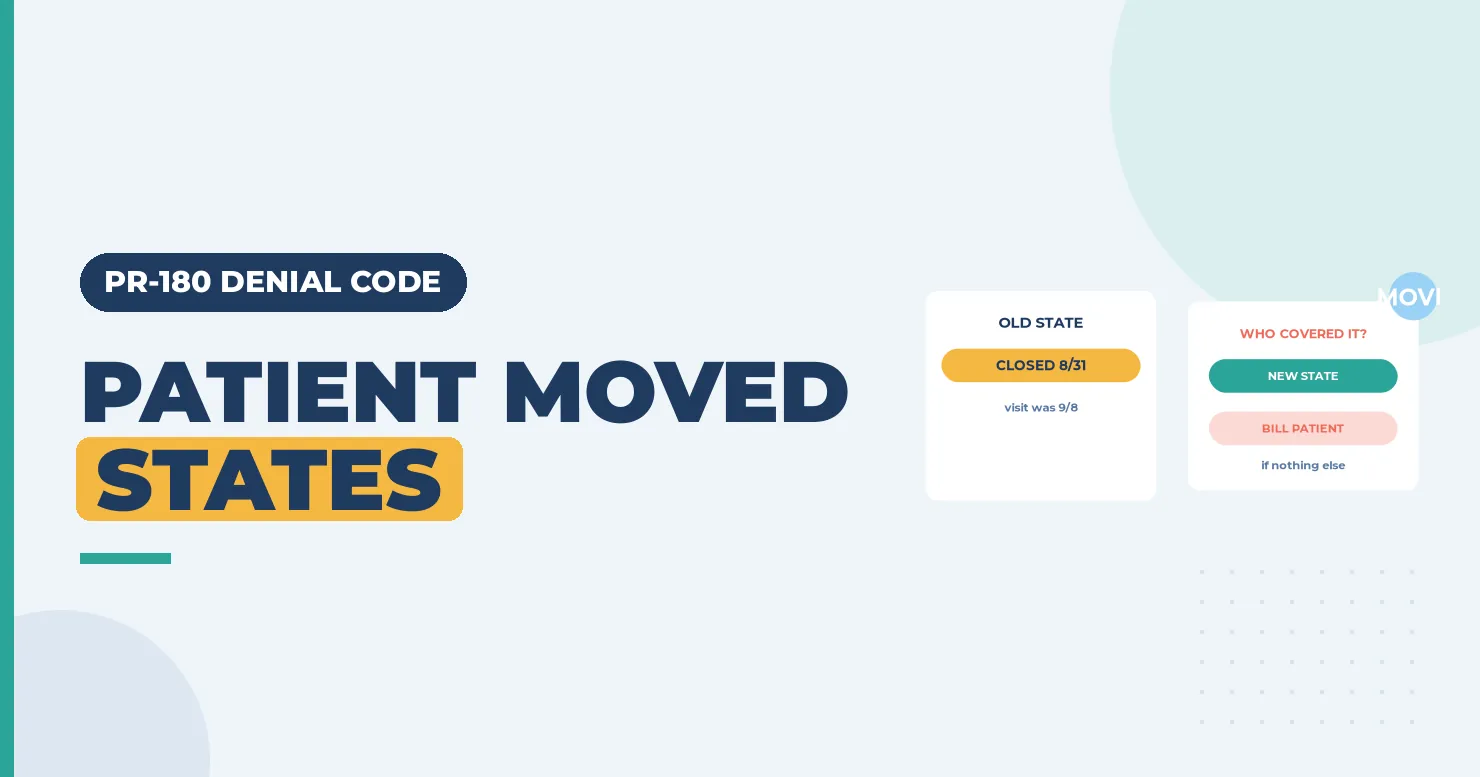
PR-180 means the payer says the patient didn’t live where the plan requires. Residency rules matter most for state programs such as Medicaid, which cover people who live in that state, and for plans tied to a service area. The usual trigger is a move. The patient relocated, but the old state’s coverage was billed, or the new coverage wasn’t set up yet. The PR group points to the patient, but the fix is often a claim to the right program. (Primary source: X12 Claim Adjustment Reason Codes)
In brief: CARC 180 reads “Patient has not met the required residency requirements.” Confirm where the patient lived on the date of service, check eligibility in the new state or plan, and bill the program that covered that date. Bill the patient only when no coverage applied.
Part of our denial codes library. Written by Manikandan J, CPC, CRCR, who has worked cross-state Medicaid denials for border-area clinics. Published 22 October 2026. Last updated: 22 October 2026. Code wording quoted word for word from X12.
Official CARC 180 description
| Field | X12 text |
|---|---|
| Code | 180 |
| Description | “Patient has not met the required residency requirements.” |
| Start | 06/30/2005 |
| Last modified | 09/30/2007 |
Source: X12 Claim Adjustment Reason Codes, checked 22 October 2026.
Key terms behind CARC 180
A residency requirement is a rule that a member must live in a certain state or area to qualify. Medicaid is run by each state under federal rules, as HealthCare.gov’s Medicaid glossary entry explains, so coverage follows the state where the person lives. A service area is the region where a plan, such as an HMO or a marketplace plan, offers coverage.
Common causes of PR-180
- The patient moved. For example, they moved across a state line and the old state’s Medicaid closed the case.
- New coverage pending. The patient applied in the new state, but the plan wasn’t active yet when the claim was filed.
- Out of service area. A plan that covers only one region received a claim for someone who now lives elsewhere.
- Old address on file. Registration never updated the address or the payer.
Example scenario (fictional names), part 1
PR-180 Denial Example: What Happened
Grace Liu handles Medicaid follow-up at Riverbend Family Clinic, which sits near a state line. A patient came in on 8 September for a follow-up on high blood pressure (I10). Registration billed 99214 to the Medicaid plan on file, Northgate Medicaid, a fictional state program.
The 835 showed CAS*PR*180 with remark LQ*HE*N30, “Patient ineligible for this service.” Northgate’s portal showed the case closed on 31 August because the patient had moved to the neighboring state.
Should Grace bill the patient, or does another state’s program cover 8 September? Keep reading, or jump to how the PR-180 denial was resolved.
Remark codes often paired with CARC 180
| RARC | X12 wording | What it tells you |
|---|---|---|
| N30 | “Patient ineligible for this service.” | Not eligible on that date |
| N130 | “Consult plan benefit documents/guidelines for information about restrictions for this service.” | The plan’s residency rules apply |
See the X12 RARC list for the full set.
How to fix a PR-180 denial
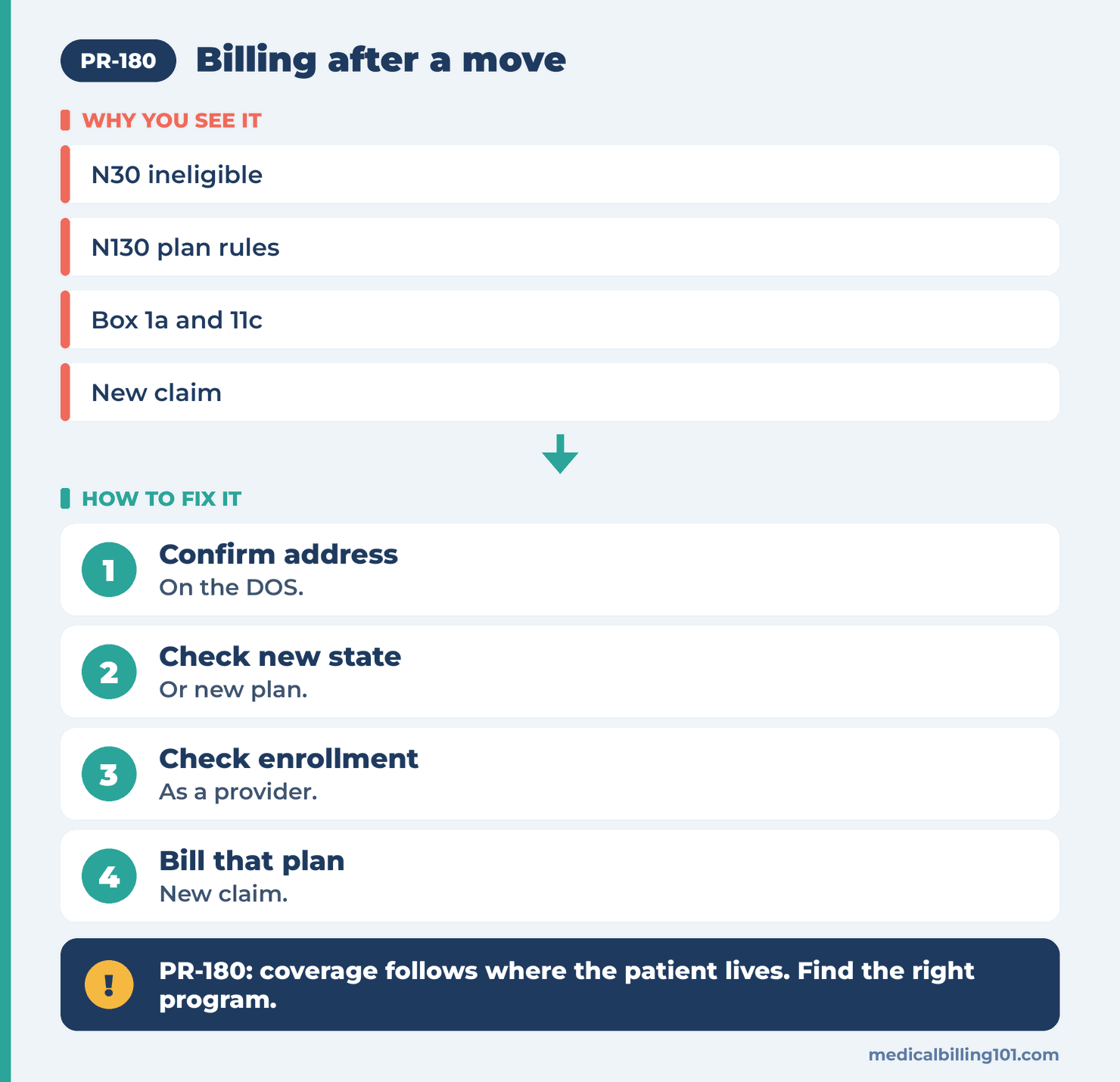
- Confirm the address the patient lived at on the date of service.
- Check eligibility in the new state or with the new plan for that date. Ask whether an application is pending.
- Check enrollment as a provider with the new state’s program before billing it.
- Bill the plan that covered the date with a new claim and the new member ID.
- If an application is pending, hold the claim and follow up once a decision is made, within the filing limit.
- If no coverage applied, bill the patient and offer a payment plan.
Example scenario (fictional names), part 2
How the PR-180 Denial Was Resolved
Grace asked the patient, who said they had applied for Medicaid in the new state in early September. The new state’s program, Lakeshore Medicaid, a fictional plan, showed approval with coverage back to 1 September. Riverbend was already enrolled with Lakeshore.
Fix: Grace updated the address, then sent a new claim to Lakeshore with the new member ID in Box 1a and Lakeshore in Box 11c. Northgate stayed on file as inactive from 31 August.
Outcome: Lakeshore paid the visit. Riverbend now asks about recent moves at every check-in and checks both states’ portals for patients who live near the border.
Names and details are illustrative; no real patient data.
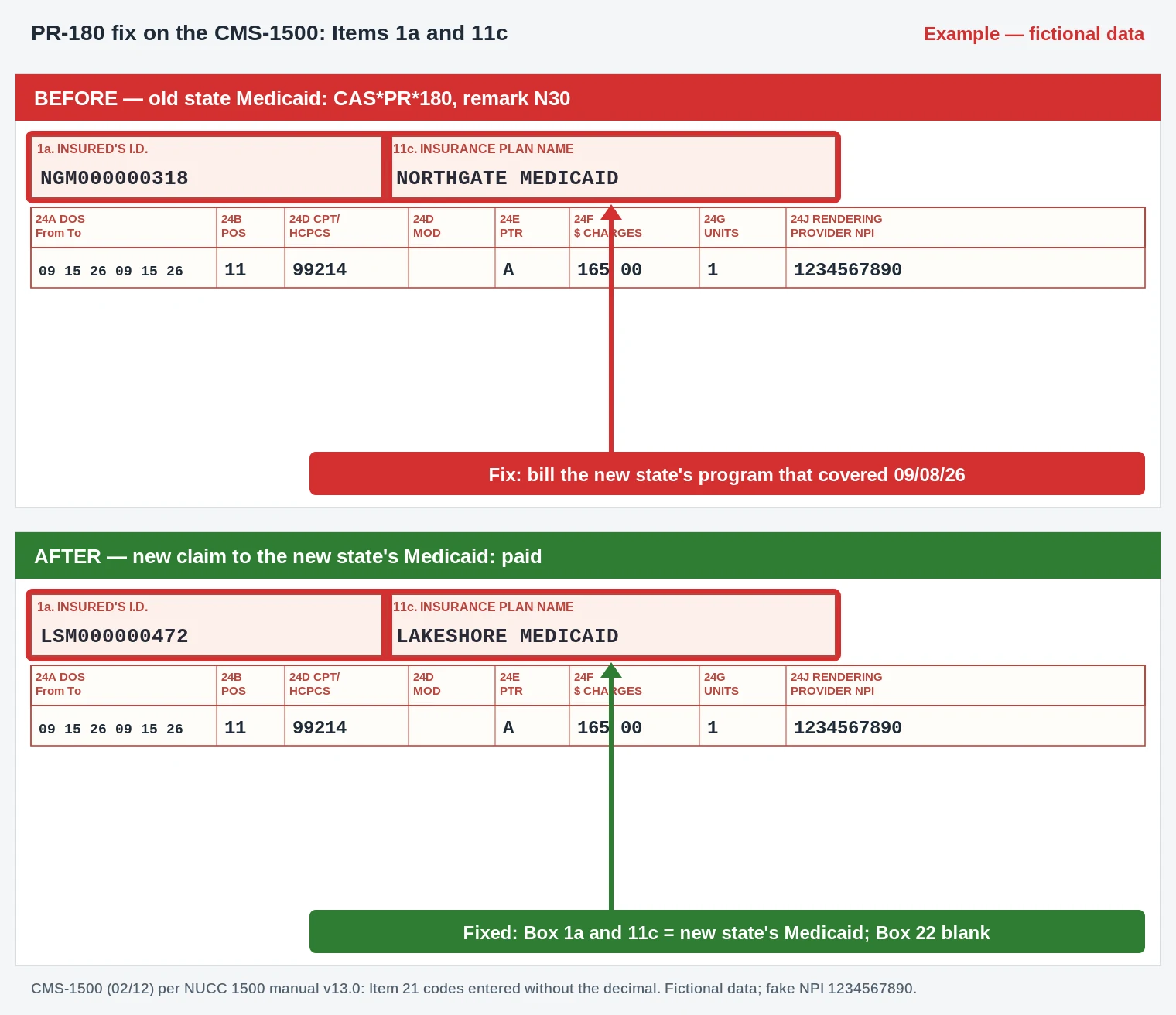
- Box 1a: old state’s Medicaid ID replaced with the new state’s member ID.
- Box 11c: the new state’s Medicaid program name.
- Box 5: the patient’s new address.
- Box 22: left blank. This is a new claim to a different payer.
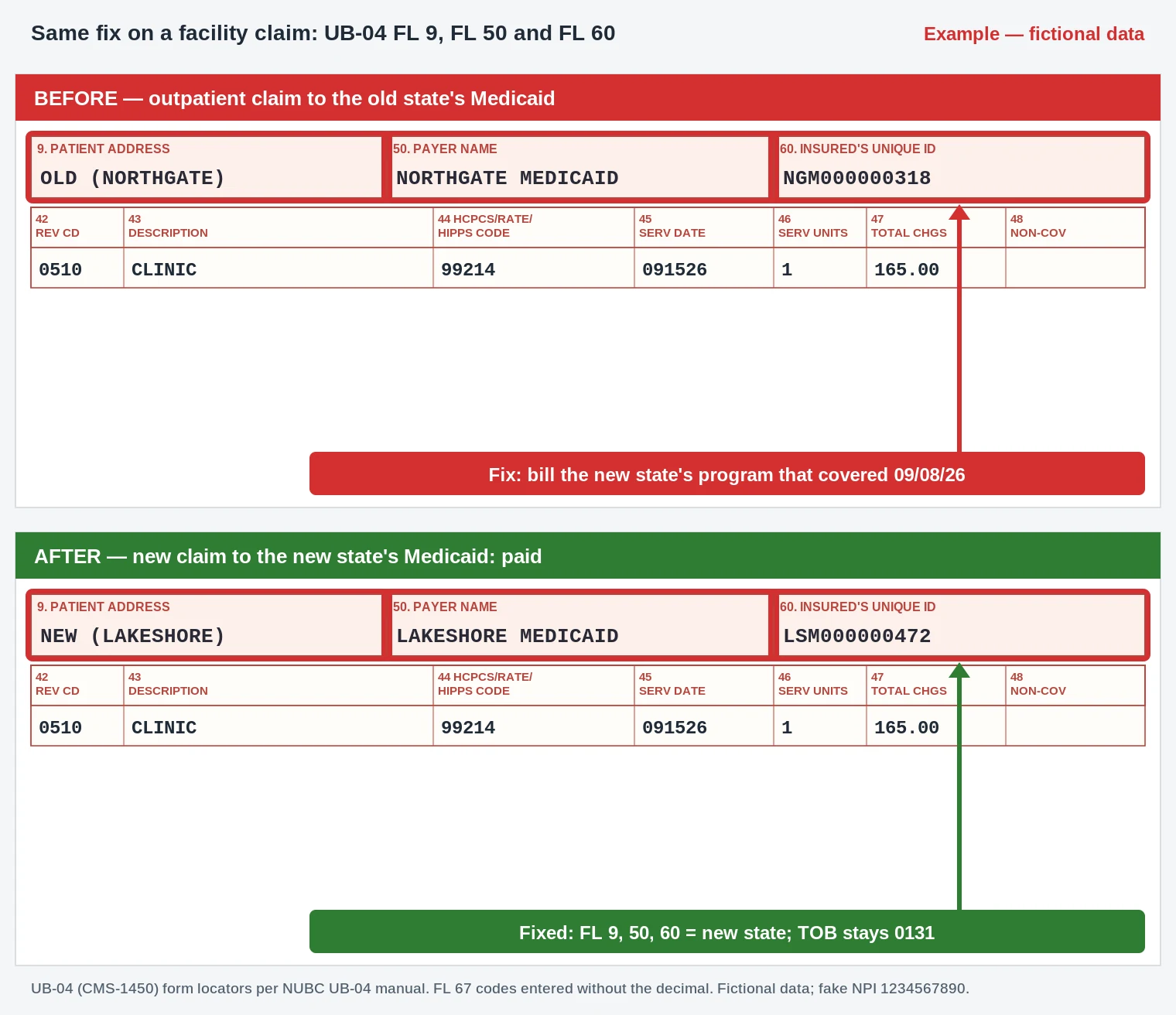
- UB-04 (facility): FL 9 new address, FL 50 new state’s Medicaid and FL 60 new member ID; new claim, type of bill stays 0131.
Worked example (illustrative)
A member of a regional HMO moves to a city outside the plan’s service area and visits a new clinic for a checkup. The claim draws PR-180. The patient had not yet picked a marketplace plan in the new area. The clinic bills the patient and points them to the marketplace, since a move can open a special enrollment period. Future visits go to the new plan once it starts.
PR-180 vs similar codes
| Code | What it means | Main difference |
|---|---|---|
| PR-180 | Residency requirements not met | Lives outside the plan’s area |
| PR-177 | Eligibility requirements not met | Fails another eligibility rule |
| CO-109 | Not covered by this payer | Bill another payer |
| CO-31 | Patient cannot be identified as our insured | Not found |
Registration checklist
- Ask about moves and confirm the address at every visit.
- Check eligibility on the date of service, not the claim date.
- Know which neighboring state programs you’re enrolled with.
- Track pending Medicaid applications so claims go out once approved.
Recap
PR-180 means the patient didn’t meet the plan’s residency rules, most often after a move. Confirm where they lived, find the program that covered the date, and bill it with a new claim. Bill the patient only when nothing applied.
FAQ
What does PR-180 mean?
The patient didn’t meet the plan’s residency requirements on the date of service.
Can I bill the patient for PR-180?
Yes, if no other coverage applied. Check the new state’s program first.
Can Medicaid in a new state cover past dates?
Some states cover months before the application. Check with that state’s program.
Do I need to enroll with another state’s Medicaid?
Usually, yes, before that state will pay you. Check its provider enrollment rules.
Corrected claim or new claim?
A new claim to the program that covered the date.
How is PR-180 different from CO-109?
CO-109 says to bill another payer. PR-180 cites residency and assigns the amount to the patient.
Sources
How we checked: each code quote on this page was matched word for word with the X12 CARC and RARC lists on 22 October 2026.
- X12, Claim Adjustment Reason Codes (CARC 180, 177, 109, 31). Accessed 22 Oct 2026.
- X12, Remittance Advice Remark Codes (N30, N130). Accessed 22 Oct 2026.
- HealthCare.gov, Medicaid (glossary). Accessed 22 Oct 2026.
Last updated: 22 October 2026 · Educational content; not legal advice.