

PR-85 is a patient interest adjustment. X12 allows reason code 85 only with group PR, and only when the patient is responsible for paying interest. It’s rare. Most interest on a remittance is the other kind: interest a payer adds because it paid a clean claim late. That payer interest is reported in different places on the 835. Mixing the two up is the most common posting error around CARC 85. (Primary source: X12 Claim Adjustment Reason Codes).
In brief: PR-85 means “Patient Interest Adjustment (Use Only Group code PR).” It’s interest the patient owes, not interest the payer pays you. Confirm the amount is really the patient’s, check that your state and your patient financial policy allow interest, and post it to the patient’s account. Payer late-payment interest goes elsewhere on the 835, usually with remark N656 and a claim-level interest amount.
Part of our denial codes library. Written by Manikandan J, CPC, CRCR, who has posted remittances and reconciled patient accounts for payers and billing companies. Published 20 October 2026. Last updated: 20 October 2026. Code wording is quoted word for word from X12.
The X12 record for CARC 85
| Field | Official X12 text |
|---|---|
| Description | “Patient Interest Adjustment (Use Only Group code PR)” |
| Start | 01/01/1995 |
| Last modified | 07/09/2007 |
| X12 note | Only use when the payment of interest is the responsibility of the patient. |
Source: X12 Claim Adjustment Reason Codes, checked 20 October 2026.
Denial code 85, CARC 85 and reason code 85
You’ll see denial code 85, CARC 85 or reason code 85 in different systems. All mean the patient interest adjustment. Since X12 limits it to PR, a CO-85 or OA-85 is a payer error worth reporting.
Patient interest vs payer interest
Patient interest is interest the patient owes, for example on a late patient balance under a plan or program that charges it. Payer interest is interest a health plan adds to a payment because it paid a clean claim after the deadline in a prompt-pay law. A prompt-pay law is a state or federal rule that sets how fast a payer must pay a clean claim and charges interest when it’s late.
| Patient interest (CARC 85) | Payer interest | |
|---|---|---|
| Who owes it | The patient | The payer |
| Group code | PR only | Not a CAS adjustment for the claim |
| Where on the 835 | CAS segment with PR and 85 | Claim-level interest amount (AMT with qualifier I), sometimes a PLB adjustment |
| Common remark | Varies | N656 |
| How you post it | Patient account | Interest income on the claim or provider level |
N656 reads, “An interest payment is being made because benefits are being paid outside the statutory requirement.” Source: X12 RARC list.
When you might see PR-85
- Payment plans run by a payer or administrator where the member agreed to interest on late installments.
- Government programs that recover overpaid benefits from a member with interest.
- Payer setup errors that map payer interest to CARC 85 by mistake.
The third case is the one to watch. If the amount looks like the payer’s late-payment interest, it doesn’t belong on the patient’s bill.
How to handle a PR-85 line
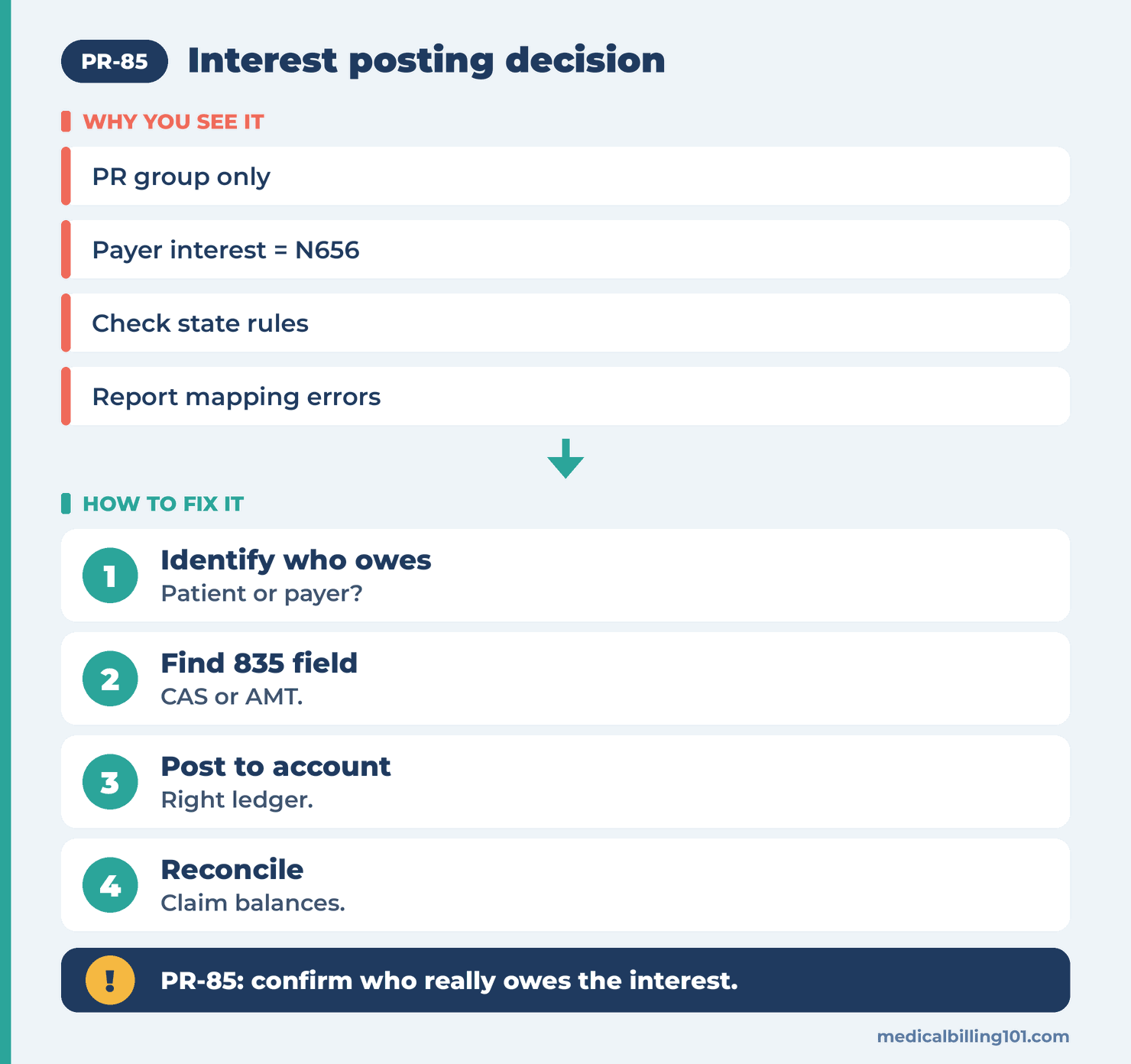
- Identify who owes it. Read the remit. If N656 or a claim interest amount is present, this is likely payer interest, not patient interest.
- Find the 835 field. Patient interest sits in a CAS segment with PR and 85. Payer interest sits in the claim-level interest amount or a provider-level adjustment.
- Check your rules. Some states limit interest on medical debt. Your financial policy must also allow it.
- Post to the right account. Patient interest goes to the patient balance. Payer interest goes to interest income.
- Reconcile. Make sure the claim balances: charges minus adjustments equal payment.
- Report mapping errors to the payer if CARC 85 carries payer interest or shows a group other than PR.
Worked example (illustrative)
A clinic gets an 835 where a claim was paid 50 days after a clean submission. The remit shows a claim-level interest amount of 4.12, remark N656, and a line with CAS*PR*85*4.12. The poster stops before billing the patient. The remark and the claim interest amount show this is payer interest, so the PR-85 line is a mapping error. She posts the 4.12 as interest income, reverses the patient amount, and emails the payer’s EDI team with the claim number.
Consider a true PR-85 case. A member on a payer-run installment plan misses two payments, and the plan’s terms add interest. The remit shows PR-85 for that amount. The clinic confirms its state allows it and that the member agreed, then posts it to the patient account.
Prevention checklist
- [ ] Map CARC 85 to patient balance only when the group is PR.
- [ ] Map claim-level interest amounts and N656 to interest income.
- [ ] Block patient statements for interest lines until reviewed.
- [ ] Check state rules on interest for medical debt each year.
- [ ] Keep your patient financial policy clear on whether you charge interest.
Related codes
- PR-1, PR-2, PR-3: deductible, coinsurance and copay.
- CO-44: prompt-pay discount.
- CO-45: charge exceeds fee schedule or contracted amount.
- OA-23: impact of prior payer adjudication.
- Full CARC and RARC list for code lookups.
- Denial codes hub for every code we cover.
Key takeaways
PR-85 is interest the patient owes, and X12 allows it only with the PR group. Payer late-payment interest is different and sits elsewhere on the 835, often with N656. Check who really owes the amount, follow state rules and your own policy, and report mapping errors to the payer.
FAQ
What does PR-85 mean?
It means the payer reported interest that the patient is responsible for paying.
Can CARC 85 be used with CO or OA?
No. X12 says to use reason code 85 only with group PR.
Is PR-85 the same as prompt-pay interest?
No. Prompt-pay interest is owed by the payer and is reported as a claim interest amount, often with remark N656.
Where is payer interest on the 835?
In the claim-level interest amount (AMT with qualifier I), and sometimes in a provider-level adjustment.
Can I bill the patient for PR-85?
Only if it’s truly patient interest and your state and financial policy allow interest charges.
What should I do if PR-85 looks like payer interest?
Post it as interest income, don’t bill the patient, and report the mapping error to the payer.
Sources
How we checked: every code quote on this page was compared word for word with the X12 CARC and RARC lists on 20 October 2026.
- X12, Claim Adjustment Reason Codes (CARC 85). Accessed 20 Oct 2026.
- X12, Remittance Advice Remark Codes (N656). Accessed 20 Oct 2026.
- CMS, Medicare Claims Processing Manual, Ch. 22, Remittance Advice. Accessed 20 Oct 2026.
Last updated: 20 October 2026 · This page is educational and doesn’t replace payer contracts or coding rules.