
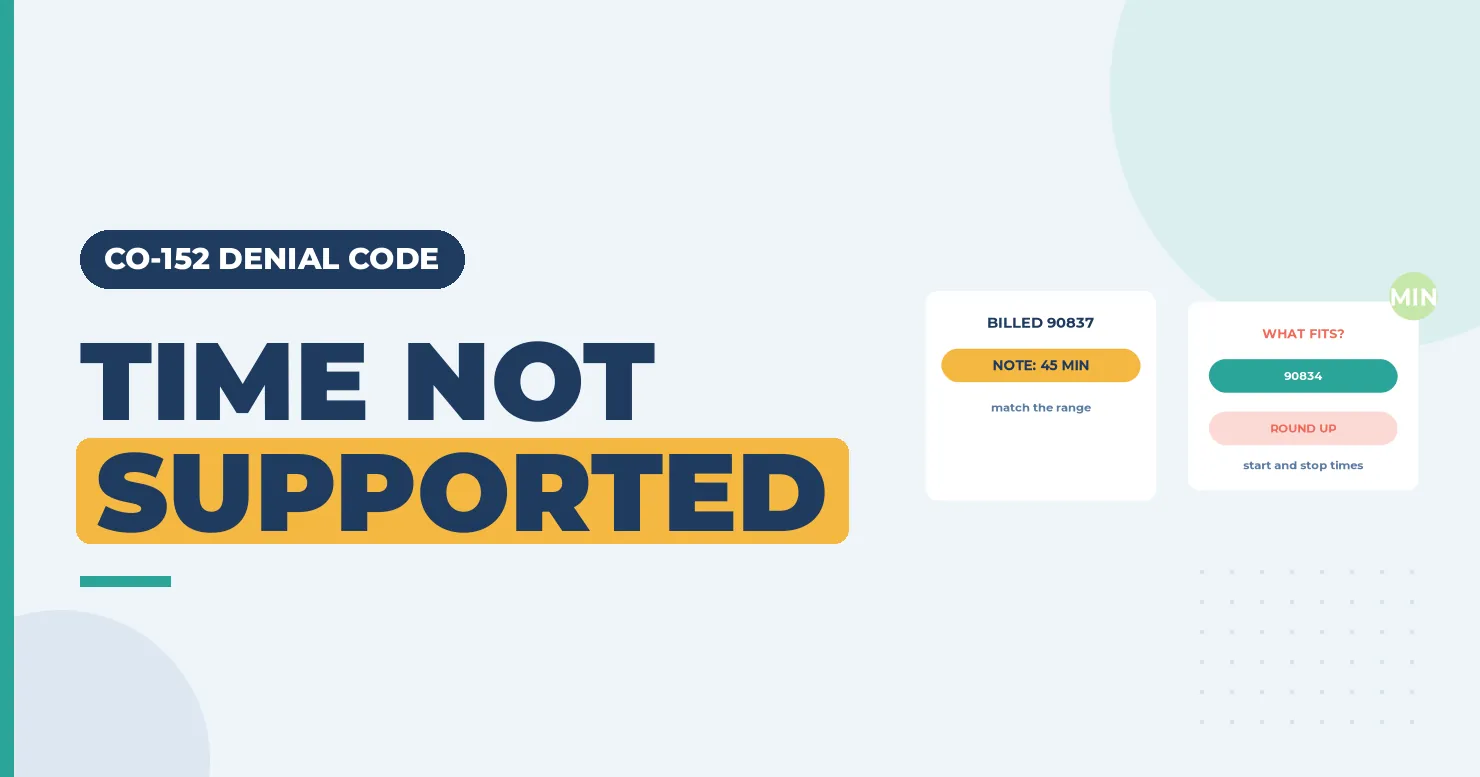
CO-152 is about time. The payer looked at how long the service lasted, in minutes, hours or days, and decided the records don’t back it up. That covers time-based codes like psychotherapy, timed therapy units and critical care, and it also covers inpatient or facility days beyond what the payer approved. The CO group means the patient doesn’t owe the cut amount. The answer depends on the note: correct the code or units when the time really was shorter, or appeal with the start and stop times when it wasn’t. (Primary source: X12 Claim Adjustment Reason Codes)
In brief: CARC 152 reads “Payer deems the information submitted does not support this length of service.” Find the documented time, compare it with the code’s time range, and either send a corrected claim or appeal with proof of the time.
From our denial codes library. Written by Manikandan J, CPC, CRCR, who has audited time-based coding for behavioral health and therapy practices. Published 21 October 2026. Last updated: 21 October 2026. Code wording quoted word for word from X12.
X12 entry for reason code 152
| Field | X12 text |
|---|---|
| Code | 152 |
| Description | “Payer deems the information submitted does not support this length of service.” |
| Usage | Refer to the 835 Healthcare Policy Identification Segment (loop 2110 Service Payment Information REF), if present. |
| Start | 10/31/2002 |
| Last modified | 07/01/2017 |
Source: X12 Claim Adjustment Reason Codes, checked 21 October 2026. The usage note matters: the payer may name the policy it used in the REF segment of the same service line.
Where length of service shows up
A time-based code is a CPT code chosen by how many minutes the service lasted. A timed unit is one billing unit for a set block of minutes, such as 15 minutes of therapeutic exercise. A length of stay is the number of days a patient spends in a hospital or other facility.
| Type of service | Example codes | What the payer checks |
|---|---|---|
| Psychotherapy | 90832, 90834, 90837 | Minutes of therapy in the note |
| Timed therapy | 97110, 97530 | Total timed minutes and units |
| Critical care | 99291, 99292 | Minutes of critical care, not counting separate procedures |
| Inpatient stays | Room and board revenue codes | Days approved by utilization review |
For Medicare therapy units, the rules on counting minutes sit in Chapter 5 of the Medicare Claims Processing Manual.
Example scenario (fictional names), part 1
CO-152 Denial Example: What Happened
Danielle Brooks bills for Quiet Harbor Counseling. A licensed counselor saw a patient for major depressive disorder, single episode, moderate (F32.1), and billed 90837, the 60-minute psychotherapy code.
The remit from Evergreen State Health, a fictional commercial plan, denied the line with CAS*CO*152 and remark LQ*HE*N657, “This should be billed with the appropriate code for these services.” The plan had pulled the note in a records review.
What did the note say about time, and which code fit it? Keep reading, or jump to how the CO-152 denial was resolved.
Remark codes that pair with CARC 152
| RARC | X12 wording |
|---|---|
| N657 | “This should be billed with the appropriate code for these services.” |
| M53 | “Missing/incomplete/invalid days or units of service.” |
| N362 | “The number of Days or Units of Service exceeds our acceptable maximum.” |
See the X12 RARC page for more.
How to fix a CO-152 denial
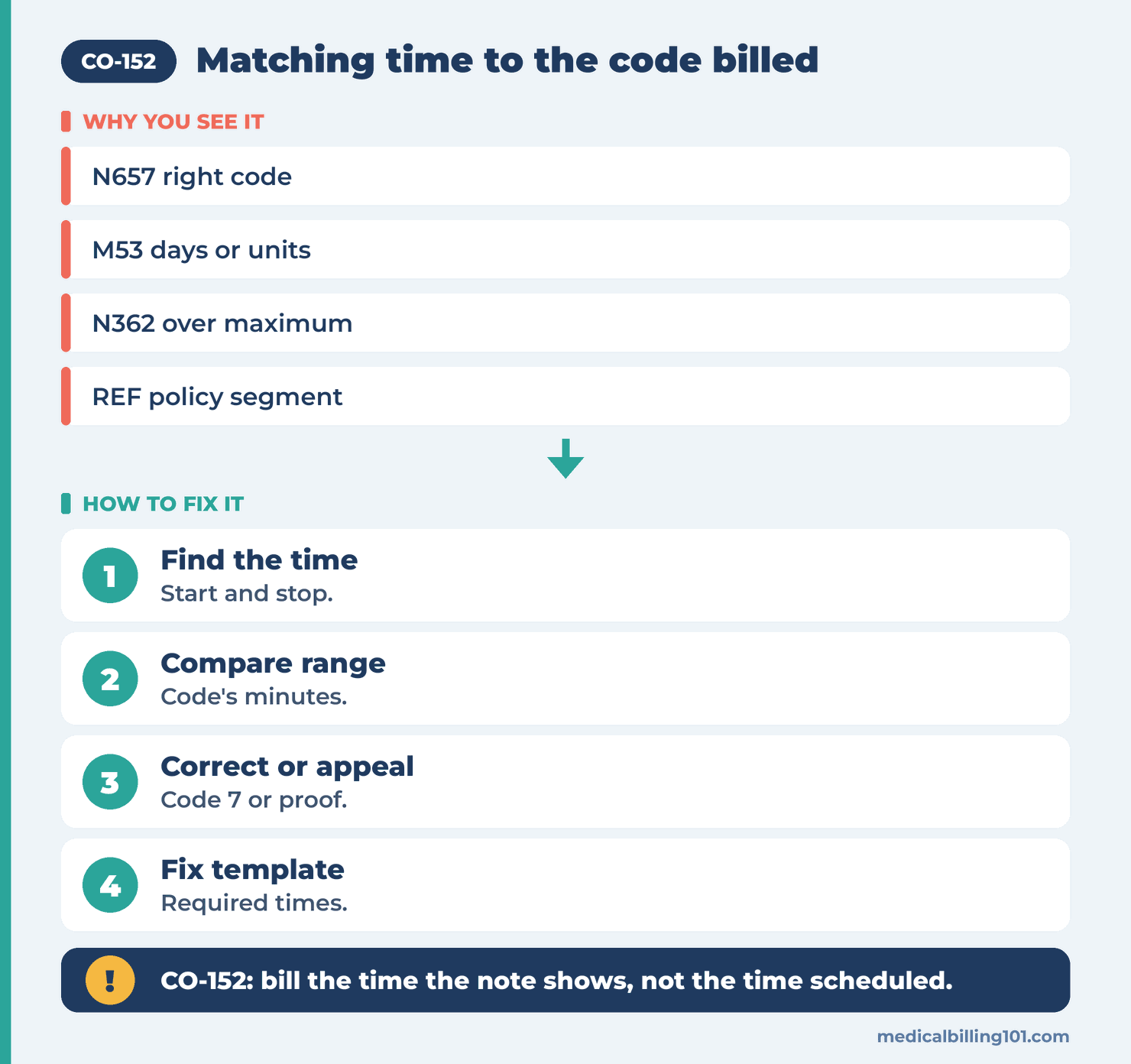
- Find the documented time. Look for start and stop times or a total, written by the clinician.
- Compare it with the code’s range. For example, CPT treats 90837 as 53 minutes or more, and 90834 as 38 to 52 minutes.
- Check the payer’s policy. Read the REF segment on the line for the policy number, if present.
- Correct the claim when the time was shorter. Send a corrected claim with frequency code 7 and the right code or units.
- Appeal when the time was there. Point to the exact time entries in the note.
- For inpatient days, check the authorization. Days beyond the approved stay may need a concurrent review appeal.
- Fix the template. Make start and stop times a required field.
Example scenario (fictional names), part 2
How the CO-152 Denial Was Resolved
Danielle read the note. It recorded a session from 2:00 to 2:45 PM, which is 45 minutes. That falls in the 90834 range, not 90837.
Fix: she sent a corrected claim with frequency code 7, billing 90834 for the same date and diagnosis.
Outcome: the plan paid 90834. Danielle added a required start and stop time to the note template and set the billing system to suggest a code from those times.
Names and details are illustrative; no real patient data.
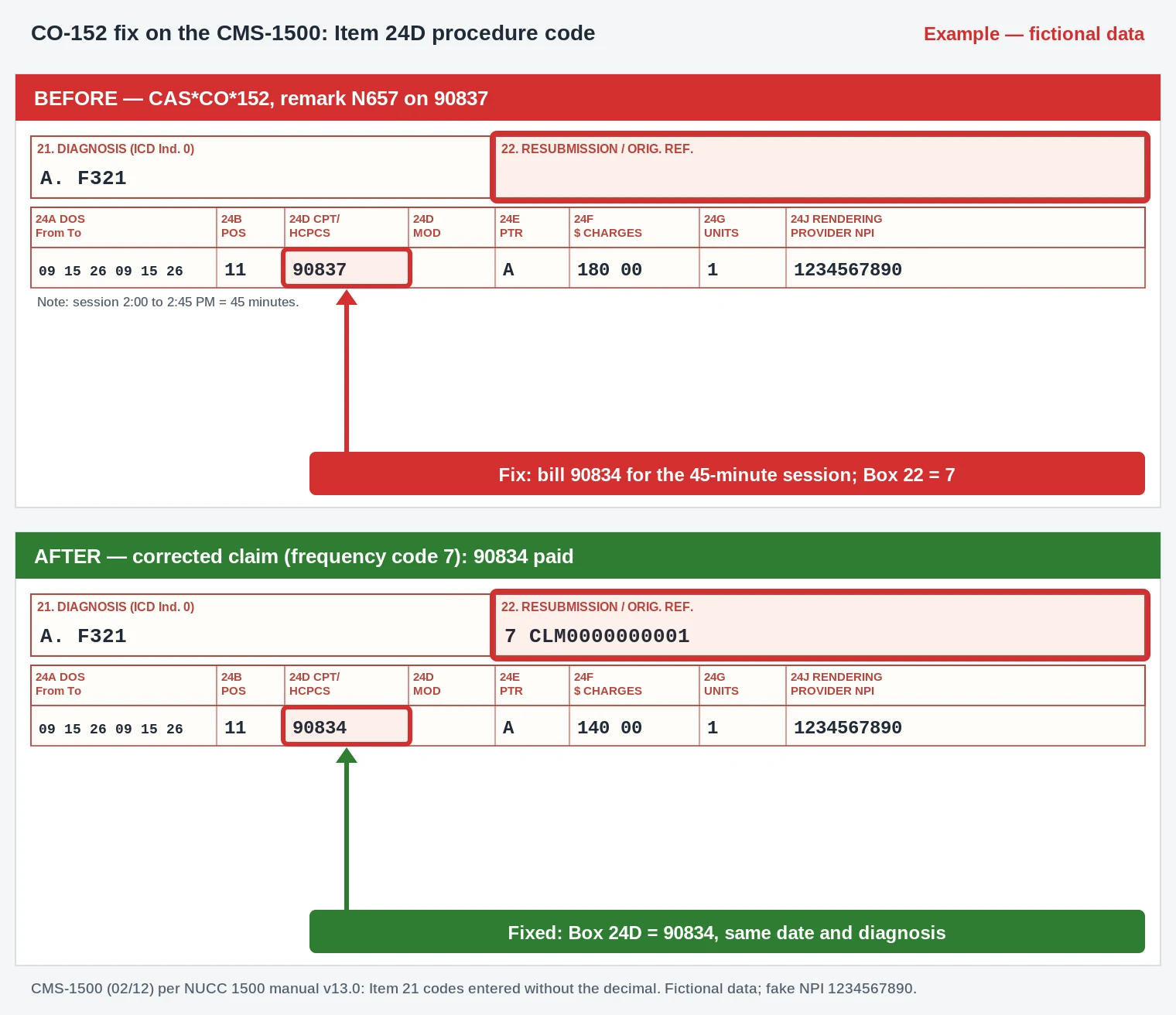
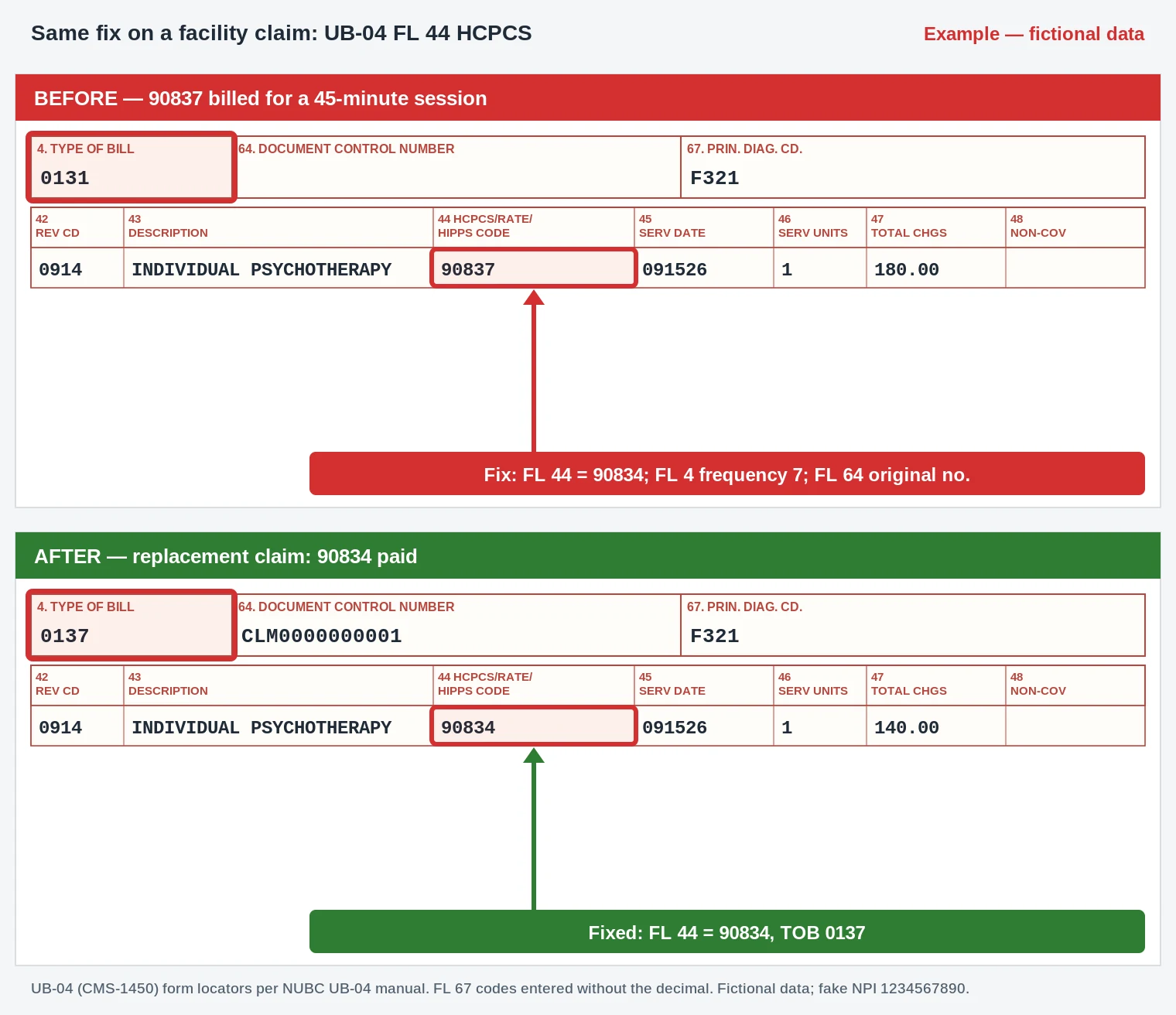
- Box 24D / FL 44: 90837 (60 minutes) changed to 90834, which fits the 45-minute session in the note.
- Box 22 / FL 4 + FL 64: frequency code 7 with the original claim number (type of bill 0137).
- Box 21A / FL 67: F32.1, entered as F321, and the date of service are unchanged.
Worked example (illustrative)
Consider a hospital patient approved for a five-day stay after surgery who stays seven days because of a wound infection. The plan pays five days and adjusts the last two with CO-152. The hospital sends the progress notes and infection treatment records for a review of the extra days. The plan’s reviewer approves the added days, and the claim is reprocessed.
Mistakes that lead to CO-152
- Rounding up time. Bill the code that fits the documented minutes, not the scheduled slot.
- Counting the wrong minutes. Paperwork after the session or time spent on separate procedures may not count.
- Missing start and stop times. Many payers want them, not just a total.
- Staying past approved days without review. Ask for more days before the stay runs over.
Related codes
- CO-150: information doesn’t support this level of service.
- CO-151: information doesn’t support this many or this frequency of services.
- CO-50: not deemed a medical necessity by the payer.
Recap
CO-152 means the payer thinks the time or days billed aren’t supported. Read the note’s time, match it to the code’s range, and send a corrected claim when it was shorter. Appeal with the exact time entries when it wasn’t. For facility days, work it through the authorization and review process.
FAQ
What does denial code CO-152 mean?
The payer says the records don’t support how long the service lasted. It reads “Payer deems the information submitted does not support this length of service.”
Can I bill the patient for CO-152?
No. It’s a CO adjustment, so the cut amount isn’t the patient’s to pay.
How is CARC 152 different from CARC 150?
CARC 150 is about the level of a service. CARC 152 is about its length, in time or days.
Which codes get CO-152 most often?
Time-based codes such as psychotherapy and timed therapy units, and inpatient days.
Do I need start and stop times?
Many payers want them. A total time alone may not be enough.
How do I appeal reason code 152?
Point to the exact time entries in the note, attach it, and cite the code’s time range.
Sources
How we checked: each code quote on this page was matched word for word with the X12 CARC and RARC lists on 21 October 2026.
- X12, Claim Adjustment Reason Codes (CARC 152, 50, 150, 151). Accessed 21 Oct 2026.
- X12, Remittance Advice Remark Codes (N657, M53, N362). Accessed 21 Oct 2026.
- CMS, Medicare Claims Processing Manual, Chapter 5. Accessed 21 Oct 2026.
Last updated: 21 October 2026 · Educational content; not legal advice.