
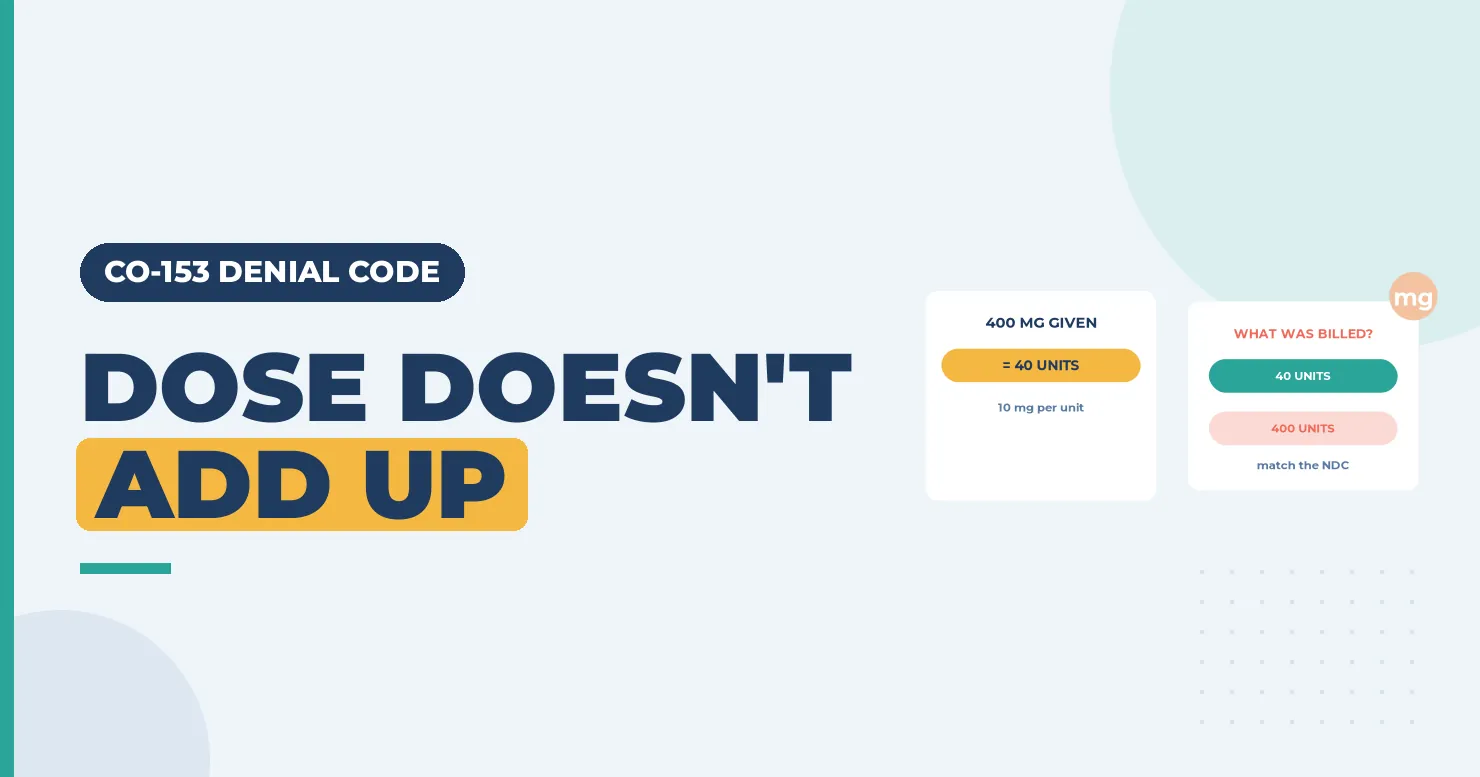
CO-153 is a drug dose problem. The payer compared the amount of drug on your claim with the order, the administration record or its own dosing policy and found they don’t line up. Most of the time, nothing was wrong with the care. The units were miscounted. A HCPCS code that is billed per 10 mg was sent in milligrams, or the NDC quantity didn’t match the HCPCS units. Sometimes the dose really is above the payer’s policy, and then you need records that justify it. The CO group means the patient doesn’t owe the cut amount. (Primary source: X12 Claim Adjustment Reason Codes)
In brief: CARC 153 reads “Payer deems the information submitted does not support this dosage.” Convert the dose given into the HCPCS unit size, check the NDC quantity, and send a corrected claim. If the dose was right but high, appeal with the order and the clinical reason.
Part of our denial codes library. Written by Manikandan J, CPC, CRCR, who has worked drug billing and infusion claims for oncology and rheumatology practices. Published 21 October 2026. Last updated: 21 October 2026. Code wording quoted word for word from X12.
The X12 wording for reason code 153
| Field | X12 text |
|---|---|
| Code | 153 |
| Description | “Payer deems the information submitted does not support this dosage.” |
| Start | 10/31/2002 |
| Last modified | 09/30/2007 |
Source: X12 Claim Adjustment Reason Codes, checked 21 October 2026.
HCPCS units vs milligrams
A HCPCS unit is the amount of drug named in the code’s description, such as 10 mg or 1 mg. The billing unit count is the dose given divided by that amount. The NDC quantity is a separate count of the product, such as mL or each, reported with the National Drug Code.
| Drug code | Code describes | Dose given | Units to bill |
|---|---|---|---|
| J1745 (infliximab) | 10 mg | 400 mg | 40 |
| J9035 (bevacizumab) | 10 mg | 500 mg | 50 |
| J0897 (denosumab) | 1 mg | 60 mg | 60 |
Medicare’s ASP pricing files list each drug code with its billing unit. The FDA’s NDC directory confirms the product and package.
Example scenario (fictional names), part 1
CO-153 Denial Example: What Happened
Erin Castillo bills for Lakeside Digestive Health, which runs an infusion suite. A patient with Crohn’s disease (K50.90) got a 400 mg infusion of infliximab. The claim listed 96413 for the infusion and J1745 for the drug.
The remit from Northern Pines Health, a fictional commercial plan, denied J1745 with CAS*CO*153 and remark LQ*HE*N362, “The number of Days or Units of Service exceeds our acceptable maximum.” The infusion line paid.
Was the dose too high, or was something else off? Keep reading, or jump to how the CO-153 denial was resolved.
Remark codes that pair with CARC 153
| RARC | X12 wording |
|---|---|
| N362 | “The number of Days or Units of Service exceeds our acceptable maximum.” |
| M123 | “Missing/incomplete/invalid name, strength, or dosage of the drug furnished.” |
| N815 | “Missing/Incomplete/Invalid NDC Unit Count” |
See the X12 RARC page for others.
How to fix a CO-153 denial
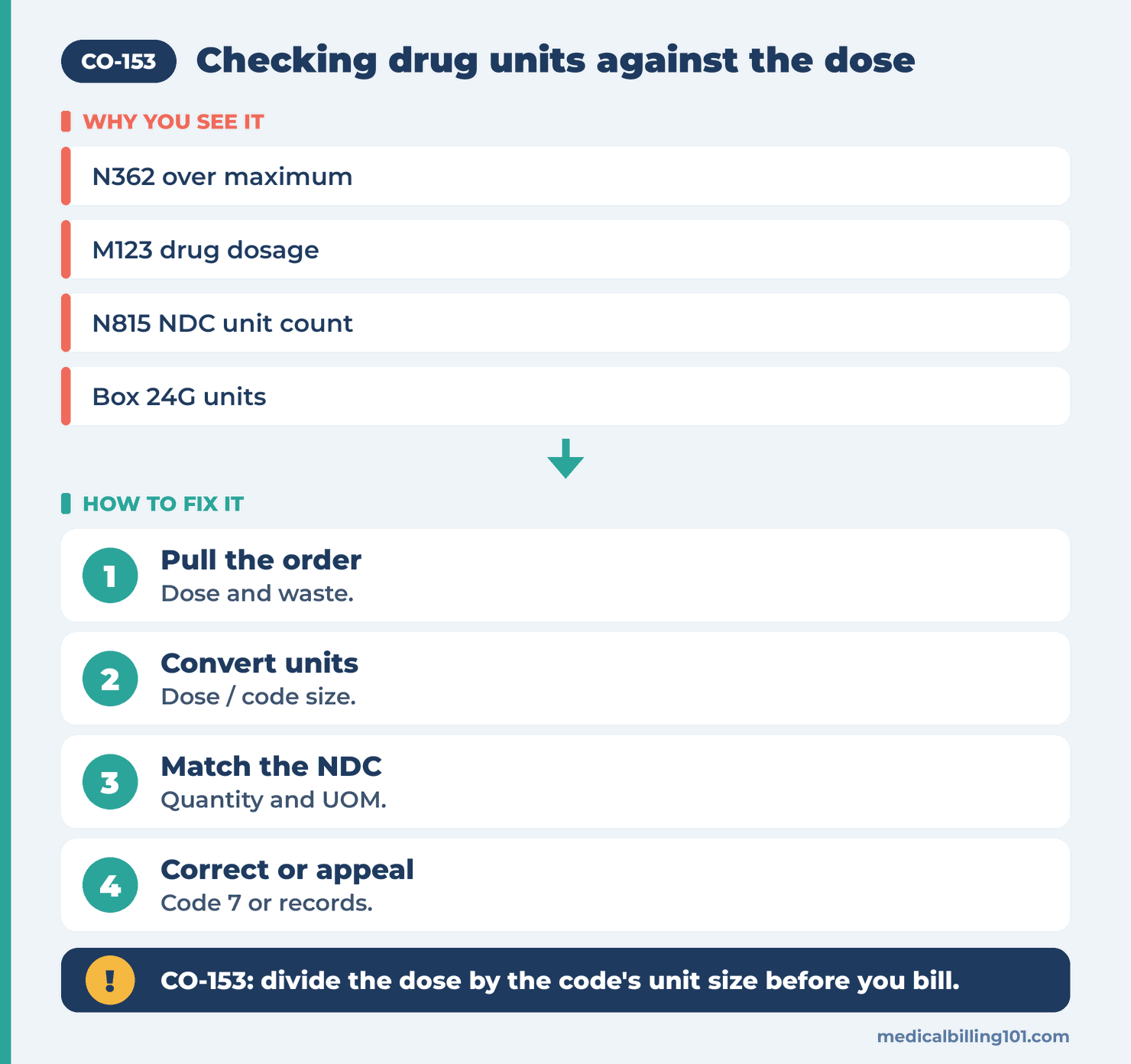
- Pull the order and the administration record. Note the dose actually given, and any waste.
- Convert to HCPCS units. Divide the dose by the amount in the code description.
- Check the NDC quantity and unit of measure. For example, a 100 mg vial reported in mL needs the mL count, not the vial count.
- Compare with the payer’s dosing policy. Many plans set a maximum per dose or per period, often by weight.
- Send a corrected claim when the units were wrong. Use frequency code 7 with the fixed units and NDC quantity.
- Appeal when the dose was right. Attach the order, weight, labs and the clinical reason for the dose.
- Build a unit check. Have the billing system convert milligrams into units from a drug table.
Example scenario (fictional names), part 2
How the CO-153 Denial Was Resolved
Erin checked the claim. It showed 400 units of J1745. The code covers 10 mg per unit, so a 400 mg dose is 40 units. The system had copied the milligram dose straight into the unit field.
Fix: she sent a corrected claim, frequency code 7, with J1745 at 40 units and the NDC quantity matching the vials used.
Outcome: the plan paid the drug line. Lakeside added a drug table to its billing system that turns the charted dose into units automatically.
Names and details are illustrative; no real patient data.
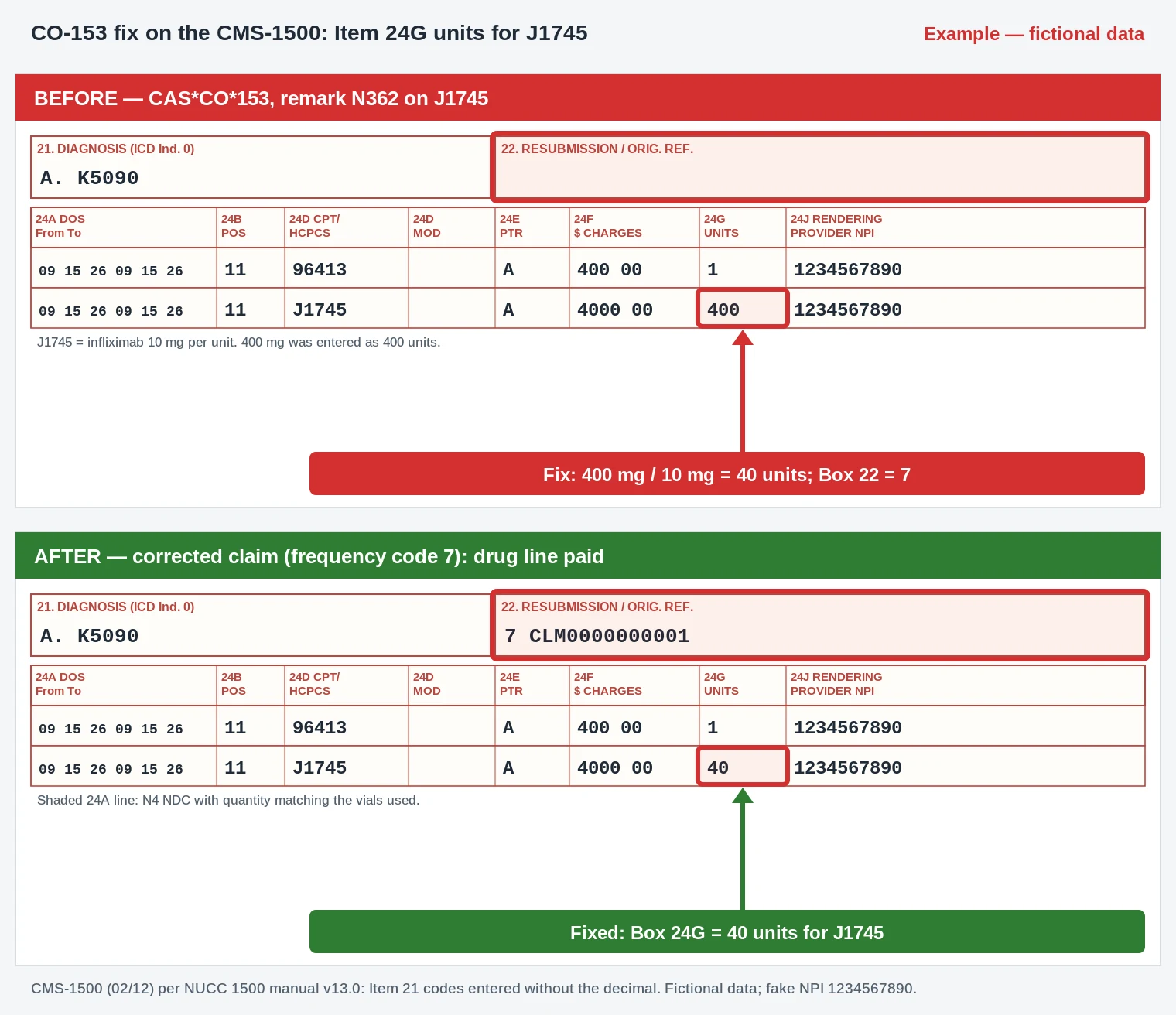
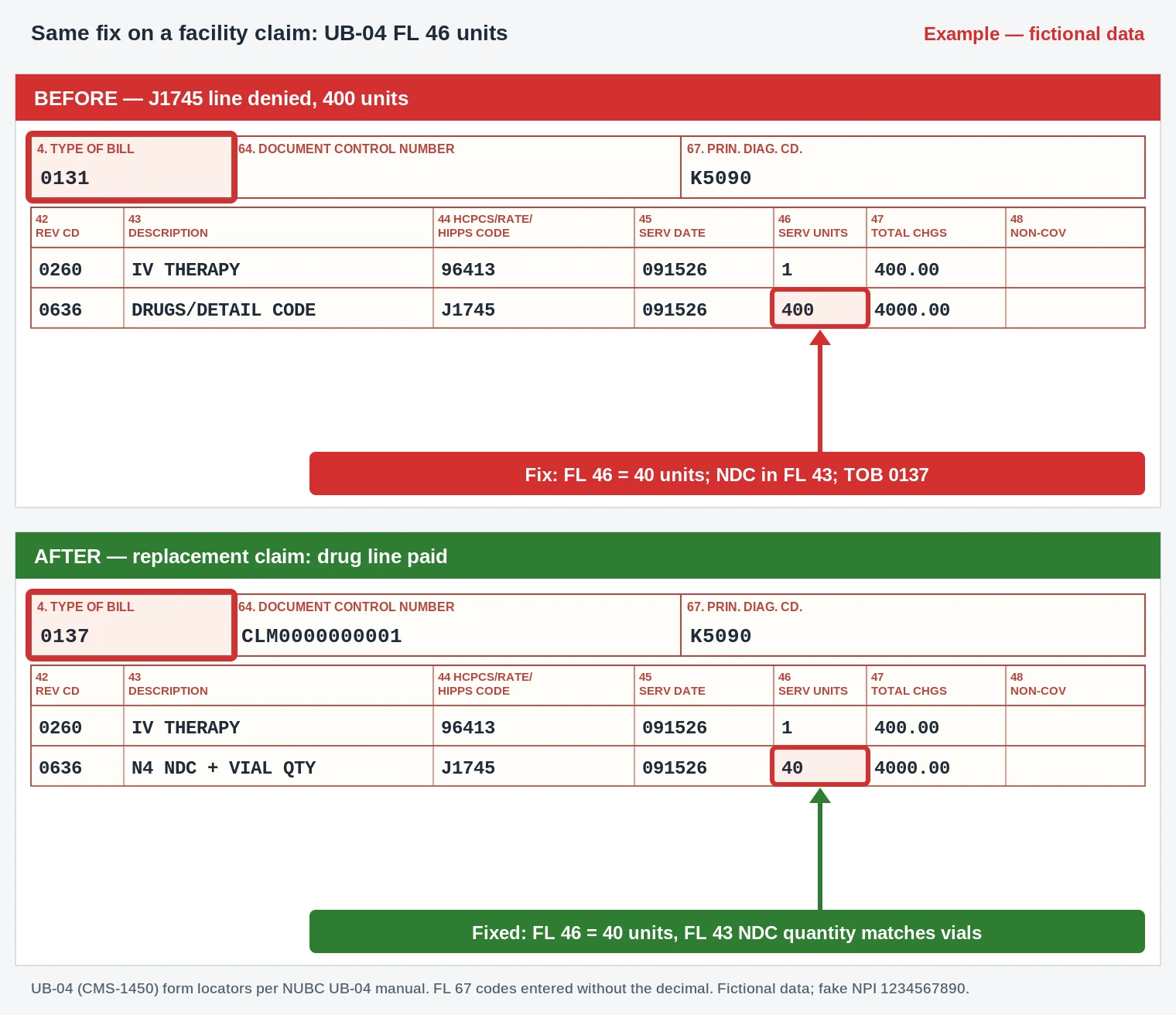
- Box 24G / FL 46: J1745 units changed from 400 to 40 (10 mg per unit, 400 mg dose).
- Shaded Box 24A / FL 43: N4 NDC with a quantity that matches the vials used.
- Box 22 / FL 4 + FL 64: frequency code 7 with the original claim number (type of bill 0137).
- Box 24D: 96413 and K50.90 (entered as K5090) are unchanged.
Worked example (illustrative)
Consider a rheumatology practice that gives a weight-based biologic at a higher dose than the plan’s policy allows, because the patient didn’t respond to the usual dose. The units on the claim are right, but the plan denies with CO-153. The practice appeals with the treatment history, labs and the specialist’s note on why the higher dose was needed. The plan approves it on review and sets an authorization for later doses.
Mistakes that trigger CARC 153
- Billing milligrams as units. The most common cause, and the easiest fix.
- Forgetting drug waste rules. Some payers want waste on its own line with modifier JW, others don’t.
- NDC and HCPCS that don’t match. The NDC must be the product the code describes.
- Skipping the authorization dose. A higher dose may need its own approval.
Related codes
- CO-152: information doesn’t support this length of service.
- CO-151: information doesn’t support this many or this frequency of services.
- CO-16: claim lacks information needed for adjudication.
- CO-197: precertification or authorization absent.
Key takeaways
CO-153 means the payer thinks the dose on the claim isn’t supported. Most are unit math errors: convert the dose into the code’s unit size, match the NDC quantity, and send a corrected claim. When the dose was right but high, appeal with the order and the clinical reason.
FAQ
What does denial code CO-153 mean?
The payer says the records don’t support the drug dose billed. It reads “Payer deems the information submitted does not support this dosage.”
Can I bill the patient for CO-153?
No. It’s a CO adjustment. Fix the claim or appeal.
How do I calculate HCPCS drug units?
Divide the dose given by the amount in the code’s description. For example, 400 mg of a 10 mg code is 40 units.
What does N362 mean with CARC 153?
The units billed went over the plan’s maximum. Check the unit math first.
Do I need to report the NDC?
Many payers require it for drugs. The NDC quantity and unit of measure must match what you gave.
How do I appeal a high but correct dose?
Send the order, the patient’s weight and labs, and the clinician’s reason for the dose.
Sources
How we checked: each code quote on this page was matched word for word with the X12 CARC and RARC lists on 21 October 2026.
- X12, Claim Adjustment Reason Codes (CARC 153, 16, 151, 152, 197). Accessed 21 Oct 2026.
- X12, Remittance Advice Remark Codes (N362, M123, N815). Accessed 21 Oct 2026.
- CMS, ASP pricing files. Accessed 21 Oct 2026.
- FDA, National Drug Code directory. Accessed 21 Oct 2026.
Last updated: 21 October 2026 · Educational content; not legal advice.