
CO-155 means the payer believes the patient declined the service you billed. Usually that comes from the records: the note says the patient declined or refused, yet the claim still has a charge for that service. Templates, order sets and charge capture tools are the usual culprits, because they drop charges for planned care whether or not it happened. Sometimes the payer is wrong, and the patient refused only part of the visit. The CO group means you can’t bill the patient for a service they refused. (Primary source: X12 Claim Adjustment Reason Codes)
In brief: CARC 155 reads “Patient refused the service/procedure.” Check the note. If the service didn’t happen, remove the line with a corrected claim and refund any payment. If it did happen, appeal with the note showing it was done.
Part of our denial codes library. Written by Manikandan J, CPC, CRCR, who has run charge capture audits for therapy and outpatient practices. Published 21 October 2026. Last updated: 21 October 2026. Code wording quoted word for word from X12.
Reason code 155 in the X12 list
| Field | X12 text |
|---|---|
| Code | 155 |
| Description | “Patient refused the service/procedure.” |
| Start | 06/30/2003 |
| Last modified | 09/30/2007 |
Source: X12 Claim Adjustment Reason Codes, checked 21 October 2026.
Why refused services end up on claims
Charge capture is how a practice turns what happened in a visit into billable codes. An order set is a group of tests or treatments a clinician picks together, such as a full therapy plan for the day. Informed refusal is the patient’s choice to decline care after being told the risks, written in the record.
| Source of the charge | How a refused service slips through |
|---|---|
| Visit or therapy template | Planned items pre-filled as done |
| Order set | Each order drops a charge when signed |
| Superbill | Staff mark the plan, not what happened |
| Pre-visit charge | Charges entered before the patient was seen |
The basic rule is to bill only for services actually provided and documented. OIG’s compliance education for physicians explains the federal fraud and abuse laws behind it. A refused service that was billed and paid is an overpayment.
Example scenario (fictional names), part 1
CO-155 Denial Example: What Happened
Jordan Pike is the billing manager at Lakeview Physical Therapy. A patient was in therapy after a right knee replacement (Z47.1 with Z96.651). The day’s claim listed 97110 for therapeutic exercise, 97116 for gait training and 97140 for manual therapy, two units each.
During a records review, Sunfield Health Plan, a fictional commercial plan, denied 97116 with CAS*CO*155 and remark LQ*HE*N10, “Adjustment based on the findings of a review organization/professional consult/manual adjudication/medical advisor/dental advisor/peer review.” The other two lines paid.
Did the patient really refuse gait training, and what should Jordan do about it? Keep reading, or jump to how the CO-155 denial was resolved.
Remark codes you may see with CARC 155
| RARC | X12 wording |
|---|---|
| N10 | “Adjustment based on the findings of a review organization/professional consult/manual adjudication/medical advisor/dental advisor/peer review.” |
| M111 | “We do not pay for chiropractic manipulative treatment when the patient refuses to have an x-ray taken.” |
| N657 | “This should be billed with the appropriate code for these services.” |
M111 is an older chiropractic remark that some plans still use. See the X12 RARC page for others.
How to handle a CO-155 denial
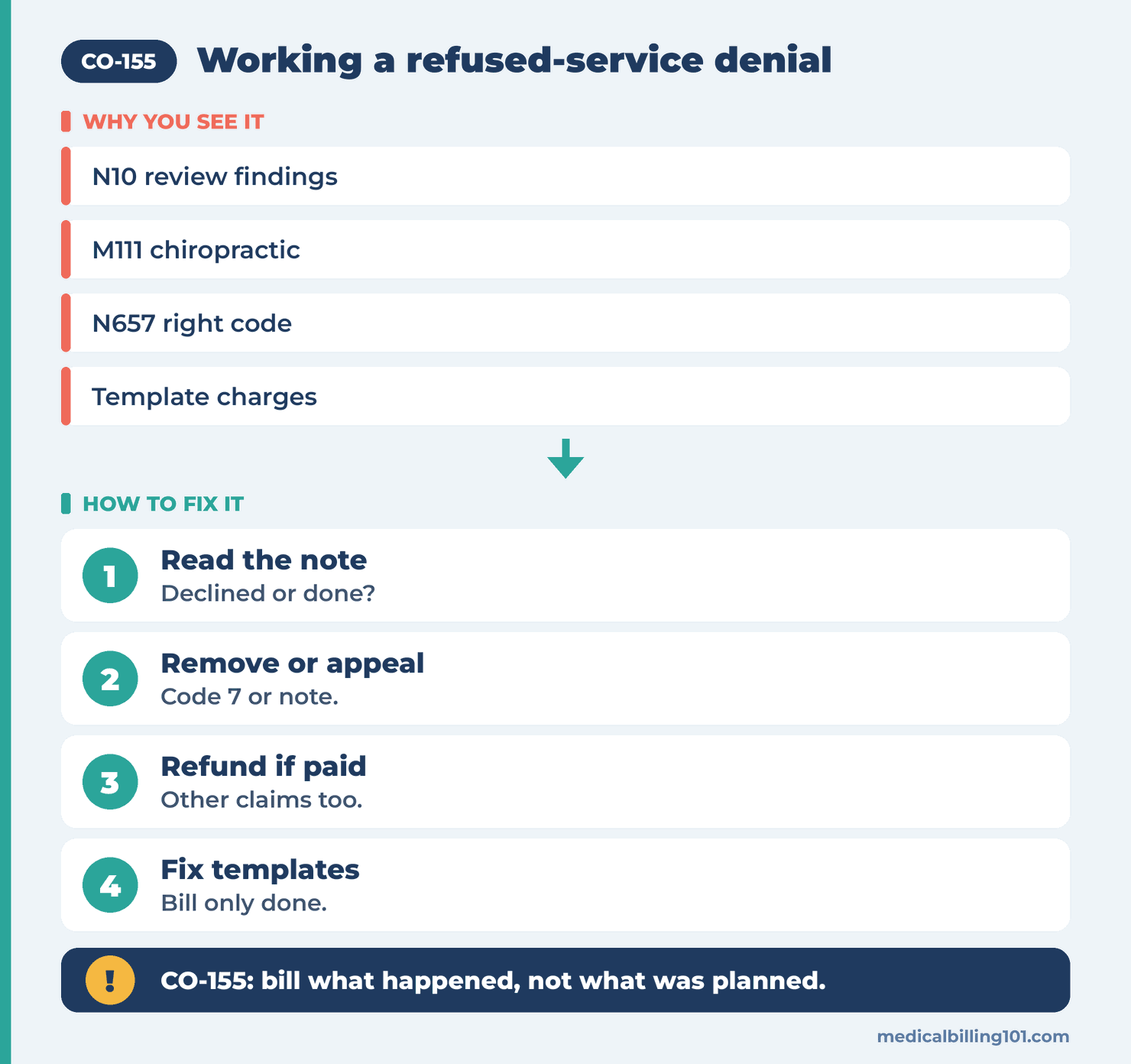
- Read the note for that date. Look for words such as declined, refused or deferred, and for the minutes spent.
- Decide what happened. For example, did the patient refuse the whole service, or only part of it?
- If it didn’t happen, remove the line. Send a corrected claim with frequency code 7 without that service.
- Refund any payment for it. If the payer paid for a refused service on another claim, report and return it.
- If it did happen, appeal. Send the note showing what was done and for how long.
- Check the units. If part of the service was done, bill only the units the note supports.
- Fix the charge source. Change templates so planned items aren’t billed until marked done.
Example scenario (fictional names), part 2
How the CO-155 Denial Was Resolved
Jordan read the therapist’s note. It said the patient declined gait training that day because of pain, and the session spent the time on exercise and manual therapy instead. The therapy template had kept 97116 on the charge list anyway.
Fix: no appeal. Jordan sent a corrected claim, frequency code 7, with 97116 removed. He checked earlier claims from the same template and found two more refused services that had been paid. He refunded those.
Outcome: the plan accepted the corrected claim and the refunds. The template now leaves each service unchecked until the therapist confirms it was done.
Names and details are illustrative; no real patient data.
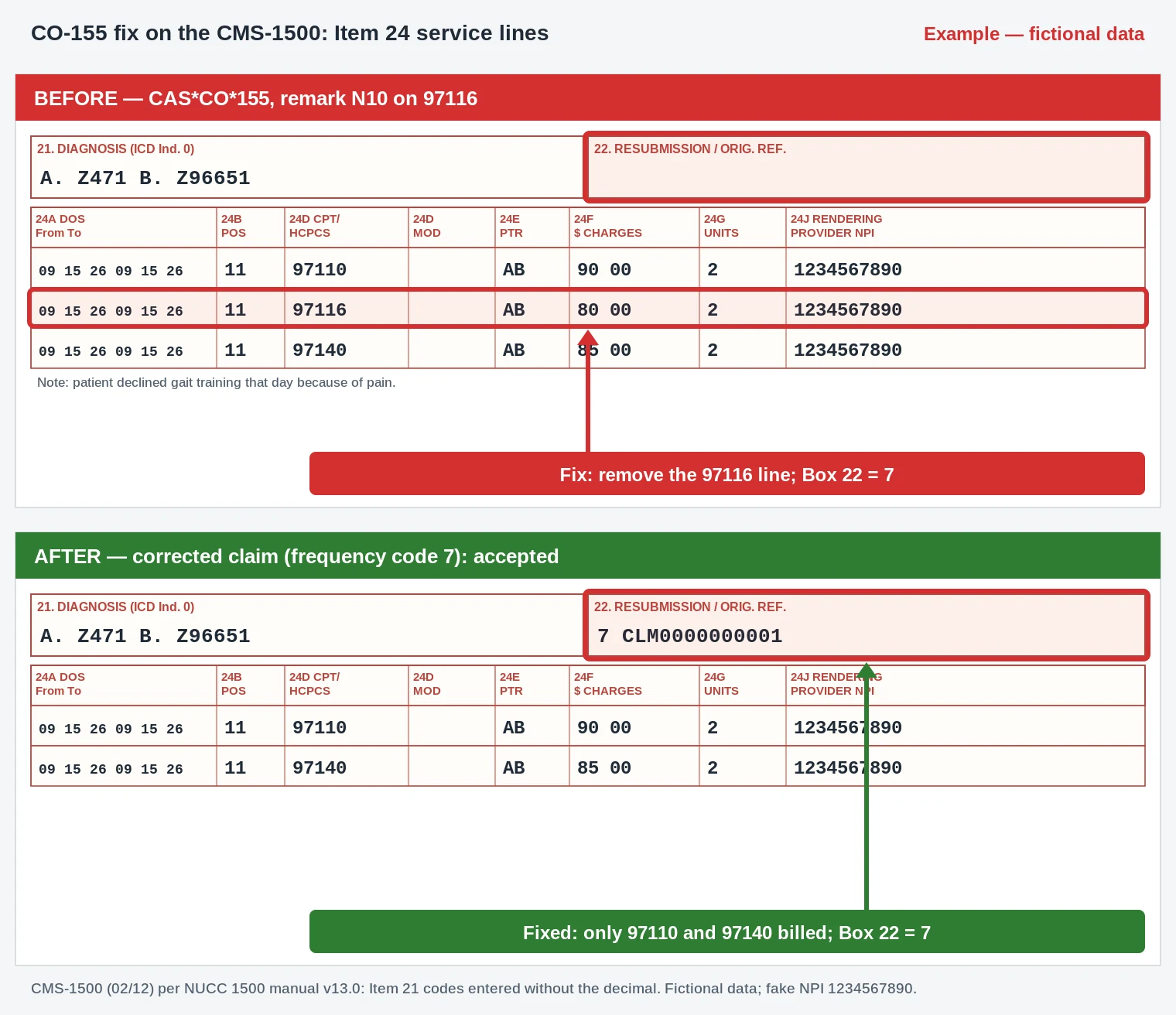
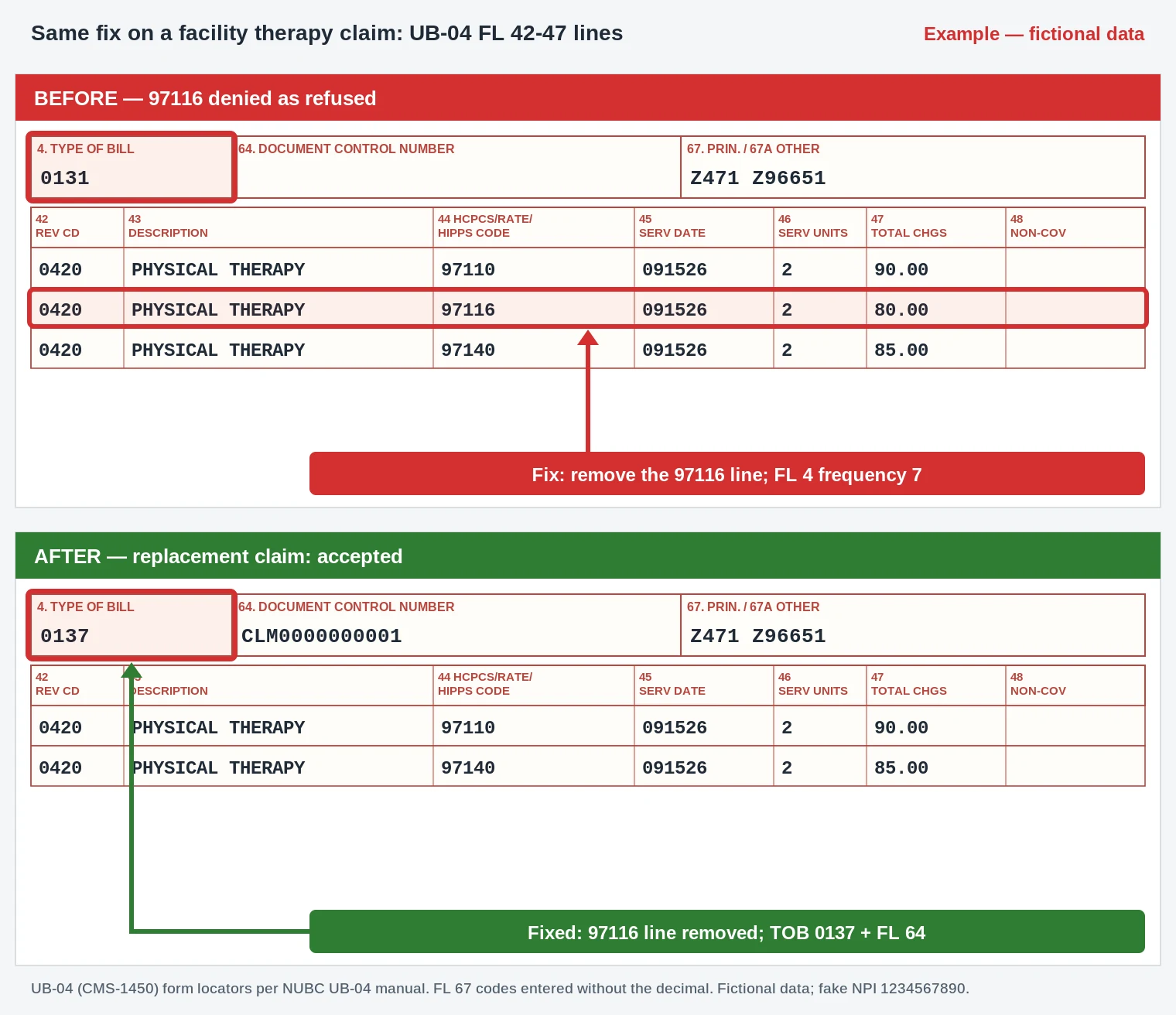
- Box 24 / FL 42-47: the 97116 gait training line removed; the patient declined it that day.
- Box 24D / FL 44: 97110 and 97140, two units each, are unchanged.
- Box 22 / FL 4 + FL 64: frequency code 7 with the original claim number (type of bill 0137).
- Box 21 / FL 67: Z47.1 and Z96.651 (entered as Z471 and Z96651) are unchanged.
Worked example (illustrative)
Consider an urgent care visit where a tetanus shot is ordered for a cut, but the patient declines it after talking with the provider. The order set still sends 90715 and the admin code. The plan denies both with CO-155. The clinic confirms the refusal in the note, removes both lines and updates its order set so vaccines bill only after the administration record is filled in.
When CO-155 is wrong
| Sign | What to do |
|---|---|
| The note shows the service was done | Appeal with the note and times |
| The patient refused a different service | Appeal and point to the right line |
| The refusal was on another date | Send the notes for both dates |
Related codes
- CO-50: not deemed a medical necessity by the payer.
- CO-152: information doesn’t support this length of service.
- CO-16: claim lacks information needed for adjudication.
- CO-18: exact duplicate claim or service.
Recap
CO-155 means the payer thinks the patient refused the service billed. Read the note: if it didn’t happen, remove it with a corrected claim and refund any payment. If it did, appeal with the note. Then fix the template or order set that let a refused service reach the claim.
FAQ
What does denial code CO-155 mean?
The payer believes the patient declined the service billed. It reads “Patient refused the service/procedure.”
Can I bill the patient after a CO-155 denial?
No. The patient didn’t get the service, and the CO group makes it a provider adjustment.
How do I fix reason code 155?
If the service wasn’t done, send a corrected claim without it. If it was done, appeal with the note.
Why do refused services get billed?
Templates, order sets and superbills often charge for planned care before anyone confirms it was done.
Do I need to refund refused services that were paid?
Yes. Payments for services not provided are overpayments and should be returned.
What does M111 mean?
It’s a chiropractic remark about a patient refusing an x-ray. Some plans still use it with CARC 155.
Sources
How we checked: each code quote on this page was matched word for word with the X12 CARC and RARC lists on 21 October 2026.
- X12, Claim Adjustment Reason Codes (CARC 155, 16, 18, 50, 152). Accessed 21 Oct 2026.
- X12, Remittance Advice Remark Codes (N10, M111, N657). Accessed 21 Oct 2026.
- HHS OIG, Compliance education for physicians. Accessed 21 Oct 2026.
Last updated: 21 October 2026 · Educational content; not legal advice.