
CO-175 means there’s an order, and it’s signed by the right person, but it’s missing something the plan needs before it will pay. Common gaps are a quantity, a frequency of use, a length of need, the item description or the prescriber’s signature date. Suppliers of equipment and recurring supplies see it most, because their orders have to describe the item well enough for the plan to check the amount billed. The fix is usually an addendum from the prescriber, then a claim that matches what the complete order says. (Primary source: X12 Claim Adjustment Reason Codes)
In brief: CARC 175 reads “Prescription is incomplete.” Compare the order with the plan’s list of required elements, get the missing parts from the prescriber (signed and dated), and make sure the units and items on the claim match the completed order. Then send a corrected claim or appeal with the complete order.
Part of our denial codes library. Written by Manikandan J, CPC, CRCR, who has built order checklists for respiratory and sleep supply teams. Published 22 October 2026. Last updated: 22 October 2026. Code wording quoted word for word from X12.
Official CARC 175 description
| Field | X12 text |
|---|---|
| Code | 175 |
| Description | “Prescription is incomplete.” |
| Start | 06/30/2005 |
| Last modified | 09/30/2007 |
Source: X12 Claim Adjustment Reason Codes, checked 22 October 2026.
Key terms behind CARC 175
A standard written order is the order a supplier must have before billing. For Medicare it must include specific elements, listed in the Medicare Program Integrity Manual. A quantity is how many units the prescriber ordered. A frequency of use is how often the item is used or replaced. An addendum is a signed and dated note from the prescriber that adds missing details without rewriting the original.
Elements plans often check
| Element | Example | Why it matters |
|---|---|---|
| Patient name | Full legal name | Matches the order to the patient |
| Order date | Date signed | Must be on or before delivery |
| Item description | Full face mask cushion | Must match the code billed |
| Quantity and frequency | 1 per month | Supports the units billed |
| Prescriber name and NPI | Signature and NPI | Shows a valid prescriber |
Common causes of CO-175
- No quantity. For example, an order says replace as needed with no number.
- Vague item description. CPAP supplies doesn’t say which items.
- Missing signature date. The prescriber signed but didn’t date it.
- Units billed don’t match the order. The claim bills more units than the order supports.
Example scenario (fictional names), part 1
CO-175 Denial Example: What Happened
Ava Thompson runs resupply billing at Clearpath Sleep Supply. A patient with obstructive sleep apnea (G47.33) on CPAP got a three-month resupply: one full face mask (A7030) and six cushions (A7031). The order from the sleep clinic said CPAP supplies, replace as needed.
Pinecrest Health, a fictional plan, denied the cushion line with CAS*CO*175 and remark LQ*HE*N456, “Incomplete/invalid Physician Order.” The mask line paid.
Was the problem the order, the claim, or both? Keep reading, or jump to how the CO-175 denial was resolved.
Remark codes often paired with CARC 175
| RARC | X12 wording | What it tells you |
|---|---|---|
| N456 | “Incomplete/invalid Physician Order.” | Something required is missing from the order |
| N57 | “Missing/incomplete/invalid prescribing date.” | The order’s date is missing or invalid |
| N31 | “Missing/incomplete/invalid prescribing provider identifier.” | The prescriber’s ID is missing |
See the X12 RARC list for the full set.
How to fix a CO-175 denial
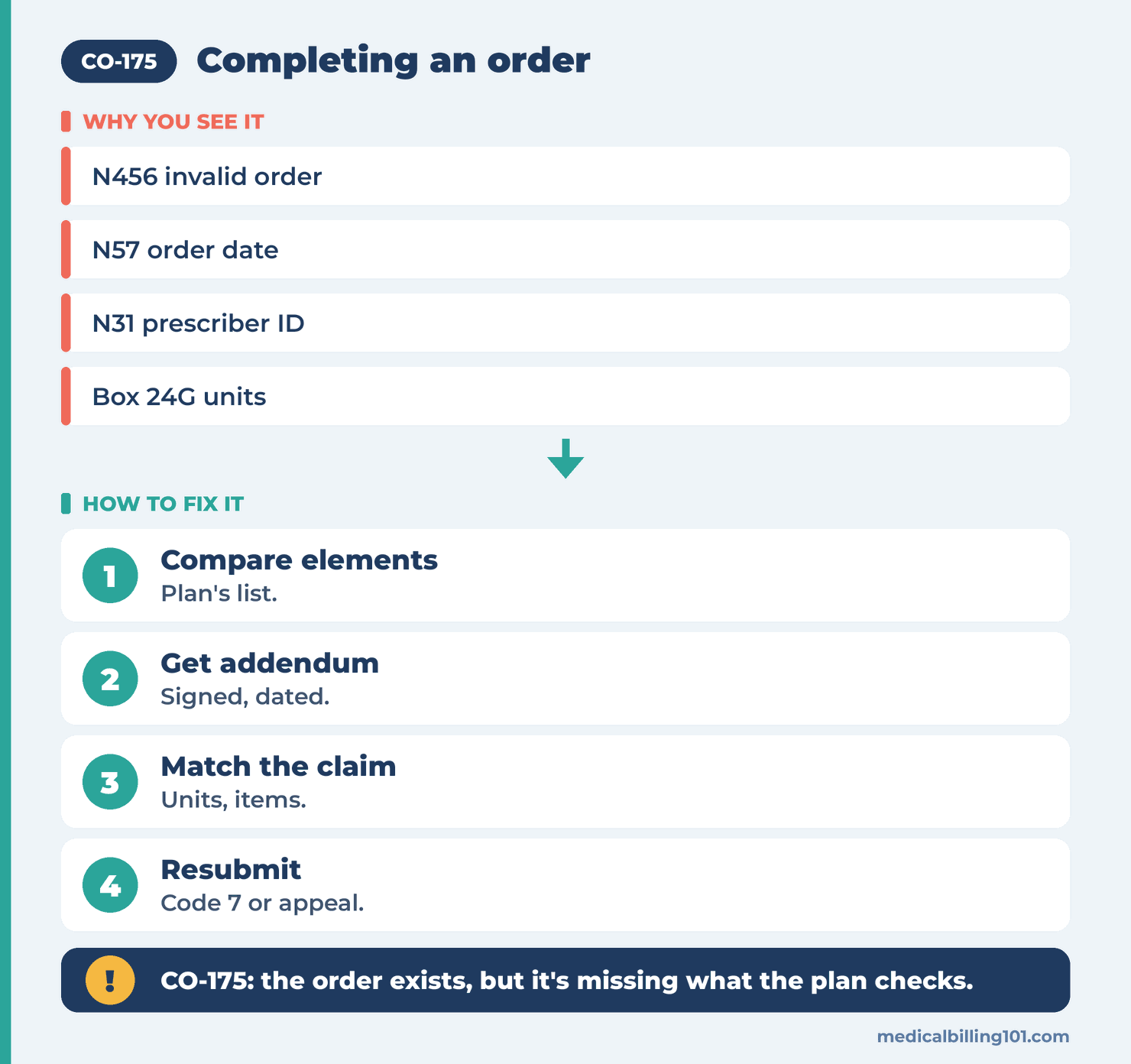
- Compare the order to the plan’s required elements. Use the payer’s policy or the Medicare list if the plan follows it.
- Ask the prescriber for an addendum that adds the missing details. It must be signed and dated.
- Match the claim to the complete order. Units, items and dates must fit what the order now supports.
- Send a corrected claim with frequency code 7 and the original claim number, or appeal with the complete order, as the payer prefers.
- Don’t bill units the order doesn’t support. Write off any excess as a CO amount.
- Fix intake. Reject vague orders before delivery and send the prescriber a checklist.
Example scenario (fictional names), part 2
How the CO-175 Denial Was Resolved
Ava checked Pinecrest’s policy. It allowed one full face mask every three months and one cushion per month, and it required orders to state quantity and frequency. The sleep clinic’s as needed order didn’t. Ava asked the clinic for an addendum, and the physician signed one stating one cushion per month and one mask every three months.
Fix: with the complete order, the three-month supply supported three cushions, not six. Ava sent a corrected claim with Box 22 resubmission code 7, the original claim number and 3 units of A7031 in Box 24G. The addendum went with it.
Outcome: Pinecrest paid the three cushions. Clearpath wrote off the extra units, refunded nothing to the patient because nothing had been collected, and now holds resupply orders until quantity and frequency are filled in.
Names and details are illustrative; no real patient data.
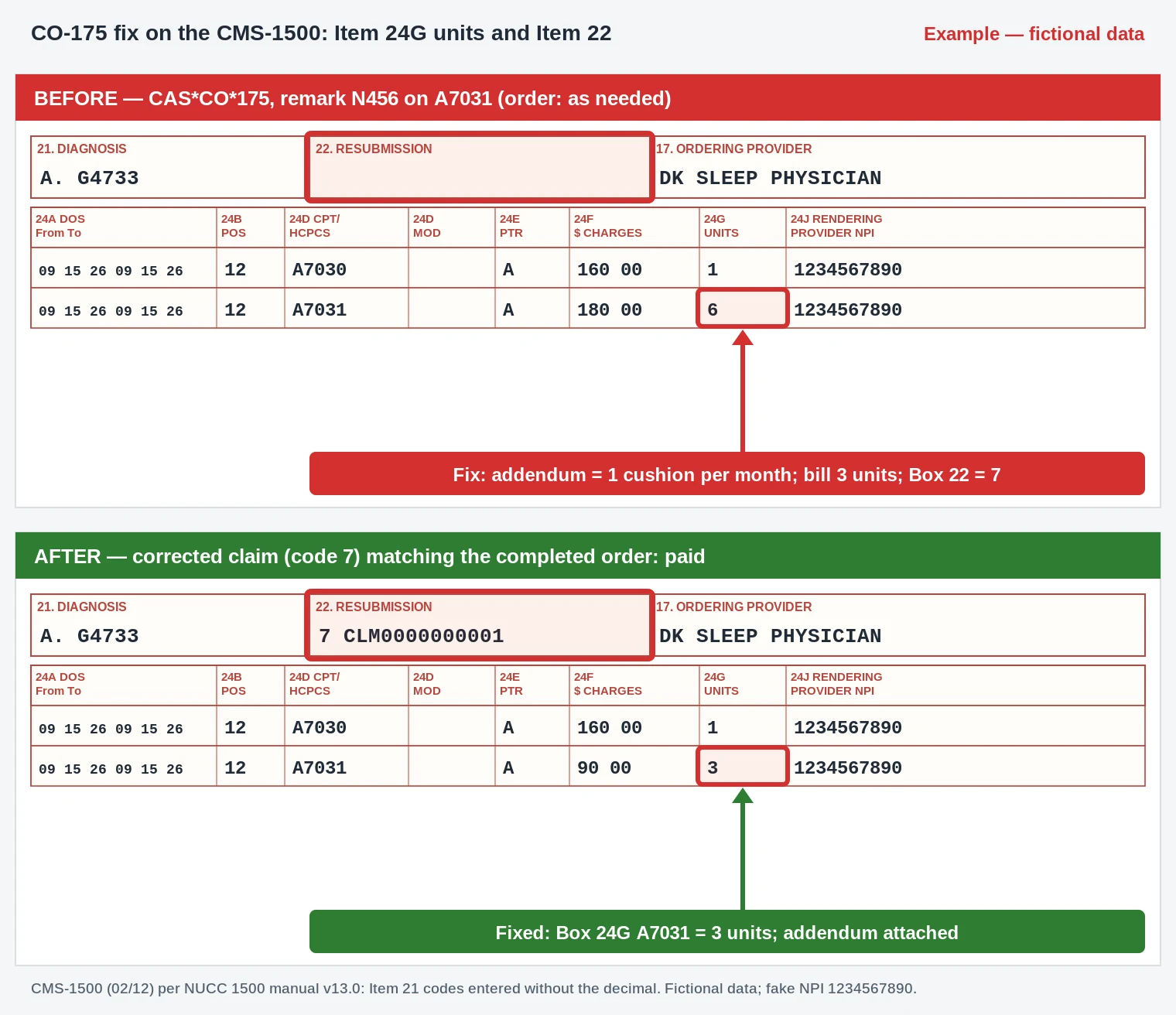
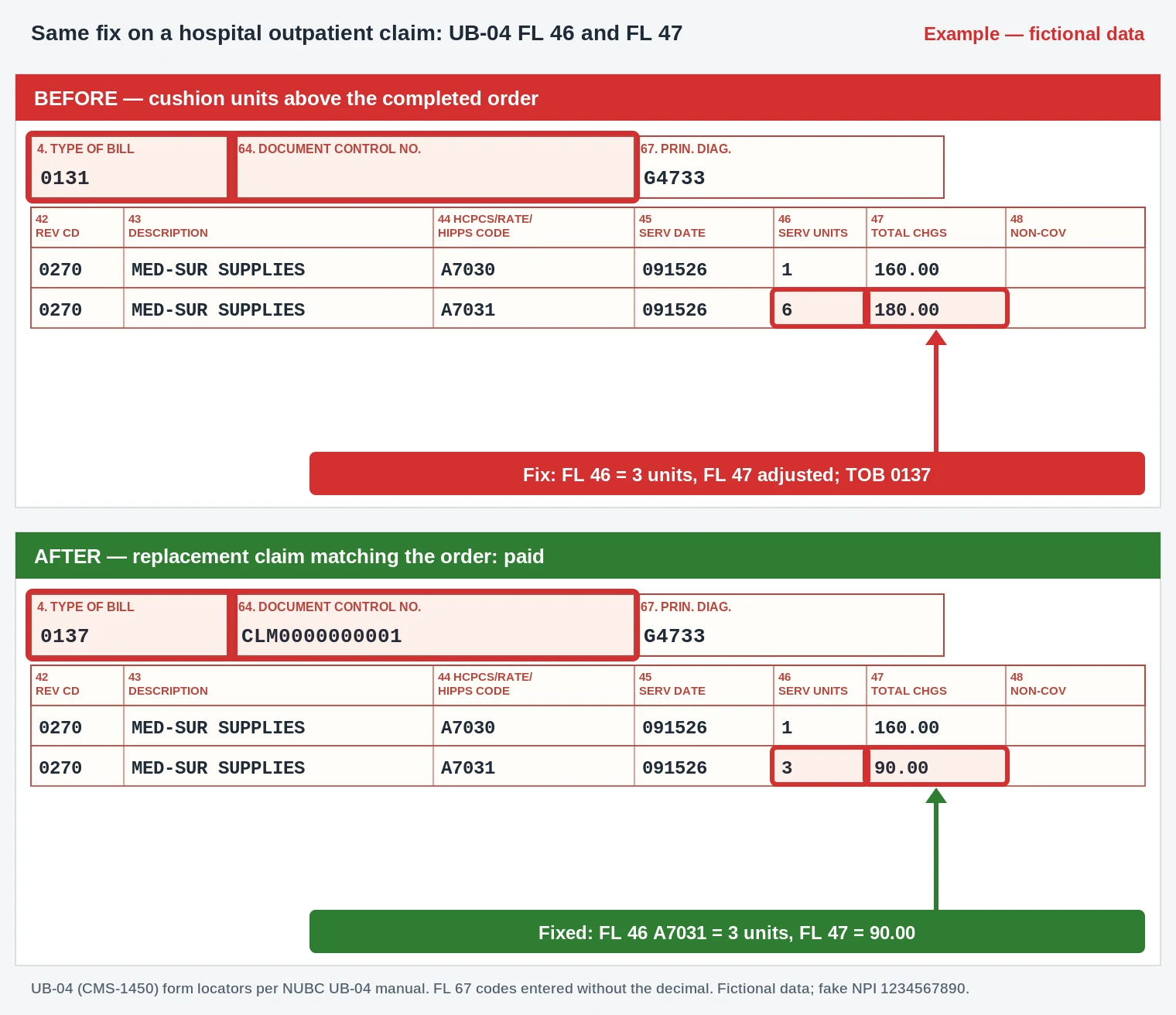
- Box 24G: A7031 units cut from 6 to 3, matching the addendum (one cushion per month for a three-month supply). Charge adjusted to match.
- Order: the physician’s signed and dated addendum adds quantity and frequency; it goes with the corrected claim.
- Box 22: resubmission code 7 with the original claim number.
- Box 24D: A7030 x1 with G47.33 (entered as G4733) is unchanged.
- UB-04 (hospital outpatient): FL 46 units for A7031 cut from 6 to 3 and FL 47 charge adjusted; type of bill 0137 with FL 64.
Worked example (illustrative)
A pharmacy-based supplier bills compression stockings with an order that says compression stockings, both legs. The plan requires the compression level and length. The claim draws CO-175. The supplier asks the physician for an addendum stating the mmHg range and knee-high length, then matches the HCPCS code to the completed order and resubmits. If the completed order describes a different stocking than the one billed, the supplier corrects the code too.
CO-175 vs similar codes
| Code | What it means | Main difference |
|---|---|---|
| CO-175 | Prescription is incomplete | Order missing elements |
| CO-173 | Not prescribed by a physician | Wrong or missing prescriber |
| CO-174 | Not prescribed prior to delivery | Order dated after delivery |
| CO-176 | Prescription is not current | Order has expired |
Order checklist
- Quantity and frequency stated, not as needed.
- Item described clearly enough to match the code.
- Signed and dated by an accepted prescriber with NPI.
- Units billed never exceed what the order supports.
Recap
CO-175 means the order is missing something the plan needs. Compare it to the plan’s required elements, get a signed and dated addendum, match the claim to the complete order and resubmit. Don’t bill units the order doesn’t support.
FAQ
What does denial code CO-175 mean?
The order behind the claim is missing something the plan requires, such as quantity, frequency or a signature date.
How do I fix an incomplete prescription?
Ask the prescriber for a signed and dated addendum that adds the missing details, then resubmit.
Can the prescriber just rewrite the order with an earlier date?
No. An addendum must show the date it was actually signed. Never backdate.
Do I need to change the claim for CO-175?
Only if the complete order supports different units or items than you billed.
Can I bill the patient for CO-175?
No. It’s a CO denial.
Is *as needed* enough on an order?
Most plans want a specific quantity and frequency. “As needed” alone often triggers CO-175.
Sources
How we checked: each code quote on this page was matched word for word with the X12 CARC and RARC lists on 22 October 2026.
- X12, Claim Adjustment Reason Codes (CARC 175, 173, 174, 176). Accessed 22 Oct 2026.
- X12, Remittance Advice Remark Codes (N456, N57, N31). Accessed 22 Oct 2026.
- CMS, Medicare Program Integrity Manual. Accessed 22 Oct 2026.
Last updated: 22 October 2026 · Educational content; not legal advice.
Related denial codes
- CO-176: Prescription Is Not Current
- CO-174: Service Was Not Prescribed Prior to Delivery
- CO-173: Service or Equipment Was Not Prescribed by a Physician
- CO-188: Covered Only When Used per FDA Recommendations
- CO-154: Information Submitted Does Not Support This Day’s Supply
- CO-153: Information Submitted Does Not Support This Dosage
- CO-205: Pharmacy Discount Card Processing Fee
- CO-211: NDC Not Eligible for Rebate