
The PR-6 denial code means the payer found a procedure or revenue code that does not fit the patient’s age, and it listed the balance as patient responsibility. That PR prefix lets you bill the patient in principle. In practice, check two things first: was the age edit real, and did the patient agree in advance to pay? (Primary source: X12 Claim Adjustment Reason Codes)
In brief: reason code 6 reads “The procedure/revenue code is inconsistent with the patient’s age.” With group PR, the plan says the member owes it. Rule out a wrong birth date or a wrong age-band code before any statement goes out.
Part of our denial codes library. Written by Manikandan J, CPC, CRCR, who has worked age-edit denials on preventive visits and vaccines in family practice billing. Published 29 October 2026. Last updated: 29 October 2026. Code wording quoted word for word from X12. Read about the author and our editorial policy, or contact us to report an error.
CARC 6 as X12 publishes it
| Field | Value |
|---|---|
| Code | 6 |
| Description | “The procedure/revenue code is inconsistent with the patient’s age.” |
| Usage note | Refer to the 835 Healthcare Policy Identification Segment (loop 2110 REF), if present |
| Start | 01/01/1995 (last modified 07/01/2017) |
| Group on this page | PR, patient responsibility |
Source: X12 Claim Adjustment Reason Codes, checked 29 October 2026. The group code list defines PR as patient responsibility (X12 Claim Adjustment Group Codes).
Key terms: CARC 6 is the reason, an age conflict between the patient and the billed code. The PR group is the owner, meaning the balance may be billed to the patient under the plan terms. An age band is the age range written into a code descriptor or a benefit. The common remark is N129, “Not eligible due to the patient’s age.” If the remit carries a policy REF in loop 2110, that identifies the payer rule that set the age limit.
Methodology: the code wording is copied from the X12 lists, and each workflow step links to the CMS, NUCC or HealthCare.gov page it relies on.
PR-6 or CO-6: who carries the balance
| Prefix | Who owes it | First move |
|---|---|---|
| CO-6 | The provider, under contract | Correct or appeal. No patient bill |
| PR-6 | The patient, per the plan | Verify the edit, then bill or fix |
| OA-6 | Neither party by default | Read the remark and call the payer |
The reason code is identical, but the financial responsibility differs. A CO-6 line stays off the patient’s statement, while a PR-6 line can appear there only after you confirm the claim information was accurate. If your own birth date or code caused the edit, the plan never had a fair look at the service.
Where age limits come from
Age restrictions live either inside the procedure code descriptor or inside the member’s benefit design. Three common sources:
- Age-banded CPT codes. Preventive medicine visits are split by age. For example, 99395 covers ages 18 to 39 and 99396 covers 40 to 64. Pick the wrong band and the age edit fires.
- Vaccines and screenings. Plans cover ACA preventive services for the ages in the federal recommendations (HealthCare.gov preventive care benefits). A shot given outside that range may fall to the member.
- Benefit limits. Some plans cover a service, such as hearing aids or orthodontics, only for children or only above a set age. The member’s plan documents spell this out.
How to work a PR-6 line
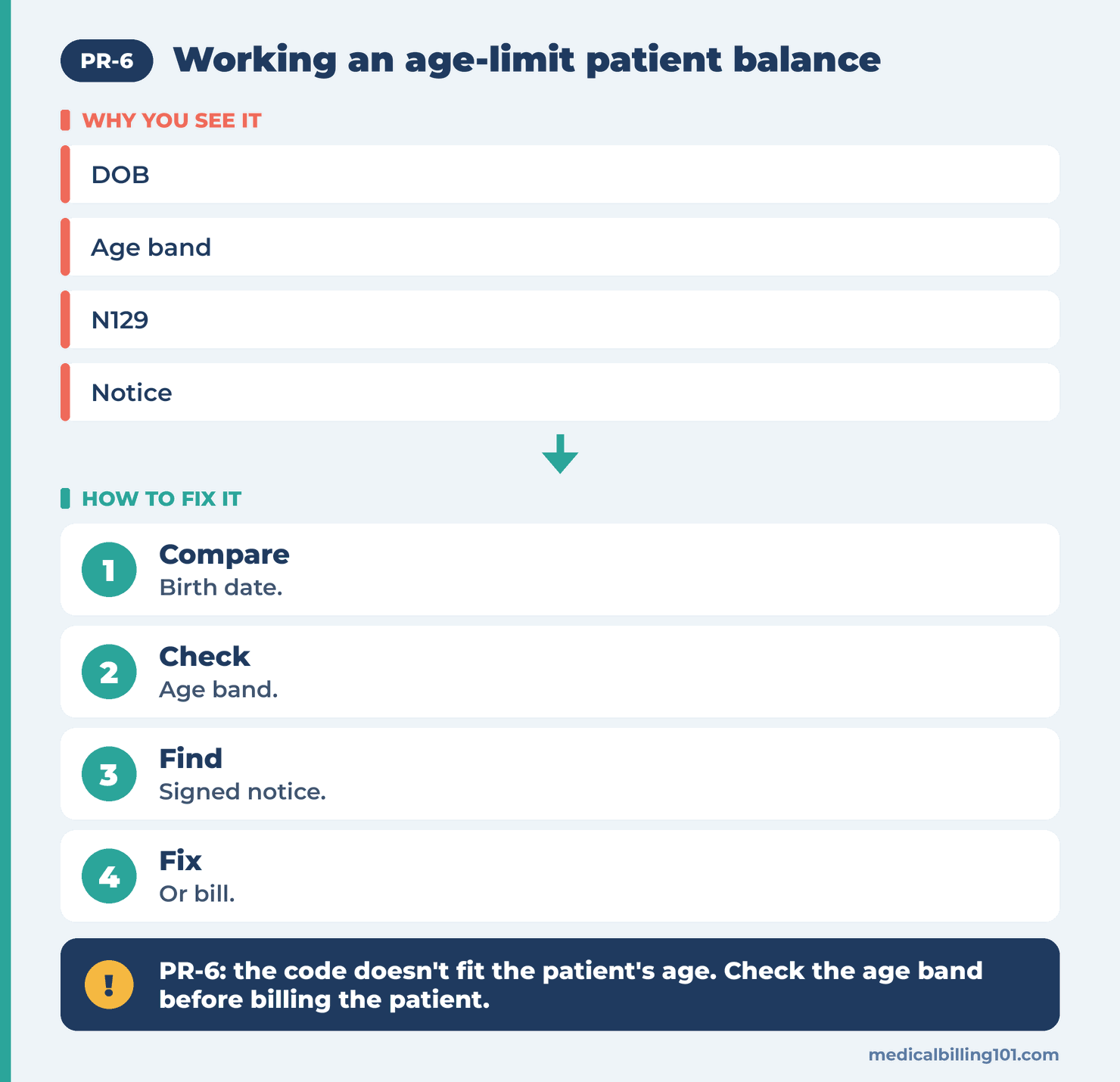
- Compare the birth date. Match the date of birth on the claim with the payer’s eligibility response. A typo here creates a false age conflict.
- Check the age band. Read the full CPT descriptor and confirm the code fits the patient’s age on the date of service, not the day you post.
- Read N129 and any policy REF. They tell you which rule applied. Note the policy number for the account.
- Look for a signed notice. For Medicare, a provider can shift liability for an expected denial only with a valid ABN on file (CMS ABN page). Commercial plans may require their own waiver.
- Fix or bill. If the error was yours, send a corrected claim with frequency code 7. If the data was right and the patient was told, bill the patient for the PR amount.
Example scenario (fictional names), part 1
PR-6 Denial Example: What Happened
Tomas Reyes handles claims for Juniper Ridge Family Practice, a fictional clinic. A remit from a fictional commercial plan for an annual physical came back with CAS*PR*6 and LQ*HE*N129 on CPT 99395. The visit itself had no problems, and the patient had paid nothing at check-in.
The PR-6 denial code put the whole visit charge on the patient. The billing system queued a statement for the full amount. The patient had recently moved into the next preventive age band, and the claim did not show it.
Should Tomas let that statement go out? Keep reading, or jump to how it was resolved. Keep reading, or jump to how the PR-6 denial was resolved.
When the patient really owes it
Sometimes the age edit is legitimate and the patient still requests the service. A healthy adult may ask for a vaccine their plan covers only at an older age. In that case:
- explain before the visit that the plan may not pay;
- document the patient’s choice and keep any signed notice;
- for Medicare patients, use the ABN and the right modifier, as set out in the Medicare Claims Processing Manual, chapter 30.
Without documented notification, an unexpected PR-6 statement invites a complaint, so many practices record those balances as an administrative or goodwill adjustment instead.
Questions to ask the payer
- Which age limit applied, and is it in the code or the benefit?
- Does the plan accept a corrected claim, or does it want an appeal?
- Is the member’s birth date in your file the same as ours?
Example scenario (fictional names), part 2
How the PR-6 Denial Was Resolved
Tomas held the statement and opened the chart. The physician had documented a full preventive visit, and the patient’s birth date matched the payer’s file. The problem was the code: 99395 is for ages 18 to 39, and the patient had already crossed into the 99396 band.
Fix: he sent a corrected claim with frequency code 7, changing 99395 to 99396. The diagnosis Z00.00 stayed the same.
Outcome: the plan processed the corrected line under the preventive benefit, and the patient balance cleared. Tomas added a front-end check that compares the age band with the birth date on every 9938x and 9939x code.
Names and details are illustrative; no real patient data.
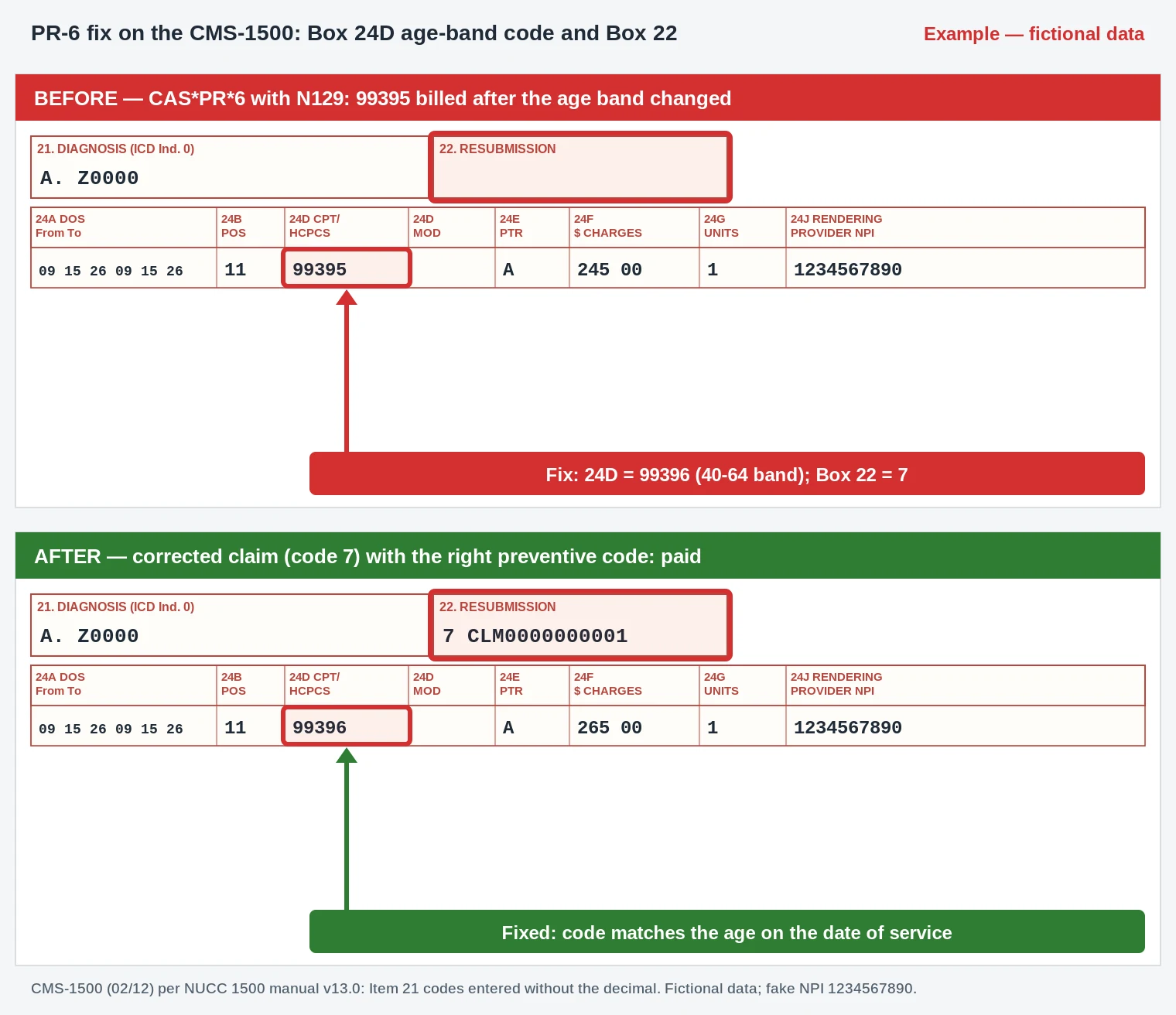
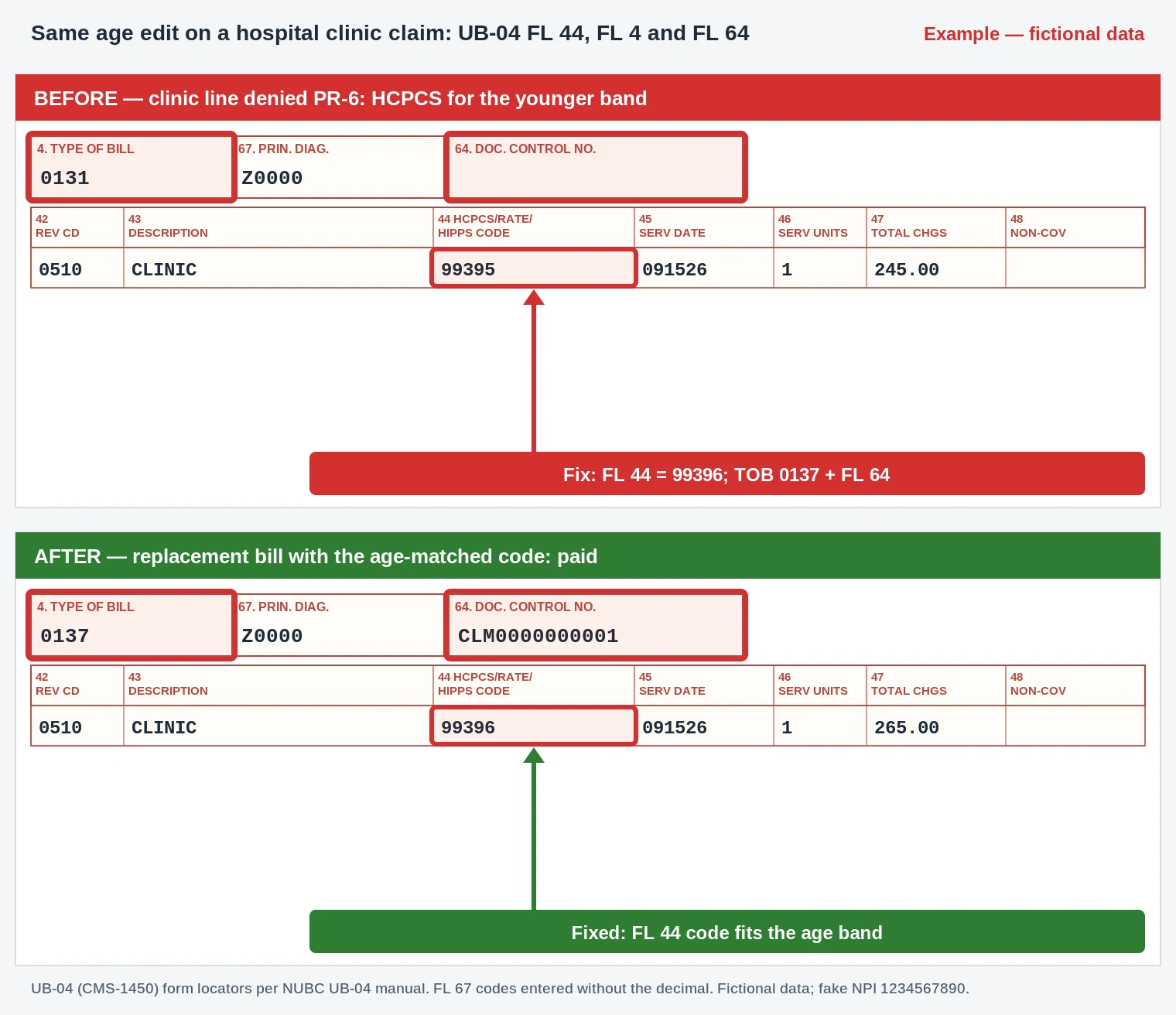
- Box 24D / FL 44: 99395 (ages 18-39) changed to 99396 (ages 40-64).
- Box 24F / FL 47: charge updated to the practice fee for 99396.
- Box 21 / FL 67: Z00.00 (entered as Z0000) is unchanged.
- Box 22 / FL 4 + FL 64: frequency code 7, or type of bill 0137, with the original claim number.
- Box 3 / FL 10: birth date checked against eligibility; it was correct.
Prevention checklist
- Verify the birth date at every registration, including established patients.
- Add a scrubber rule that matches age-banded codes with the patient’s age on the date of service.
- Flag immunizations and screenings with age limitations during scheduling.
- Keep a signed financial notice for any service the plan may not cover.
Related codes
| Code | Meaning | Note |
|---|---|---|
| CO-6 | Same age conflict, provider owes | No patient billing |
| CO-9 | Diagnosis inconsistent with age | Check the ICD-10-CM code |
| CO-7 | Procedure inconsistent with gender | Similar demographic edit |
| PR-11 | Diagnosis inconsistent with procedure | Another PR mismatch |
| PR-204 | Service not covered by the plan | Benefit exclusion |
FAQ
What does PR-6 mean?
The procedure or revenue code did not fit the patient’s age, and the plan assigned the balance to the patient.
Can I bill the patient for PR-6?
Yes, if the claim data was correct and the patient was told in advance. Fix your own errors first.
What remark code comes with denial code 6?
Often N129, “Not eligible due to the patient’s age.” Some payers add a policy REF in loop 2110.
Is PR-6 the same as CO-6?
The reason is the same. CO-6 makes the provider responsible, and PR-6 makes the patient responsible.
How do I fix a PR-6 caused by a coding error?
Change the code or the birth date and send a corrected claim with frequency code 7.
Sources
How we checked: the CARC 6 quote and the N129 remark were matched word for word with the X12 lists on 29 October 2026.
- X12, Claim Adjustment Reason Codes (CARC 6). Accessed 29 Oct 2026.
- X12, Remittance Advice Remark Codes (N129). Accessed 29 Oct 2026.
- X12, Claim Adjustment Group Codes. Accessed 29 Oct 2026.
- CMS, Advance Beneficiary Notice of Non-coverage (ABN). Accessed 29 Oct 2026.
- CMS, Medicare Claims Processing Manual, chapter 30. Accessed 29 Oct 2026.
- HealthCare.gov, Preventive care benefits. Accessed 29 Oct 2026.
- NUCC, 1500 claim form instructions. Accessed 29 Oct 2026.
Last updated: 29 October 2026 · Educational content; not legal advice.
Related denial codes
- CO-6: Procedure or Revenue Code Inconsistent With the Patient’s Age
- CO-7: Procedure or Revenue Code Inconsistent With the Patient’s Gender
- CO-5: Procedure Code or Type of Bill Inconsistent With Place of Service
- PR-8: Provider Type Mismatch Billed to the Patient
- PR-4: Procedure Code Inconsistent With the Modifier
- CO-8: Procedure Code vs Provider Type
- CO-4: Modifier Inconsistent or Missing – Fix
- CO-9: Diagnosis Inconsistent With the Patient’s Age