
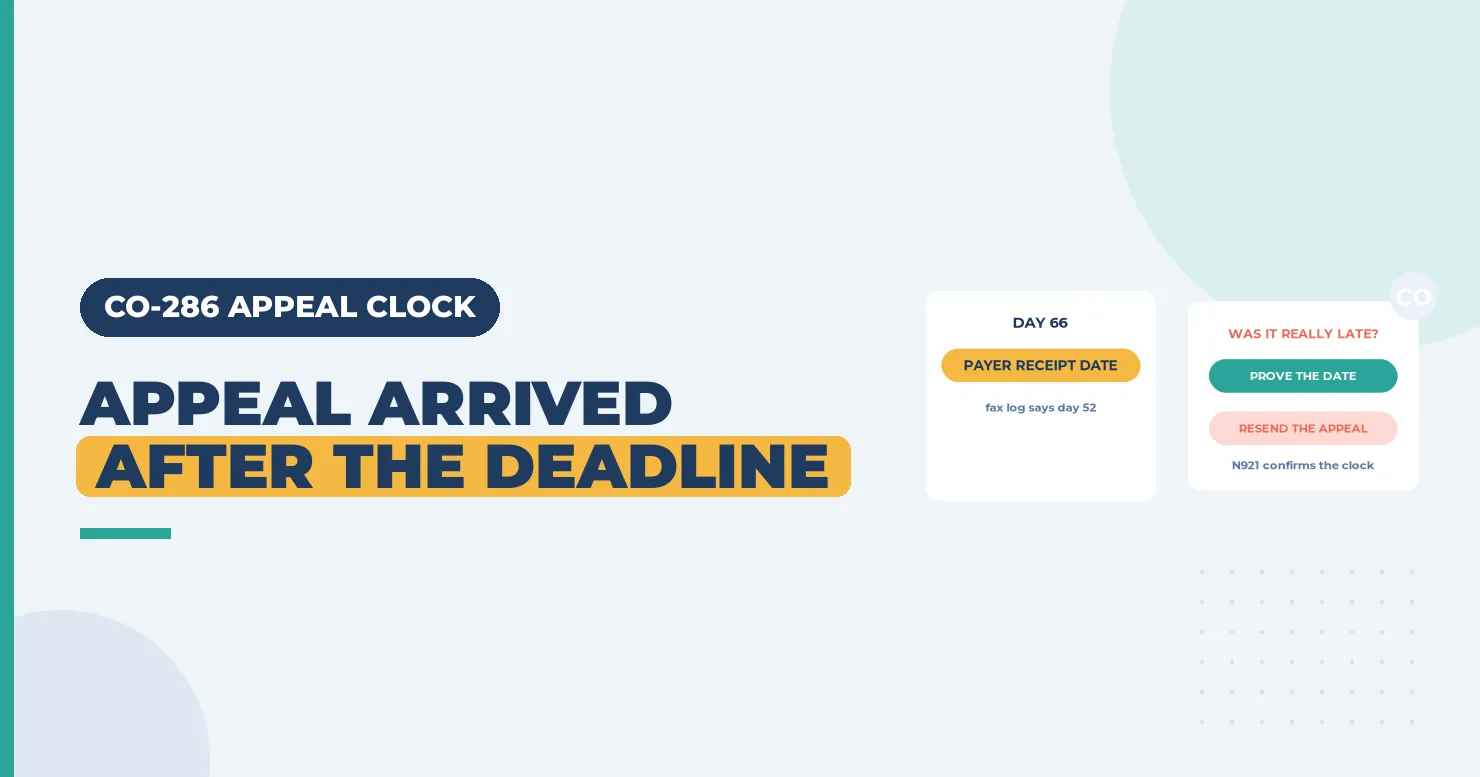
The CO-286 denial code means the payer refused to review your appeal because it arrived after the appeal deadline. The original denial stays in place. To fix it, prove the appeal was on time, or ask for a late-filing exception with a real good-cause reason. (Primary source: X12 Claim Adjustment Reason Codes)
In brief: CARC 286 is about the appeal clock, not the claim clock. A late claim gets CARC 29. A late appeal gets CARC 286. With CO, the provider carries the balance and cannot bill the patient.
Part of our denial codes library. Written by Manikandan J, CPC, CRCR, who has rescued late-appeal rejections for sleep medicine and orthopedic practices. Published 13 November 2026. Last updated: 13 November 2026. Code wording quoted word for word from X12. Read about the author and our editorial policy, or contact us to report an error.
What does denial code CO-286 mean?
Denial code CO-286 means the payer counted the days from its decision to your appeal and found you were past the limit. Consequently, it closed the appeal without evaluating the medical records. Reason code 286 does not say your argument was weak; it says the administrative deadline had already passed.
| Field | Value |
|---|---|
| Code | 286 |
| Description | “Appeal time limits not met” |
| Group codes | No X12 group restriction; CO is the most common |
| Start | 11/01/2017 |
| Common remark | N921, “The time limit for filing a reconsideration or appeal has expired.” |
Source: X12 Claim Adjustment Reason Codes, checked 13 November 2026.
Methodology: the code wording is copied from the X12 list, and the filing deadlines and good-cause rules come from the eCFR regulations cited below.
Key terms: The appeal window is the number of days you have to dispute a claim decision. The receipt date is the day the payer logs your appeal, which may differ from your mailing date. Good cause is a reason the payer accepts for a late filing.
CO-286 vs OA-286: what is the difference?
CO-286 means a contracted payer applied the appeal deadline in your agreement or provider manual. OA-286 reports the same late appeal without naming a contract basis, for example from a secondary plan. Either way, the balance is not the patient’s responsibility. Your first task is identical: verify the dates.
| Version | Whose deadline you missed | What usually decides it |
|---|---|---|
| CO-286 | The appeal window in your contract or provider manual | Contract terms, payer receipt log, fax or portal proof |
| OA-286 | The plan’s general appeal window, no contract named | Plan documents and the notice on the first denial |
CO-286 is also not CO-285. CARC 285 means a missed procedural step, such as the wrong form. CARC 286 means the steps may be fine, but the date is not.
How long is the appeal window?
The appeal window depends on the payer category. Medicare allows 120 days from receipt of the initial determination to ask for a redetermination (42 CFR 405.942). Medicare treats a request as filed on the day the contractor receives it, not the day you send it. Employer health plans must give at least 180 days for a member’s internal appeal (29 CFR 2560.503-1).
Commercial provider disputes follow the participation agreement, and many are shorter, such as 60 or 90 days. Some contracts count from the remittance date, and others from the date printed on the denial letter. Read the exact wording carefully, because one week can decide the outcome.
Example scenario (fictional names), part 1
CO-286 Denial Example: What Happened
Dana Whitfield handles appeals for Pinecrest Sleep Center. A fictional commercial plan denied an in-lab sleep study, 95810, for medical necessity. The patient had obstructive sleep apnea, G47.33, entered as G4733.
The provider manual gave 60 days to appeal. Dana faxed the appeal with the sleep physician’s notes on day 52.
Weeks later the plan’s answer came back with CAS*CO*286 and N921. The plan logged the appeal on day 66.
Was the appeal really late, or was the date wrong? Keep reading, or jump to how it was resolved. Keep reading, or jump to how the CO-286 denial was resolved.
How do I fix a CO-286 denial?
To fix a CO-286 denial, first test the payer’s date math. Then pick one of two paths. If you filed on time, send proof and ask the payer to reopen the appeal. If you were truly late, ask for a good-cause exception, or accept the write-off.
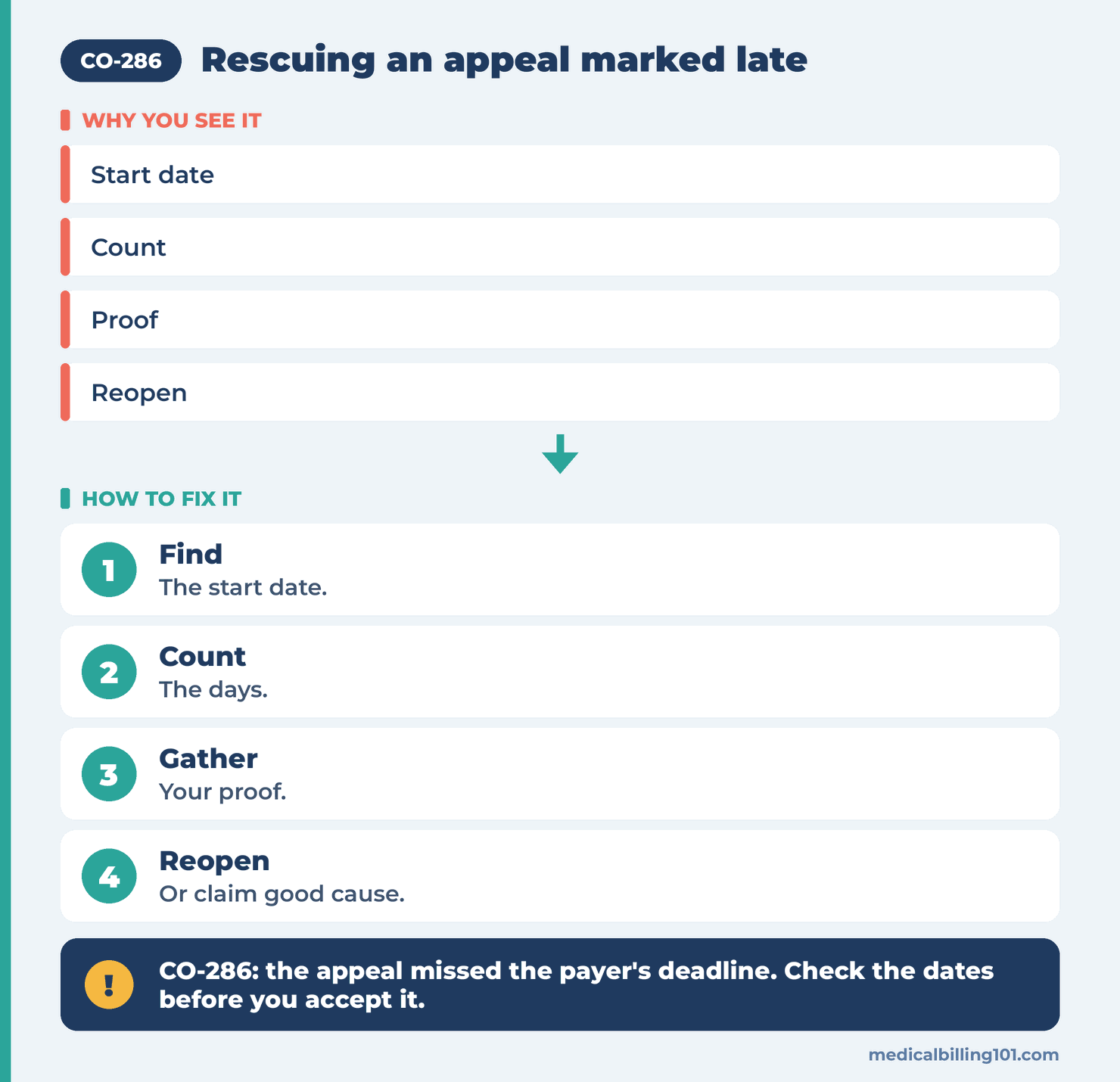
- Find the start date. Note the remittance or letter date the contract uses.
- Count the days. Use the contract’s rule for calendar or business days.
- Gather proof. Fax confirmations, portal receipts and certified mail slips all count.
- Send a reopening request. Attach the proof and ask the payer to review the original appeal.
- Claim good cause if late. Explain the reason with documents, such as a payer outage.
- Post the write-off if nothing applies. Do not bill the patient for a CO amount.
Example scenario (fictional names), part 2
How the CO-286 Denial Was Resolved
Dana pulled the fax log for the appeal. It showed a completed transmission on day 52, eight days inside the window.
Fix: she called provider services and asked how the date was set. The plan had scanned the fax two weeks later. Dana sent a written reopening request with the fax confirmation page and the call reference number.
Outcome: the plan accepted the fax date as the receipt date. It reviewed the sleep physician’s notes and overturned the denial for 95810. Dana now files appeals through the portal, which time-stamps each upload.
Names and details are illustrative; no real patient data.
Names and details are illustrative; no real patient data.
When does good cause save a late appeal?
Good cause saves a late appeal when something outside your normal control caused the delay. Medicare lists examples such as a serious illness or records destroyed by a disaster. It also counts incorrect or incomplete information from the contractor about when and how to file (42 CFR 405.942).
Commercial plans evaluate good cause individually. A busy month or staff turnover rarely qualifies. A documented payer system outage, a misrouted payer letter or an incorrect address on the remittance often does. Put the explanation in writing and attach supporting evidence.
How can I stop CARC 286 from coming back?
You can stop most CARC 286 rejections with a simple calendar rule. Log every denial on the day it posts. Calculate the appeal due date from the payer’s own start date, then subtract ten days as your internal deadline. Submit appeals through the portal or by tracked fax.
Track submission proof the same way you track claims, and save every receipt with the appeal file. Run a weekly report of open appeals approaching their deadline. This also helps with CO-29 timely filing denials, which use a separate claim submission clock.
Can I bill the patient for CO-286?
No, you cannot bill the patient for a CO-286 amount. CO means the contract puts the loss on the provider. The late appeal was the provider’s step, not the patient’s. If the patient filed their own appeal late, the plan may report it differently, so read the group code.
Related codes
| Code | Meaning |
|---|---|
| CO-285 | Appeal procedures not followed |
| CO-29 | The time limit for filing the claim has expired |
| CO-50 | Not medically necessary, often the first denial behind an appeal |
| CO-18 | Exact duplicate claim or service |
FAQ
What does CO-286 mean?
The payer closed your appeal because it arrived after the appeal deadline.
Is CO-286 the same as CO-29?
No. CO-29 means the claim was filed late. CO-286 means the appeal was filed late.
What does N921 mean with CO-286?
N921 confirms that the time limit for a reconsideration or appeal has expired.
Can a CO-286 decision be reopened?
Yes, if you prove the appeal was on time or show good cause for the delay.
Does the patient owe a CO-286 amount?
No. CO keeps the denied balance with the provider under the contract.
Sources
How we checked: the CARC 286 quote was matched word for word with the X12 CARC list on 13 November 2026, and N921 with the X12 RARC list.
- X12, Claim Adjustment Reason Codes (CARC 286, 285, 29). Accessed 13 Nov 2026.
- X12, Remittance Advice Remark Codes (N921). Accessed 13 Nov 2026.
- eCFR, 42 CFR 405.942 (time frame for filing a redetermination; good cause). Accessed 13 Nov 2026.
- eCFR, 29 CFR 2560.503-1 (employer plan claims and appeals). Accessed 13 Nov 2026.
- HealthCare.gov, appeal definition. Accessed 13 Nov 2026.
Last updated: 13 November 2026 · Educational content; not legal advice.