

An x-ray claim denial, modifier FY cut, or new modifier 50 or 25 edit usually means the payer changed its imaging policy. Your coding may be fine. The fix is to check three things per carrier: the bilateral rule, the E/M rule and the film or computed radiography modifier.
Yes, carriers are changing how they process x-ray claims. The changes are real, but they are payer-specific. So build a short rule sheet for each payer, and stop applying one plan’s fix to every claim.
TL;DR: Most plain x-ray codes carry CMS bilateral indicator 3, so each side pays at 100 percent. Medicare accepts modifier 50 or RT and LT lines. Some commercial plans want one line with 50. Put modifier 25 on the E/M, never on the x-ray. Add FX for film and FY for computed radiography.
Written by Manikandan J, CPC, CRCR, a certified coder and revenue cycle specialist. Published 14 November 2026. Last updated: 14 November 2026.
Table of Contents
What changed in how payers process x-ray claims?
Three rules changed for many x-ray claims. Payers now enforce their own bilateral format, such as modifier 50 on one line. Many apply an edit that denies an E/M billed with an x-ray unless the E/M has modifier 25. Medicare also cuts the technical payment for film and computed radiography.
None of these is new in federal law. What is new is how strictly each carrier edits for them. One plan pays 73560-RT and 73560-LT. Another plan denies the same lines and wants 73560-50. A third bundles the office visit into the x-ray.
That is why the same claim pays at one carrier and denies at another. The denial reason is often a generic modifier message. Read the remark code and the payer’s reimbursement policy before you rebill.
| Change you see | What the rule is | Where it comes from |
|---|---|---|
| Bilateral views denied or underpaid | Payer wants modifier 50, or RT and LT lines | CMS bilateral indicator plus payer policy |
| E/M denied with the x-ray | Payer wants modifier 25 on the E/M | NCCI Chapter I and payer edits |
| X-ray paid lower than the fee schedule | FX cuts 20 percent and FY cuts 10 percent of the technical part | Medicare statute and Claims Processing Manual |
Should bilateral x-rays be billed with modifier 50 or RT and LT?
The bilateral indicator is a fee schedule flag that tells payers how to pay a code done on both sides. Modifier 50 is the CPT modifier for a bilateral procedure in one session.
For Medicare, either format works for most plain x-ray codes. Codes like 73030, 73110, 73560, 73610 and 73630 carry bilateral indicator 3 in the 2026 fee schedule file. Indicator 3 means each side pays at 100 percent of the fee schedule. The usual 150 percent bilateral cut does not apply.
The CMS physician fee schedule relative value file defines indicator 3. It says to pay each side when billed with modifier 50, or with RT and LT, or with 2 units. CMS notes that this category is generally radiology and other diagnostic tests.
Commercial plans can be stricter. UnitedHealthcare’s bilateral procedures policy says to bill one line with modifier 50 and one unit, with the full charge for both sides. Under that policy, an indicator 3 code then pays 200 percent of the single allowable.
Some codes must never carry modifier 50. Code 73565 is a bilateral standing knee study. It has bilateral indicator 2, so its value already covers both knees. Code 73521 says “bilateral” in its descriptor and has indicator 0. Bill each of those codes once.
Why is the E/M denied when the doctor takes and reads the x-ray?
The E/M is denied because the payer’s edit treats the visit as part of the x-ray. Plain x-ray codes have an XXX global indicator. NCCI says an XXX procedure includes its own pre- and post-procedure work. A significant, separately identifiable E/M can still be billed with modifier 25.
The rule is in Chapter I of the Medicare NCCI Policy Manual. The E/M cannot include the time spent reading the film. So put 25 on the E/M line only, and only when the note supports a separate visit.
We cover this payer edit in detail in our answer on Aetna denying 99213 billed with an x-ray. To test a code pair before you send it, use our modifier 25 and 59 helper.
Do you bill -26 or -TC when your doctor owns the x-ray machine?
The technical component (-TC) is the equipment, staff and supply part of the x-ray. The professional component (-26) is the physician’s reading and report.
No, bill the global code with no -26 or -TC when your practice owns the equipment and your doctor reads the film. The global code pays both parts. Use -26 only when you read films taken elsewhere. Use -TC only when someone outside your group reads them.
For example, in the 2026 national file, 73560 has 1.03 total non-facility RVUs. The professional part is 0.24 RVUs and the technical part is 0.79 RVUs. Splitting a global claim into -26 and -TC lines can trigger a duplicate edit. You can check any code in our RVU calculator.
If you bill a test that an outside physician performed or read, other rules apply. Our guide to the CMS anti-markup rule explains how Medicare limits payment for purchased tests.
What are modifiers FX and FY on an x-ray claim?
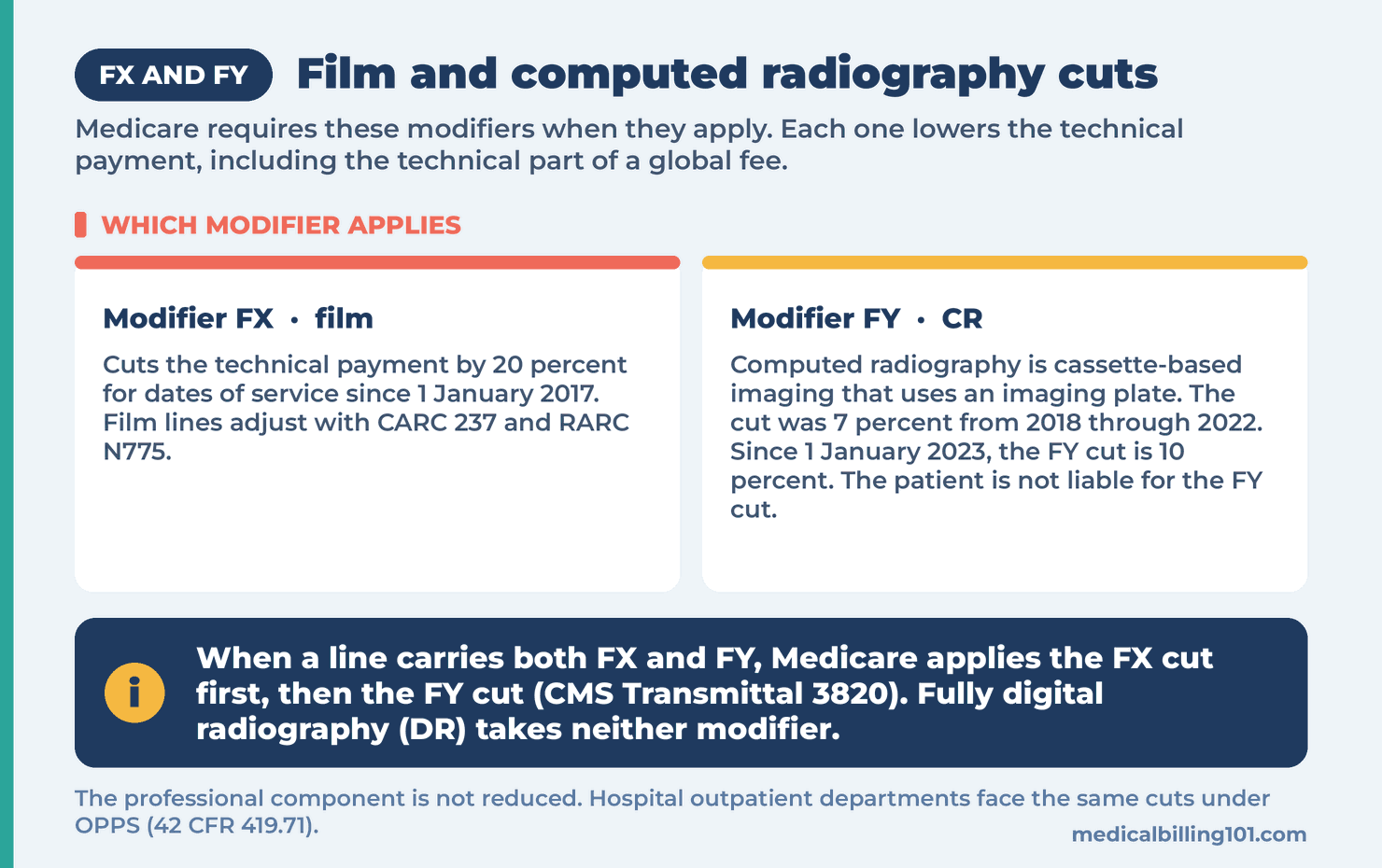
Modifier FX is the HCPCS modifier for an x-ray taken using film. Modifier FY is the HCPCS modifier for an x-ray taken using computed radiography. Computed radiography is cassette-based imaging that uses an imaging plate. Medicare requires these modifiers when they apply. Each one lowers the technical payment, including the technical part of a global fee.
FX cuts that technical payment by 20 percent for dates of service since January 1, 2017. FY cut it by 7 percent from 2018 through 2022. Since January 1, 2023, the FY cut is 10 percent. These rules sit in the Medicare Claims Processing Manual, Chapter 13, sections 20.2.5 and 20.2.6.
When a line carries both FX and FY, Medicare applies the FX cut first, then the FY cut. That order is in CMS Transmittal 3820. Film lines adjust with CARC 237 and RARC N775. The patient is not liable for the FY cut, per Noridian’s FY modifier page.
Hospital outpatient departments face the same cuts under OPPS. That rule is 42 CFR 419.71. Fully digital radiography (DR) takes neither modifier.
Here is an illustrative example. A global 73560 has 0.79 technical RVUs. At the 2026 conversion factor of $33.4009, that is about $26.39 before locality adjustment. FY removes about $2.64 of that, and the professional part does not change.
When I audit x-ray underpayments, I first ask the office what equipment they use. A clinic that still runs a CR reader but never adds FY is not underpaid. It is overpaid, and an audit can take that money back.
How do you fix x-ray claims that a payer reprocessed or denied?
Fix them payer by payer. Pull the denial remark code and the plan’s current reimbursement policy. Then correct only the line the policy targets, and send a replacement claim with frequency code 7. Appeal when the claim already matches the payer’s written policy.
Keep a one-page rule sheet for each carrier. List its bilateral format, its modifier 25 stance and whether it follows FX and FY. Update it when a plan posts a new reimbursement policy. If a correct claim still denies, our appeal letter generator drafts the reconsideration.
3-step checklist
- Check the bilateral indicator and the payer’s format: modifier 50 on one line, or RT and LT lines.
- Put modifier 25 on the E/M only when the note shows a separate visit; bill the x-ray as global if you own the machine.
- Add FX for film or FY for computed radiography on Medicare claims, and record each payer’s rules on one sheet.
FAQ
Does Medicare accept modifier 50 on bilateral x-rays?
Yes. Most plain extremity x-ray codes, such as 73560 and 73630, have bilateral indicator 3. Medicare pays each side at 100 percent whether you bill modifier 50, RT and LT lines, or 2 units. Commercial plans may require one specific format.
How much does modifier FY reduce an x-ray payment?
Since January 1, 2023, modifier FY reduces the technical component, including the technical part of a global fee, by 10 percent. It was 7 percent from 2018 through 2022. The professional component is not reduced, and the patient is not billed for the cut.
What does modifier FX mean?
Modifier FX means the x-ray was taken using film. Since January 1, 2017, Medicare reduces the technical component of a film x-ray by 20 percent. The adjustment appears with CARC 237 and RARC N775 on the remittance.
Should modifier 25 go on the x-ray code?
No. Modifier 25 goes on the E/M code only. It tells the payer the provider performed a significant, separately identifiable visit on the same day as the x-ray. The x-ray code is billed without modifier 25.
Can I bill 73565 with modifier 50?
No. Code 73565 is a bilateral standing knee study with bilateral indicator 2. Its value already covers both knees, so bill it once with no modifier 50 and no RT or LT lines.
Sources
My methodology was simple. I read the CMS manual sections and transmittal on film and computed radiography cuts, the 2026 fee schedule indicators, the NCCI manual, and one commercial bilateral policy. Payer edits differ, so confirm details with each plan.
- CMS, Medicare Claims Processing Manual, Chapter 13, sections 20.2.5, 20.2.5.1 and 20.2.6. Accessed 14 Nov 2026.
- CMS Transmittal 3820, Payment Reduction for X-Rays Taken Using Computed Radiography. Accessed 14 Nov 2026.
- 42 CFR 419.71, Payment reduction for certain X-ray imaging services. Accessed 14 Nov 2026.
- CMS, 2026 PFS Relative Value Files (bilateral and PC/TC indicators). Accessed 14 Nov 2026.
- CMS, Medicare NCCI Policy Manual, Chapter I. Accessed 14 Nov 2026.
- Noridian JE Part B, FY modifier. Accessed 14 Nov 2026.
- UnitedHealthcare, Bilateral Procedures Policy, Professional (2026R0023F). Accessed 14 Nov 2026.
Read about the author, or contact us with a question. See our editorial policy.
Last updated: 14 November 2026 · Educational content for U.S. billers. Check each payer’s current policy.