
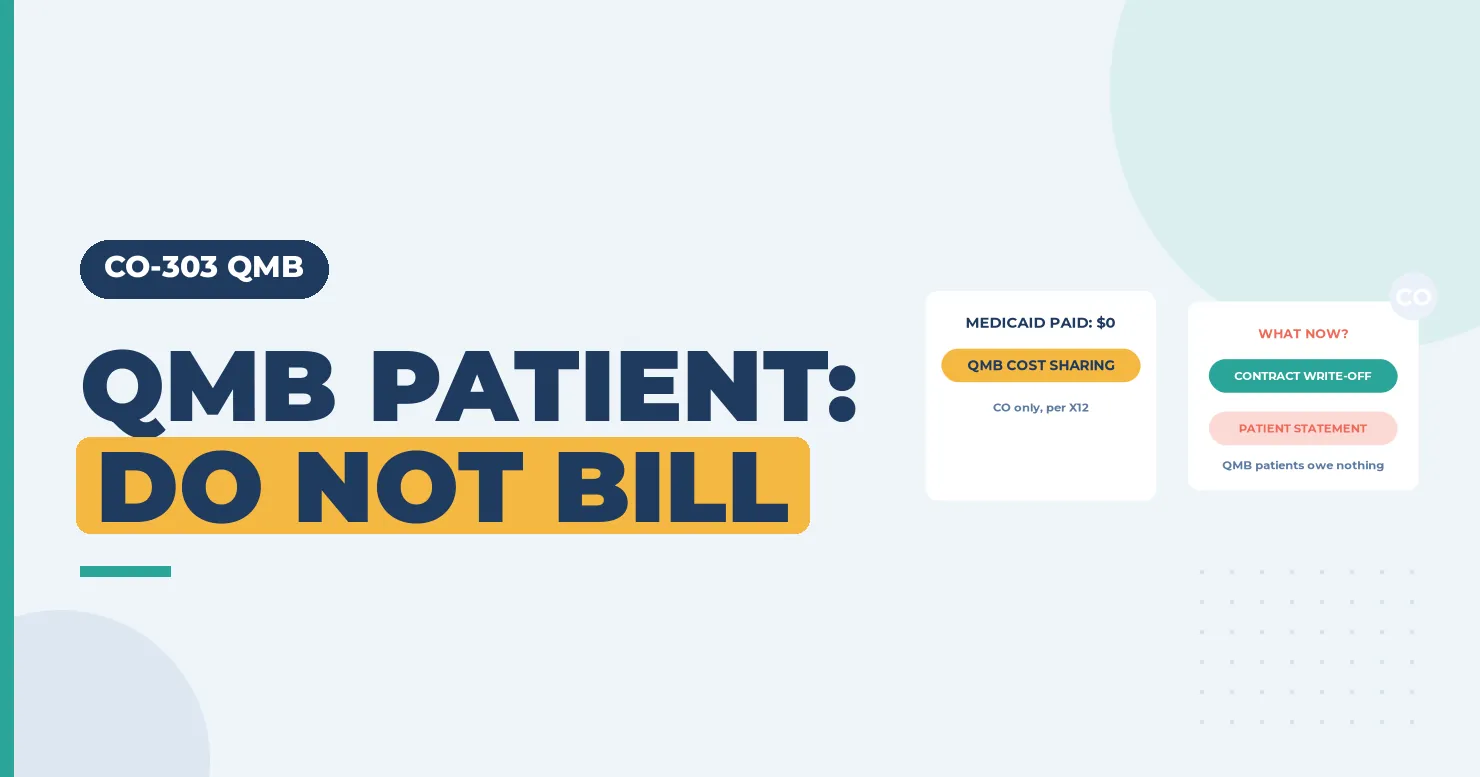
The CO-303 denial code means the next payer left a QMB patient’s Medicare cost sharing unpaid. QMB stands for Qualified Medicare Beneficiary, and you cannot bill that patient for it. Post it as a contractual write-off, and recall any patient statement. (Primary source: X12 Claim Adjustment Reason Codes)
In brief: CARC 303 is a QMB protection code. The Medicaid side paid less than the Medicare cost sharing, or nothing. Federal law bars billing a QMB patient for the difference, so the balance is yours to adjust.
Part of our denial codes library. Written by Manikandan J, CPC, CRCR, who has cleaned up dual-eligible crossover balances for internal medicine and home health billing teams. Published 16 November 2026. Last updated: 16 November 2026. Code wording quoted word for word from X12. Read about the author and our editorial policy, or contact us to report an error.
What does denial code CO-303 mean?
Denial code CO-303 means the payer after Medicare will not cover the patient’s Medicare cost sharing, and the patient is a QMB. Reason code 303 usually comes on a crossover remit from a state Medicaid program or a Medicaid plan. It closes the balance without moving it to the patient.
| Field | Value |
|---|---|
| Code | 303 |
| Description | “Prior payer’s (or payers’) patient responsibility (deductible, coinsurance, co-payment) not covered for Qualified Medicare and Medicaid Beneficiaries. (Use only with Group Code CO)” |
| Group codes | CO only, per X12 |
| Start | 07/01/2021 |
| Related alerts | N781, N782 and N783 on the Medicare remit flag a QMB patient |
Source: X12 Claim Adjustment Reason Codes, checked 16 November 2026.
Methodology: the code wording is copied from the X12 list, and the billing rules come from the CMS QMB guidance cited below.
Key terms: A QMB is a Medicare patient whose state Medicaid program covers Medicare premiums and cost sharing. A crossover is Medicare sending its processed claim to the next payer. CO is the contractual obligation group code.
CO-303 vs OA-303: what is the difference?
X12 allows CARC 303 only with group code CO. So CO-303 is the only valid form, and it always means a provider write-off. An OA-303 line points to a payer setup error. If you see one, ask the payer to reprocess it as CO. Either way, a QMB patient still owes nothing.
Why did Medicaid pay nothing on the QMB crossover?
Medicaid often pays less than the full Medicare cost sharing, such as a coinsurance amount, because states may limit it. Many states use a lesser-of rule. If Medicare already paid more than the Medicaid rate, the state pays zero. The CMS QMB program page explains that providers must accept Medicare and Medicaid payment as payment in full.
The Medicare remit gives an early warning. For example, remark code N782 reads “Alert: Patient is a Medicaid/ Qualified Medicare Beneficiary. Review your records for any wrongfully collected coinsurance. This amount may be billed to a subsequent payer.”
Example scenario (fictional names), part 1
CO-303 Denial Example: What Happened
- Practice: Brookfield Internal Medicine, a primary care office.
- Biller: Hannah Quist. Physician: Dr. Mateo Salcedo, MD.
- Visit: a follow-up for type 2 diabetes, billed as 99214 with diagnosis E119.
- Medicare remit: paid its share and moved the rest to coinsurance, with alert
N782. - Medicaid crossover remit: zero paid, with
CAS*CO*303on the coinsurance. - The slip: the billing system had already mailed the patient a statement for that coinsurance.
What should Hannah do with the balance and the statement? Keep reading, or jump to how it was resolved. Keep reading, or jump to how the CO-303 denial was resolved.
How do I post a CO-303 adjustment?
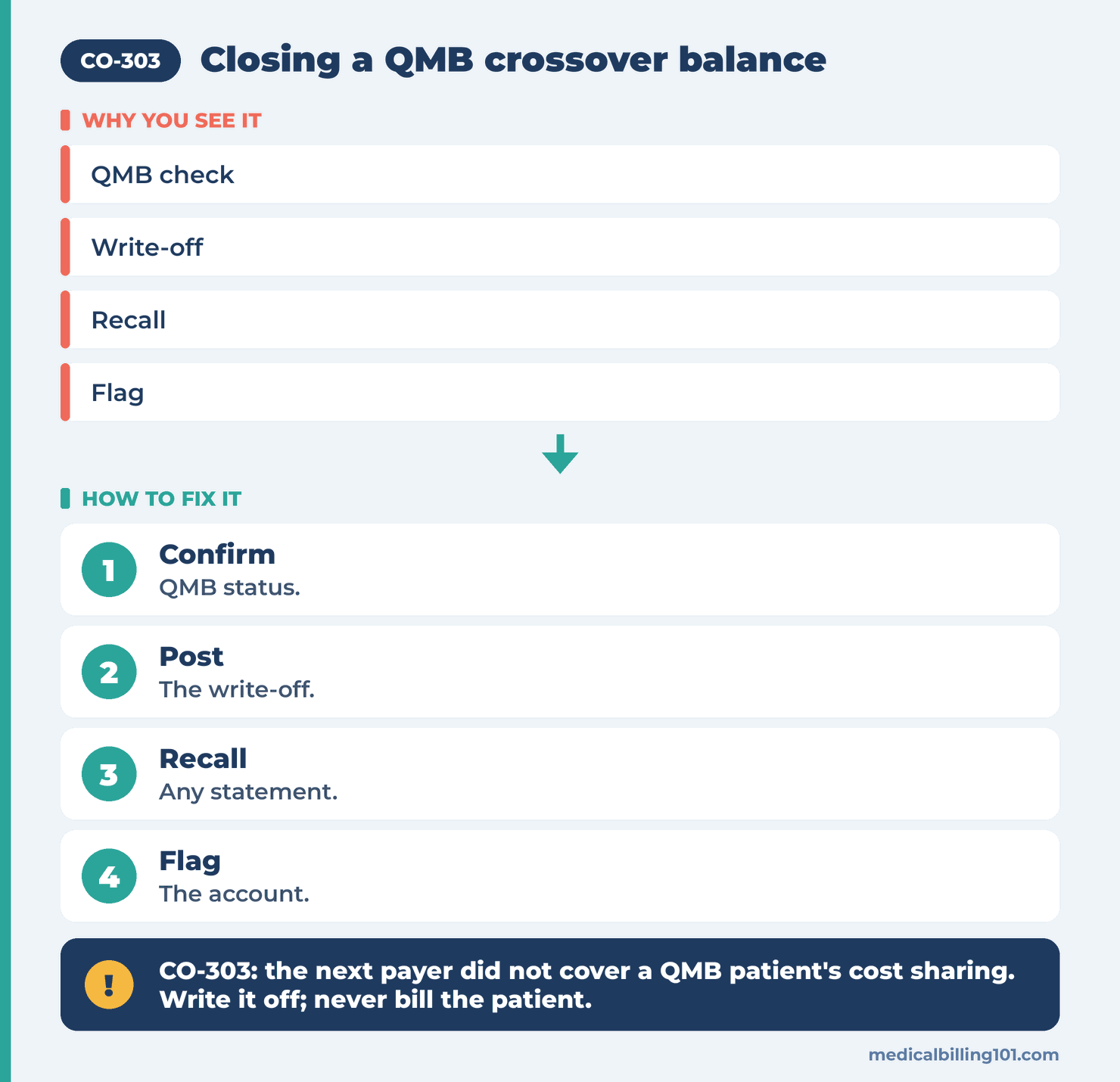
To post a CO-303 adjustment, write off the cost sharing as a contractual adjustment and close the line. Do not transfer it to the patient. Check whether any patient payment or statement went out, and reverse it. Then flag the account so future crossover balances stay off statements.
| Situation | What to do |
|---|---|
| Patient balance is zero | Post CO-303 as a contract write-off and close the line |
| A statement went out | Recall it and stop any collection referral |
| The patient paid | Refund the payment |
| QMB ended before the date of service | Ask the payer to reprocess; check for N935 |
Example scenario (fictional names), part 2
How the CO-303 Denial Was Resolved
Hannah confirmed QMB status in the state Medicaid eligibility portal. The N782 alert and the CO-303 line matched. The statement was the only error.
Fix: she posted the coinsurance as a contractual write-off under CARC 303. She recalled the statement and sent a short letter saying the patient owed nothing. No payment had been made, so no refund was needed.
Outcome: the account closed at zero. Hannah set a rule that holds statements on any line with N781, N782 or N783.
Names and details are illustrative; no real patient data.
Names and details are illustrative; no real patient data.
Can I bill a QMB patient for a CO-303 balance?
No. Federal law bars billing a QMB patient for Medicare deductibles, coinsurance or copays. That holds even when Medicaid pays nothing. Providers who bill these amounts face sanctions, as the CMS MLN Matters article SE1128 explains. A QMB patient may owe only a small Medicaid copay, if the state sets one.
When should I dispute a CO-303 adjustment?
Dispute CO-303 only when the patient was not a QMB on the date of service. Remark code N935 reads “Alert: Patient is no longer a Medicaid/Qualified Medicare Beneficiary.” If eligibility had ended, ask the payer to reprocess with the correct status. The Medicare Savings Programs page explains who qualifies.
Related codes
| Code | Meaning |
|---|---|
| PR-1, PR-2, PR-3 | Deductible, coinsurance and copay amounts |
| CO-23 | Impact of prior payer adjudication |
| CO-22 | Care may be covered by another payer |
| CO-45 | Charge exceeds the fee schedule or contracted amount |
FAQ
What does CO-303 mean?
The next payer did not cover a QMB patient’s Medicare cost sharing, so you adjust it off.
Can I bill the patient for CO-303?
No. QMB patients are protected from Medicare deductibles, coinsurance and copays.
Why is CARC 303 only used with CO?
X12 limits it to CO because the balance is always a provider write-off.
Is CO-303 an error I should appeal?
Usually not. Appeal only if the patient was not a QMB on the date of service.
Which remark codes warn me about a QMB patient?
N781, N782 and N783 on the Medicare remit flag QMB deductible, coinsurance and copay.
Sources
How we checked: the CARC 303 quote was matched word for word with the X12 CARC list on 16 November 2026, and N782 and N935 with the X12 RARC list.
- X12, Claim Adjustment Reason Codes (CARC 303, 23, 22). Accessed 16 Nov 2026.
- X12, Remittance Advice Remark Codes (N781, N782, N783, N935). Accessed 16 Nov 2026.
- CMS, Qualified Medicare Beneficiary program. Accessed 16 Nov 2026.
- CMS, MLN Matters SE1128, QMB billing prohibition. Accessed 16 Nov 2026.
- Medicare.gov, Medicare Savings Programs. Accessed 16 Nov 2026.
Last updated: 16 November 2026 · Educational content; not legal advice.