
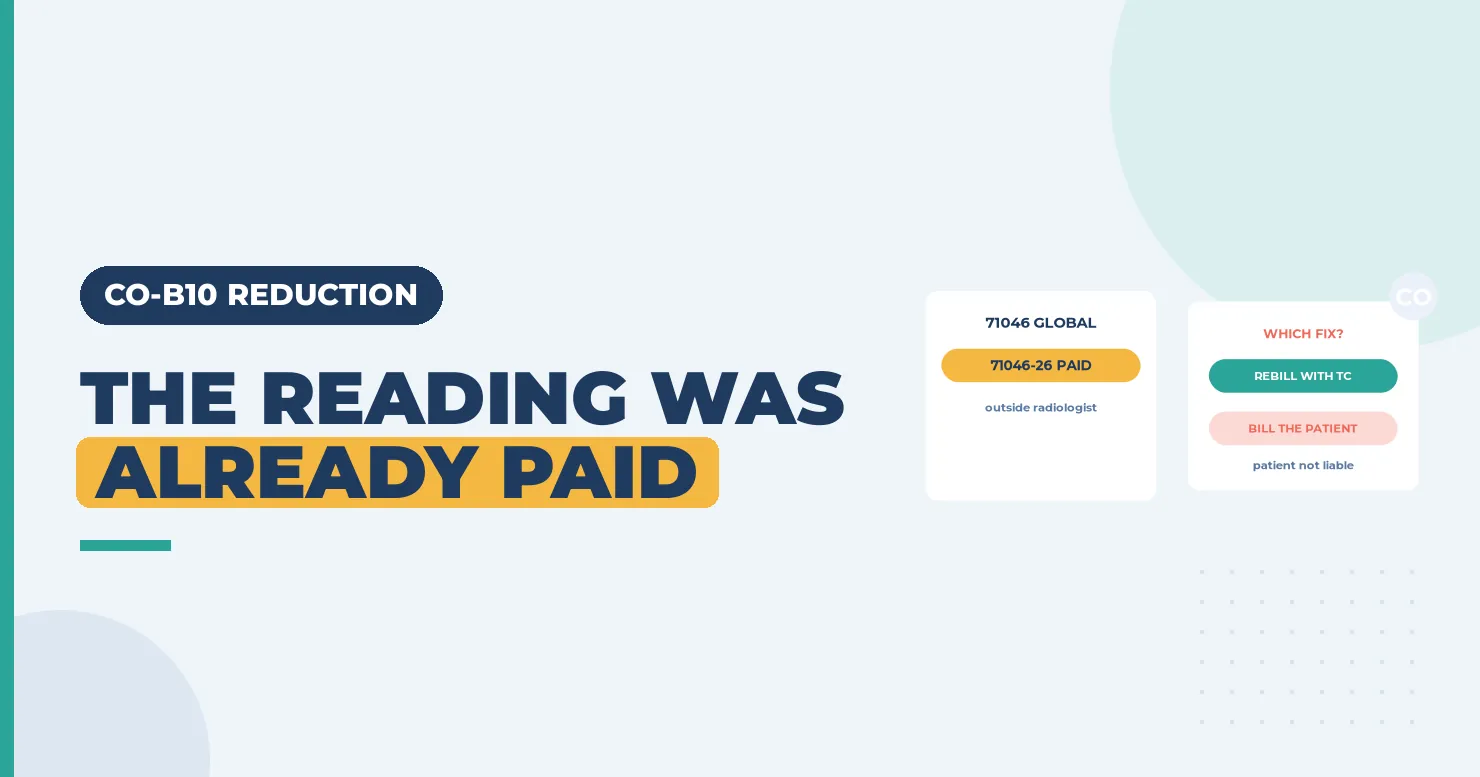
The CO-B10 denial code means the payer reduced your allowed amount because part of the same test was already paid, usually the professional reading billed by another provider. You billed the global service; the payer paid only the piece you did not share. Confirm who did the reading, then bill your own component correctly. (Primary source: X12 Claim Adjustment Reason Codes)
In brief: reason code B10 is a reduction, not a full denial. It shows up on imaging, EKG and other tests with a professional and technical split. The usual fix is a corrected claim with modifier TC or 26, and the patient cannot be billed for the cut.
Part of our denial codes library. Written by Manikandan J, CPC, CRCR, who has posted and corrected imaging center claims reduced for components another group already billed. Published 18 November 2026. Last updated: 18 November 2026. Code wording quoted word for word from X12. Read about the author and our editorial policy, or contact us to report an error.
What does denial code CO-B10 mean?
Denial code CO-B10 tells you the payer matched your claim to an earlier claim for the same test on the same date. Many diagnostic tests have two parts: the technical component (equipment, staff and supplies) and the professional component (the doctor’s reading and report). When one provider bills the whole test after another was paid for one part, CARC B10 explains the reduction.
| Field | Value |
|---|---|
| Code | B10 |
| Description | “Allowed amount has been reduced because a component of the basic procedure/test was paid. The beneficiary is not liable for more than the charge limit for the basic procedure/test.” |
| Group codes | No X12 group restriction; CO is the usual pairing |
| Start | 01/01/1995 |
| Typical services | X-rays, CT, MRI, ultrasound, EKG and other split tests |
Source: X12 Claim Adjustment Reason Codes, checked 18 November 2026.
Methodology: the code wording is copied from the X12 list, and the component rules come from the CMS physician fee schedule and claims manual cited below.
Key terms: the technical component is the equipment and staff part of a test, billed with modifier TC. The professional component is the physician’s interpretation, billed with modifier 26. A global service is both parts billed on one line with no modifier.
CO-B10 vs OA-B10
On a CO-B10 line, the reduction is a contractual write-off for your practice, and the patient is protected from it. An OA-B10 line reports the same reduction without assigning it to anyone, which tends to appear when a secondary payer repeats what the primary did. In both cases the patient pays only cost sharing on the part that was allowed.
Example scenario (fictional names), part 1
CO-B10 Denial Example: What Happened
Bianca Ferraro handles billing for Summit Ridge Imaging, an outpatient X-ray center. A patient came in with a lingering cough, R05.9, and had a two-view chest X-ray, 71046. Dr. Owen Nakamura of an outside radiology group read the films under a reading agreement.
Bianca billed 71046 with no modifier. The 835 from a fictional commercial payer showed CAS*CO*B10 with remark code N13, “Payment based on professional/technical component modifier(s).” The allowed amount was much lower than the center’s contracted global rate.
Was the payer wrong, or did the center bill more than it performed? Keep reading, or jump to how the CO-B10 denial was resolved.
Which component did the payer pay?
Look at what was billed against what was performed. The CMS Claims Processing Manual, Chapter 13 covers how radiology professional and technical components are billed.
| You billed | Another provider was paid | What the payer allows you |
|---|---|---|
| Global (no modifier) | Professional component, modifier 26 | Technical component only |
| Global (no modifier) | Technical component, modifier TC | Professional component only |
| TC | Nothing yet | Technical component |
| 26 | Hospital billed the technical part | Professional component |
How do I fix a CO-B10 denial?
To fix a CO-B10 denial, confirm which part your practice actually furnished. If you did only the technical part, send a corrected claim with modifier TC. If you did only the reading, use modifier 26. If you truly did both, appeal with proof, such as your own radiologist’s signed report.
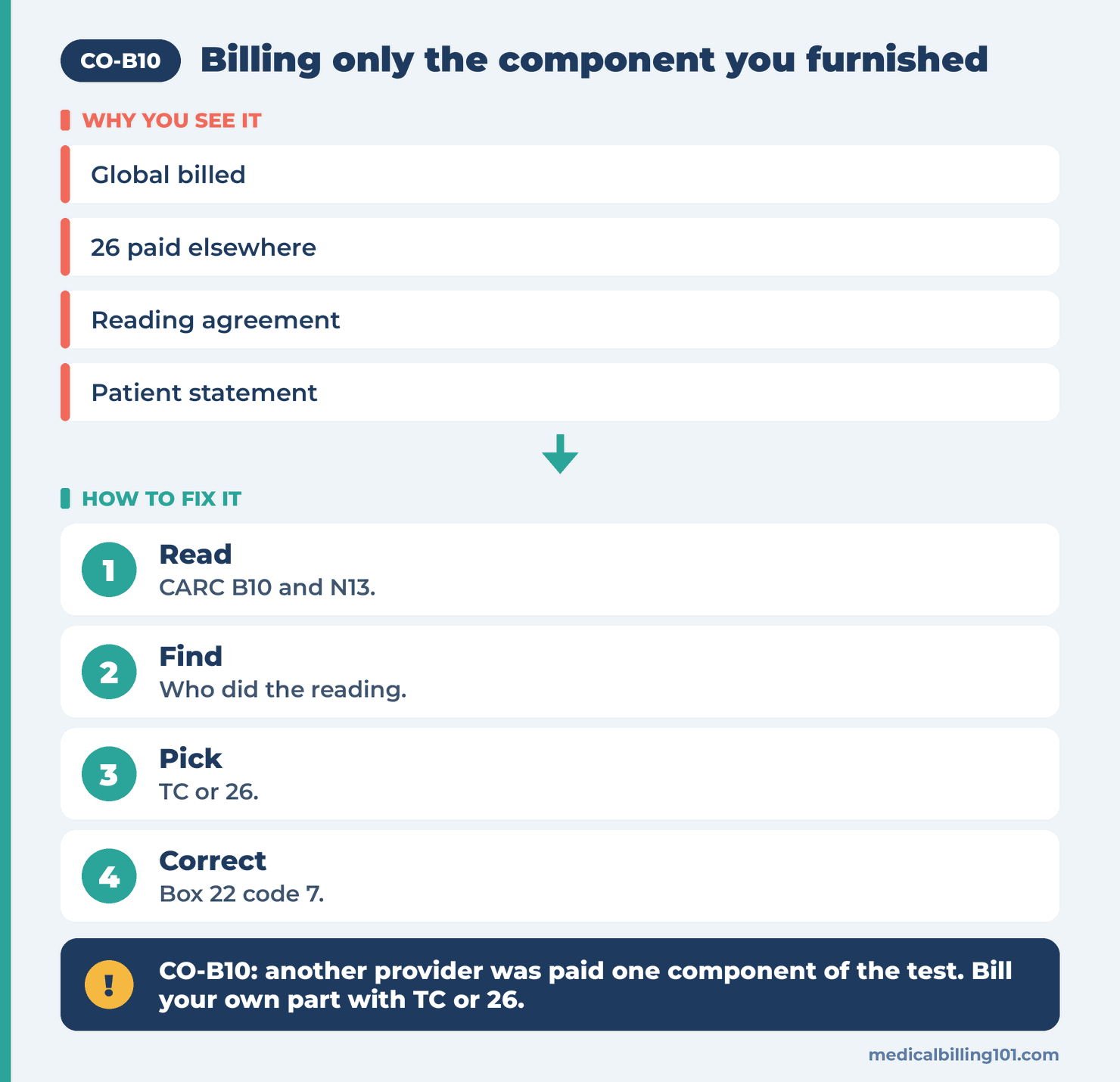
| Step | Action | Proof to pull |
|---|---|---|
| 1. Read the remit | Note CARC B10 and any remark, for example N13 | 835 CAS and LQ segments |
| 2. Find the other claim | Ask who read or performed the test | Reading agreement or report signature |
| 3. Choose the modifier | TC for equipment only, 26 for reading only | Your service record |
| 4. Correct or appeal | Box 22 code 7 with the modifier, or an appeal if you did both | Signed report, equipment log |
| 5. Clean up the account | Write off the reduction and fix any patient statement | Posting notes |
The CMS physician fee schedule look-up tool shows the PC/TC indicator and separate values for each component. Use it to check whether a code even splits before you add a modifier.
Example scenario (fictional names), part 2
How the CO-B10 Denial Was Resolved
Bianca checked the reading agreement and the payer portal. Here is what she found:
- Dr. Nakamura’s group had billed 71046-26 and was paid first.
- Summit Ridge only owned the machine and employed the technologist.
- The patient statement showed the full global balance, which was wrong.
Fix: she sent a corrected claim with resubmission code 7 in Box 22 and the original claim number. Box 24D now read 71046 with modifier TC, and R05.9 stayed in Box 21.
Outcome: the payer reprocessed the line at the technical rate. Bianca wrote off the earlier reduction and reissued the patient statement for coinsurance only.
Names and details are illustrative; no real patient data.
Names and details are illustrative; no real patient data.
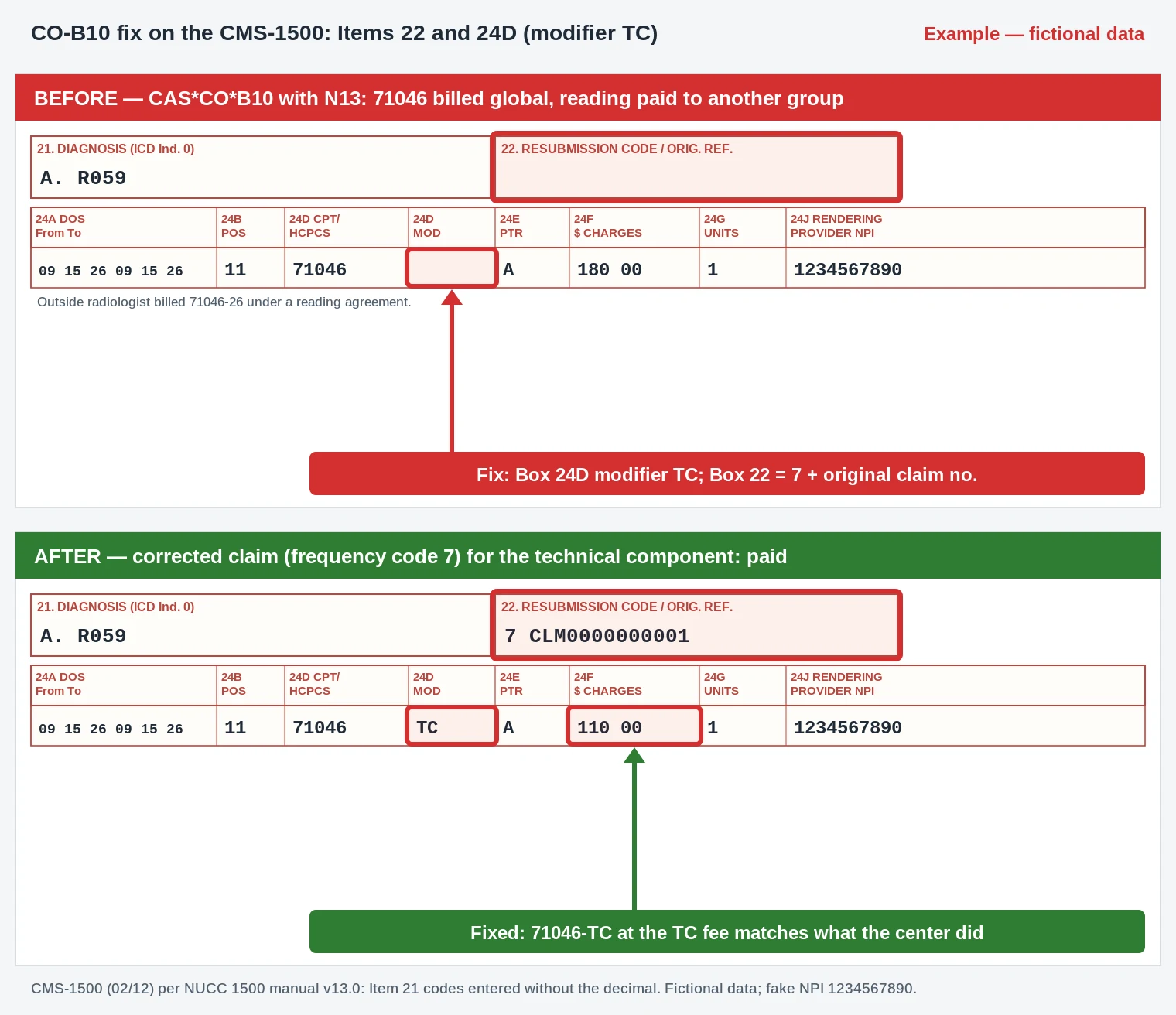
- Box 24D: modifier TC added to 71046, because the center supplied the equipment and technologist but not the reading.
- Box 24F: the charge changed to the center’s technical component fee (amounts are placeholders).
- Box 22: resubmission code 7 (corrected claim) with the original claim number.
- Box 21 / 24E: R05.9 (entered as R059) and its pointer are unchanged.
- UB-04: not shown; hospital outpatient imaging is billed on the UB-04 without TC or 26 modifiers.
Can I bill the patient for the CO-B10 reduction?
No. The X12 wording itself says the patient is not liable for more than the charge limit for the test. The CO group code makes the reduction a provider adjustment. Bill the patient only the deductible, copay or coinsurance shown on the remit.
How do I prevent CARC B10?
Prevent it by setting up charge rules for each reading arrangement. If an outside group reads your studies, build your charge codes with modifier TC by default. If your radiologists read for a hospital, default to modifier 26. Recheck the rules whenever a contract or reading group changes.
Related codes
| Code | Meaning |
|---|---|
| CO-4 | Procedure code is inconsistent with the modifier or a modifier is missing |
| CO-234 | This procedure is not paid separately |
| CO-18 | Exact duplicate claim or service |
| CO-B13 | Previously paid; payment may have been provided earlier |
FAQ
What does CO-B10 mean?
The payer lowered the allowed amount because another provider was already paid one component of the same test.
Is CO-B10 a full denial?
No. It is a reduction. You are paid for the component you did not share.
Which modifier fixes CARC B10?
Modifier TC if you did only the technical part, or 26 if you did only the reading.
Can I appeal a CO-B10 reduction?
Yes, if your practice really did both parts. Send your signed report and proof you performed the test.
Which group code comes with CARC B10?
X12 sets no group restriction. CO is the most common pairing.
Sources
How we checked: the CARC B10 quote was matched word for word with the X12 CARC list on 18 November 2026, and N13 with the X12 RARC list.
- X12, Claim Adjustment Reason Codes (CARC B10, B13, 4, 18, 234). Accessed 18 Nov 2026.
- X12, Remittance Advice Remark Codes (N13). Accessed 18 Nov 2026.
- CMS, Medicare Claims Processing Manual, Chapter 13 (radiology services). Accessed 18 Nov 2026.
- CMS, Physician Fee Schedule look-up tool. Accessed 18 Nov 2026.
- NUCC, 1500 claim form reference instruction manual. Accessed 18 Nov 2026.
Last updated: 18 November 2026 · Educational content; not legal advice.