Medicare annual wellness visit billing guidelines require proof of every required element, not a scanned copy of each test form. An auditor checks that the note shows the health risk assessment, vitals, cognitive check and written prevention plan.
The fix: document each element with the tool used, the result and your interpretation. For telehealth, bill G0438 or G0439 with the right place of service and record how you got the vitals.
TL;DR: Bill G0438 for the first AWV and G0439 for later ones, once every 12 months. CMS does not say the Mini-Cog clock drawing must be scanned into the chart. It does require you to detect cognitive impairment, so record the tool, score and interpretation. AWVs can be done by telehealth, and self-reported vitals can be documented as patient-reported.
Written by Manikandan J, CPC, CRCR, a certified coder and revenue cycle specialist. Published 19 November 2026. Last updated: 19 November 2026.
Table of Contents
What are the Medicare annual wellness visit billing guidelines for G0438 and G0439?
Use G0438 for the patient’s first annual wellness visit, once per lifetime. Use G0439 for every later AWV. Medicare pays either code once in a 12-month period. Do not bill an AWV within 12 months of the Welcome to Medicare visit, G0402.
- G0438 is the initial AWV with a personalized prevention plan of service (PPPS).
- G0439 is the subsequent AWV, billed each year after the first one.
- G0402 is the initial preventive physical exam (IPPE), also called the Welcome to Medicare visit.
The CMS annual wellness visit page lists the codes and billing rules. It says you may report any diagnosis code that fits the exam. FQHCs add G0468 with the AWV code, as our RTP reason code W7009 answer explains.
A physician, PA, NP or clinical nurse specialist can perform the AWV. A health educator, dietitian or other licensed professional can also do it under a physician’s direct supervision.
The patient pays nothing when the provider accepts assignment, per the Medicare.gov wellness visit page. Cost sharing applies to any problem-oriented E/M billed the same day.
| Code | When to use it | Common mistake |
|---|---|---|
| G0438 | First AWV, once per lifetime | Billed when another practice already did the first AWV |
| G0439 | Every subsequent AWV, once per 12 months | Billed less than 12 months after the last AWV or IPPE |
| G0468 | FQHC per-diem line with an IPPE or AWV | Missing the G0438 or G0439 line on the same claim |
| 99497 + modifier 33 | Advance care planning added to the AWV | No modifier 33, so the patient gets a coinsurance bill |
| 99202-99215 + modifier 25 | Separate problem visit on the same day | No separate problem documented beyond the AWV |
What must be documented in a Medicare annual wellness visit?
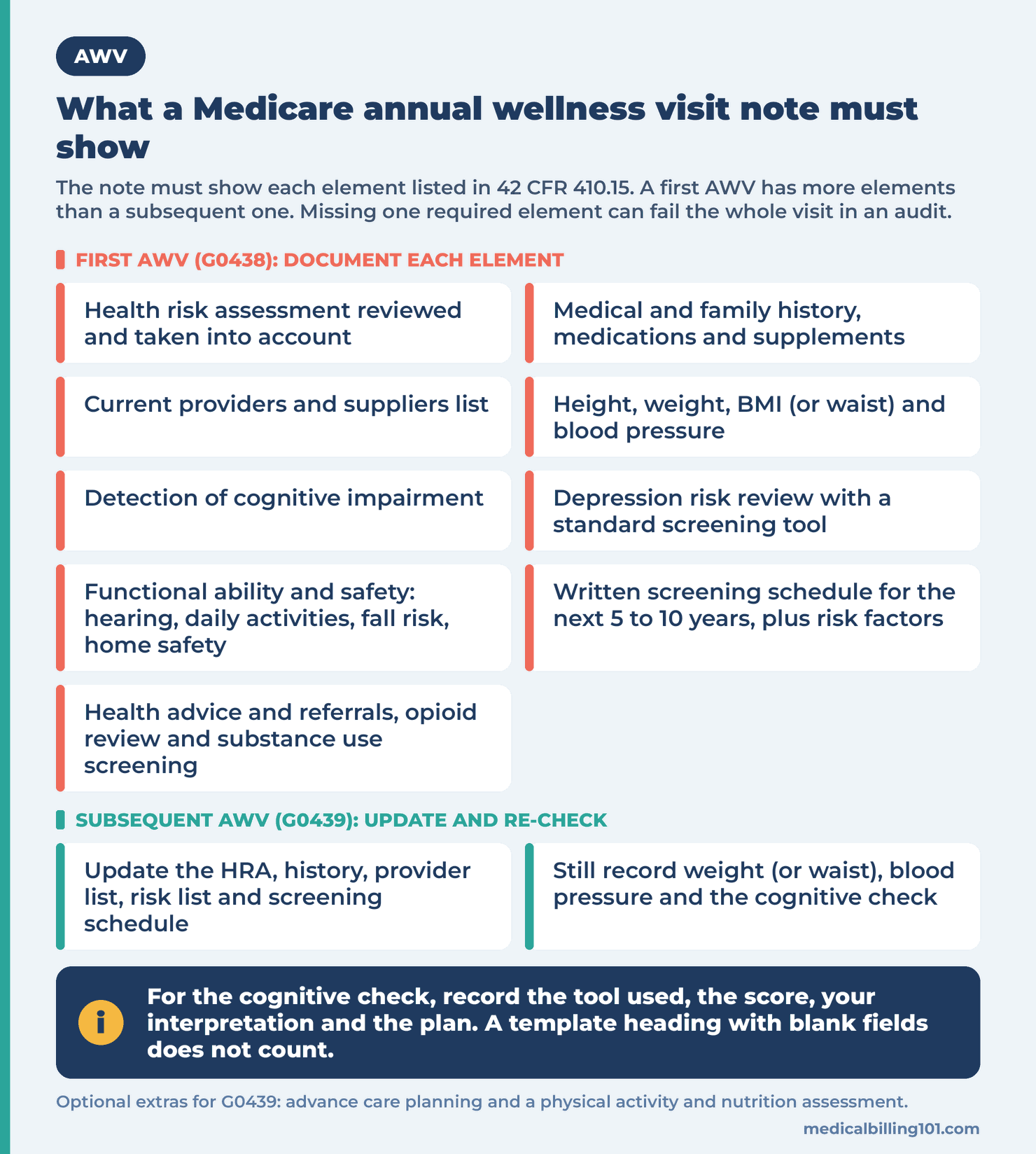
The note must show each element listed in 42 CFR 410.15. A first AWV has more elements than a subsequent one. Missing one required element can fail the whole visit in an audit.
For a first AWV (G0438), document these items:
- Health risk assessment (HRA) reviewed and taken into account.
- Medical and family history, including medications and supplements.
- Current providers and suppliers list.
- Height, weight, BMI (or waist circumference) and blood pressure.
- Detection of cognitive impairment.
- Depression risk review with a standard screening tool.
- Functional ability and safety review: hearing, daily activities, fall risk and home safety.
- Written screening schedule for the next 5 to 10 years, plus a list of risk factors.
- Personalized health advice and referrals, an opioid review and substance use screening.
A subsequent AWV (G0439) updates the HRA, history, provider list, risk list and screening schedule. It still needs weight (or waist circumference), blood pressure and the cognitive check. Advance care planning and a physical activity and nutrition assessment are optional extras.
Does the Mini-Cog clock drawing have to be scanned into the medical record?
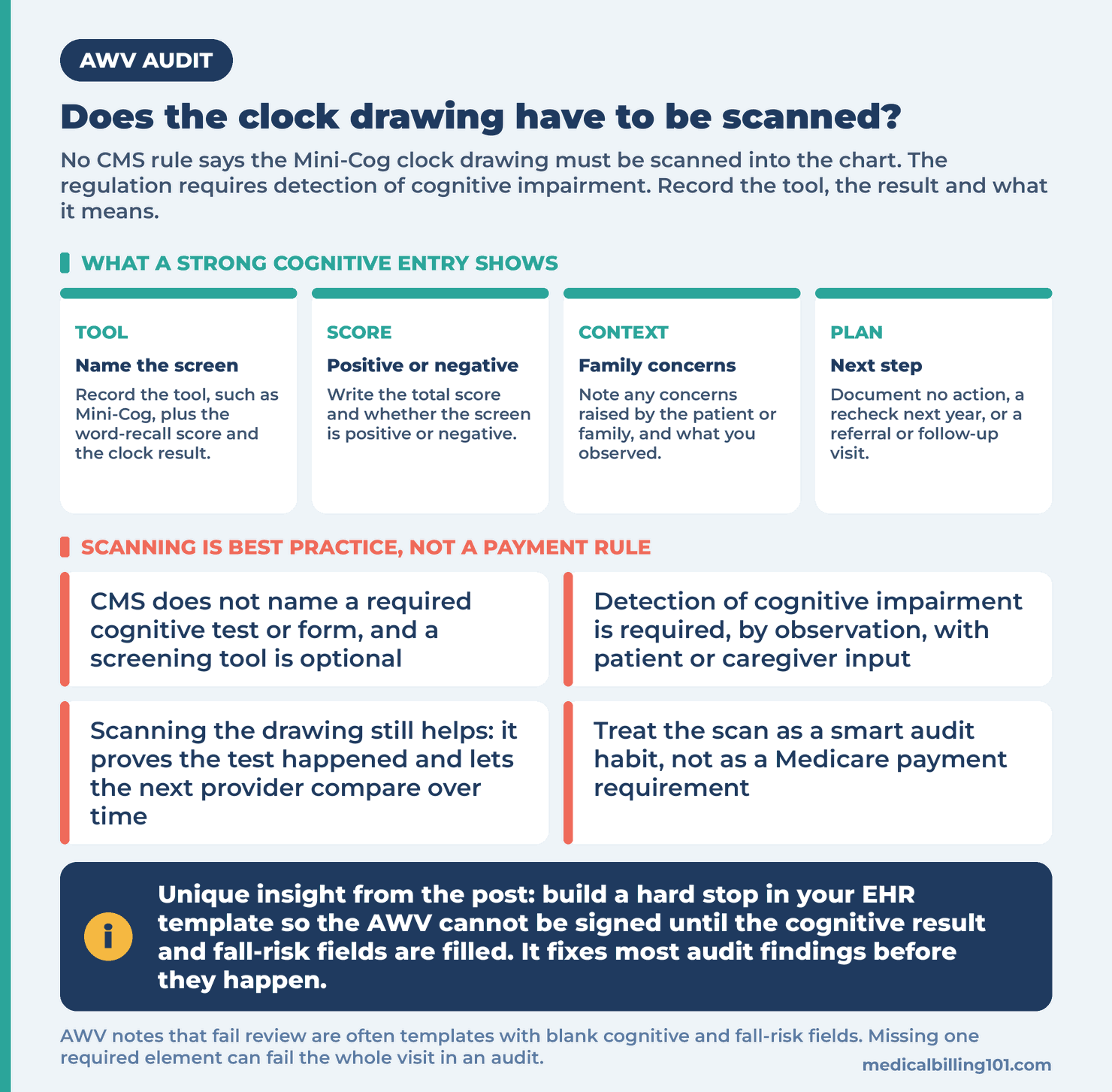
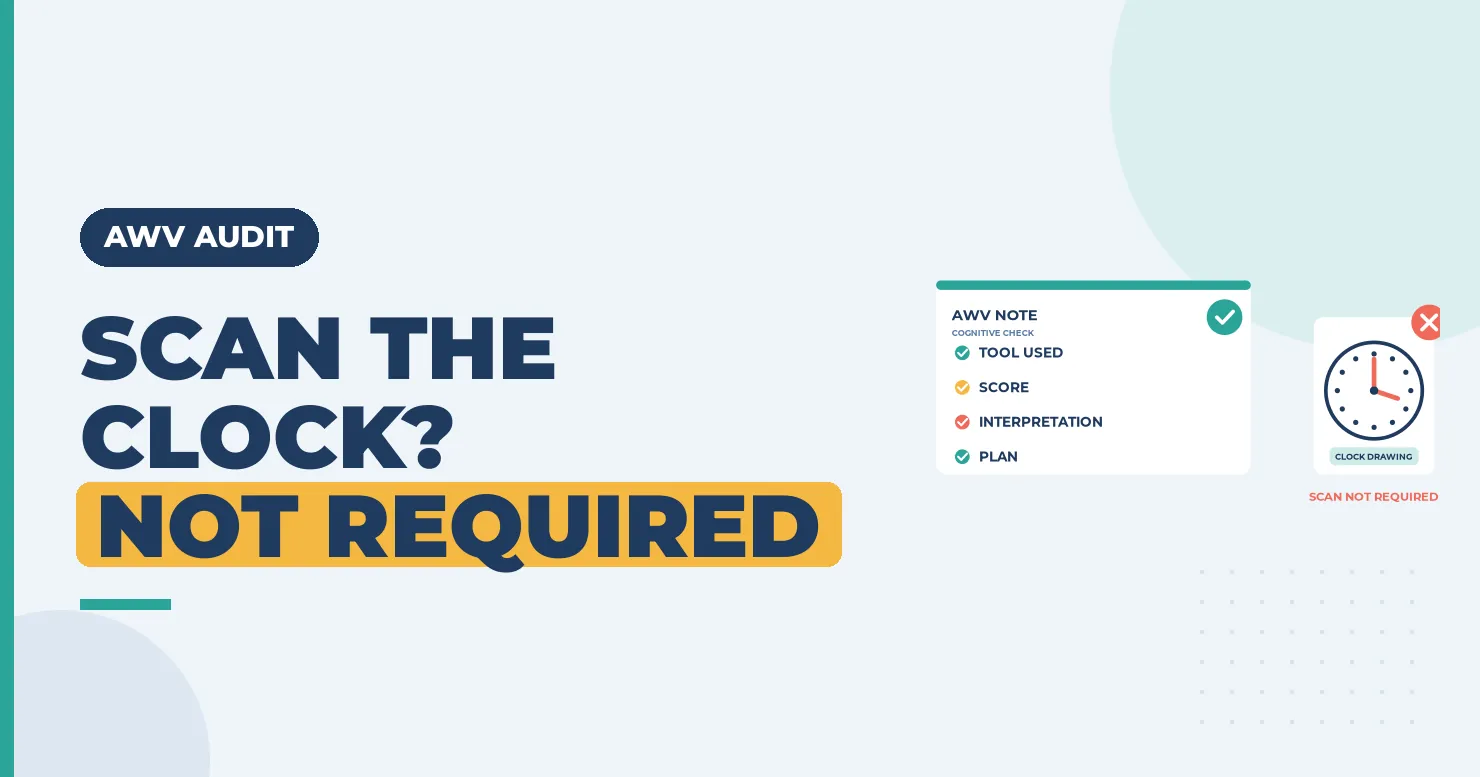
No CMS rule says the clock drawing itself must be scanned. The regulation requires detection of cognitive impairment by direct observation, with input from the patient, family or caregivers. A screening tool is optional. So the note must show what was done, the result and what it means.
CMS’s wording supports this. It asks you to assess cognition by observation and to “consider” brief cognitive tests. It does not name a required test or form. The Mini-Cog is one common 3-minute screen with word recall and a clock drawing.
For audit purposes, a strong cognitive entry includes these points:
- The tool name, such as Mini-Cog, plus the word-recall score and clock result.
- The total score and whether it is a positive or negative screen.
- Any concerns raised by the patient or family.
- The plan: no action, recheck next year, or a referral or follow-up visit.
Scanning the drawing is still a smart habit. It proves the test happened if a reviewer asks. It also helps the next provider compare drawings over time. Treat it as best practice, not a payment rule.
How should an AWV audit be done?
Audit each AWV against the element list for its code. Check G0438 notes against the first-visit list and G0439 notes against the subsequent-visit list. Then check frequency, provider type and any same-day codes.
- Eligibility: the patient is past the first 12 months of Part B, with no AWV or IPPE in the last 12 months.
- Right code: G0438 only once in a lifetime; G0439 after that.
- Every required element: each one is present, not just a template heading with blank fields.
- Prevention plan: a written screening schedule was given to the patient.
- Same-day E/M: a separate problem is documented to support modifier 25.
- Add-ons: 99497 and G0136 carry modifier 33 when done with the AWV.
Our guide to a preventive visit and sick visit on the same day covers the modifier 25 test. You can also check a pairing with our modifier 25 and 59 helper.
Can a Medicare annual wellness visit be done by telehealth?
Yes. G0438 and G0439 are on the CY 2026 Medicare Telehealth Services List, and CMS pays for them by telehealth. CMS has no separate telehealth AWV checklist, so the same required elements apply.
The CMS telehealth FAQ updated October 2026 says patients can get telehealth at home, anywhere in the U.S., through December 31, 2027. Use POS 10 for the patient’s home and POS 02 for other locations.
Audio-only is allowed at home when the patient cannot use video or does not consent to it. Under 42 CFR 410.78, add modifier 93. RHCs and FQHCs also add modifier FQ.
How do you document vitals, balance and gait in a telehealth AWV?
Use patient-reported vitals and label them that way. In a 2020 call, CMS staff said self-reported vitals can count for a telehealth AWV, as AAFP reported. Write “self-reported by patient” with the reading and date.
Balance and gait are not named exam items in 42 CFR 410.15. The rule asks for a fall-risk review, using direct observation or screening questions. On video, you can watch the patient stand and walk. On audio-only, use a standard fall-risk questionnaire.
If a patient has no scale or blood pressure cuff, record that the vital was not available. Then plan an in-office reading. Our answer on a phone follow-up by telehealth shows how audio-only rules affect other visits.
Which denials show up on AWV claims?
A common AWV denial is a frequency denial. Medicare denies G0438 or G0439 billed within 12 months of the last AWV or IPPE. The remittance shows CARC 119, benefit maximum reached, on the X12 claim adjustment reason code list.
Check the last AWV date in your eligibility response before the visit. If the patient already had an AWV elsewhere, bill G0439 later or plan a problem visit instead. Our CARC 119 denial guide covers the fix. A second common error is G0438 billed when the first AWV was done by another practice.
In my audit work, the AWV notes that failed review were usually templates with blank cognitive and fall-risk fields.
Build a hard stop in your EHR template: the AWV cannot be signed until the cognitive result and fall-risk fields are filled. It fixes most audit findings before they happen. For wider audit risks, see our medical necessity documentation guide.
3-step checklist
- Confirm the last AWV or IPPE date, then pick G0438 or G0439.
- Document every required element, including the cognitive tool, score and plan.
- For telehealth, use POS 10 or 02, add modifier 93 for audio-only, and label self-reported vitals.
FAQ
Does Medicare require the Mini-Cog clock drawing to be scanned?
No CMS rule requires the drawing itself in the chart. CMS requires detection of cognitive impairment, so document the tool, the score, the interpretation and the plan. Scanning the drawing is a good audit habit.
What is the difference between G0438 and G0439?
G0438 is the first annual wellness visit and is billed once per lifetime. G0439 is every later AWV. Medicare pays either one once in a 12-month period.
Can the Medicare AWV be done by telehealth?
Yes. G0438 and G0439 are on the CY 2026 Medicare Telehealth Services List. Use POS 10 for the patient’s home or POS 02 for other sites, and add modifier 93 for audio-only visits.
Can patients self-report vitals for a telehealth AWV?
Yes. CMS staff said self-reported vitals can count for a telehealth AWV. Document them as self-reported by the patient, with the reading and date.
Can I bill an E/M visit on the same day as an AWV?
Yes, if a separate, medically necessary problem is addressed. Bill 99202-99215 with modifier 25. The patient’s deductible and coinsurance apply to that E/M.
Sources
My methodology was simple. I checked 42 CFR 410.15 and 410.78, the CMS annual wellness visit page, the CY 2026 Medicare Telehealth Services List, the CMS telehealth FAQ, Medicare.gov, the X12 CARC list, the Mini-Cog site and AAFP’s report on self-reported vitals.
- eCFR, 42 CFR 410.15, annual wellness visit elements (linked above). Accessed 19 Nov 2026.
- CMS, Annual Wellness Visit page, last modified 16 Nov 2026 (linked above). Accessed 19 Nov 2026.
- Medicare.gov, yearly wellness visits (linked above). Accessed 19 Nov 2026.
- Mini-Cog, screening tool overview (linked above). Accessed 19 Nov 2026.
- CMS, CY 2026 Medicare Telehealth Services List (linked above). Accessed 19 Nov 2026.
- CMS, Telehealth FAQ updated 10/8/2026 (linked above). Accessed 19 Nov 2026.
- eCFR, 42 CFR 410.78, telehealth services and modifier 93 (linked above). Accessed 19 Nov 2026.
- AAFP, CMS on self-reported vitals for telehealth AWVs (linked above). Accessed 19 Nov 2026.
- X12, Claim Adjustment Reason Code 119 (linked above). Accessed 19 Nov 2026.
Read about the author, or contact us with a question. See our editorial policy.
Last updated: 19 November 2026 · Educational content for U.S. billers. Check each payer’s current rules.