
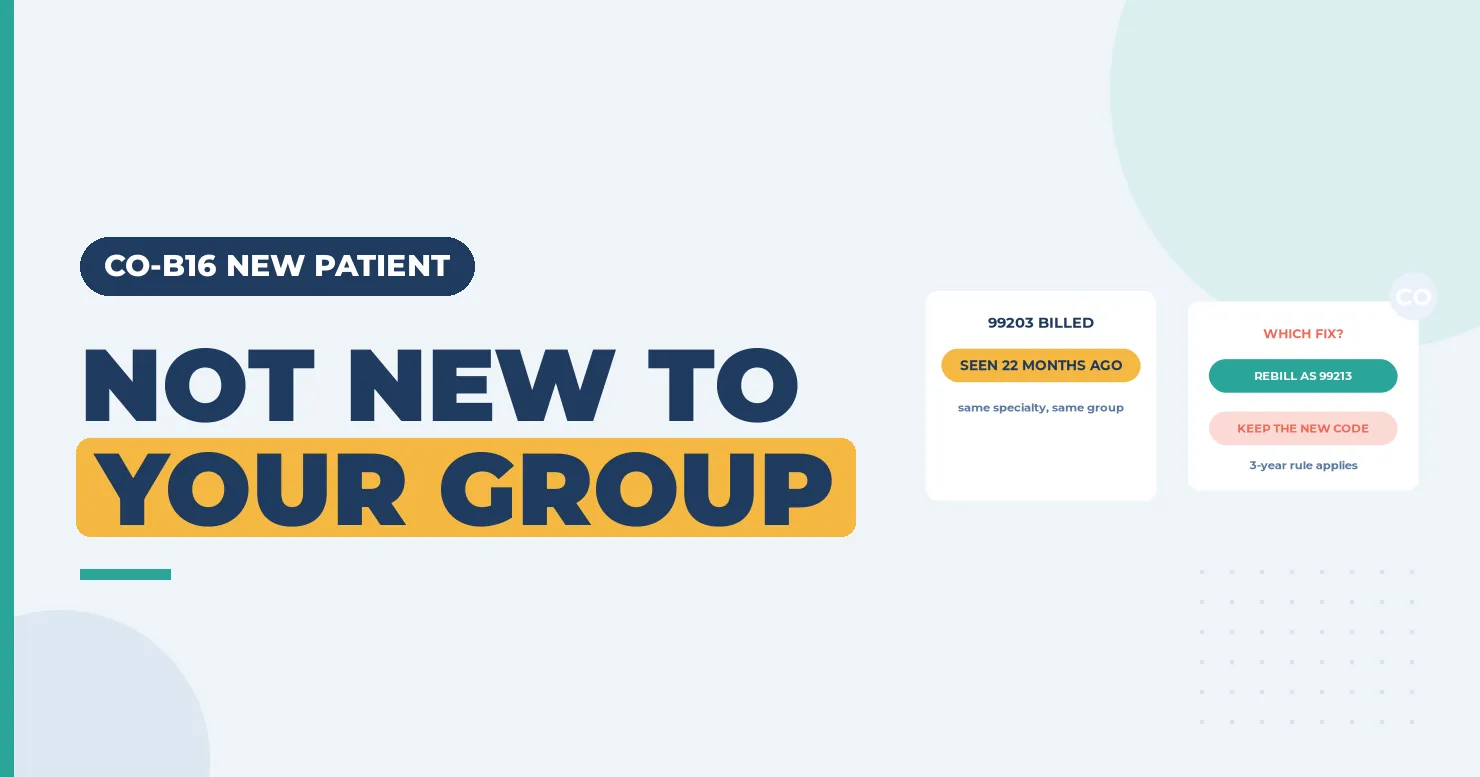
The CO-B16 denial code means you billed a new patient visit, but the payer’s history shows the patient already received care from your doctor or from a same-specialty colleague in your group in the last three years. The fix is usually a corrected claim with the matching established patient code. Appeal when the earlier service does not count under the rule. (Primary source: X12 Claim Adjustment Reason Codes)
In brief: reason code B16 is about patient history, not the visit level. Look up every professional service the patient had with your group in the past three years, by specialty. If one counts, rebill as established. If none counts, appeal.
Part of our denial codes library. Written by Manikandan J, CPC, CRCR, who has worked new patient denials for multi-doctor dermatology, orthopedic and primary care groups. Published 20 November 2026. Last updated: 20 November 2026. Code wording quoted word for word from X12. Read about the author and our editorial policy, or contact us to report an error.
What does denial code CO-B16 mean?
Denial code CO-B16 says the visit did not meet the payer’s definition of a new patient. It hits new patient codes such as 99202 to 99205, and new patient preventive codes such as 99381 to 99387. The payer checks its own claim history for your tax ID, your specialty and the past three years.
| Field | Value |
|---|---|
| Code | B16 |
| Description | “‘New Patient’ qualifications were not met.” |
| Group codes | No X12 group restriction; CO is the usual pairing |
| Start | 01/01/1995 (last modified 09/30/2007) |
| Common remark | N113 |
Source: X12 Claim Adjustment Reason Codes, checked 20 November 2026.
Methodology: the code wording is copied from the X12 list, and the 3-year rule is quoted from the CMS manual chapter cited below.
Key terms: a new patient has had no professional service from the doctor, or a same-specialty doctor in the group, in three years. An established patient has. Taxonomy is the code that tells the payer each doctor’s specialty.
CO-B16 or OA-B16: which one did you get?
| Group | Who carries the amount | What to do |
|---|---|---|
| CO-B16 | Your practice, as a contractual write-off; the patient is not billed | Rebill as established or appeal |
| OA-B16 | No one is named, often a secondary payer echoing the primary’s denial | Fix the primary claim, then rebill the secondary |
Example scenario (fictional names), part 1
CO-B16 Denial Example: What Happened
Priya Raman runs billing at Harbor Point Dermatology. Dr. Marcus Bell joined the group this year. His first visit with a patient was for actinic keratosis, L57.0, and registration booked her as new because she had never seen Dr. Bell.
The claim went out with 99203. The 835 came back with CAS*CO*B16 and remark code N113, “Only one initial visit is covered per physician, group practice or provider.” The patient insisted she had never met Dr. Bell.
So whose earlier visit was the payer counting? Keep reading, or jump to how the CO-B16 denial was resolved.
How does the 3-year new patient rule work?
The CMS Claims Processing Manual, Chapter 12, section 30.6.7 defines a new patient as one who has not received any professional services from the physician or group practice (same physician specialty) within the previous 3 years. Most commercial plans use the same CPT definition.
| Earlier contact | Does it make the patient established? |
|---|---|
| Office visit with the same doctor 2 years ago | Yes |
| Visit with a same-specialty doctor in your group | Yes |
| Visit with a different-specialty doctor in your group | No |
| Only an EKG or x-ray reading, no face-to-face visit | No, per the CMS example |
| Last visit more than 3 years ago | No |
A doctor who changes groups brings history along. A patient who follows the doctor to a new practice is usually established with that doctor.
How do I fix a CO-B16 denial?
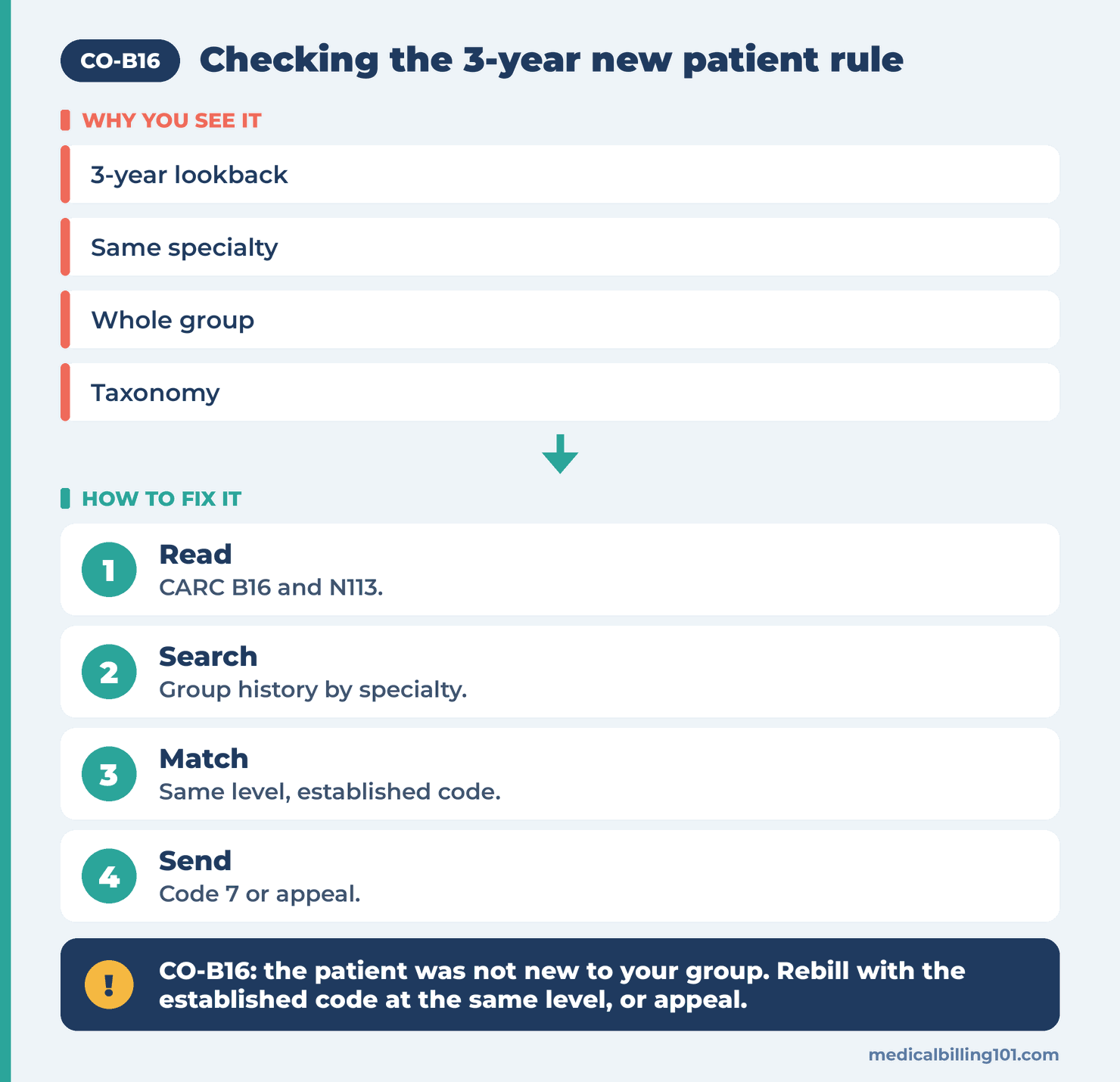
To fix a CO-B16 denial, pull the patient’s history across your whole tax ID, not just the rendering doctor. Then match the result to one of the rows below.
| Situation | Fix | Proof |
|---|---|---|
| Same-specialty visit in the past 3 years | Corrected claim with the established code at the same level, Box 22 code 7 | Visit history |
| Earlier visit was another specialty | Appeal; ask the payer to check the other doctor’s taxonomy | Enrollment records |
| Only a test reading, no visit | Appeal citing section 30.6.7 | The earlier claim |
| Earlier visit more than 3 years ago | Appeal with the dates | Visit history |
Keep the visit level the same when you switch codes. A low-complexity 99203 becomes 99213, because both rest on the same medical decision making. The CMS E/M services guide lists the new and established code families.
Example scenario (fictional names), part 2
How the CO-B16 Denial Was Resolved
Priya searched the group’s records, not just Dr. Bell’s. Here is what she found:
- Dr. Lena Okafor, also a dermatologist in the group, had treated the same patient for a rash 22 months earlier.
- Same specialty, same group, inside 3 years: the patient was established.
- The visit itself was documented at low complexity.
Fix: she sent a corrected claim with code 7 in Box 22 and the original claim number. Box 24D changed from 99203 to 99213, and L57.0 stayed the same.
Outcome: the payer paid 99213. Priya changed registration so the new-patient flag checks the whole group’s 3-year history by specialty.
Names and details are illustrative; no real patient data.
Names and details are illustrative; no real patient data.
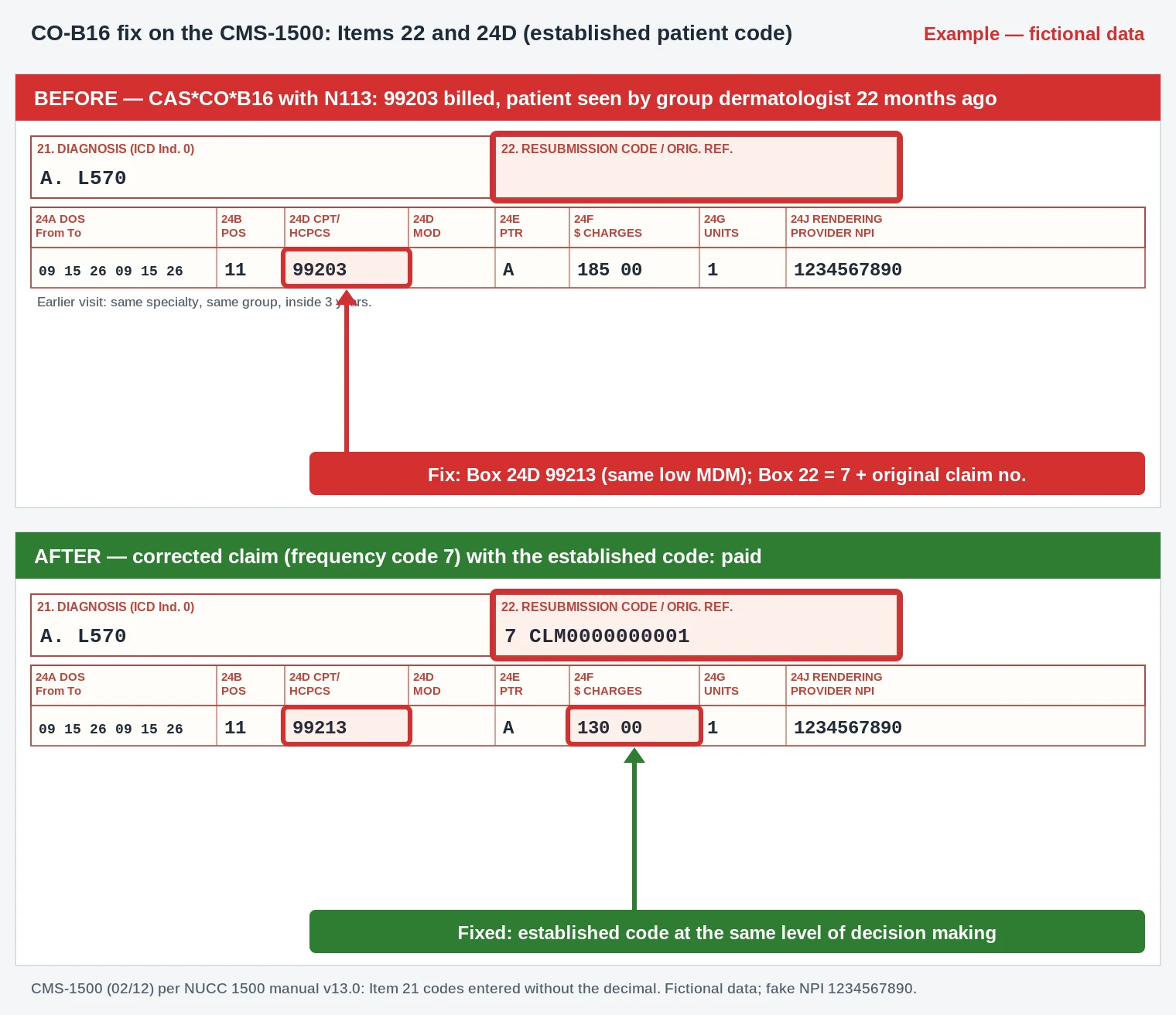
- Box 24D: 99203 changed to 99213; both reflect low-complexity medical decision making, so the level stays the same.
- Box 24F: the charge follows the established code (amounts are placeholders).
- Box 22: resubmission code 7 (corrected claim) with the original claim number.
- Box 21: L57.0 (entered as L570) is unchanged.
- UB-04: not shown; hospital clinic visits use G0463 with no new or established split.
Can I bill the patient for a CO-B16 denial?
No. The CO group code makes the denied amount a contractual provider write-off. The patient owes only the copay, deductible or coinsurance on the visit the payer allows after you rebill.
How do I prevent CARC B16?
Prevent it at scheduling. Search the patient by name and date of birth across every location and doctor in your tax ID, then check the specialty and the date of the last face-to-face service. For example, a group that adds a new doctor often sees a wave of B16 denials, because staff assume a patient who is new to the doctor is new to the practice. Keep each doctor’s taxonomy current, such as dermatology versus plastic surgery, so the payer counts specialties the way you do.
Related codes
| Code | Meaning |
|---|---|
| CO-150 | Information submitted does not support this level of service |
| CO-8 | Procedure code inconsistent with the provider type or specialty |
| CO-B13 | Previously paid; payment may have been made in an earlier payment |
| CO-16 | Claim lacks information or has a submission or billing error |
FAQ
What does CO-B16 mean?
The payer says the patient does not qualify as new, so the new patient visit code was denied.
How long before a patient is new again?
Three years with no professional service from the doctor or a same-specialty doctor in the group.
Does a new doctor in my group make the patient new?
Not if a same-specialty doctor in the group saw the patient in the last three years.
Should I rebill or appeal CARC B16?
Rebill with the established code if a qualifying visit exists. Appeal if the earlier service was another specialty, a test reading only, or older than three years.
Which group code comes with CARC B16?
X12 sets no group restriction. CO is the most common pairing.
Sources
How we checked: the CARC B16 quote was matched word for word with the X12 CARC list on 20 November 2026, and N113 with the X12 RARC list.
- X12, Claim Adjustment Reason Codes (CARC B16, 150, 8, B13, 16). Accessed 20 Nov 2026.
- X12, Remittance Advice Remark Codes (N113). Accessed 20 Nov 2026.
- CMS, Medicare Claims Processing Manual, Chapter 12 (section 30.6.7, new patient). Accessed 20 Nov 2026.
- CMS, Evaluation and Management Services Guide (MLN). Accessed 20 Nov 2026.
- NUCC, 1500 claim form reference instruction manual. Accessed 20 Nov 2026.
Last updated: 20 November 2026 · Educational content; not legal advice.