
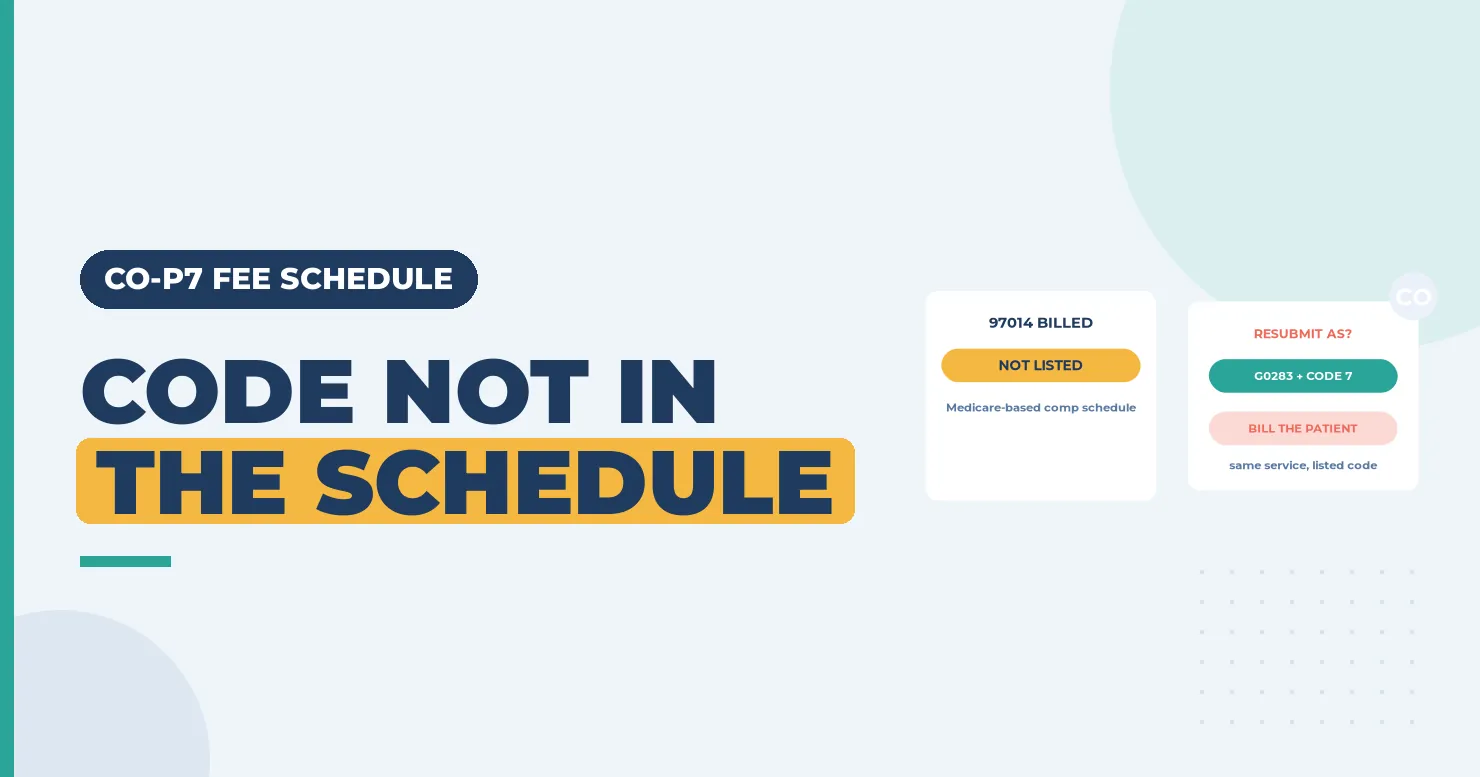
The CO-P7 denial code means the workers’ comp or auto payer could not find your billed code in the fee schedule it must use. The service may be payable, but not under that code. Look up the code the schedule does list for the same service, then resubmit a bill with it and any records the payer asks for. (Primary source: X12 Claim Adjustment Reason Codes)
In brief: reason code P7 is a code-set mismatch, not a coverage denial. Find which fee schedule applies to the claim, search it for the service, and rebill with the listed code. Many state comp schedules follow Medicare codes, so a code Medicare does not recognize may be missing.
Part of our denial codes library. Written by Manikandan J, CPC, CRCR, who has corrected fee schedule rejections for physical therapy, chiropractic and hospital outpatient rehab claims. Published 21 November 2026. Last updated: 21 November 2026. Code wording quoted word for word from X12. Read about the author and our editorial policy, or contact us to report an error.
What does denial code CO-P7 mean?
Denial code CO-P7 says the fee schedule or fee database the payer uses has no entry for the procedure code you billed. Only property and casualty payers send it. That means workers’ compensation carriers and auto insurers, including no-fault and personal injury protection plans.
| Field | Value |
|---|---|
| Code | P7 |
| Description | “The applicable fee schedule/fee database does not contain the billed code. Please resubmit a bill with the appropriate fee schedule/fee database code(s) that best describe the service(s) provided and supporting documentation if required. To be used for Property and Casualty only.” |
| Group codes | No X12 group restriction; CO is the usual pairing |
| Start | 11/01/2013; replaces code 220 |
| Common remark | N448 |
Source: X12 Claim Adjustment Reason Codes, checked 21 November 2026.
Methodology: the code wording is copied from the X12 list, and the fee schedule examples come from the CMS and state pages cited below.
Key terms: A fee schedule is the official list of codes and maximum payments a state or payer adopts. A fee database is a commercial data set some auto payers use instead. A crosswalk is a lookup that matches a code the schedule lacks to one it lists.
CO-P7 or OA-P7: which one did you get?
| Group | Who carries the amount | What to do |
|---|---|---|
| CO-P7 | Your practice, until you resubmit with a listed code; do not bill the injured patient | Rebill with the schedule’s code |
| OA-P7 | No one is named; often a secondary auto payer repeating the first decision | Fix the code, then rebill both payers in order |
Example scenario (fictional names), part 1
CO-P7 Denial Example: What Happened
Theo Vance runs billing at Northshore Rehab, a physical therapy clinic that treats many injured workers. Therapist Carla Nguyen treated a warehouse worker for a low back strain, S39.012D, with exercise, 97110, and unattended electrical stimulation, 97014.
The fictional comp carrier paid 97110. The 97014 line came back with CAS*CO*P7 and remark code N448, “This drug/service/supply is not included in the fee schedule or contracted/legislated fee arrangement.” The same code had always paid from health plans. The carrier’s explanation of review named the state comp fee schedule as its source.
Why would a common therapy code be missing from the schedule? Keep reading, or jump to how the CO-P7 denial was resolved.
Why is my code missing from the fee schedule?
Each state picks its own comp fee schedule, and many build it on Medicare’s code set and payment rules. For example, the Texas Division of Workers’ Compensation fee guidelines set reimbursement methods for professional services in 28 TAC Chapter 134. When a schedule follows Medicare, a code Medicare does not recognize may simply not be listed.
| Common cause | Example | Fix |
|---|---|---|
| Medicare-style schedule lacks a CPT code | 97014 billed where the schedule lists G0283 | Rebill with the listed HCPCS code |
| New code not yet adopted | A new CPT code billed before the state update | Use the prior code the schedule still lists, or ask for a by-report review |
| Unlisted or state-only codes | A state comp report code billed to an auto payer | Use the payer’s own schedule |
| Wrong schedule applied | Auto claim priced on the comp schedule | Ask the payer to apply the right schedule |
How do I fix a CO-P7 denial?
To fix a CO-P7 denial, confirm which schedule the payer used, then find the listed code that best describes the same service. Do not change the service to fit a code that pays more.
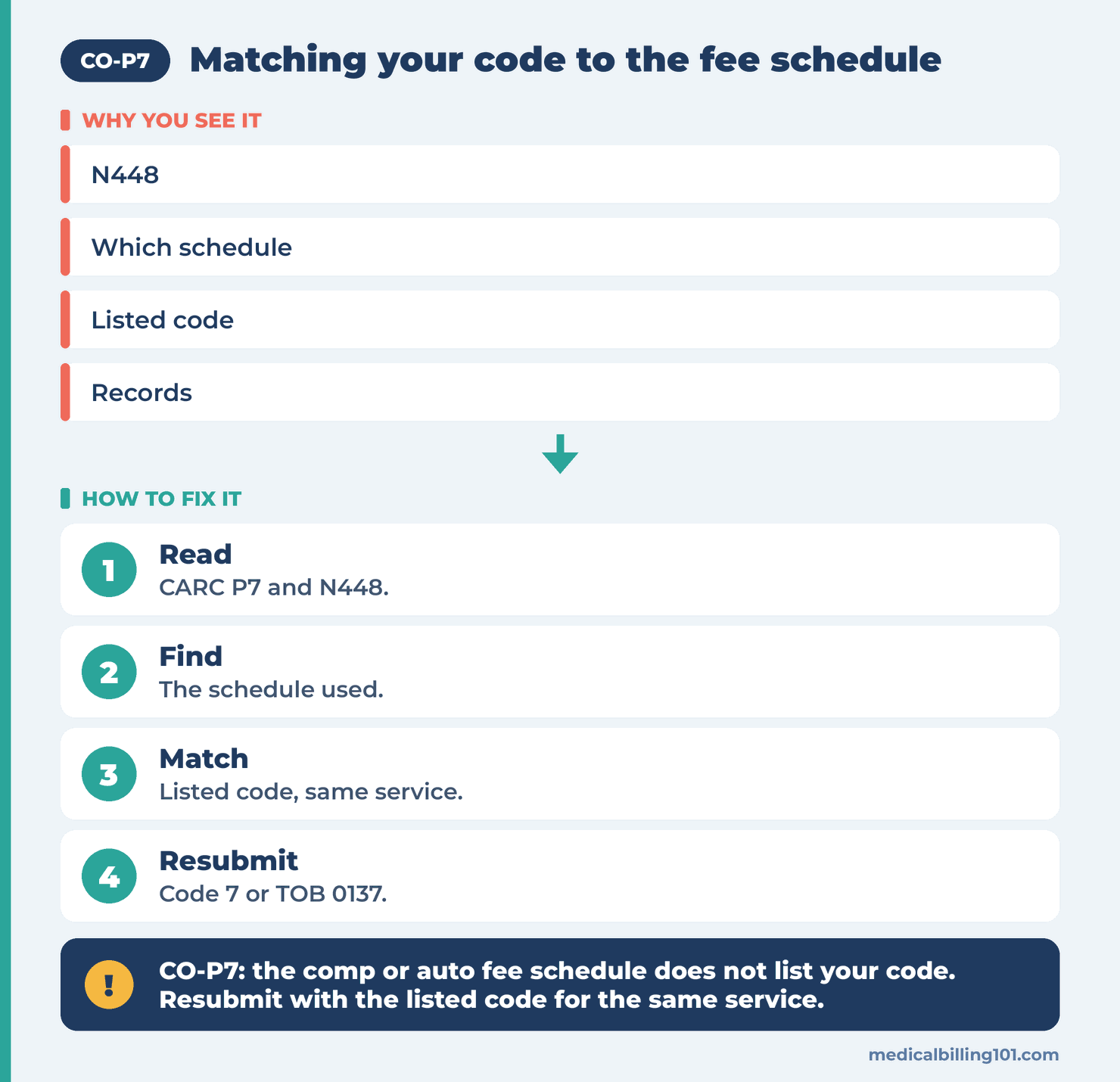
| Step | What to do | Where to look |
|---|---|---|
| 1 | Read the remark and the payer’s letter for the schedule name | 835 and explanation of review |
| 2 | Search the schedule for the service | State comp agency or payer fee database |
| 3 | Check the Medicare status of the code | CMS Physician Fee Schedule lookup |
| 4 | Resubmit with the listed code and any records required | Corrected bill, Box 22 code 7 or bill type 0137 |
Example scenario (fictional names), part 2
How the CO-P7 Denial Was Resolved
Theo checked the state’s comp schedule and saw it used Medicare’s code set. Medicare does not pay 97014 and uses HCPCS G0283 for unattended electrical stimulation instead. The therapy note supported exactly that service.
Fix: he sent a corrected bill with Box 22 code 7 and the original claim number. Box 24D changed from 97014 to G0283, and S39.012D stayed linked to the line.
Outcome: the carrier paid G0283 at the schedule rate. Theo built a payer rule so comp claims in that state swap 97014 for G0283 before they go out.
Names and details are illustrative; no real patient data.
Names and details are illustrative; no real patient data.
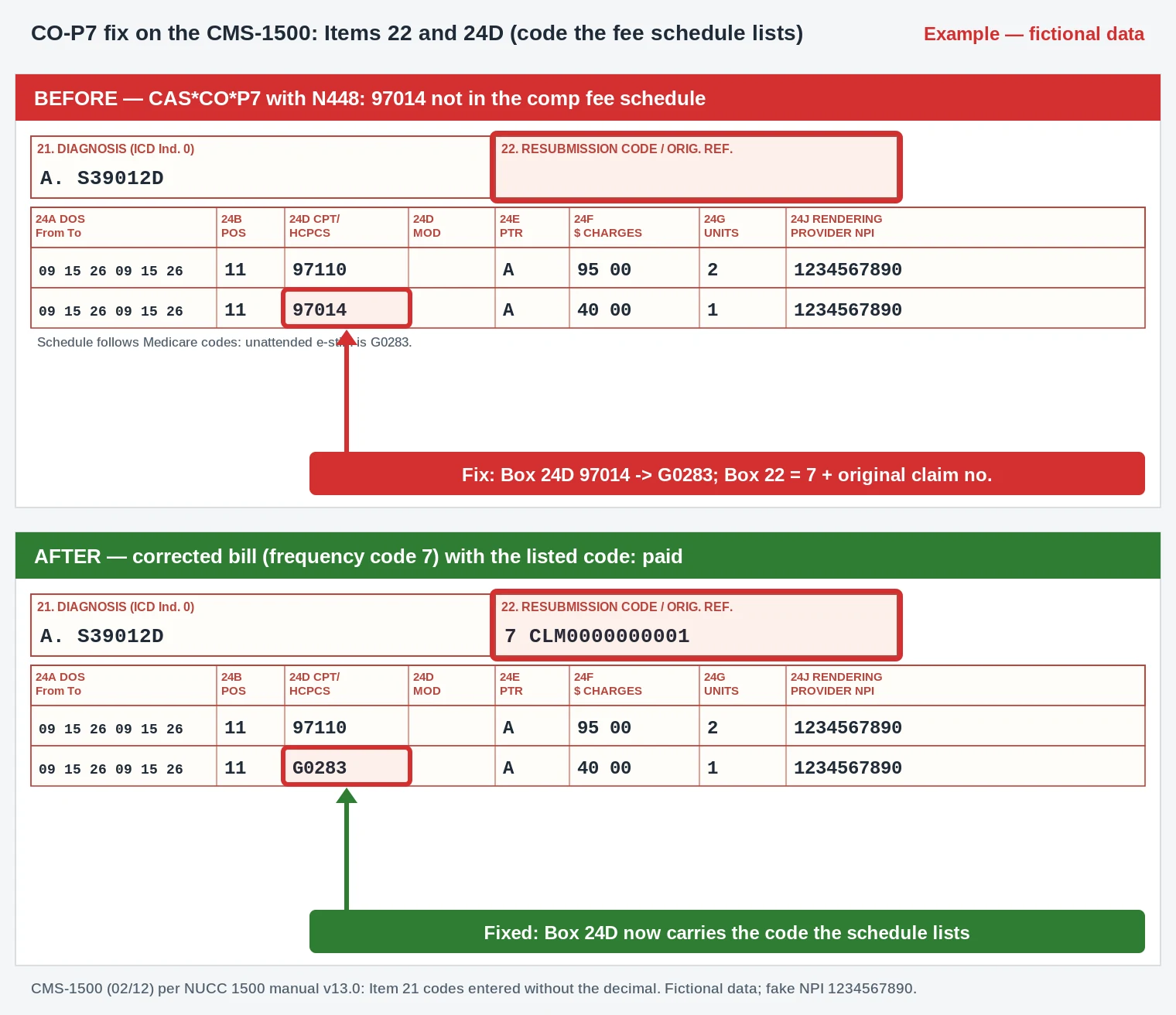
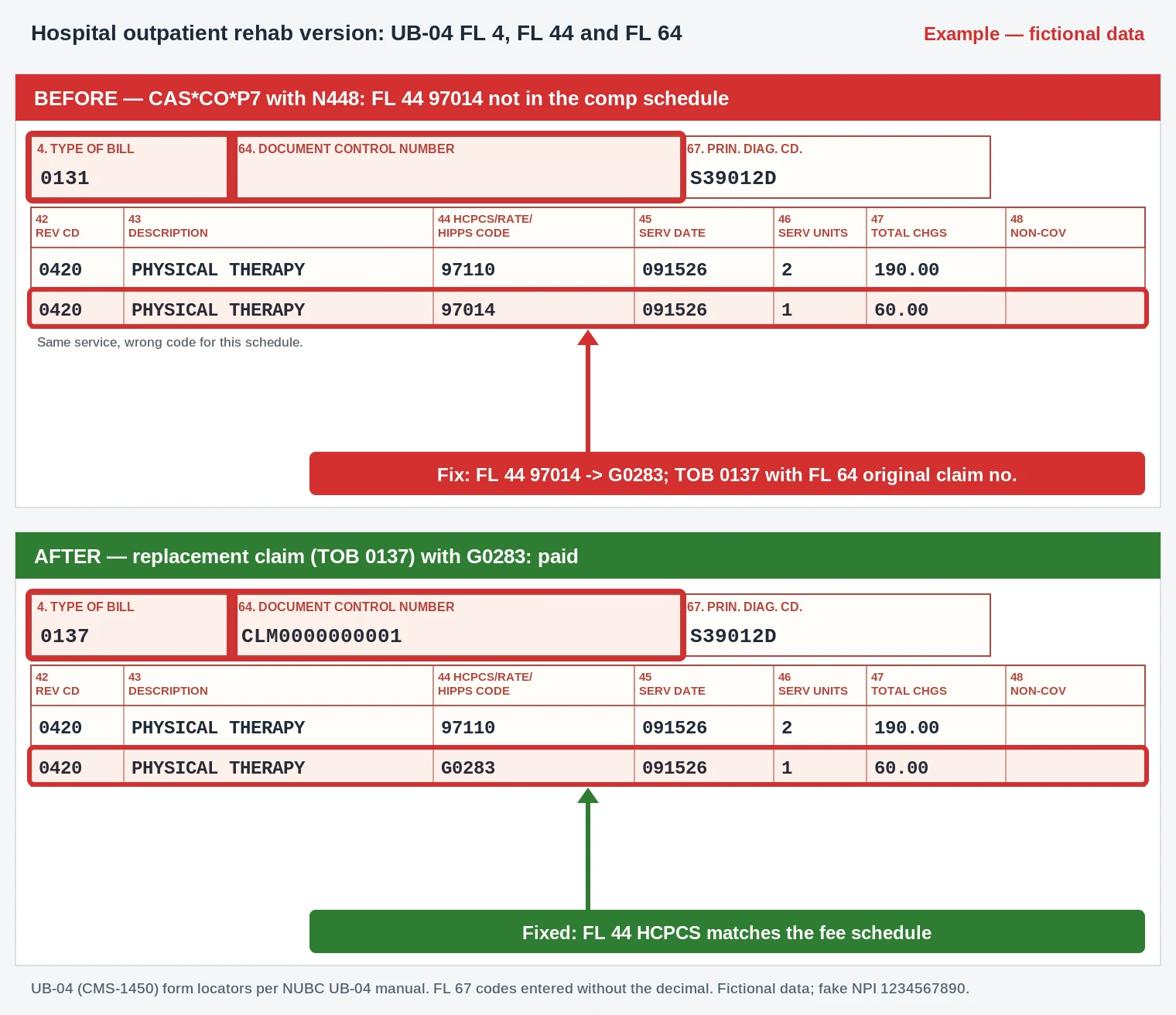
- Box 24D / FL 44: 97014 replaced by HCPCS G0283, the code the Medicare-based schedule lists for unattended electrical stimulation; the service itself did not change.
- Box 22 / FL 4 + FL 64: frequency code 7 with the original claim number (bill type 0137 on the UB-04).
- Box 21 / FL 67: S39.012D (entered as S39012D) and the 97110 line are unchanged.
- Box 24F / FL 47: charges are placeholders; the payer prices the line from the schedule.
Can I bill the patient for a CO-P7 denial?
No. Comp and most auto injury laws limit what an injured patient can be charged for covered care. A CO-P7 line is a billing fix on your side, so correct the code and resubmit instead of sending a statement.
How do I prevent CARC P7?
Keep a payer-specific code list for each comp and auto schedule you bill, such as a short table of codes that differ from your health plan billing. Check it each time the state publishes a new schedule. Common traps include therapy modalities, injections and supply codes.
Related codes
| Code | Meaning |
|---|---|
| CO-P1 | State-mandated requirement for property and casualty |
| CO-P4 | Workers’ comp claim adjudicated as non-compensable |
| CO-181 | Procedure code was invalid on the date of service |
| CO-16 | Claim lacks information or has a submission or billing error |
FAQ
What does CO-P7 mean?
The comp or auto fee schedule the payer uses does not list your billed code, so you need to resubmit with a code it does list.
Is CARC P7 a final denial?
No. X12 wording asks you to resubmit a bill with the right fee schedule code and any supporting documentation.
What does N448 mean with CO-P7?
It says the service is not included in the fee schedule or the contracted or legislated fee arrangement.
Can I switch to any code that pays?
No. Pick the listed code that best describes the service you actually gave, and keep the note to support it.
Which group code comes with CARC P7?
X12 sets no group restriction. CO is the most common pairing, and OA also appears.
Sources
How we checked: the CARC P7 quote was matched word for word with the X12 CARC list on 21 November 2026, and N448 with the X12 RARC list.
- X12, Claim Adjustment Reason Codes (CARC P7, P1, P4, 181, 16). Accessed 21 Nov 2026.
- X12, Remittance Advice Remark Codes (N448). Accessed 21 Nov 2026.
- Texas Department of Insurance, Division of Workers’ Compensation, medical fee guidelines. Accessed 21 Nov 2026.
- CMS, Physician Fee Schedule lookup. Accessed 21 Nov 2026.
- NUCC, 1500 claim form reference instruction manual. Accessed 21 Nov 2026.
Last updated: 21 November 2026 · Educational content; not legal advice.