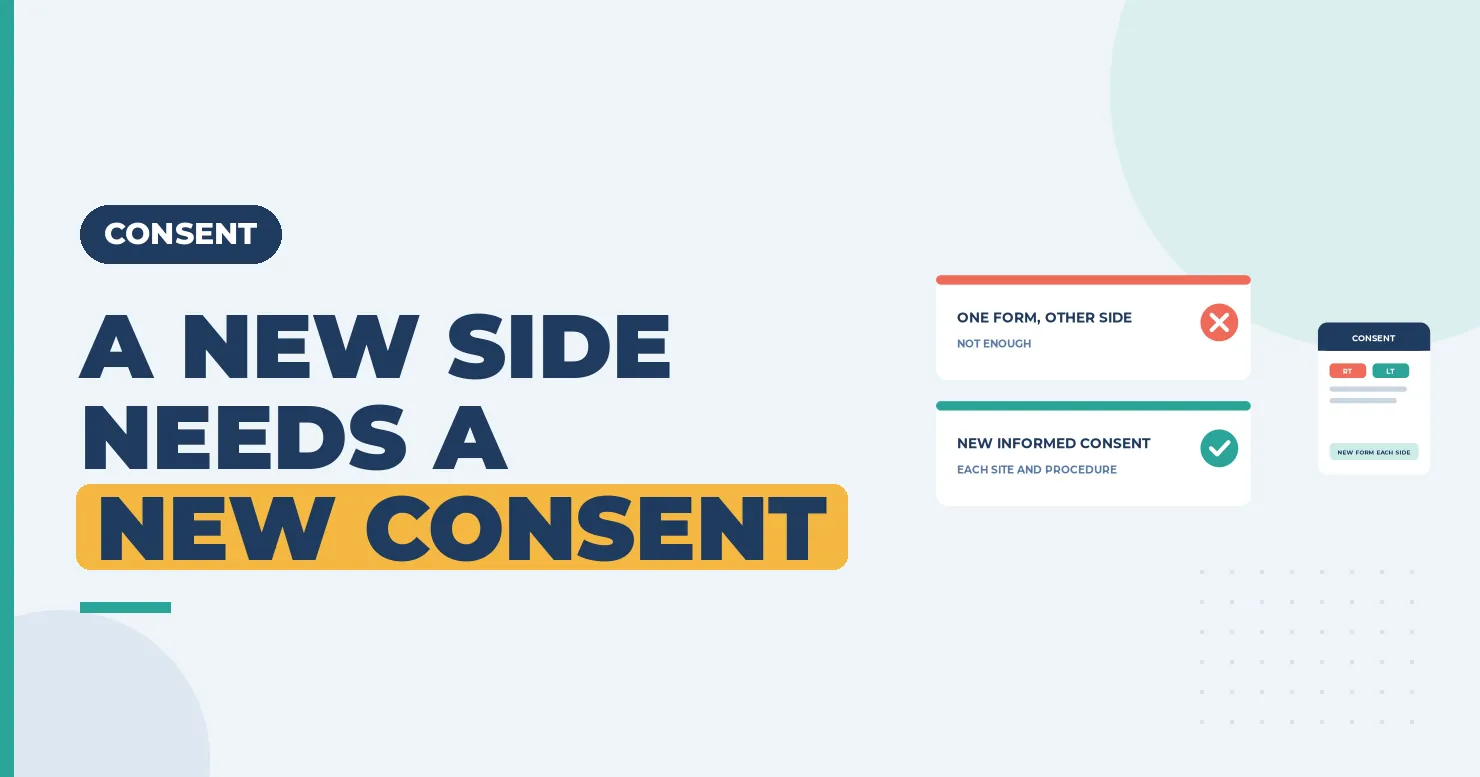
A consent for treatment form has no federal expiration date. Most offices get a general consent at the first visit and renew it yearly, and they get a new informed consent for each procedure.
The fix: keep two separate forms. Use one general consent and billing authorization on a set schedule, and one informed consent for every new procedure, side or change in risk.
TL;DR: No CMS rule sets how often a general consent must be re-signed. Annual renewal is a common office policy, not a federal rule. Informed consent belongs to a specific procedure. If the same procedure moves to the other leg, get and document a new informed consent. Your state law and payer contracts can add stricter rules.
Written by Manikandan J, CPC, CRCR, a certified coder and revenue cycle specialist. Published 22 November 2026. Last updated: 22 November 2026.
Table of Contents
How often does a consent for treatment form need to be signed?
There is no single federal schedule for a general consent for treatment form. Federal rules for physician offices do not say it expires after a year. Many practices still renew it yearly, and that is a sound habit.
A yearly refresh lets the front desk confirm insurance, contacts and the patient’s signature at the same time. Your state law, malpractice carrier or payer contract may set a stricter rule. Ask your compliance lead which source your policy follows.
A general consent is a different form from an informed consent. The general form covers the right to examine, treat and bill. The informed consent covers one specific procedure and its risks.
Example scenario (fictional names), part 1
Consent for treatment example: what happened
- Practice: Piedmont Ridge Orthopedics, a fictional specialist office (POS 11).
- Biller: Marisol Okafor. Physician: Dr. Graham Whitfield.
- Week 1: knee injection 20610-RT for right knee osteoarthritis (M17.11), with a signed informed consent.
- Week 2: the same injection on the left knee, billed 20610-LT with M17.12.
A fictional commercial plan then asked for records on the left-knee claim. Marisol pulled the chart. The general consent was current, but the only procedure consent named the right knee.
Was the left-knee visit covered by the old form? Keep reading, or jump to how the case was resolved.
What is the difference between general consent and informed consent?
General consent is the patient’s broad agreement to be seen and treated. Informed consent is agreement to one specific procedure after the risks, benefits and options are explained. The first is an office form. The second is a clinical conversation.
The AMA Code of Medical Ethics opinion on informed consent describes that conversation. The physician explains the diagnosis, the purpose of the procedure, and the risks, benefits and options, including no treatment. The decision is then documented in the record.
| Form | What it covers | Common renewal |
|---|---|---|
| General consent for treatment | Permission to examine and treat | First visit, then yearly by office policy |
| Assignment of benefits and billing authorization | Release of claim information and payment to the provider | Medicare: on file until revoked |
| Notice of Privacy Practices acknowledgment | Receipt of the HIPAA notice | First service date; requirement ends by July 19, 2027 |
| Informed consent | One procedure, its risks and options | Each new procedure, side or change in risk |
Do you need a new informed consent for the same procedure on the other side?
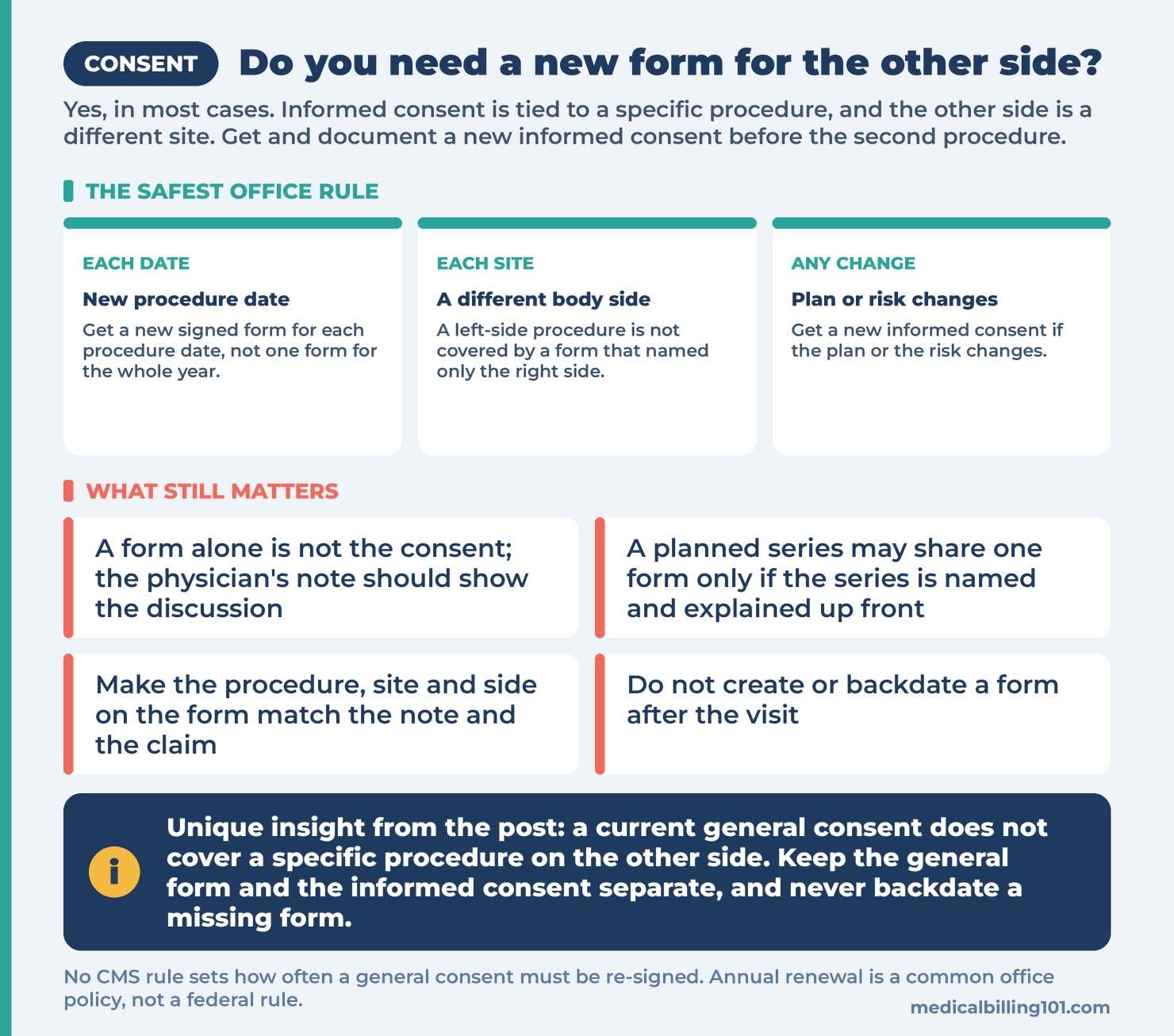
Yes, in most cases. Informed consent is tied to a specific procedure, and the left leg is a different site than the right leg. Get and document a new informed consent before the second procedure.
The safest office rule is simple. Get a new signed form for each procedure date, each body site and any change in plan or risk. Some practices allow one consent for a planned series. For example, a set of weekly injections on one knee may share one form. That series must be named and explained up front.
A form alone is not the consent. The physician’s note should show the discussion. Our guide to urodynamic documentation requirements shows how signatures and reports support a billed service. The same thinking applies to procedure notes.
The side must match on the claim too. Bill RT and LT, or the payer’s bilateral rule, the way our post on x-ray claim modifiers 50, RT and LT explains.
What does North Carolina law say about informed consent?
North Carolina sets an informed consent standard, not a renewal schedule. The law asks whether consent met the practice standard of similar providers. It also asks whether a reasonable person would understand the procedure and its usual risks.
N.C. Gen. Stat. 90-21.13 also helps written forms. A signed written consent that meets the standard is presumed valid. That is a strong reason to get a signed form for each procedure.
Other states use their own rules. Check your state statute or medical board guidance before you set a policy.
Does Medicare require a new billing signature every year?
No. For Medicare Part B claims, a signature on file stays effective until the patient revokes it. A signature on file means a signed billing authorization kept in the office record. That covers release of claim information and payment to the provider on assigned claims.
The Medicare Claims Processing Manual, Chapter 26 explains Items 12 and 13 of the CMS-1500. The patient may sign a statement kept in the office file. The claim can then show “Signature on File.” The authorization is effective indefinitely unless revoked.
The rule behind this is 42 CFR 424.36, which covers beneficiary signatures and who may sign when the patient cannot. Commercial plans may ask for more. A yearly refresh still catches name changes and new insurance.
In AR follow-up, many eligibility denials I worked traced back to an old insurance card on file. A yearly re-sign is a good time to scan the new card.
Does HIPAA require a signed consent to bill insurance?
No. HIPAA lets a provider use and share health information for treatment, payment and operations without a patient consent. A practice may still ask for one, but federal privacy law does not require it.
45 CFR 164.506 makes that consent optional. The separate duty under 45 CFR 164.520 is the Notice of Privacy Practices. Today, a provider gives the notice by the first service date and makes a good faith effort to get a written acknowledgment.
That acknowledgment rule is changing. A final HIPAA Privacy Rule published November 19, 2026 removes the written acknowledgment requirement. It takes effect January 19, 2027, and compliance is due by July 19, 2027.
When is a signed consent form a payment requirement?
Some services, such as Medicaid sterilization, cannot be paid without a specific consent form. Sterilization is the clearest case. The federal consent form must be signed at least 30 days, but not more than 180 days, before the procedure.
That timing comes from 42 CFR 441.253, with exceptions for premature delivery and emergency abdominal surgery. Hospitals also have a records rule. 42 CFR 482.24 requires properly executed informed consent forms in the record for listed procedures.
For most office procedures, the consent supports the record rather than the claim. Auditors still read it. Missing or mismatched consents show up in record reviews, as our list of OIG audit triggers in medical billing shows. Pair them with notes that prove medical necessity documentation.
How do you set up a consent for treatment policy?
Write one policy that names each form, who signs it and when it renews. Then train the front desk and clinical staff on the same list. Audit a few charts each month.
- Get the general consent and billing authorization at the first visit.
- Refresh them yearly, or when insurance or guardianship changes.
- Get a new informed consent for each procedure, side or change in risk.
- Make the procedure, site and side on the form match the note and claim.
- Keep a Medicare signature on file and note any revocation.
- Store every signed form in the chart, not a loose binder.
Example scenario (fictional names), part 2
How the consent for treatment case was resolved
- Marisol read Dr. Whitfield’s week 2 note. It documented a left-knee risk and benefit talk and the patient’s agreement.
- She sent the note, the order and the general consent with the records. She did not create or backdate any form.
- The compliance lead changed the policy. Now each procedure date and side gets its own signed informed consent.
The plan closed its records request with no change to the claim. The new policy started the next week.
Names and details are illustrative; no real patient data.
What should patients know about consent and billing forms?
Patients can ask what each form covers before they sign. A general consent does not approve a specific procedure. A billing authorization does not mean insurance will pay.
If a bill arrives that a patient did not expect, our guide for a patient upset about a medical bill lists calm next steps. Our patient cost estimator helps estimate the share before a procedure.
3-step checklist
- Separate the general consent, billing authorization and informed consent forms.
- Renew the general consent yearly, and get a new informed consent for each procedure or side.
- Check that the form, note and claim show the same procedure and side.
FAQ
How often should a consent for treatment form be signed?
No federal rule sets a schedule for physician offices. Most get it at the first visit and renew it yearly by policy.
Is an informed consent good for a year?
No. Informed consent is tied to a specific procedure. Get a new one for each new procedure, side or change in risk.
Does Medicare need a new signature on file every year?
No. A Medicare signature on file stays effective until the patient revokes it.
Does HIPAA require patient consent to bill insurance?
No. HIPAA permits uses and disclosures for treatment, payment and operations without consent. Consent is optional.
Is the HIPAA privacy notice acknowledgment still required?
Yes, for now. A final rule removes it, effective January 19, 2027, with compliance due by July 19, 2027.
Sources
My methodology was simple. I checked federal rules, CMS manuals, the AMA ethics opinion and North Carolina law.
- AMA Code of Medical Ethics, Opinion 2.1.1 Informed Consent (linked above). Accessed 22 Nov 2026.
- N.C. Gen. Stat. 90-21.13, Informed consent to health care treatment or procedure (linked above). Accessed 22 Nov 2026.
- CMS, Medicare Claims Processing Manual, Chapter 26, Items 12 and 13 (linked above). Accessed 22 Nov 2026.
- 42 CFR 424.36, Signature requirements (linked above). Accessed 22 Nov 2026.
- 45 CFR 164.506 and 164.520, HIPAA Privacy Rule (linked above). Accessed 22 Nov 2026.
- HHS, HIPAA Privacy Rule final rule, Federal Register, November 19, 2026 (linked above). Accessed 22 Nov 2026.
- 42 CFR 441.253 and 482.24 (linked above). Accessed 22 Nov 2026.
Read about the author, or contact us with a question. See our editorial policy.
Last updated: 22 November 2026 · Educational content for U.S. billing teams. State consent laws vary. This is not legal advice.