
The OA-P11 denial code means the payer will not settle your claim yet, because the related auto, comp or liability claim for the same injury is stuck in a lawsuit. First check whether the visit is really tied to that injury. If it is not, correct the accident fields and resubmit. If it is, track the case and follow up. (Primary source: X12 Claim Adjustment Reason Codes)
In brief: reason code P11 links your claim to another claim in court. Many P11 denials come from accident flags copied onto unrelated visits. Remove wrong flags with a corrected claim. For real injury care, give the payer the case details and wait for the outcome.
Part of our denial codes library. Written by Manikandan J, CPC, CRCR, who has worked accident-flagged and third-party liability holds for primary care, lab and hospital outpatient clients. Published 22 November 2026. Last updated: 22 November 2026. Code wording quoted word for word from X12. Read about the author and our editorial policy, or contact us to report an error.
What does denial code OA-P11 mean?
Denial code OA-P11 says the outcome of a related property and casualty claim, for the same injury or illness, is waiting on a lawsuit. Until that case ends, the payer holds your line. X12 allows only the OA group with this code, so no one is named as owing the balance yet.
| Field | Value |
|---|---|
| Code | P11 |
| Description | “The disposition of the related Property & Casualty claim (injury or illness) is pending due to litigation. To be used for Property and Casualty only. (Use only with Group Code OA)” |
| Group codes | OA only, per X12 |
| Start | 11/01/2013; replaces code 255 |
| Common remark | Often none; read the payer’s letter |
Source: X12 Claim Adjustment Reason Codes, checked 22 November 2026.
Methodology: the code wording is copied from the X12 list. Accident field rules come from the NUCC manual and the UB-04 occurrence code list.
Key terms: A related claim is the auto, comp or liability claim for the same injury. An accident indicator is a claim field that tells the payer an injury came from an accident. A corrected claim is a replacement for the first claim, sent with frequency code 7.
OA-P11 vs CO-P10: why is this one OA only?
The two codes look similar but describe different situations. CO-P10 comes from the payer involved in the lawsuit, and it assigns the zero to your practice. OA-P11 points to a different claim in litigation, so X12 names no owner. A CO-P11 or PR-P11 does not fit X12 rules; ask the payer to correct the remittance.
| Code | Which claim is in court | Who holds the balance |
|---|---|---|
| OA-P11 | A related claim for the same injury | No one yet |
| CO-P10 | The claim this payer is processing | Your practice, until the case ends |
| CO-P11 or PR-P11 | Not valid under X12 | Ask the payer to fix the group code |
Example scenario (fictional names), part 1
OA-P11 Denial Example: What Happened
Nadia Brooks bills for Elmwood Family Medicine. A patient there had a car crash in March and has a lawsuit open against the other driver. In September, he came in for a routine diabetes check, E11.9, with an HbA1c test, 83036.
The claim went to his health plan. It came back with CAS*OA*P11 and no payment. Nadia saw that Box 10b, auto accident, was marked yes. The accident date sat in Box 14 too, copied from his March visits.
Is this diabetes visit really tied to the crash? Keep reading, or jump to how the OA-P11 denial was resolved.
When is CARC P11 a mistake?
CARC P11 is often a data problem, not a legal one. If a claim flags an accident on a visit unrelated to the injury, such as a routine checkup, the payer links it to the court case. Check these fields, defined in the NUCC 1500 manual, before you do anything else.
- CMS-1500 Box 10b: auto accident yes or no, plus the state.
- CMS-1500 Box 10c: other accident yes or no.
- CMS-1500 Box 14: date of the current illness or injury.
- UB-04 FL 29: accident state.
- UB-04 FL 31 to 34: occurrence codes 01, 02 or 03 with the accident date.
- Diagnosis codes: injury codes or external cause codes on an unrelated visit.
How do I fix an OA-P11 denial?
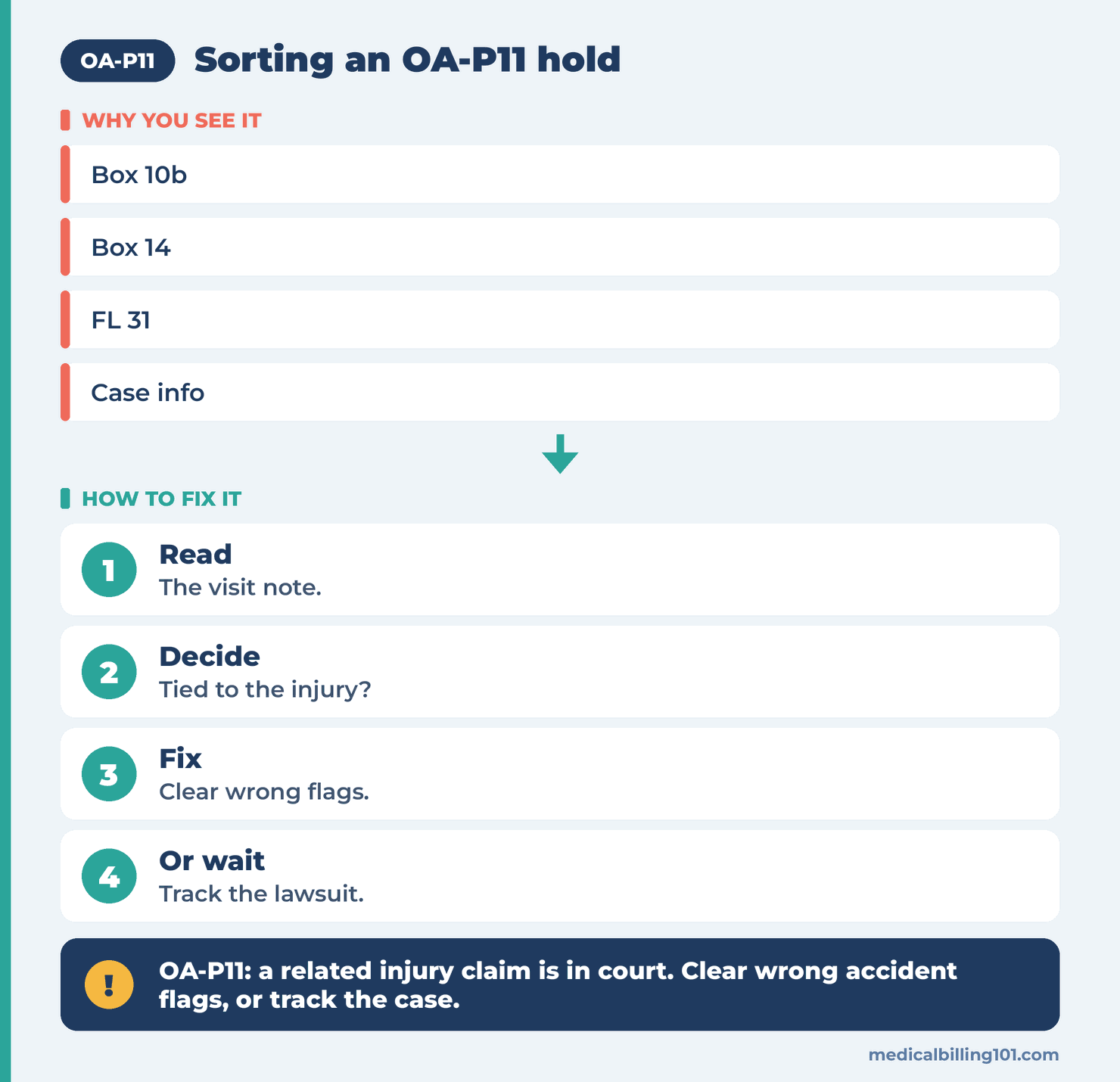
To fix an OA-P11 denial, first decide whether the service treats the injury in litigation. Then follow the matching path below.
| Situation | What to do |
|---|---|
| Visit is unrelated to the injury | Send a corrected claim with the accident fields cleared; add a note if the payer allows |
| Visit treats the injury | Give the payer the related claim number and attorney contacts, and ask how it handles pending cases |
| Unsure | Read the note; ask the provider which condition was treated |
| Patient filled out an accident questionnaire wrong | Ask the patient to update it with the payer, then resubmit |
Example scenario (fictional names), part 2
How the OA-P11 Denial Was Resolved
Nadia reviewed the visit note. The physician treated diabetes only, with no mention of the crash, and the practice system had copied the accident flags from the March episode.
Fix: she sent a corrected claim with Box 22 code 7 and the original claim number. Box 10b changed to no, the state was cleared, and the accident date left Box 14. E11.9 (entered as E119) and 83036 stayed the same.
Outcome: the health plan paid the visit and the lab in the next cycle. Nadia set the system to ask staff to confirm the visit is for the accident before it copies any accident data.
Names and details are illustrative; no real patient data.
Names and details are illustrative; no real patient data.
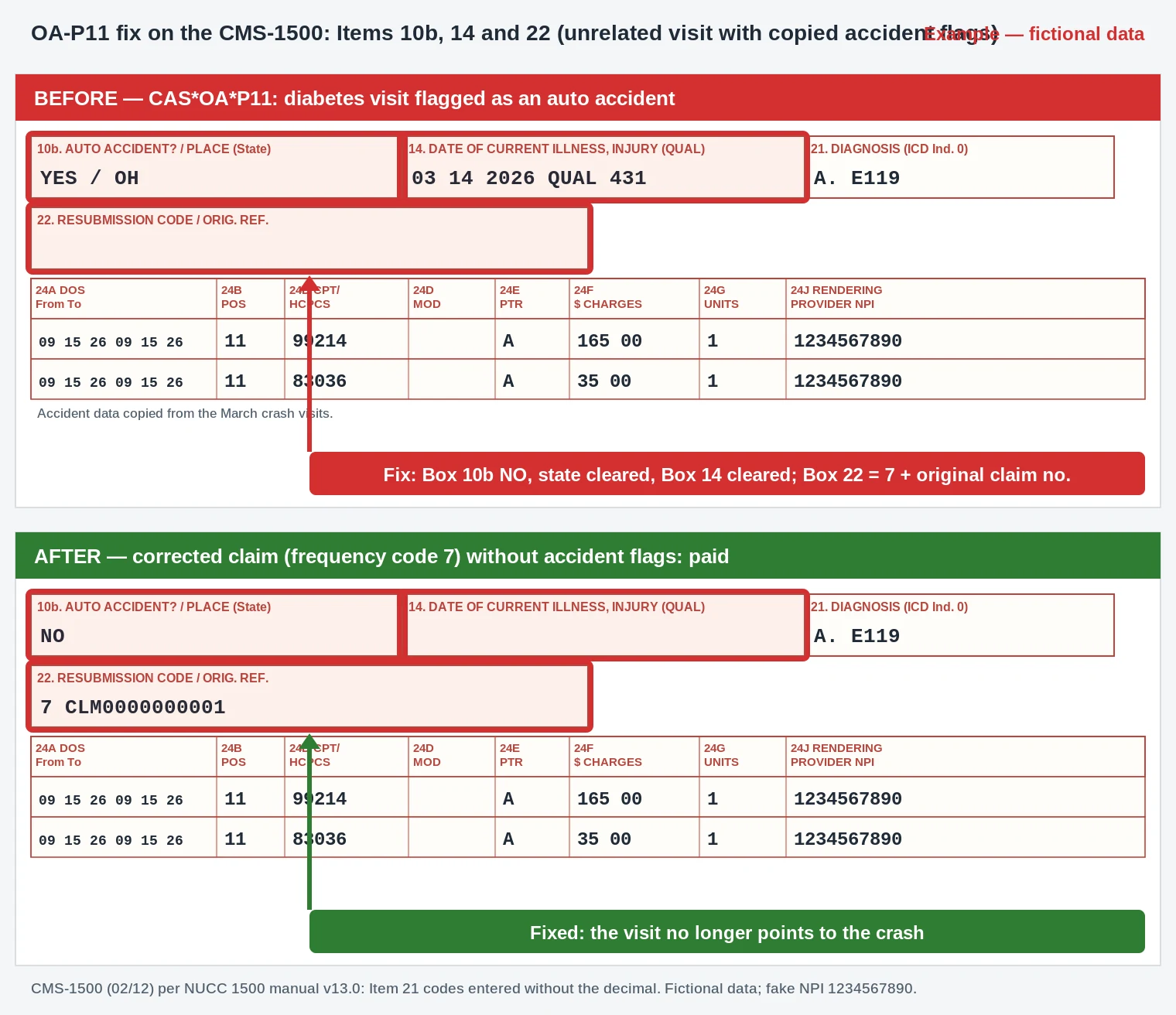

- Box 10b: auto accident changed from yes to no, and the state was cleared, because the visit treated diabetes only.
- Box 14: the copied crash date was removed; it belonged to the March injury visits.
- Box 22 / FL 4 + FL 64: frequency code 7 with the original claim number (bill type 0137 on the UB-04).
- UB-04 FL 29 / FL 31: accident state and occurrence code 02 (no-fault insurance involved, including auto accident) removed.
- Box 21 / FL 67: E11.9 (entered as E119), 99214 and 83036 are unchanged.
Can I bill the patient for an OA-P11 line?
Not yet. The OA group means the payer named no one as owing the balance, and billing the patient now could violate your payer contract or state regulations. Correct any inaccurate accident data first. For genuine injury care, wait for the case outcome or a payer decision.
How long can an OA-P11 hold last?
As long as the related lawsuit continues, which can be months or years. For example, a disputed-fault auto case may continue past a year. Keep the account active, document the related claim number and attorney contacts, and call every 60 to 90 days. Monitor your filing limits too, so a late resubmission does not cost you the claim. If the patient has Medicare, review the CMS coordination of benefits and recovery overview before billing Medicare.
Related codes
| Code | Meaning |
|---|---|
| CO-P10 | Payment reduced to zero due to litigation |
| CO-P8 | Claim is under investigation |
| CO-20 | Injury or illness is covered by the liability carrier |
| CO-21 | Injury or illness is the liability of the no-fault carrier |
FAQ
What does OA-P11 mean?
The related auto, comp or liability claim for the same injury is waiting on a lawsuit, so the payer is holding your line.
Why is P11 used only with OA?
X12 limits CARC P11 to group code OA. The amount is held because of another claim, so no owner is named yet.
Does OA-P11 come from health plans?
It can. A health plan or second payer may send it when it links your claim to an injury claim in litigation.
Which accident fields should I check first?
On the CMS-1500, check Boxes 10b, 10c and 14. On the UB-04, check FL 29 and occurrence codes in FL 31 to 34.
What code did CARC P11 replace?
CARC P11 replaced code 255 when X12 moved property and casualty codes to the P series in 2013.
Sources
How we checked: the CARC P11 quote was matched word for word with the X12 CARC list on 22 November 2026. Box 10b and Box 14 rules were checked in the NUCC manual.
- X12, Claim Adjustment Reason Codes (CARC P11, P10, P8, 20, 21). Accessed 22 Nov 2026.
- NUCC, 1500 claim form reference instruction manual. Accessed 22 Nov 2026.
- CMS, Coordination of Benefits and Recovery overview. Accessed 22 Nov 2026.
Last updated: 22 November 2026 · Educational content; not legal advice.