
The 78815 PSMA PET diagnosis code for restaging with no recurrence depends on cancer status. A clean impression does not decide it. Use C61 if the cancer is still current or under treatment. Use Z85.46 if treatment is finished and no cancer remains.
The fix: read the order and clinical history, not just the impression. If a rising PSA after treatment prompted the scan, add R97.21. If the record does not make the status clear, query the ordering physician.
TL;DR: A negative PSMA PET does not turn current cancer into history. Code C61 when the treating physician documents active disease or ongoing cancer treatment. Code Z85.46 when treatment is complete and no disease is documented. Add R97.21 when a rising PSA after treatment is the reason for the scan.
Written by Manikandan J, CPC, CRCR, a certified coder and revenue cycle specialist. Published 24 November 2026. Last updated: 24 November 2026.
Table of Contents
Should a PSMA PET restaging scan with no recurrence use C61 or Z85.46?
It depends on what the treating physician documents. Use C61 when the cancer is still present or still treated. Use Z85.46 when the prostate cancer was removed or eradicated, treatment is over, and no disease remains. A negative scan alone does not decide it. The order and history do.
C61 is Malignant neoplasm of prostate. Z85.46 is Personal history of malignant neoplasm of prostate. R97.21 is Rising PSA following treatment for malignant neoplasm of prostate.
CPT 78815 is a PET scan with CT done at the same time for attenuation correction and anatomic mapping, from skull base to mid-thigh. A PSMA PET uses a tracer that binds prostate-specific membrane antigen, a protein found on most prostate cancer cells.
Example scenario (fictional names), part 1
78815 PSMA PET diagnosis code example: what happened
- Setting: Saguaro Point Imaging, a fictional independent imaging center in Arizona. Ingrid Halvorsen is the coder.
- Order: Dr. Lucia Ferraro, a urologist, ordered a gallium-68 PSMA PET for “prostate cancer restaging.”
- Report: Dr. Kwame Asante read the scan. The impression showed no recurrence anywhere.
- Claim: Ingrid billed 78815-PS and A9800 to a fictional Medicare Advantage plan with Z85.46 alone.
- Result: the 835 showed
CAS*CO*11with remarkM76.
The scan was ordered, read and documented. So what was missing?
Where would you look first? Keep reading, or jump to how the case was resolved.
Does a negative PET impression mean the prostate cancer is history?
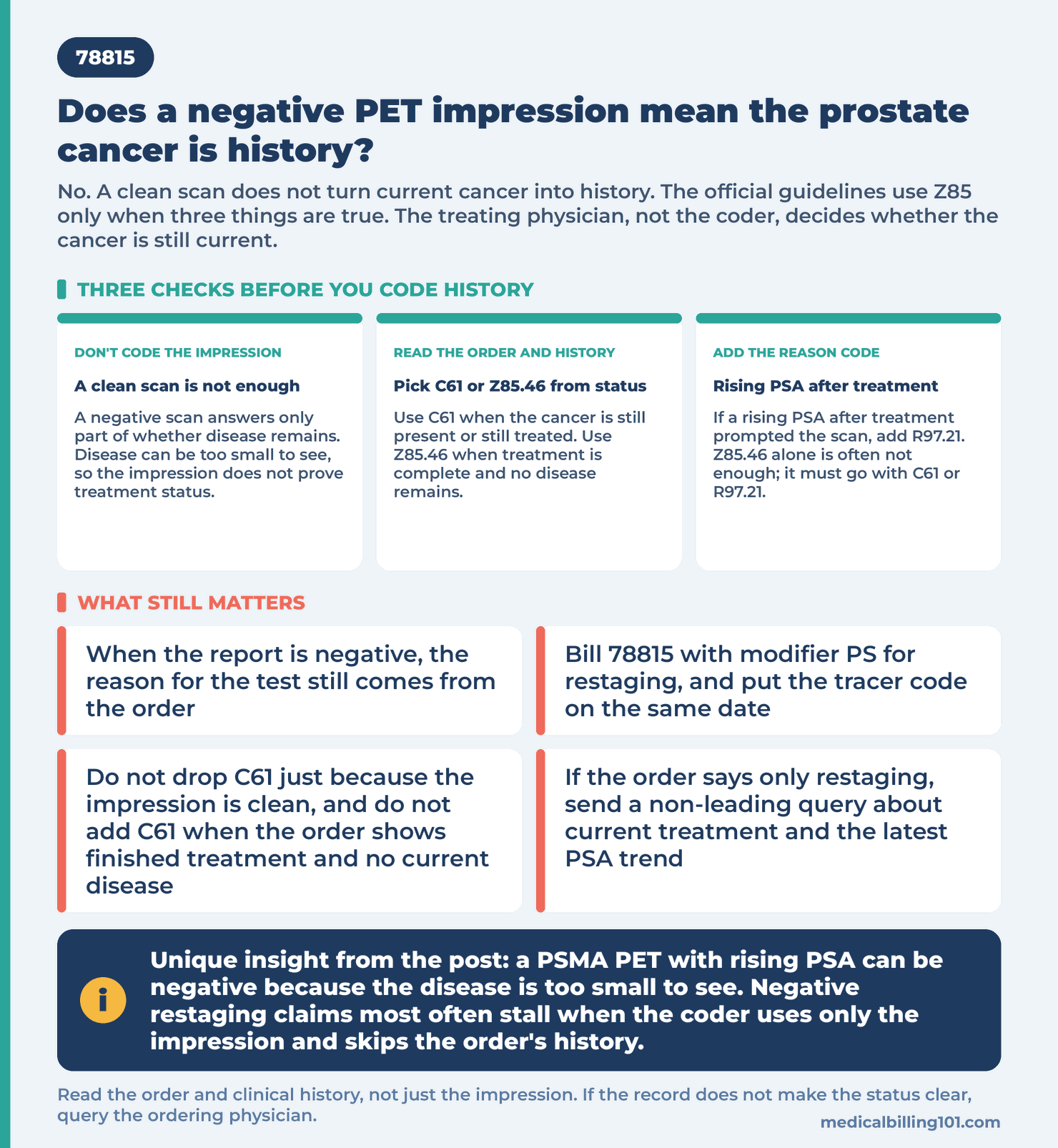
No. The official guidelines use Z85 only when three things are true. The cancer was removed or eradicated, no further treatment is aimed at it, and no existing cancer remains at that site. A clean scan answers only part of the third point.
The rule is in Section I.C.2.m of the FY 2027 ICD-10-CM Official Guidelines. The same section says to keep the cancer code while treatment aimed at the site continues.
A PSMA PET with rising PSA can be negative because the disease is too small to see. The treating physician, not the coder, decides whether the cancer is still current. For a quick refresher on these rules, see our ICD-10-CM guidelines cheat sheet.
When is C61 still the right code for a PSMA PET?
Use C61 when the ordering physician documents current prostate cancer. Common signs are ongoing radiation, chemotherapy or other cancer treatment, or notes calling the disease active or recurrent. The negative scan does not override that documentation.
The guideline lists surgery, radiation and chemotherapy as examples of further treatment. If the chart shows another ongoing cancer drug, such as hormone therapy, ask the physician whether they consider the cancer current.
The ICD-10-CM Tabular List under C61 adds a note. Use an extra code, when it applies, for a rising PSA after treatment (R97.21) or hormone sensitivity status (Z19.1 or Z19.2). So C61 with R97.21 is a valid pair.
When should you use Z85.46 with R97.21 instead?
Use Z85.46 when treatment is complete, nothing is aimed at the prostate cancer now, and the physician documents no current disease. If a rising PSA after that treatment prompted the scan, list R97.21 first as the reason, then Z85.46.
Section IV.K of the guidelines says outpatient diagnostic encounters list first the reason chiefly responsible for the test. When the report is negative, that reason still comes from the order.
Code Z08 fits routine surveillance after completed treatment. Its Tabular note says to add the Z85 history code. But PSMA PET labels cover suspected recurrence based on elevated PSA, so a pure surveillance scan may not meet payer coverage.
| What the record shows. | Diagnosis codes. |
|---|---|
| Cancer still treated or called active, PSA rising. | C61, R97.21. |
| Cancer still treated or called active, no PSA note. | C61. |
| Treatment complete, no disease, PSA rising after treatment. | R97.21, Z85.46. |
| Treatment complete, routine surveillance only. | Z08, Z85.46 (coverage risk). |
| Scan finds new spread, such as bone. | Code the finding, such as C79.51, with C61 or Z85.46 per status. |
Which codes do Medicare contractors expect on a PSMA PET claim?
Medicare contractors expect a prostate cancer code, the PS modifier for restaging, and a tracer code on the same date. CGS says Z85.46 alone is not enough. It must go with C61 or R97.21.
The CGS PSMA PET billing instructions also require records showing both a prostate cancer diagnosis and elevated PSA for suspected recurrence. They pair modifier PS with C61 and R97.21, or C61 and C79.82.
First Coast’s PSMA PET coding page lists the tracer codes. They are A9595 (Pylarify), A9800 (Locametz), A9596 (Illuccix), A9608 (Posluma) and A9616 (Gozellix). The scan and tracer deny together if either one fails.
Modifier PS means the PET informs the subsequent treatment strategy. Modifier PI means it informs the initial strategy. Both are defined in the Medicare Claims Processing Manual, Chapter 13, Section 60.16.
PSMA PET coverage is local. CMS retired the umbrella PET NCD 220.6 in 2022 and left those decisions to the contractors. For a similar coverage-list problem, see our answer on a 93306 denied for a diagnosis not covered by the LCD.
Does an independent imaging center code differently than a hospital outpatient department?
No. Both follow the outpatient rules in Section IV. Code confirmed findings from the final report, and take the reason for the test from the order and clinical history. The impression proves what the scan saw. It does not prove the cancer’s treatment status.
So a center should not drop C61 just because the impression is clean. It also should not add C61 when the order shows finished treatment and no current disease.
In my years on payer and provider billing teams, negative restaging scans most often stalled when the coder used only the impression and skipped the order’s history.
When the order says only “restaging,” send a short, non-leading query to the ordering office. Ask about current treatment and the latest PSA trend. Our guide on medical necessity documentation shows what payers look for.
How do you fix a denied 78815 PSMA PET claim?
Start with the remark code, then the order. Most diagnosis denials on these scans come from a history code with no reason code, or a missing PS modifier or tracer line.
- Read the CARC and RARC. A CO-50 denial points to coverage, while CO-11 points to a diagnosis that does not fit the service.
- Pull the order and history. Confirm cancer status, treatment status and the PSA trend.
- Recode from the record only. Add R97.21 or C61 only when the physician documented it.
- Check that 78815 carries PS and that the tracer code shares the date of service.
- Send a corrected claim or reopening request, or appeal with the order and report. Our appeal letter generator can help draft it.
If the scan will not meet the payer’s rules, Medicare patients may need an Advance Beneficiary Notice before the scan, not after.
Example scenario (fictional names), part 2
How the 78815 PSMA PET case was resolved
Ingrid read the remark: M76, “Missing/incomplete/invalid diagnosis or condition.” The CO-11 denial code meant the plan saw a history code with no reason for the scan.
- She opened Dr. Ferraro’s order. It noted a prostatectomy, no current treatment, and a PSA rising on two checks.
- So Z85.46 was correct, but the rising PSA was missing. CARC 11 made sense.
- She sent a corrected claim (frequency code 7) with R97.21 first, then Z85.46, and 78815-PS with A9800.
Outcome: the plan reprocessed both lines. Ingrid added a rule: every PSMA PET claim needs cancer status and the PSA reason.
Names and details are illustrative; no real patient data.
Do commercial payers follow the same PSMA PET rules?
Not always. Many commercial and Medicare Advantage plans use their own imaging policies and may need prior authorization for PET. Check the plan’s current policy before the scan.
The ICD-10-CM rules do not change by payer. Code the status the physician documents, list the reason for the scan, and query when the order is vague. For cancer-related visit coding, see our answer on E/M levels for cancer patients.
3-step checklist
- Read the order for cancer status, current treatment and PSA trend.
- Pick C61 or Z85.46 from that status, and add R97.21 when PSA is rising after treatment.
- Bill 78815 with PS and the tracer code on the same date.
FAQ
What is the diagnosis code for a PSMA PET with no recurrence?
It depends on cancer status. Use C61 if the cancer is current or still treated. Use Z85.46 if treatment is complete and no disease is documented.
Can I use Z85.46 alone on a PSMA PET claim?
Often not. CGS says Z85.46 alone is not sufficient and must go with C61 or R97.21. Add R97.21 when a rising PSA after treatment prompted the scan.
Does a negative PSMA PET mean I should code history?
No. A clean scan does not show that treatment is finished. The treating physician’s notes on treatment and disease status decide C61 versus Z85.46.
Which modifier goes on 78815 for PSMA PET restaging?
Modifier PS, for a PET that informs the subsequent treatment strategy. Modifier PI is for the initial treatment strategy.
Which tracer code goes with a gallium-68 PSMA PET?
It depends on the product. A9800 is Locametz, A9596 is Illuccix and A9616 is Gozellix. Bill the tracer on the same date as 78815.
Sources
My methodology was simple. I checked the FY 2027 ICD-10-CM guidelines and Tabular List, two Medicare contractor PSMA PET pages, one CMS manual chapter and two CMS coverage pages.
- CDC/NCHS, ICD-10-CM FY 2027 Official Guidelines, Sections I.C.2.d, I.C.2.m, I.C.21.c.8 and IV.K (linked above). Accessed 24 Nov 2026.
- CMS, FY 2027 ICD-10-CM code files, Tabular List entries for C61, R97.21, Z08 and Z85.46. Accessed 24 Nov 2026.
- CGS Administrators, Billing and Coding Instructions: Radioactive Diagnostic Agents for PET of PSMA Positive Lesions, revised 30 Aug 2024 (linked above). Accessed 24 Nov 2026.
- First Coast Service Options, Radioactive diagnostic agents for PET of PSMA positive lesions, 25 Feb 2026 (linked above). Accessed 24 Nov 2026.
- CMS, Medicare Claims Processing Manual, Chapter 13, Section 60.16 (linked above). Accessed 24 Nov 2026.
- CMS, NCD 220.6, PET Scans (retired), and the ABN page (linked above). Accessed 24 Nov 2026.
- X12, Claim Adjustment Reason Code 11 and Remittance Advice Remark Code M76 (code lists). Accessed 24 Nov 2026.
Read about the author, or contact us with a question. See our editorial policy.
Last updated: 24 November 2026 · Educational content for U.S. coding and billing teams. Code descriptions are plain-language summaries; check the current CPT code set for full wording.