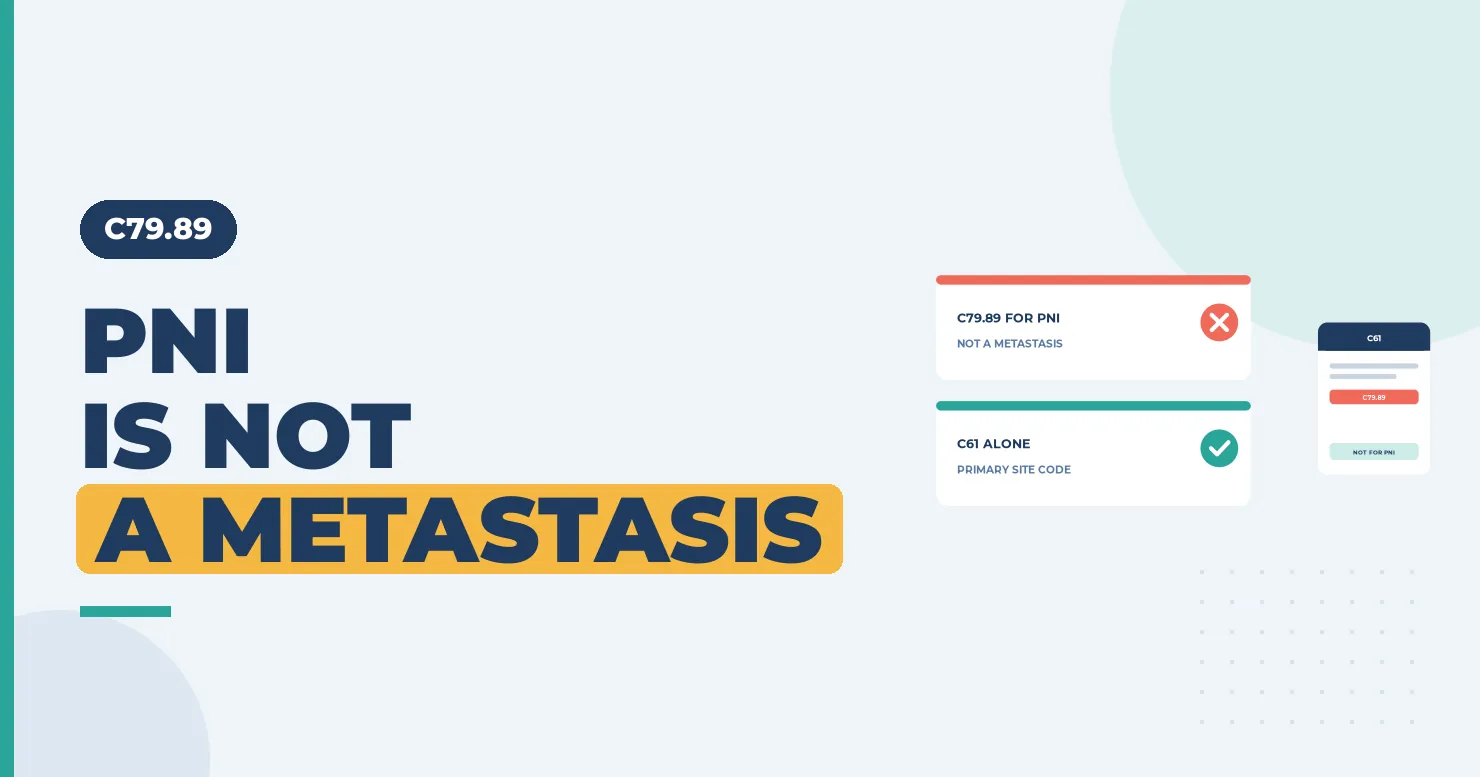
Perineural invasion prostate ICD 10 coding has a short answer: report C61 alone. Perineural invasion is not a metastasis, so C79.89 does not apply.
The fix is to code the primary prostate cancer and stop there. Add a secondary code only when the provider documents spread to a separate site.
TL;DR: Perineural invasion means prostate cancer cells are growing along small nerves inside or at the edge of the prostate. It describes the main tumor, not a new tumor site. ICD-10-CM has no separate code for it. Code C61, Malignant neoplasm of prostate. Use C79.89 or another secondary code only for documented metastatic disease.
Written by Manikandan J, CPC, CRCR, a certified coder and revenue cycle specialist. Published 26 November 2026. Last updated: 26 November 2026.
Table of Contents
Do you code C79.89 for perineural invasion of the prostate?
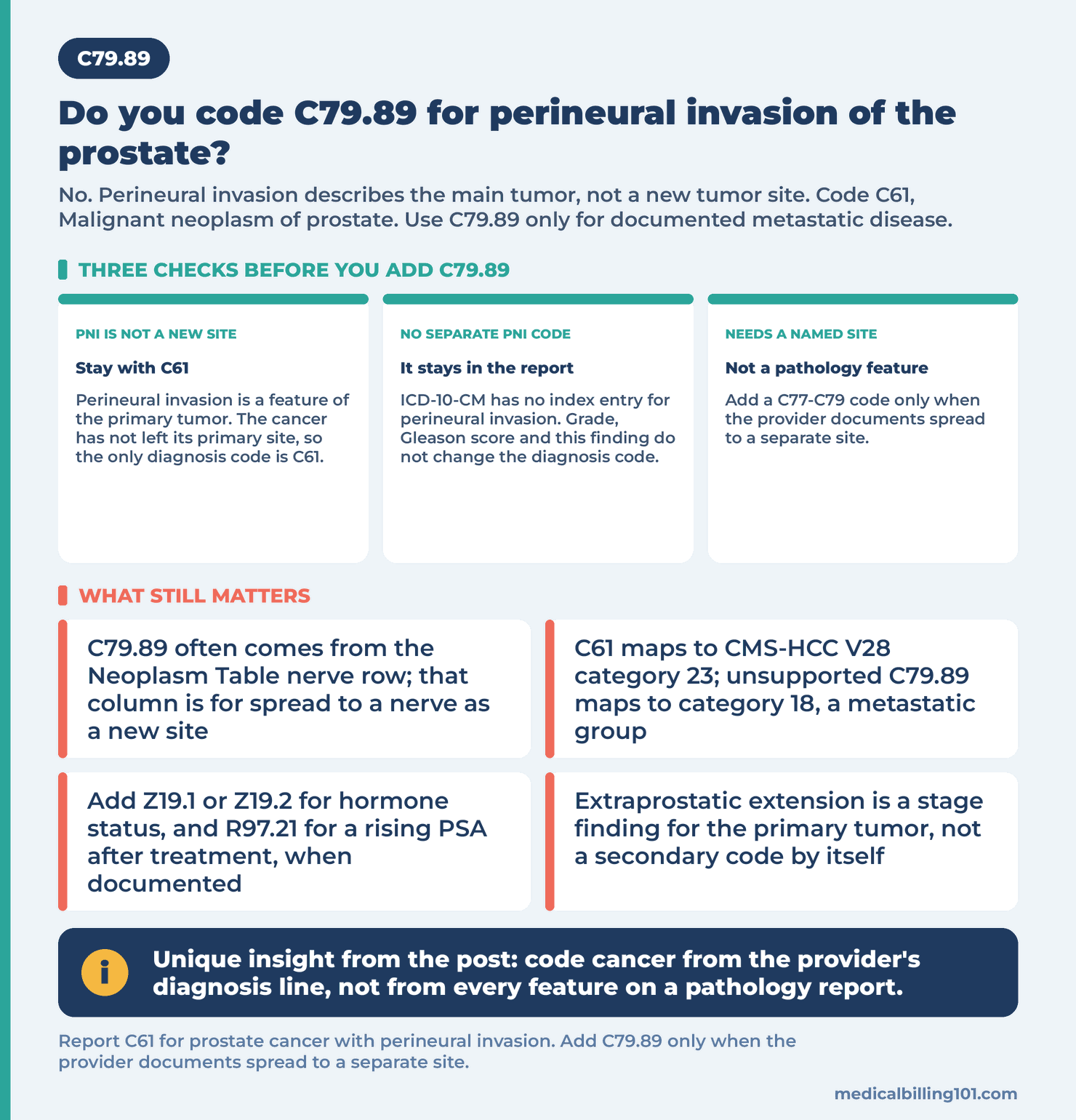
No. C79.89 is Secondary malignant neoplasm of other specified sites. It is for cancer that has spread to a separate site. Perineural invasion is tumor growing along nerves within the prostate itself. The cancer has not left its primary site, so the only code is C61.
The FY 2027 ICD-10-CM Official Guidelines tell you to decide whether a neoplasm is malignant. If it is, you then determine any secondary (metastatic) sites. A feature seen inside the tumor is not a new site.
Perineural invasion (PNI) is cancer cells tracking around or along a nerve. Metastasis is spread to another part of the body. The National Cancer Institute defines metastasis as cancer cells that break away, travel through blood or lymph, and form a new tumor.
Example scenario (fictional names), part 1
Perineural invasion example: what happened
Willow Creek Urology is a fictional practice in Iowa. Rosalind Achterberg codes its office visits. Dr. Tobias Ferreira saw a 67-year-old patient to review a prostate biopsy.
The pathology report showed adenocarcinoma, Gleason score 3+4=7, with perineural invasion present. The visit note listed prostate cancer and planned an MRI. A new coder added C79.89 next to C61 for the perineural invasion.
The Medicare Advantage plan later sent a record request. It asked where the metastatic disease was documented.
Was the C79.89 supported? Keep reading, or jump to how the case was resolved.
What is the ICD-10 code for prostate cancer with perineural invasion?
The code is C61, Malignant neoplasm of prostate. C61 is the primary site code for cancer that starts in the prostate. It has no fifth character for invasion, grade or stage. For example, perineural invasion, Gleason score and tumor size all stay in the pathology report. They do not change the diagnosis code.
The FY 2027 ICD-10-CM code files from CMS show a use-additional-code note at C61. It points to hormone sensitivity status, Z19.1 or Z19.2. It also points to R97.21 for a rising PSA after treatment. Seminal vesicle cancer is excluded to C63.7.
The FY 2027 Alphabetic Index has no entry for perineural invasion. The only perineural term indexed is a perineural cyst, G96.191, which is a spinal nerve root cyst. It has nothing to do with cancer.
Why does C79.89 show up for perineural invasion?
It comes from the Neoplasm Table. The row for “nerve (ganglion)” lists C79.89 in the Malignant Secondary column. Coders who look up “nerve” after reading “perineural” land on that code. But that column is for cancer that has spread to a nerve as a new site.
In PNI, the tumor is still the prostate primary. It is following nerves that run through the gland. The Neoplasm Table row for prostate lists C61 as primary and C79.82 as secondary. The secondary column only applies when another cancer spreads to the prostate.
The guideline wording can also mislead. Section I.C.2.d says any mention of extension, invasion or metastasis to another site is coded as a secondary neoplasm. That rule covers a previously excised primary, and it says “to another site.” Perineural invasion stays within the same site.
What does perineural invasion mean on a prostate pathology report?
It is a tumor feature the pathologist notes, like grade and margins. The CAP radical prostatectomy protocol, version 4.3.0.0, lists perineural invasion as an optional item. It calls PNI a common finding and says most studies find it is not an independent predictor of outcome.
The CAP prostate needle biopsy protocol, version 1.1.0.0, also lists it as optional. It notes PNI on biopsy has been linked to extraprostatic extension in some studies. Even so, it is a stage risk signal, not a coded diagnosis.
Staging lives in the TNM fields, not in ICD-10-CM. In the CAP protocol, pT2 is organ confined, pT3a is extraprostatic extension, and pT3b is seminal vesicle invasion. None of these turn perineural invasion into a secondary neoplasm code.
When do you add a secondary cancer code with C61?
Add one only when the provider documents spread to a separate site. Code the site named, not the pathology feature. For prostate cancer, the most common examples are pelvic lymph nodes and bone.
| Documented finding. | ICD-10-CM code. | Add with C61? |
|---|---|---|
| Perineural invasion within the prostate. | None. | No. Report C61 only. |
| Prostate cancer, primary site. | C61. | This is the main code. |
| Metastasis to pelvic lymph nodes. | C77.5. | Yes, when documented. |
| Metastasis to bone. | C79.51. | Yes, when documented. |
| Metastasis to another named site not listed elsewhere. | C79.89. | Yes, when that site is documented. |
| Hormone sensitive or castrate resistant status. | Z19.1 or Z19.2. | Yes, when documented. |
For an outpatient pathology or imaging read, Section IV.K says to code confirmed diagnoses in the final interpretation. For other encounters, Section I.A.19 says code assignment rests on the provider’s diagnostic statement. If the note and the report conflict, query the provider.
Does adding C79.89 change risk adjustment?
Yes, and that is why audits catch it. In the CMS 2027 initial ICD-10 mappings, C61 maps to CMS-HCC V28 category 23. C79.89 maps to category 18, a metastatic cancer group.
A C79.89 with no proof moves the patient into a higher-risk group. A Medicare Advantage audit will ask for the documented metastatic site. Our guide on risk adjustment codes versus documentation explains how those reviews work.
In my 10+ years of billing and AR work, I learned to code cancer from the provider’s diagnosis line. I never coded from every feature on a pathology report.
How do you fix a claim that already has C79.89 for perineural invasion?
Send a corrected claim that removes C79.89 and keeps C61. Do this before a payer review finds it. Then check the other claims for this patient for the same code.
- Read the pathology report and the provider note for any named metastatic site.
- If there is none, remove C79.89 and keep C61, plus Z19.1 or Z19.2 if documented.
- If a site is named, replace C79.89 with that site’s code, such as C77.5 or C79.51.
Our corrected claim guide covers frequency code 7 by payer type. If a procedure denies for a diagnosis mismatch, see the CO-11 denial guide. For a PSMA PET that follows treatment, read C61 or Z85.46 for a 78815 restaging scan.
Example scenario (fictional names), part 2
How the perineural invasion case was resolved
- Rosalind reread the biopsy report. It named no lymph node, bone or organ involvement.
- Dr. Ferreira’s note said “prostate adenocarcinoma, localized, staging MRI ordered.” No metastatic site was stated.
- She confirmed C79.89 came from the Neoplasm Table “nerve” row, not from any documented spread.
Fix: a corrected claim with C61 alone for the visit.
Outcome: the plan closed the record request with no further finding. The practice added a coding rule: no secondary C77-C79 code without a named metastatic site.
Names and details are illustrative; no real patient data.
For more cancer visit coding, see choosing the E/M level for a cancer patient. Our ICD-10-CM guidelines cheat sheet summarizes the neoplasm rules.
3-step checklist
- Code C61 for prostate cancer, even when the report says perineural invasion is present.
- Add a C77-C79 secondary code only for a metastatic site the provider names.
- Add Z19.1, Z19.2 or R97.21 when the record supports them, as the C61 note directs.
FAQ
Is perineural invasion of the prostate coded as metastatic cancer?
No. Perineural invasion is cancer growing along nerves within the prostate. It is part of the primary tumor, so code C61 only.
Is there an ICD-10 code for perineural invasion?
No. The FY 2027 ICD-10-CM index has no entry for perineural invasion. The finding is captured in the pathology report, not in a diagnosis code.
When is C79.89 used with prostate cancer?
Use C79.89 only when the provider documents spread to a specified site that has no more specific secondary code. Pelvic lymph nodes go to C77.5 and bone to C79.51.
Does extraprostatic extension need a secondary code?
Extraprostatic extension is a stage finding (pT3a) for the primary tumor. Do not add a secondary code from the pathology feature alone. Code a secondary site only when the provider names one.
What additional codes go with C61?
The C61 note says to add hormone sensitivity status, Z19.1 or Z19.2, and R97.21 for a rising PSA after treatment, when documented.
Sources
My methodology was simple. I checked the FY 2027 ICD-10-CM Tabular, Index and Neoplasm Table files, the FY 2027 guidelines, the CAP prostate protocols and the CMS 2027 risk adjustment mappings.
- CMS and NCHS, ICD-10-CM Official Guidelines for Coding and Reporting FY 2027, Sections I.A.19, I.C.2 and IV.K (linked above). Accessed 26 Nov 2026.
- CMS, 2027 ICD-10-CM code files: Tabular List, Alphabetic Index and Table of Neoplasms (linked above). Accessed 26 Nov 2026.
- College of American Pathologists, Radical Prostatectomy protocol v4.3.0.0 and Prostate Needle Biopsy protocol v1.1.0.0 (linked above). Accessed 26 Nov 2026.
- CMS, 2027 Initial ICD-10-CM Mappings, CMS-HCC V28 (linked above). Accessed 26 Nov 2026.
- National Cancer Institute, Dictionary of Cancer Terms, metastasis (linked above). Accessed 26 Nov 2026.
Read about the author, or contact us with a question. See our editorial policy.
Last updated: 26 November 2026 · Educational content for U.S. coding and billing teams. Code descriptions are plain-language summaries; check the current ICD-10-CM code set for full wording.