The phantom limb pain ICD-10 code is G54.6, Phantom limb syndrome with pain. Use G54.7 only when the patient has phantom sensations without pain.
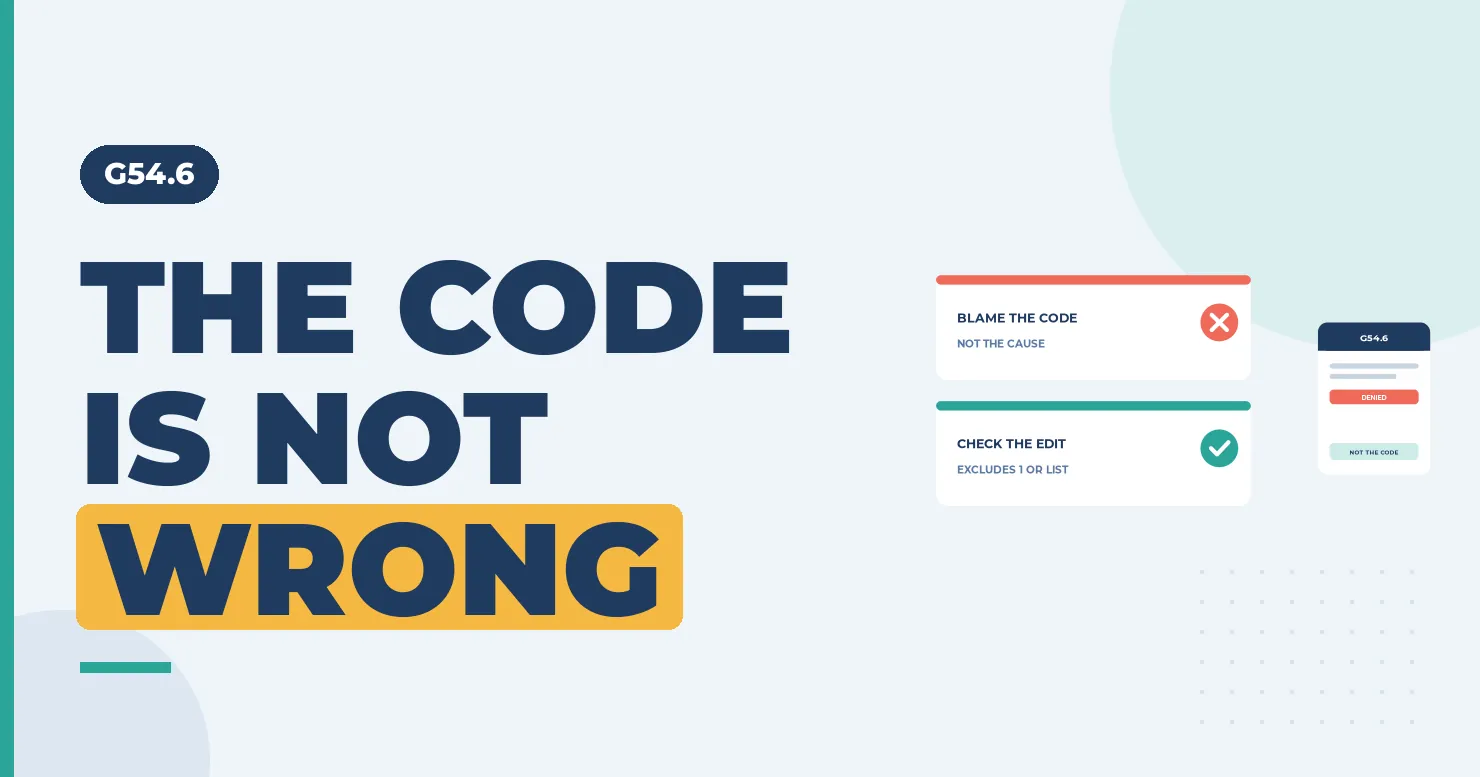
If payers keep denying G54.6, the code is usually not the problem. The denial most often comes from an Excludes1 edit, a coverage list, or a missing link to the procedure.
TL;DR: G54.6 is the right code for phantom limb pain, and there is no better substitute. G54 has an Excludes1 note for radiculopathy and radiculitis, so payer edits may deny G54.6 with M54.1- codes. The guidelines allow both codes when the two conditions are unrelated. Add the Z89 code for the missing limb, check the payer’s covered diagnosis list for the procedure, and appeal with the notes.
Written by Manikandan J, CPC, CRCR, a certified coder and revenue cycle specialist. Published 27 November 2026. Last updated: 27 November 2026.
Table of Contents
What is the ICD-10 code for phantom limb pain?
The ICD-10-CM code for phantom limb pain is G54.6, Phantom limb syndrome with pain. It sits in category G54, Nerve root and plexus disorders. The code is valid for billing in the FY 2027 code set.
Phantom limb pain is pain a patient feels in a limb that was amputated. Phantom limb syndrome is the wider term for any feeling in the missing limb. An Excludes1 note is a rule that says two codes should not be reported together.
The ICD-10-CM Index sends Phantom limb syndrome to G54.7 and the subterm with pain to G54.6. You can download the index and tabular files from the CMS ICD-10 codes page.
Example scenario (fictional names), part 1
Phantom limb example: what happened
Copper Ridge Pain Center is a fictional clinic in Ohio. Marisol Tenney works its denials. Dr. Everett Lindqvist treats chronic pain there.
A patient with a right below-knee amputation came in for phantom limb pain and new low back pain with leg symptoms. The claim listed G54.6 and M54.16.
The payer denied the visit. A subsequent visit, documented with only G54.6 and Z89.511, was also denied.
What went wrong? Keep reading, or jump to how the case was resolved.
What is the difference between G54.6 and G54.7?
G54.6 is phantom limb syndrome with pain. G54.7 is phantom limb syndrome without pain, and it also covers phantom limb syndrome NOS. If the note says pain, use G54.6. If it only says phantom sensations, use G54.7.
Do not code both for the same limb. Pick the one that matches the provider’s words. If the note just says phantom limb with no detail, query the provider before you default to G54.7.
| Code. | FY 2027 description. | When to use it. |
|---|---|---|
| G54.6. | Phantom limb syndrome with pain. | Pain felt in the missing limb. |
| G54.7. | Phantom limb syndrome without pain. | Phantom sensations, no pain. |
| Z89.511. | Acquired absence of right leg below knee. | Add as status code for the amputation level. |
| Z89.611. | Acquired absence of right leg above knee. | Add as status code for the amputation level. |
| T87.33. | Neuroma of amputation stump, right lower extremity. | Pain from a stump neuroma, not phantom pain. |
Why do insurance companies deny G54.6?
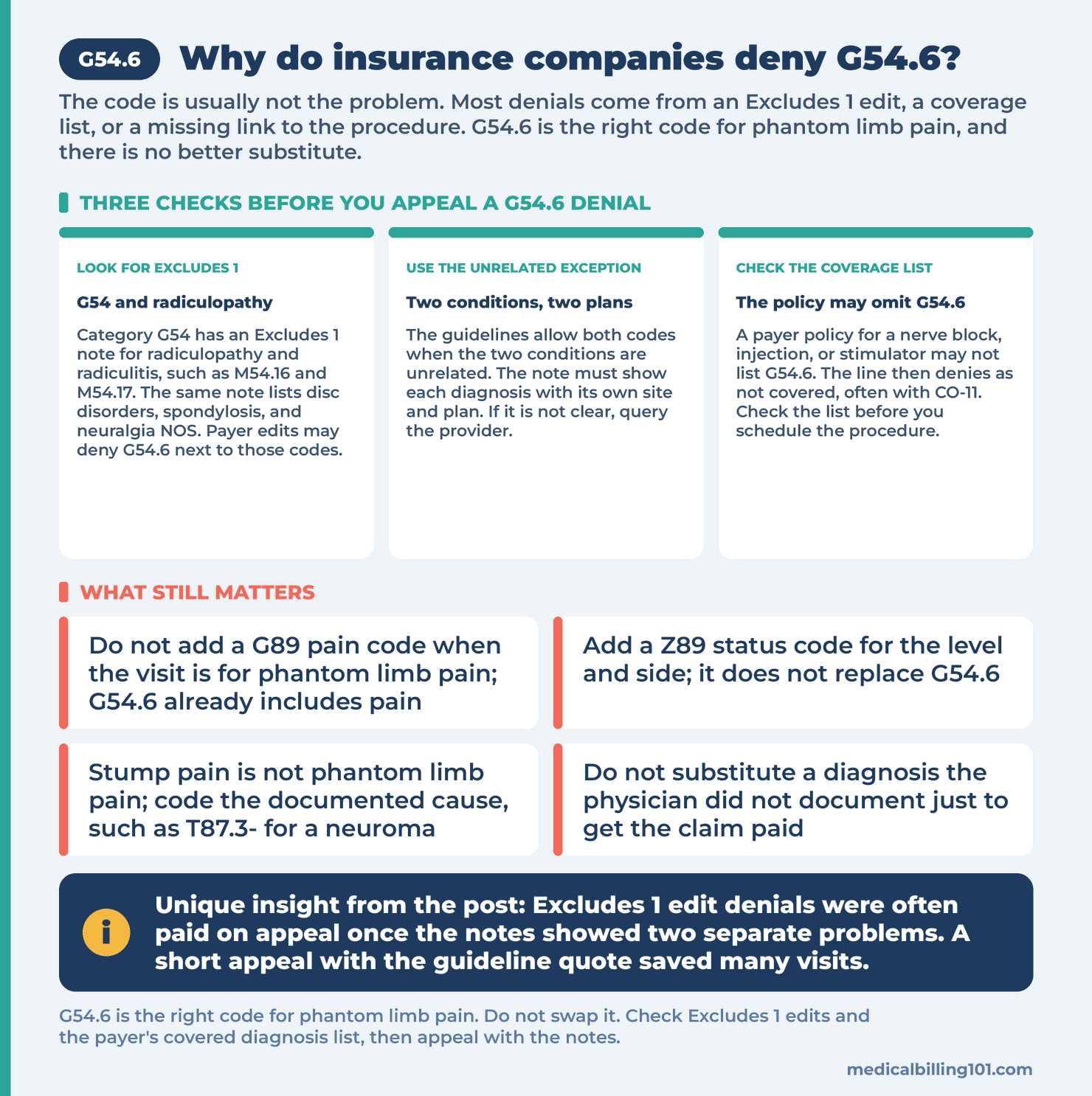
Most G54.6 denials come from claim edits, not a wrong code. Category G54 has an Excludes1 note for radiculopathy and radiculitis codes, such as M54.16 and M54.17. Many payers deny any claim that puts G54.6 next to one of those codes.
The same Excludes1 note also lists intervertebral disc disorders (M50-M51), spondylosis (M47.-) and neuralgia or neuritis NOS (M79.2). Pain management practices frequently document these conditions for the same patient, so the edit triggers regularly.
A second cause is coverage. A payer policy for a nerve block, injection or stimulator may list covered diagnosis codes. If G54.6 is not on that list, the line denies as not covered, often with denial code CO-11.
In my 10+ years of billing and AR work, Excludes1 edit denials were often paid on appeal once the notes showed two separate problems. A short appeal with the guideline quote saved many visits.
Can you code G54.6 with radiculopathy?
Yes, when the two conditions are unrelated. The FY 2027 guidelines say an exception to Excludes1 applies when the two conditions are unrelated to each other. If it is not clear, the guidelines say to query the provider.
Phantom pain in an amputated leg and lumbar radiculopathy are often separate problems. The note must make that clear. Ask the provider to document each diagnosis with its own site and plan.
The rule is in section I.A.12.a of the FY 2027 ICD-10-CM Official Guidelines. Our ICD-10-CM guidelines cheat sheet sums up the Excludes1 and Excludes2 rules.
Should you add a G89 pain code to G54.6?
No. G89 has an Excludes2 note for phantom limb syndrome with pain (G54.6), but G54.6 already says the patient has pain. The guidelines also say not to use G89 when the definitive diagnosis is known, unless the visit is for pain control.
Therefore, for an encounter focused on phantom limb pain, G54.6 alone communicates the complete clinical picture. A G89 code adds little and can trigger more edits. Use G89.29 or G89.4 only when the provider documents a separate chronic pain problem.
Which Z89 code goes with phantom limb pain?
Add a Z89 code for the amputation level and side as a secondary code. For example, use Z89.511 for an acquired absence of the right leg below the knee, or Z89.612 for the left leg above the knee.
Z89 is a status code, so it does not replace G54.6. It explains why the patient has phantom pain. The guidelines say Z89 is for use only when there are no complications of the amputation site.
So if the provider finds a stump neuroma, code T87.3- instead of Z89. For example, T87.33 is a neuroma of the amputation stump, right lower extremity. That is a stump problem, which is not the same as phantom limb pain.
What documentation supports a G54.6 claim?
Documentation should state phantom limb pain, the amputated limb, the side and the amputation level. It should also describe the pain’s character, severity and functional impact, and the treatment plan for that specific diagnosis.
When radiculopathy, spondylosis or disc disease is also treated, the assessment should list each diagnosis separately, with its own anatomical location and management plan. That separation is the evidence a reviewer needs to accept the Excludes1 exception on appeal.
Medications, previous therapies, prosthetic fitting problems and psychological factors are also useful details. If the physician documents related psychological factors associated with pain, the G89 category note says to code also F45.42.
How do you fix a G54.6 denial?
First, read the denial reason. If it cites an Excludes1 edit, appeal with notes that show two unrelated problems. If it cites coverage, check the payer policy for the procedure and its covered diagnosis list.
For Medicare, search the LCD and billing article in the Medicare Coverage Database. For commercial plans, pull the medical policy for the CPT code. Our post on a 93306 denial for a diagnosis not covered by the LCD shows that review step by step.
Do not substitute G54.6 with a diagnosis the physician did not document. Removing it from the superbill to obtain payment misrepresents the medical record and can create compliance problems during an audit.
Example scenario (fictional names), part 2
How the phantom limb case was resolved
- Marisol saw the first denial cited an Excludes1 edit between G54.6 and M54.16.
- Dr. Lindqvist’s note showed two separate problems: phantom pain in the missing right foot, and L5 radiculopathy in the left leg.
- The second denial was for a nerve block whose payer policy did not list G54.6 as covered.
Fix: she appealed the first visit with the note and the Excludes1 exception quote. For the block, she asked the provider for a peer-to-peer review before the next session.
Outcome: the payer paid the first visit on appeal. The clinic now checks the payer’s covered diagnosis list before it schedules any block for phantom pain.
Names and details are illustrative; no real patient data.
To fix a claim that went out with the wrong codes, follow our corrected claim guide. To write the appeal, try our appeal letter generator. For another ICD-10 answer, see how to code perineural invasion of the prostate. For pain clinic billing, see whether a third level of nerve blocks or RFA gets paid.
3-step checklist
- Code G54.6 for phantom pain, G54.7 for no pain, and add the Z89 code for the level and side.
- If radiculopathy or disc codes are on the claim, make sure the note shows they are unrelated.
- Check the payer’s covered diagnosis list for the procedure, then appeal Excludes1 denials with the guideline.
FAQ
Is G54.6 a billable ICD-10 code?
Yes. G54.6 is a valid, billable code in the FY 2027 ICD-10-CM code set. It has no further characters, so report it exactly as G54.6.
Can G54.6 be the first-listed diagnosis?
Yes. When the visit is for phantom limb pain, list G54.6 first. Add the Z89 code for the amputation level and side after it.
Does G54.6 need a laterality code?
No. G54.6 has no side in its code. The Z89 code carries the side and level, such as Z89.512 for the left leg below the knee.
What if the pain is in the stump, not the missing limb?
Stump pain is not phantom limb pain. Code the cause the provider documents, such as T87.3- for a stump neuroma, and do not use G54.6 for it.
Is phantom limb pain coded for upper limb amputations too?
Yes. G54.6 applies to any amputated limb. Pair it with the Z89.2- code for the upper limb level, such as Z89.221 for the right arm above the elbow.
Sources
My methodology was simple. I checked the FY 2027 ICD-10-CM tabular list, index and official guidelines, and the CMS Medicare Coverage Database.
- CMS, FY 2027 ICD-10-CM tabular list and index, categories G54, G89, T87 and Z89 (ICD-10 codes page linked above). Accessed 27 Nov 2026.
- CMS, FY 2027 ICD-10-CM Official Guidelines, sections I.A.12, I.C.6.b and I.C.21.c.3 (linked above). Accessed 27 Nov 2026.
- CMS, Medicare Coverage Database, LCD and billing article search (linked above). Accessed 27 Nov 2026.
Read about the author, or contact us with a question. See our editorial policy.
Last updated: 27 November 2026 · Educational content for U.S. coding and billing teams. ICD-10-CM descriptions are from the FY 2027 code set; check your payer’s policy for coverage rules.