
CO-96 is a Claim Adjustment Reason Code that means the payer treated the charge as not covered, and the CO group code puts the amount on the provider, not the patient. (Primary sources: X12 Claim Adjustment Reason Codes · CMS Medicare Claims Processing Manual, Ch. 22 · CMS Ch. 30, ABN)
Quick answer: CO-96 means “non-covered charge(s).” The payer won’t pay the line, and because the group code is CO, you can’t bill the patient for it. The remark code next to 96 tells you why. Fix it if the code, diagnosis or claim format was wrong. Appeal if the service is a covered benefit. Otherwise, write it off.
Part of our denial codes library. Written by Manikandan, a revenue cycle management specialist with more than 10 years of US medical billing experience. Last reviewed: 6 October 2026. Official code wording is quoted word for word from X12; Medicare rules link to their CMS or Medicare contractor source.
CO-96 denial code description (official X12 wording)
X12 Claim Adjustment Reason Code 96, verbatim:
“Non-covered charge(s). At least one Remark Code must be provided (may be comprised of either the NCPDP Reject Reason Code, or Remittance Advice Remark Code that is not an ALERT.) Usage: Refer to the 835 Healthcare Policy Identification Segment (loop 2110 Service Payment Information REF), if present.”
Source: X12 Claim Adjustment Reason Codes, checked 6 October 2026. Start: 01/01/1995 | Last Modified: 07/01/2017.
Two parts of that text matter in practice. First, X12 requires a remark code with CARC 96, so a CO-96 line without one is incomplete and worth a call to the payer. Second, the usage note points you to the policy reference in loop 2110 REF, which often names the exact plan rule behind the denial.
What CO-96 means in plain English
Each part of the code answers a different question:
- CO (Contractual Obligation) means the provider carries the amount. CMS describes CO adjustments as amounts that are “generally… considered a write off for the provider and are not billed to the patient” (Medicare Claims Processing Manual, Ch. 22, §60.1).
- CARC 96 means the payer classed the charge as non-covered.
- The remark code (RARC) is the detail that says what kind of non-covered. It might be a benefit the law excludes, a code the payer doesn’t cover with that procedure, or a claim sent on the wrong form.
CO-96 is broader than CO-50. CO-50 is specifically a medical necessity decision. CO-96 covers anything the plan or the law doesn’t pay for, which is why the remark code matters so much here.
CO-96 vs PR-96 vs OA-96 vs PI-96
CARC 96 can come with any group code. The group code changes who owes the money:
| Group + 96 | Who carries the amount | Can you bill the patient? | When you’ll typically see it |
|---|---|---|---|
| CO-96 | Provider | No, unless your contract and the patient’s prior written agreement allow it | A billing or format problem (for example M117), or a non-covered line your contract makes you absorb |
| PR-96 | Patient | Yes, under your contract and any notice rules | A benefit the patient’s plan or the law excludes, such as a Medicare statutory exclusion (N425) |
| OA-96 | Neither group fits | Check the remark code and your contract first | Rare on 96. Used “when no other group code applies” (CMS Ch. 22, §60.1) |
| PI-96 | Payer-initiated reduction | No | Non-Medicare remits only. CMS lists just CO, OA and PR as valid on Medicare remittances |
The Medicare pattern in the remark code table below shows the split well. Noridian’s JE Part B top denials for Q4 2025 listed PR-96 with N425 (statutorily excluded), while its provider-liability pairings for 96 (N431, M117) appear as CO-96.
Remark codes that come with CO-96
X12 requires at least one non-Alert remark code with 96. These are the pairings Medicare contractors publish:
| RARC | Official X12 text | What it points to | Published by |
|---|---|---|---|
| N425 | “Statutorily excluded service(s).” | The law excludes the service from Medicare. Usually reported as PR-96 | First Coast (#5 denial, Apr to Jun 2026), Novitas JL, Noridian JE (PR-96/N425) |
| N431 | “Not covered with this procedure.” | A code Medicare doesn’t cover in this situation, such as some ambulance or MolDX lines | Noridian JE Part B |
| M117 | “Not covered unless submitted via electronic claim.” | A paper CMS-1500 from a provider who must bill electronically | Noridian JE Part B |
| N130 | “Consult plan benefit documents/guidelines for information about restrictions for this service.” | A plan benefit limit or exclusion. Common on commercial remits | X12 RARC list (general use) |
RARC wording is quoted from the X12 RARC list, checked 6 October 2026. N130 is listed for reference only. We didn’t find a Medicare contractor table pairing it with 96.
Where CO-96 shows up in the 835
On an electronic remittance (835), the denial sits in the service line loop. Here’s a trimmed, illustrative example for a $185.00 line:
SVC*HC:99213*185.00*0.00**1~
DTM*472*20260915~
CAS*CO*96*185.00~
LQ*HE*N431~
REF*0K*POLICY-REF-0123~
CAS*CO*96*185.00is the group code, reason code and adjusted amount.LQ*HE*N431is the remark code. HE marks it as a remittance advice remark code.REF*0Kis the Healthcare Policy Identification segment that X12’s usage note tells you to check. When a payer sends it, it identifies the policy behind the denial.
On a paper EOB or a Medicare Standard Paper Remittance, look for “CO 96” in the adjustment column and the remark code in the remarks column or footnotes.
How to fix CO-96: decision path
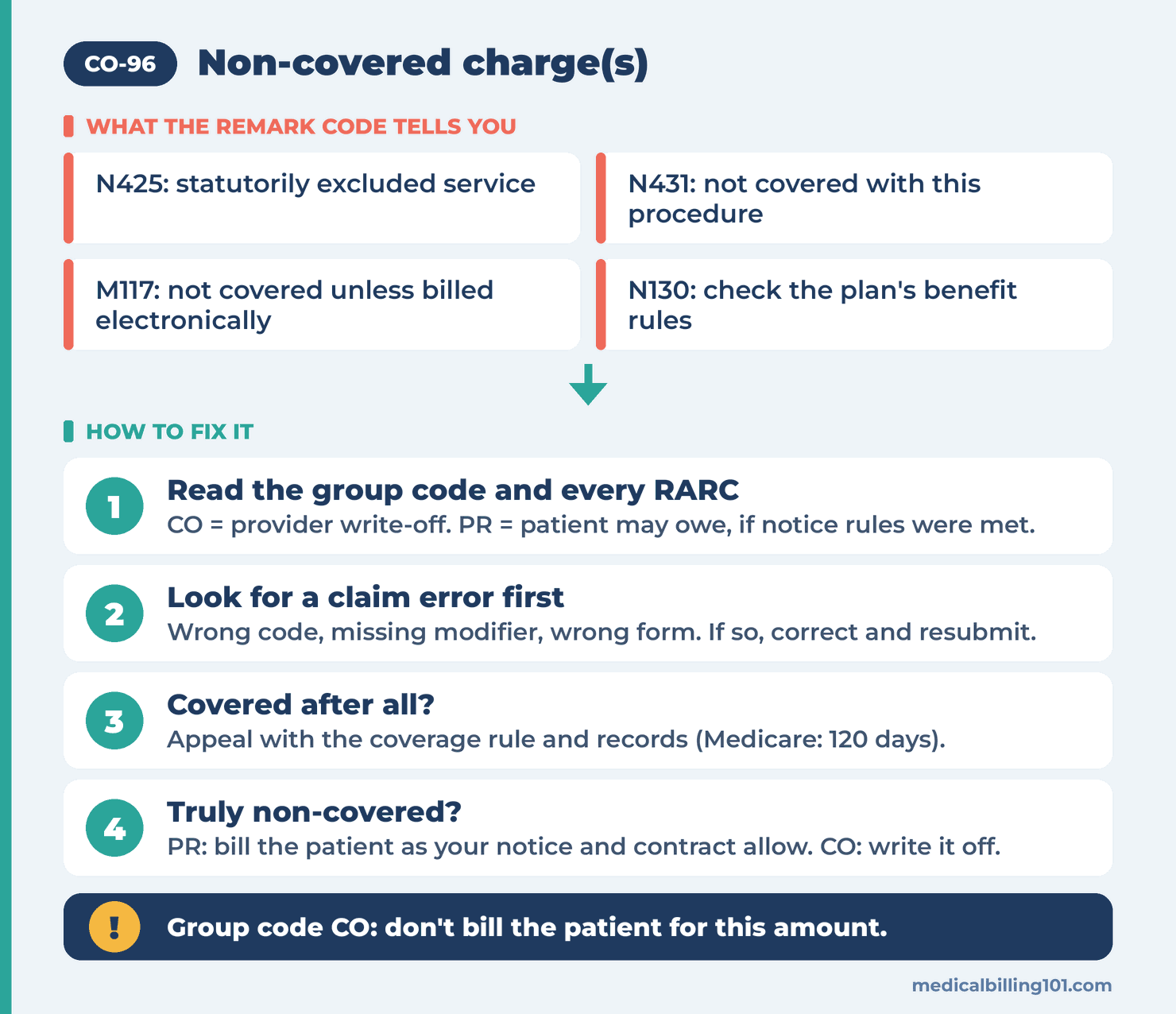
- Read the group code and every remark code. CO-96 and PR-96 call for different actions, and the RARC tells you which branch you’re on.
- Check the claim for a fixable error first. Wrong CPT or HCPCS code, wrong diagnosis, a missing modifier, or the wrong claim format can all produce 96. First Coast’s advice for statutorily excluded denials starts the same way: “Review the service billed to ensure the correct code was submitted” (FCSO, PR 96 tips).
- If you find an error, correct and resubmit. For Medicare, resend only the corrected line so you don’t trigger an OA-18 duplicate. For M117, Noridian’s next step is simply “Resubmit claim electronically.” For other payers, follow the corrected claim process in the provider manual.
- If the claim was right and the service is a covered benefit, appeal. Noridian notes that items denied with CO-96/N431 “have appeal rights.” Attach the policy or benefit language that shows coverage, plus the records. Medicare redeterminations are due within 120 days of receiving the initial determination (CMS). See our Medicare appeals guide.
- If the service really isn’t covered, decide who owes it. PR-96: bill the patient under your contract and notice rules. CO-96: write the amount off unless your contract allows billing the member with their prior written consent.
- Fix the root cause. Add a front-end check for non-covered services and update scrubber edits so the same line doesn’t go out again.
Medicare and major payer notes
Original Medicare. Statutory exclusions are services Medicare never covers, such as cosmetic surgery, routine physicals, and hearing aids or hearing exams (CMS MLN906765, September 2025). First Coast says you “can append a GY modifier” to a line for statutorily excluded services, which signals the item “does not meet the definition of a Medicare benefit.” An ABN isn’t required for care that’s never covered, but CMS “strongly encourage[s]” issuing one voluntarily (Medicare Claims Processing Manual, Ch. 30, §50.2.1). Our GY modifier guide covers the modifier in detail.
Medicare paper claims. M117 means Medicare expected an electronic claim. Noridian notes that if one provider in a group has the electronic filing requirement, “all members of group must submit electronically,” and providers who qualify can apply for an exemption under the Administrative Simplification Compliance Act.
UnitedHealthcare (commercial). UHC’s medical policy bulletins state that providers “may not seek or collect payment from a member for services not covered by the applicable benefit plan unless first obtaining the member’s written consent, acknowledging that the service is not covered by the benefit plan and that they will be billed directly for the service” (UHC Medical Policy Update Bulletin, September 2026). Without that signed consent, treat a CO-96 from UHC as a write-off or an appeal, not a patient bill.
Other commercial and Medicaid plans. Rules on billing members for non-covered services sit in your participation agreement and, for Medicaid, in state rules. Read the remark code and the 835 REF policy reference, then check the plan’s benefit documents before you bill anyone.
Worked example (illustrative)
A practice that is required to bill Medicare electronically sends a paper CMS-1500 for an office visit, CPT 99213, billed at $185.00. The remit comes back:
CAS*CO*96*185.00withLQ*HE*M117
Reading it: CO means the provider carries the $185.00. M117 says the service isn’t covered “unless submitted via electronic claim.” Nothing is wrong with the visit, the code or the diagnosis.
Fix: resubmit the same line electronically through the clearinghouse. Don’t bill the patient. The resubmission still has to meet Medicare’s 12-month filing limit from the date of service (42 CFR 424.44).
Contrast: if the same remit had shown CAS*PR*96 with N425 on a cosmetic procedure billed with GY, the patient would owe the amount, and a voluntary ABN or similar notice before the service would have set that expectation.
CO-96 appeal letter template
Use this when the claim was billed correctly and you believe the service is a covered benefit. Replace the bracketed text.
[Date]
[Payer name] Appeals / Redetermination Unit
[Address or portal reference]

Re: Request for reconsideration of CO-96 denial
Patient: [Name]   Member ID: [ID]
Claim number: [ICN / claim #]   Date of service: [MM/DD/YYYY]
Service: [CPT/HCPCS + modifiers]   Billed amount: [$]
Remit codes: CO-96, [RARC]

We request reconsideration of the denial above. The service is a covered
benefit under [plan document / Medicare benefit category / policy name and
section], which states: "[quote the coverage language]".

The claim was coded correctly: [CPT/HCPCS] describes the service documented
in the enclosed record, and the diagnosis [ICD-10-CM] supports it.
[If applicable: The remark code [RARC] does not apply because ...]

Enclosed: remittance advice, claim copy, [office note / operative report],
[policy excerpt]. Please reprocess the line for payment.

[Name, credentials]  [Practice, NPI]  [Phone / email]
If the denial came from a coding error instead, don’t appeal. Send a corrected claim.
CO-96 prevention checklist
- Check benefits for the specific service at scheduling, not just active coverage.
- Flag services your MAC or payer lists as excluded, and route them to a patient financial conversation before the visit.
- Use GY on Medicare lines for statutorily excluded services, and give a voluntary ABN or similar notice.
- Get written consent before a non-covered service for plans that require it, such as UHC commercial.
- Confirm whether your practice must bill Medicare electronically, and block paper claims in your PM system if so.
- Add scrubber edits for code pairs your payers list as “not covered with this procedure.”
- Track CO-96 and PR-96 separately in your denial reports. They have different owners and different fixes.
Related denial codes
- CO-50: not deemed a medical necessity. The closest sibling to 96.
- CO-96 in cosmetic billing: how plan exclusions play out for cosmetic and aesthetic services.
- CO-97: the service is bundled into another one already paid. Not a coverage decision.
- CO-16: claim lacks information. Fix and resubmit.
- PR-204: “This service/equipment/drug is not covered under the patient’s current benefit plan.” Some payers use 204 where others use 96.
- PR-1, PR-2 and PR-3: the patient’s deductible, coinsurance and copay.
FAQ
What is the CO 96 denial code description?
X12 describes CARC 96 as “Non-covered charge(s).” Its usage notes require at least one remark code and point you to the 835 policy reference segment (loop 2110 REF). With the CO group code, the provider carries the amount.
What does denial code CO 96 mean in medical billing?
It means the payer won’t pay the line because it treats the charge as not covered, and the provider can’t bill the patient for it under the CO group code. The remark code explains whether it’s an exclusion, a code problem or a claim format problem.
How do I fix a CO 96 denial?
Read the remark code, then check the claim for errors in the code, diagnosis, modifier or claim format. Correct and resubmit if you find one. Appeal with the coverage language if the service is a covered benefit. Write it off if it truly isn’t covered and you have no signed patient agreement.
Can I bill the patient for CO-96?
Not usually. CO means a provider write-off. You can bill the patient when the remit shows PR-96, or when your payer contract allows it and the patient signed a written agreement before the service.
What is the difference between CO-96 and PR-96?
The reason is the same, non-covered charge. The group code differs: CO-96 puts the amount on the provider, PR-96 on the patient. Medicare statutory exclusions with remark code N425 commonly come as PR-96.
Can a CO-96 denial be appealed?
Yes, when the payer got coverage wrong. Noridian notes that CO-96 lines with remark code N431 “have appeal rights.” If the denial came from your own coding or format error, a corrected claim is faster than an appeal.
Sources
- X12, Claim Adjustment Reason Codes (CARC 96, 50, 97, 16, 204). CARC 96 Start 01/01/1995, Last Modified 07/01/2017. Accessed 6 Oct 2026.
- X12, Remittance Advice Remark Codes (N425, N431, M117, N130). Accessed 6 Oct 2026.
- CMS, Medicare Claims Processing Manual (IOM 100-04), Ch. 22, §60.1 Group Codes
- CMS, Medicare Claims Processing Manual (IOM 100-04), Ch. 30, §50.2.1 Optional ABN Uses
- CMS MLN906765, Items & Services Not Covered Under Medicare (September 2025)
- CMS, First Level of Appeal: Redetermination by a Medicare Contractor
- 42 CFR 424.44, Time limits for filing claims
- Noridian JE Part B, Non-Covered Charge (CO-96/N431), last updated Apr 30, 2025
- Noridian JE Part B, Electronic Claim Submission Requirement (CO-96/M117), last updated Apr 2, 2025
- First Coast Service Options, Top claim errors, Apr to Jun 2026
- First Coast Service Options, Tips to prevent CARC PR 96 (Feb 16, 2026)
- Novitas Solutions JL, Top claim denials, Apr to Jun 2026
- UnitedHealthcare, Commercial Medical Policy Update Bulletin, September 2026
Last reviewed: 6 October 2026 · This page is educational and doesn’t replace payer-specific instructions.