
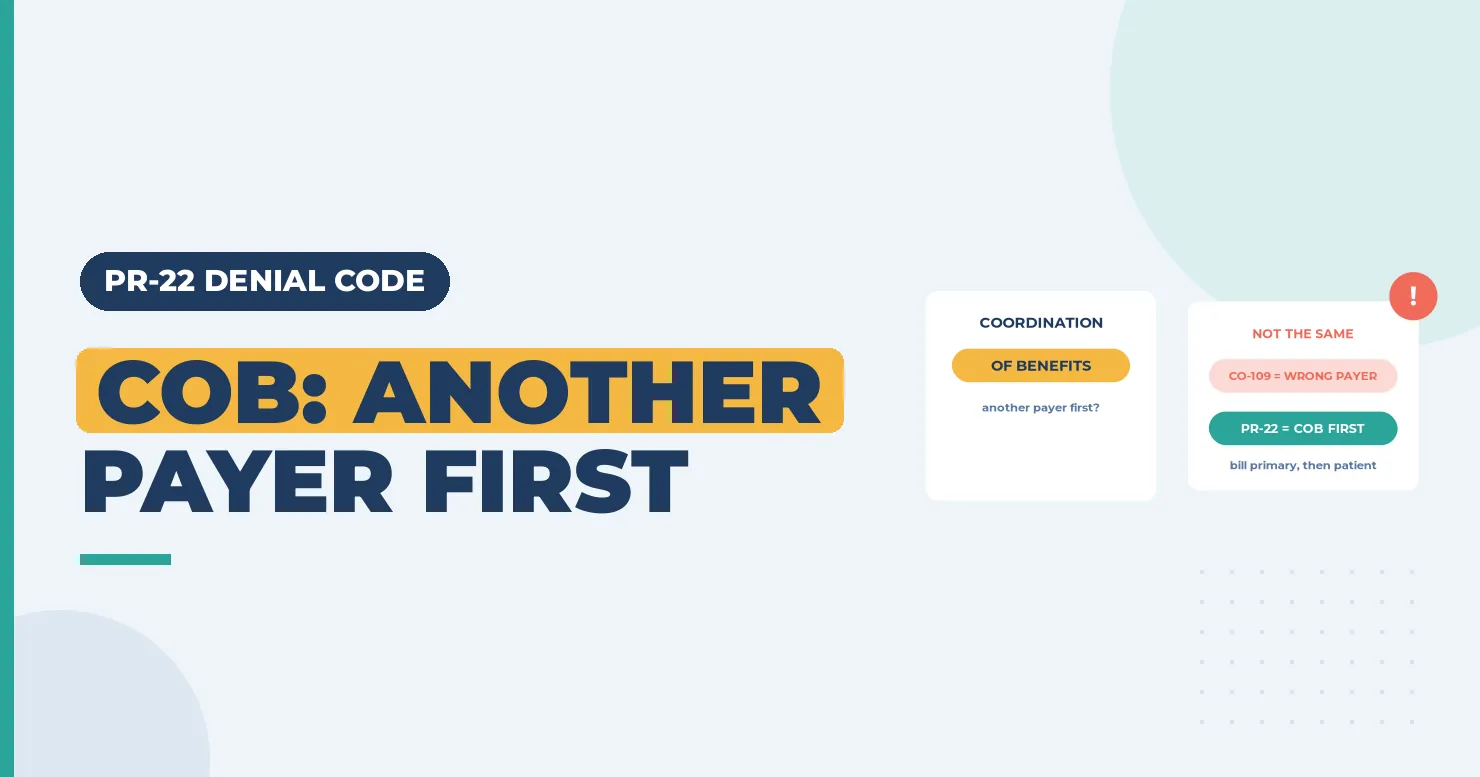
PR-22 is Claim Adjustment Reason Code 22 with group code PR. CARC 22 says the care may be covered by another payer under coordination of benefits (COB). PR means Patient Responsibility. COB is the rule set that decides which plan pays first. So the remit says two things at once. Another plan may owe the claim, and the patient may be billed. Do not send a statement yet. The first job is to find out which plan is primary. Many people search for “pr 22 denial code”, and that is the phrase this page answers. (Primary sources: X12 Claim Adjustment Reason Codes · CMS Claims Processing Manual, Ch. 22, §60.1 · CMS MSP Manual, Ch. 3)
Quick answer: PR-22 is a coordination of benefits problem filed under patient responsibility. Verify every plan the patient has for the date of service. Bill the primary plan first. Send the secondary claim with the primary remit. Bill the patient only for what remains after both plans have processed the claim.
Part of our denial codes library. Written by Manikandan, a revenue cycle management specialist with more than 10 years of US medical billing experience. Last reviewed: 16 October 2026. Official code wording is quoted word for word from X12; Medicare rules link to their CMS source.
PR-22 denial code description (official X12 wording)
X12 Claim Adjustment Reason Code 22, verbatim:
“This care may be covered by another payer per coordination of benefits.”
Source: X12 Claim Adjustment Reason Codes, checked 16 October 2026. Start: 01/01/1995. Last Modified: 09/30/2007. X12 lists no group code restriction for this code.
The group code is a separate field. CMS Claims Processing Manual, Ch. 22, §60.1 says PR “shall be used when the adjustment represent an amount that may be billed to the patient or insured.” The key words are “may be.” PR does not mean the patient must pay.
What PR-22 means in plain English
- The payer thinks another plan pays first. It may have other coverage on file, or the claim may be missing the other plan’s details.
- The amount is filed under PR. On its face, that points to the patient or insured. For example, a $420 line would show as $420 owed by the patient.
- That does not settle who owes the money. Until COB is sorted out, the real owner may be another insurer.
- It is a billing-order problem. It is not a coverage exclusion and not a coding denial.
- The common version is CO-22. See CO-22. PR-22 is the same reason with a different group code.
PR-22 vs CO-22, OA-23, CO-109 and lookalikes
| Code | Official X12 idea | What it tells you |
|---|---|---|
| PR-22 | Another payer may be primary (group PR) | COB problem filed as patient responsibility. This page |
| CO-22 | Same reason, group CO | COB problem filed as a contract adjustment. See CO-22 |
| OA-23 | Impact of prior payer adjudication (OA only) | A prior payer already paid. See OA-23 |
| 109 | Claim not covered by this payer; send to the correct payer | Wrong payer or contractor. See CO-109 |
| 136 | Failure to follow prior payer’s coverage rules (OA only) | Secondary denied for not following the primary’s rules |
| MA04 (RARC) | Secondary payment cannot be considered without the primary payer’s identity or payment information | Missing primary details on a secondary claim |
Why the PR group does not settle the bill
The group code only says who may be billed. The reason code says why. Here the reason is “another payer may cover this.” If another plan is primary, the patient may owe nothing yet. Billing the patient first can mean a refund later.
For Medicare, the rules are firm. The CMS MSP Manual, Ch. 3, §10 says claims for beneficiaries where Medicare is secondary “must be directed first to the primary plan where there is primary coverage for the services involved.” Section 30.1 adds that a group health plan “is billed first as primary payer.”
CMS also limits what you can charge a beneficiary. Under §10.1, a provider that receives direct payment from Medicare “may not charge a beneficiary if the provider… has been paid or could have been paid by a GHP an amount which equals or exceeds any applicable deductible or coinsurance amount.”
Common triggers for PR-22
- Missed insurance card. Registration did not capture every plan the patient has.
- Outdated COB record. The payer’s file shows a plan that ended, or misses a plan that started.
- Claim sent to the wrong plan first. The patient has two plans and the claim went to the secondary.
- Missing other-insurance data on the claim. The payer cannot confirm the primary, so it flags COB.
- Medicare Secondary Payer situation. A working-aged patient, an accident, or another MSP case, such as a no-fault claim, puts Medicare second.
Where PR-22 shows up in the 835
CLP*PCN88231*4*420.00*0.00*420.00*12*CLAIM334455~
SVC*HC:99215*420.00*0.00**1~
CAS*PR*22*420.00~
- Status code 4 means the claim was denied.
- The line paid $0.
- CAS*PR*22*420.00 moved the full charge to patient responsibility with the COB reason.
- This sample is illustrative only. Real remits vary. Look for a remark code such as N598 or MA92 in the same line.
How to fix PR-22: decision path

- Confirm the CAS segment. Check the group (PR), the reason (22), and the amount. Save the remit.
- Hold the patient statement. Do not bill the patient from this line yet.
- Verify all coverage for the date of service. Use the payer portal or a 270/271 eligibility check. Ask the patient about every plan.
- Decide the order. If another plan is primary, bill it first. For Medicare, use the MSP questions and the MSP data on file.
- Send the secondary claim with the primary payer’s payment details and adjudication. Attach the primary remit.
- If the denying payer is actually primary, the patient may need to update the COB record with the plan. For Medicare, the Benefits Coordination & Recovery Center handles it.
- Rebill and watch the clock. Check timely filing for each payer while you fix COB.
- Bill the patient last. Send a statement only for the amount that remains after every plan has processed the claim, and only if the payer’s group code and contract allow it.
Medicare, commercial and Medicaid notes
Medicare. CMS lists CO, OA and PR as valid group codes on Medicare remittances. MSP rules decide who pays first. The MSP Manual, Ch. 3, §20 covers admission questions that help you find other coverage.
Commercial. Each plan has its own COB policy that sets the order of payment. Ask the payer for it in writing when two plans disagree on who is primary.
Medicaid. Rules on other coverage vary by state. Confirm them in the state’s provider manual before you bill the patient.
Worked example (illustrative)
A patient sees a physician and presents one insurance card. The claim goes to Plan A. The remit shows CAS*PR*22*420.00 and pays $0.
Reading it: Plan A thinks another plan may be primary. It also filed the amount under PR.
Check: Consider what the front desk learns at the next visit. At the next visit, the front desk asks about other coverage. The patient has an employer plan through a spouse. The employer plan is primary for this patient, based on the plan’s COB rules.
Action: The biller does not send a patient statement. The biller bills the employer plan first. When the primary remit arrives, the biller sends Plan A a secondary claim with the primary payment details. Plan A now pays its share. Any balance left after both plans goes to the patient.
Second scenario: The employer coverage ended last year. The biller asks the patient to update the record with Plan A. After the update, the biller resubmits the claim to Plan A as primary.
Prevention checklist
- [ ] Ask about all insurance at every visit, not only the first one.
- [ ] Run eligibility for every date of service and compare the COB flags.
- [ ] Use an MSP questionnaire for Medicare patients.
- [ ] Block patient statements on any account with an open COB reason.
- [ ] Track the payers that send PR-22 and CO-22 and share the pattern.
- [ ] Keep the CARC and RARC guide handy for staff training.
Related denial codes
- CO-22: the same COB reason under group CO.
- OA-23: prior payer impact on a secondary remit.
- CO-109: claim sent to the wrong payer.
- CO-16: missing or invalid information.
- CARC and RARC guide.
Key takeaways
PR-22 means another plan may owe the claim, even though the amount sits in patient responsibility. Verify coverage first. Bill the primary plan, then the secondary plan. Bill the patient last.
FAQ
What is the PR-22 denial code description?
X12 describes CARC 22 as “This care may be covered by another payer per coordination of benefits.” PR-22 is that reason with group code PR.
Can I bill the patient for PR-22?
Not yet. PR means the amount “may be billed” to the patient. The reason says another payer may be primary. Resolve COB first, then bill only what remains.
Is PR-22 the same as CO-22?
They share the same reason code. CO-22 files the amount as a contract adjustment. PR-22 files it as patient responsibility. The fix, finding the primary plan, is the same.
What remark codes come with PR-22?
Common pairings are N598 (“Health care policy coverage is primary.”) and MA92 (“Missing plan information for other insurance.”). Check your own remit for the exact code.
How do I fix PR-22 for Medicare?
Check the MSP data and ask the patient the MSP questions. If another plan is primary, bill it first. Then send Medicare the secondary claim with the primary payer’s details.
Is PR-22 a denial?
It can be. The claim may pay $0 until COB is resolved. After you bill the right plan first, the same payer often pays as secondary.
Quick facts
| Item | Value |
|---|---|
| X12 code | 22 |
| X12 start | 01/01/1995 |
| Last modified | 09/30/2007 |
| Official wording | This care may be covered by another payer per coordination of benefits |
| Group code | PR (Patient Responsibility) |
| Same reason, other group | CO-22 |
| Last reviewed | 16 October 2026 |
Sources
- X12, Claim Adjustment Reason Codes (CARC 22, 23, 109, 136). CARC 22 Start 01/01/1995; Last Modified 09/30/2007. Accessed 16 Oct 2026.
- X12, Remittance Advice Remark Codes (N598, MA92, MA04). Accessed 16 Oct 2026.
- CMS, Medicare Claims Processing Manual (IOM 100-04), Ch. 22, §60.1 Group Codes. Accessed 16 Oct 2026.
- CMS, Medicare Secondary Payer Manual (IOM 100-05), Ch. 3, §10, §10.1, §30.1. Accessed 16 Oct 2026.
- Medical Billing 101, CO-22 guide.
Code wording and Medicare rules on this page were checked on 16 October 2026 against X12 and CMS sources.
Last reviewed: 16 October 2026 · This page is educational and doesn’t replace payer-specific contracts or coding rules.