
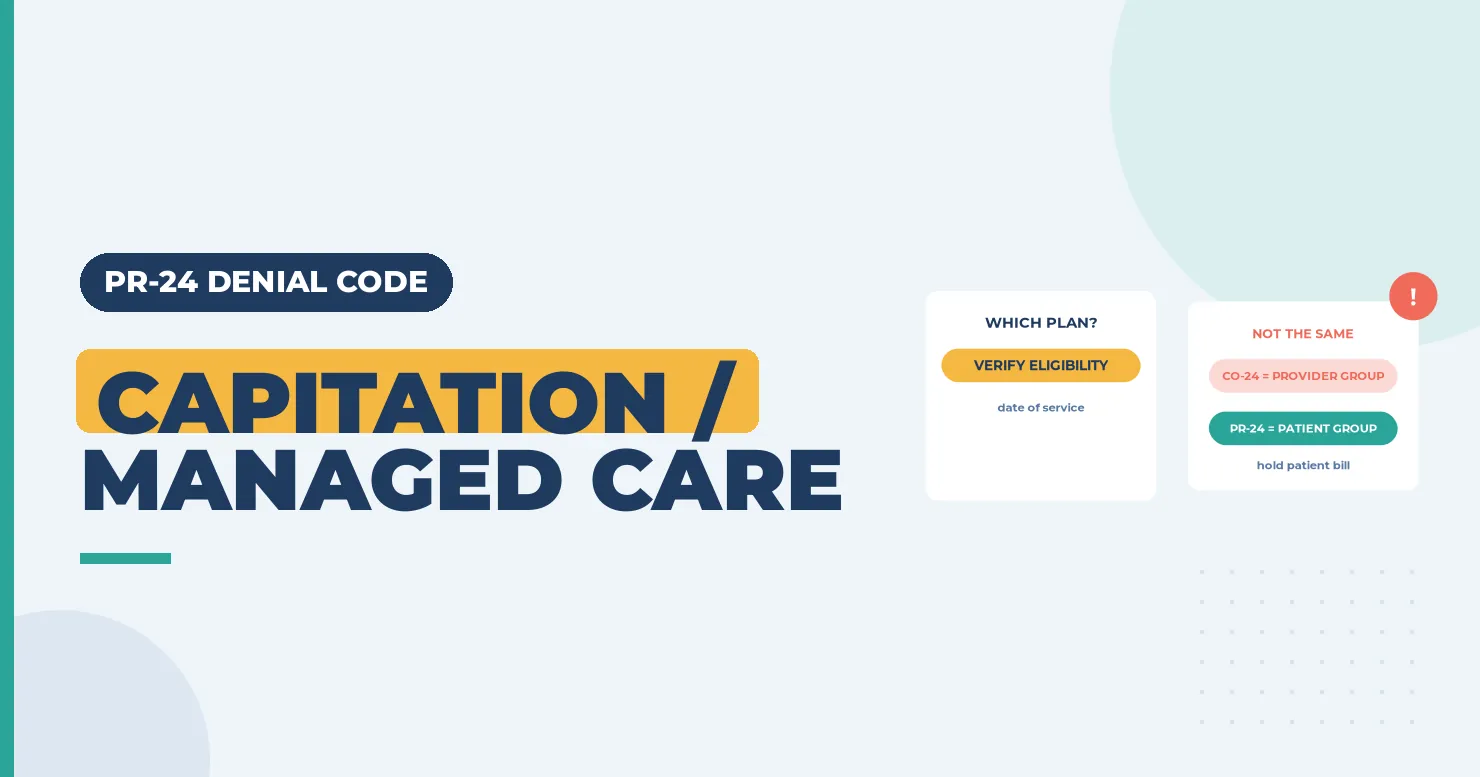
PR-24 is Claim Adjustment Reason Code 24 with group code PR. CARC 24 means the charges are covered under a capitation agreement or managed care plan. A capitation agreement is a contract in which a plan pays a provider a set amount per enrolled member, instead of paying each claim. The payer says the service belongs to a managed care arrangement, and it placed the amount under patient responsibility. That pairing is unusual, so check it before you bill anyone. Many people search for “pr 24 denial code”, and that is the phrase this page answers. (Primary sources: X12 Claim Adjustment Reason Codes · CMS Claims Processing Manual, Ch. 22, §60.1 · Noridian JE Part B, Medicare Advantage Plan)
Quick answer: PR-24 is a routing question first. Verify the patient’s coverage for the date of service. If the patient is in a managed care plan, bill that plan or the capitated group. Then ask the payer what the PR amount is, because a capitation adjustment is not a deductible or a copay. Hold the patient statement until the payer answers.
Part of our denial codes library. Written by Manikandan, a revenue cycle management specialist with more than 10 years of US medical billing experience. Last reviewed: 16 October 2026. Official code wording is quoted word for word from X12; Medicare rules link to their CMS or Medicare contractor source.
PR-24 denial code description (official X12 wording)
X12 Claim Adjustment Reason Code 24, verbatim:
“Charges are covered under a capitation agreement/managed care plan.”
Source: X12 Claim Adjustment Reason Codes, checked 16 October 2026. Start: 01/01/1995. Last Modified: 09/30/2007.
The CARC is 24. Here the group code is PR. CMS describes PR as the group code used “when the adjustment represent an amount that may be billed to the patient or insured. This group would typically be used for deductible and copay adjustments.” CMS Transmittal 470 (2005) lists CARC 24 with group code CO, not PR, for Medicare fiscal intermediaries.
What PR-24 means in plain English
- The payer says a managed care arrangement covers the service. Either another plan should be billed, or a capitation payment already covers it.
- The group is PR. The remit says the patient may be responsible for the amount.
- That is not the usual group for this reason. CMS describes PR as typically used for deductible and copay adjustments.
- Do not assume the patient owes it. Ask the payer what the PR amount represents.
- Eligibility decides the fix. Check which plan covered the patient on the date of service.
PR-24 vs CO-24, OA-24 and lookalikes
| Code | Official X12 idea | What it tells you |
|---|---|---|
| PR-24 | Charges covered under a capitation agreement/managed care plan | Managed care reason in the patient group. This page |
| CO-24 | Same reason, group CO | Provider write-off path. See CO-24 |
| 109 | Claim/service not covered by this payer/contractor; send to the correct payer | Wrong payer. See CO-109 |
| 22 | Care may be covered by another payer per coordination of benefits | Other plan may be primary. See PR-22 |
| 31 | Patient cannot be identified as our insured | Member match failed. See CO-31 |
How the payer reaches PR-24
For Medicare, First Coast explains the situation this way: “If a Medicare beneficiary enrolls in an MA plan, the MA plan replaces the beneficiary’s original Medicare plan.” Claims “must be submitted to the MA plan.” First Coast adds that a claim sent to Medicare “will be returned as an unprocessable claim, and the remittance advice (RA) will indicate CARC CO 24.”
Noridian lists the common reasons for the message. The patient was enrolled in a Medicare Advantage plan on the date of service. The patient’s record was not updated after disenrollment. The patient is in an MA plan and also elected hospice. Or the patient is in an MA plan and in a clinical trial. Commercial plans use CARC 24 for their own capitation and managed care rules.
Common triggers for PR-24
- Patient joined a managed care plan. For example, a Medicare Advantage plan began on the first of the month.
- Old coverage on file. The front desk used last year’s card.
- Capitation contract. The service is covered by a monthly capitation payment to your group or to another provider.
- The patient’s plan record was not updated. The payer’s file still shows a plan that ended.
- The group was set by the payer. The reason is right, but the payer put the amount in PR.
Where PR-24 shows up in the 835
CLP*PCN33018*4*165.00*0.00*165.00*12*CLAIM441972~
SVC*HC:99213*165.00*0.00**1~
DTM*472*20260902~
CAS*PR*24*165.00~
- Status code 4 means the claim was denied.
- The line paid $0.
- CAS*PR*24*165.00 put the full charge under patient responsibility.
- The DTM line shows the service date the payer read.
- This sample is illustrative only. Real remits vary.
How to fix PR-24: decision path
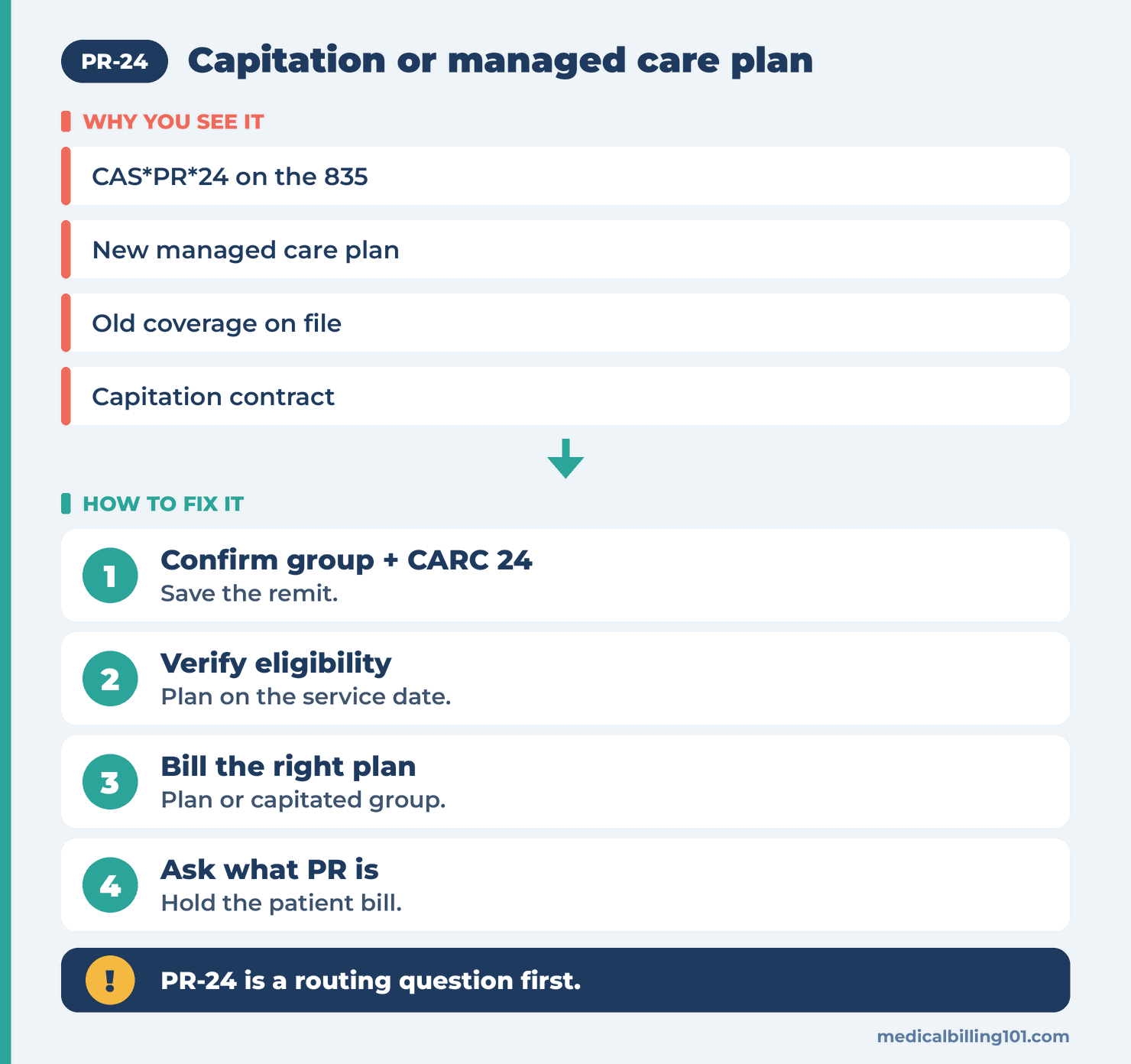
- Confirm the CAS segment. Check the group (PR), the reason (24), and the amount. Save the remit.
- Verify eligibility for the date of service. Use the payer portal or the Medicare portal.
- Look at the card. Ask the patient for every insurance card, and ask about any new plan.
- If a managed care plan covers the date, bill that plan or the capitated group.
- If the plan was not valid on that date, ask the payer to update its record, then send a new claim.
- For Medicare hospice or trial cases, Noridian says to refile with the right modifier: GV or GW for hospice, and Q0 or Q1 for clinical trial services.
- Ask the payer what the PR amount is. A capitation adjustment is not a deductible or a copay.
- Hold the patient bill until the payer confirms the patient share.
Medicare, commercial and Medicaid notes
Medicare. First Coast says “claims that are returned as unprocessable cannot be appealed.” If the beneficiary’s record with CMS shows no MA plan on the date of service, resubmit the claim. For an ESRD capitation agreement, First Coast says to contact the capitation provider before the service. Noridian’s modifiers are GV (attending physician not employed or paid under agreement by the patient’s hospice provider), GW (condition not related to the patient’s terminal condition), Q0 (investigational clinical service in an approved research study) and Q1 (routine clinical service in an approved research study). Medicare lists CARC 24 with CO, so ask your contractor why the group is PR.
Commercial. Ask which contract rule applies. Ask whether your capitation payment covers the service, and what you may bill the patient, such as a copay your contract allows.
Medicaid. Managed care plans in state Medicaid programs have their own billing rules. Check the plan manual and the state provider manual.
Worked example (illustrative)
A practice bills 99213 on 2 September 2026. The remit shows CAS*PR*24*165.00. The practice’s file shows the patient with a commercial PPO from last year.
Reading it: The payer says a managed care arrangement covers this service.
Check: The eligibility response shows the patient moved to an HMO on 1 September 2026, and the HMO assigned the patient to a different capitated group.
Action: The biller updates the insurance on file, sends the claim to the HMO or the capitated group under its rules, and asks the old payer what the PR amount was. The biller holds the patient statement.
Second scenario: The patient’s HMO enrollment is real, and the HMO says the patient owes a copay under the plan. The biller then bills the patient only for the copay amount the plan states.
Prevention checklist
- [ ] Run eligibility before each visit, not once a year.
- [ ] Ask every patient about new insurance at check-in.
- [ ] Keep a list of your capitation contracts and the services they cover.
- [ ] Hold patient statements on any PR line with reason 24.
- [ ] Track PR-24 by payer to spot wrong group code use.
- [ ] Keep the CARC and RARC guide handy for staff training.
Related denial codes
- CO-24: the same reason under the contractual group.
- CO-109: claim not covered by this payer, send to the correct payer.
- PR-22: another payer may be primary.
- CO-31: patient cannot be identified as the payer’s insured.
- CARC and RARC guide.
Key takeaways
PR-24 says a capitation agreement or managed care plan covers the service. Verify the plan for the date of service, bill the right plan, and ask what the PR amount is. Hold the patient bill until the payer confirms it.
FAQ
What is the PR-24 denial code description?
X12 describes CARC 24 as “Charges are covered under a capitation agreement/managed care plan.” PR-24 is that reason with group code PR.
Can I bill the patient for PR-24?
Not yet. The PR group says the patient may owe the amount, but a capitation adjustment is not a deductible or a copay. Ask the payer to confirm what the patient share is first.
What is the difference between PR-24 and CO-24?
The reason is the same. The group is not. CO means a provider write-off, and PR means the patient may owe the amount.
Does PR-24 mean the patient has Medicare Advantage?
It can. First Coast says a claim for an MA enrollee that is sent to Medicare is returned with CARC CO 24. Verify eligibility to be sure.
How do I fix PR-24?
Verify coverage for the date of service, bill the managed care plan or the capitated group, and ask the payer what the PR amount is.
Is PR-24 appealable?
Claims that Medicare returns as unprocessable cannot be appealed. For other payers, appeal only if the plan was not valid on that date and the payer’s record is wrong.
Quick facts
| Item | Value |
|---|---|
| X12 code | 24 |
| X12 start | 01/01/1995 |
| Last modified | 09/30/2007 |
| Official wording | Charges are covered under a capitation agreement/managed care plan |
| Group on this page | PR |
| CMS 2005 group for CARC 24 | CO |
| Common confusions | CO-24 (same reason, CO group), CO-109 (wrong payer) |
| Last reviewed | 16 October 2026 |
Sources
- X12, Claim Adjustment Reason Codes (CARC 22, 24, 31, 109). CARC 24 Start 01/01/1995; Last Modified 09/30/2007. Accessed 16 Oct 2026.
- CMS, Medicare Claims Processing Manual (IOM 100-04), Ch. 22, §60.1 Group Codes. Accessed 16 Oct 2026.
- CMS, Transmittal 470 (4 Feb 2005). Accessed 16 Oct 2026.
- Noridian JE Part B, Medicare Advantage Plan (updated 30 Apr 2025). Accessed 16 Oct 2026.
- First Coast Service Options, Tips to prevent RUC CO 24 (29 Jun 2026). Accessed 16 Oct 2026.
- Medical Billing 101, CO-24 guide.
Code wording and Medicare rules on this page were checked on 16 October 2026 against X12, CMS, Noridian and First Coast sources.
Last reviewed: 16 October 2026 · This page is educational and doesn’t replace payer-specific contracts or coding rules.