

N2 is a Remittance Advice Remark Code (RARC) that says an allowance was set under a plan provision. A remark code is a message on a remittance that adds detail to a payment or adjustment. A course of treatment provision is a plan term that lets the payer choose which treatment it will base its payment on. N2 is a remark, not a Claim Adjustment Reason Code, so the CARC and group code on the same line carry the money. Many people search for “n2 remark code”, and that is the phrase this page answers. (Primary sources: X12 Remittance Advice Remark Codes · X12 Claim Adjustment Reason Codes · ADA, Least Expensive Alternative Treatment clause)
Quick answer: N2 says the allowance was made under the plan’s “most appropriate course of treatment” provision. In practice this usually means the plan priced a different, often cheaper, treatment than the one billed. It is not a missing-information message. Read the CARC and group code, find which treatment the plan paid for, read the plan wording, and decide whether to bill the difference, appeal, or fix your estimate process.
Part of our denial codes library. Written by Manikandan, a revenue cycle management specialist with more than 10 years of US medical billing experience. Last reviewed: 17 October 2026. Official code wording is quoted word for word from X12; other claims link to their source.
N2 remark code description (official X12 wording)
X12 Remittance Advice Remark Code N2, verbatim:
“This allowance has been made in accordance with the most appropriate course of treatment provision of the plan.”
Source: X12 Remittance Advice Remark Codes, checked 17 October 2026. Start: 01/01/2000. X12 lists no later modification and no usage note.
What N2 means in plain English
- The service was recognized. The payer did not say it was missing or invalid.
- The allowance is the issue. The amount was set under a plan provision, not the billed amount alone.
- The plan chose the treatment to price. The code does not say which one.
- The CARC and group code carry the money. Read them first.
- The plan document holds the rule. X12 only points to “the plan.”
How N2 relates to alternate benefits
The wording of N2 does not name dental care. The practice is best documented in dental plans, though. The American Dental Association describes a least expensive alternative treatment (LEAT) clause. When several treatments are viable for a condition, the plan pays only for the least expensive one. The ADA also describes an alternate benefit provision as a way for the payer to set the benefit on an alternative procedure that is generally less expensive than the one performed.
For example, the ADA says a dentist may recommend a fixed bridge, but the plan may reimburse only a removable partial denture. The plan covers the condition. It just pays the benefit for the cheaper option.
X12 CARC 169 reads “Alternate benefit has been provided.” It fits this situation well. X12 does not tie N2 to any one CARC, so read the code on your own remit.
N2 vs CARC 169, CO-45 and lookalikes
| Code | Type | Official idea | Difference |
|---|---|---|---|
| N2 | RARC | Allowance made under the most appropriate course of treatment provision | Remark that explains the basis. This page |
| 169 | CARC | Alternate benefit has been provided | The adjustment itself, when an alternate was paid |
| 45 | CARC | Charge exceeds fee schedule/maximum allowable or contracted/legislated fee arrangement | Fee schedule limit. See CO-45 |
| 50 | CARC | Not deemed a medical necessity by the payer | Necessity, not a cheaper alternative. See CO-50 |
| 204 | CARC | Service/equipment/drug not covered under the patient’s current benefit plan | Not covered at all. See PR-204 |
| N381 | RARC (Alert) | Consult our contractual agreement | Contract pointer. See N381 |
What the plan has to tell you
The ADA states a policy about LEAT decisions. It says the plan should inform the plan purchaser of the clause, and should give the patient and treating dentist the name and qualifications of the individual who made the determination, with the basis for it. Use that when you ask a payer to explain an N2 line.
The ADA also notes that these policies are usually in the dentist’s provider manual or on the payer’s online portal, not in the participating agreement itself. Check both.
Who can the patient be billed
It depends. The ADA says the amount a dentist can bill the patient depends on whether the dentist signed a participating provider agreement with the plan. In its example, an out-of-network dentist can bill up to the full fee. A participating dentist follows the contract. The EOB should state the patient’s out-of-pocket responsibility.
CMS Claims Processing Manual Ch. 22, §60.1 describes the group codes for Medicare. CO adjustments are generally a write-off for the provider, and PR is an amount that may be billed to the patient. Other payers set their own rules.
Do not assume the difference is billable. Read the group code on the CARC, the contract and the EOB first.
Common triggers for an N2 line
- A cheaper option exists. The plan believes another treatment is professionally acceptable for the condition.
- No pre-treatment estimate. The office did not learn of the clause before the work was done.
- Plan terms were not checked. The office assumed the plan covers the procedure at its full allowance.
- Thin clinical support. The records did not show why the cheaper option would not work.
- A different plan year or group. The employer plan has the clause and another group does not.
Where N2 shows up in the 835
CLP*PCN40267*1*4200.00*1650.00*0.00*12*CLAIM558309~
SVC*AD:D6240*4200.00*1650.00**1~
CAS*PR*169*2550.00~
LQ*HE*N2~
- Status code 1 means the claim was processed as primary.
- The line paid $1,650.00 of the $4,200.00 billed.
- LQ*HE*N2 carries the remark code. In some remits it appears in an RMK segment instead.
- The CARC on the CAS segment is the reason for the adjustment. Here it is 169 under PR.
- This sample is illustrative only. Real remits vary, and the group code depends on the payer and contract.
How to work an N2 line: decision path
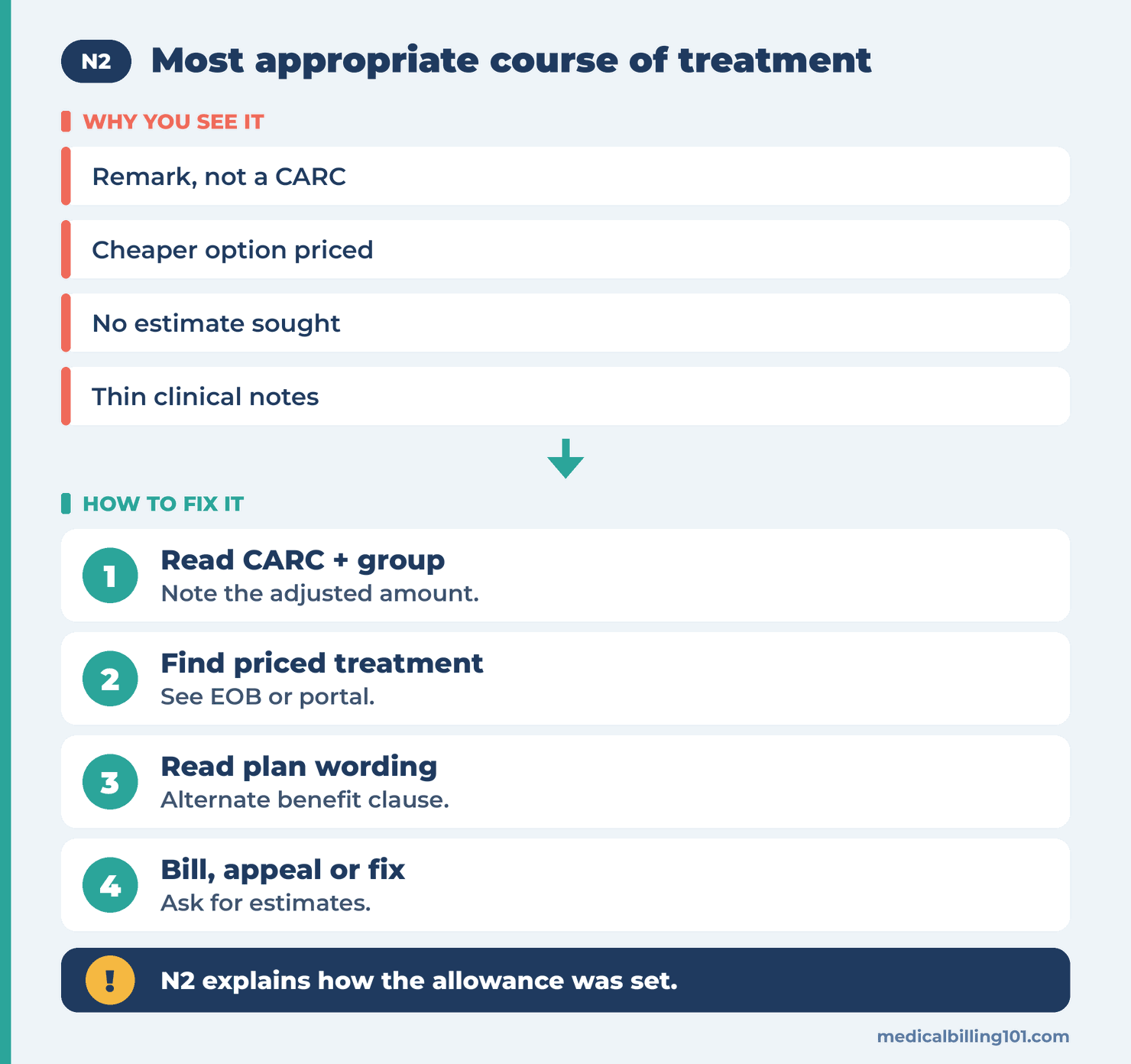
- Read the CARC and group code on the same line. Note the adjusted amount.
- Find the treatment the plan priced. The EOB or the payer portal should say.
- Read the plan wording for the alternate benefit or course of treatment clause.
- Compare the treatment billed with the treatment paid. Note the difference in amount.
- Check who owes it under the group code, your contract and the EOB.
- If the clause applies, post the payment and adjustment. Bill the patient only if the contract allows.
- If the cheaper option was not suitable, appeal with clinical records, such as notes, imaging or a narrative.
- Fix the front end. Ask for a pre-treatment estimate before the next similar case.
Commercial, Medicare and Medicaid notes
Commercial. This is where N2 fits best. Employer and individual plans write their own clauses. Ask the plan for the clause and for its internal review criteria.
Medicare. The alternate benefit examples on this page come from dental plans. If N2 appears on a Medicare remit, read the CARC and use your MAC’s guidance.
Medicaid. State programs publish their own coverage and payment rules. Check the state provider manual.
Worked example (illustrative)
A dental office bills a fixed bridge line for $4,200. The remit shows a payment of $1,650 and a PR adjustment of $2,550 with CARC 169 and remark N2.
Reading it: The plan paid under its course of treatment provision. The CARC says an alternate benefit was provided.
Check: The plan’s clause says it pays for the least expensive professionally acceptable option. The EOB shows the plan priced a removable partial denture instead. The office is a participating provider, and its contract allows billing the patient the difference between the plan’s payment and the contracted fee for the service done.
Fix: The office posts the payment and the adjustment, then bills the patient the amount the contract allows, not the full PR amount. It also asks the plan for the name and qualifications of the reviewer and the basis for the decision.
Second scenario: The patient’s records show the partial denture would not be suitable. The office sends the notes and imaging with an appeal and asks for the allowance to be redone.
Prevention checklist
- [ ] Ask for a pre-treatment estimate on major work.
- [ ] Read the plan’s alternate benefit or LEAT wording at verification.
- [ ] Tell the patient before treatment what the plan may pay and what they may owe.
- [ ] Keep notes and imaging that show why the chosen treatment fits the condition.
- [ ] Track N2 lines by plan and procedure to see which clauses cost you the most.
- [ ] Keep the CARC and RARC guide handy for staff training.
Related codes
- CO-45: charge exceeds the fee schedule or contracted amount.
- CO-50: not deemed a medical necessity.
- PR-204: service not covered under the patient’s plan.
- N381: consult the contractual agreement.
- CARC and RARC guide.
Key takeaways
N2 says the allowance followed the plan’s most appropriate course of treatment provision. It usually means the plan priced a different treatment than the one billed. Read the CARC and group code, compare the treatments, check the plan wording and the contract, then bill, appeal or improve your estimate step.
FAQ
What is the N2 remark code description?
X12 describes N2 as “This allowance has been made in accordance with the most appropriate course of treatment provision of the plan.”
Is N2 a denial?
No. It is a remark code that explains the basis of an allowance. The CARC and group code on the line show the adjustment.
Is N2 the same as an alternate benefit?
They are close. An alternate benefit provision lets the plan set the benefit on a cheaper alternative. CARC 169 reads “Alternate benefit has been provided.” X12 does not link N2 to a single CARC.
Can I bill the patient for the difference?
It depends on the group code, your contract and the EOB. The ADA says the billable amount depends on whether the dentist is a participating provider.
Can I appeal an N2 line?
Yes, if the plan’s cheaper option was not suitable. Send clinical records and ask the plan for the basis of its decision.
Does N2 only apply to dental plans?
The X12 wording does not say so. Dental plans are where the clause is best documented, but any plan with such a provision can use it.
Quick facts
| Item | Value |
|---|---|
| X12 RARC | N2 |
| X12 start | 01/01/2000 |
| Type | Remark code |
| Official wording | This allowance has been made in accordance with the most appropriate course of treatment provision of the plan |
| Related CARC wording | 169: Alternate benefit has been provided |
| Common confusions | CO-45 (fee schedule), CO-50 (medical necessity), PR-204 (not covered) |
| Last reviewed | 17 October 2026 |
Sources
- X12, Remittance Advice Remark Codes (N2, N381). N2 Start 01/01/2000. Accessed 17 Oct 2026.
- X12, Claim Adjustment Reason Codes (45, 50, 169, 204). Accessed 17 Oct 2026.
- CMS, Medicare Claims Processing Manual (IOM 100-04), Ch. 22, §60.1 Group Codes. Accessed 17 Oct 2026.
- American Dental Association, Least Expensive Alternative Treatment Clause. Accessed 17 Oct 2026.
- American Dental Association, Least Expensive Alternative Treatment (LEAT) Clauses (PDF, updated 12/16/2021). Accessed 17 Oct 2026.
Code wording and the ADA descriptions on this page were checked on 17 October 2026 against X12, CMS and ADA sources.
Last reviewed: 17 October 2026 · This page is educational and doesn’t replace payer-specific contracts or coding rules.