

PR-32 is an eligibility denial. It tells you the payer found the subscriber, but not a valid link between that subscriber and the patient. In its records, the patient isn’t an eligible dependent on the policy on that date. Maybe the child aged out, the spouse was removed after a divorce, or the plan wants proof it never got. The PR group means the payer has put the balance on the patient, but that’s often the start of the story, not the end. (Primary sources: X12 Claim Adjustment Reason Codes · X12 Remittance Advice Remark Codes · HealthCare.gov, young adult coverage).
In brief: PR-32 means “our records indicate the patient is not an eligible dependent.” Check eligibility for the date of service, confirm the relationship code and patient details on the claim, and ask the subscriber to fix the plan’s records if they’re wrong. If the patient truly wasn’t covered, look for other coverage before you bill them. A PR balance can be billed to the patient, but only after you’ve ruled out a fixable error.
Part of our denial codes library. Written by Manikandan J, CPC, CRCR, who has more than 10 years of US medical billing and revenue cycle experience. Published 20 October 2026. Last updated: 20 October 2026. Code wording is quoted word for word from X12.
CARC 32 official description
| Field | Official X12 text |
|---|---|
| Description | “Our records indicate the patient is not an eligible dependent.” |
| Start | 01/01/1995 |
| Last modified | 03/01/2018 |
Source: X12 Claim Adjustment Reason Codes, checked 20 October 2026.
The phrase “our records indicate” is worth noticing. The payer is reporting what its file says, not proving the patient is ineligible. Files are often wrong, especially after life events such as a marriage, a birth or a job change.
Denial code 32, CARC 32 and reason code 32
All three are the same X12 code. Denial code 32 and reason code 32 are what billers say. On the remit you’ll see it with a group code: PR-32 when the payer assigns the balance to the patient, CO-32 when it assigns it to the provider, which some contracts require.
PR-32 vs CO-32: who pays
| Group + CARC | Who carries it | What it means for you |
|---|---|---|
| PR-32 | Patient | You may bill the patient, once you’ve confirmed no other coverage applies and no error was made. |
| CO-32 | Provider | Your contract bars billing the patient. Fix eligibility or write off. |
| OA-32 | Not assigned | Often on a secondary line. Check the primary payer. |
CMS describes PR amounts as ones that “may be billed to the patient or insured” (Medicare Claims Processing Manual, Ch. 22, §60.1).
Why payers send CARC 32
Remark wording is from the X12 RARC list. Pairings vary.
| Cause | Typical RARC | Fix |
|---|---|---|
| Dependent child aged out of the plan | N30 | Confirm the birth date and the plan’s age limit. Look for the young adult’s own coverage. |
| Plan needs a dependent eligibility questionnaire | N375 | Have the subscriber return the form, then ask for reprocessing. |
| Wrong relationship code on the claim | MA60 | Fix the patient’s relationship to the subscriber and send a corrected claim. |
| Spouse or stepchild removed after a life event | N197 | The subscriber must update the plan through the employer or the plan. |
| Patient listed under the wrong subscriber | N30 | Bill under the right subscriber’s policy. |
How to resolve PR-32
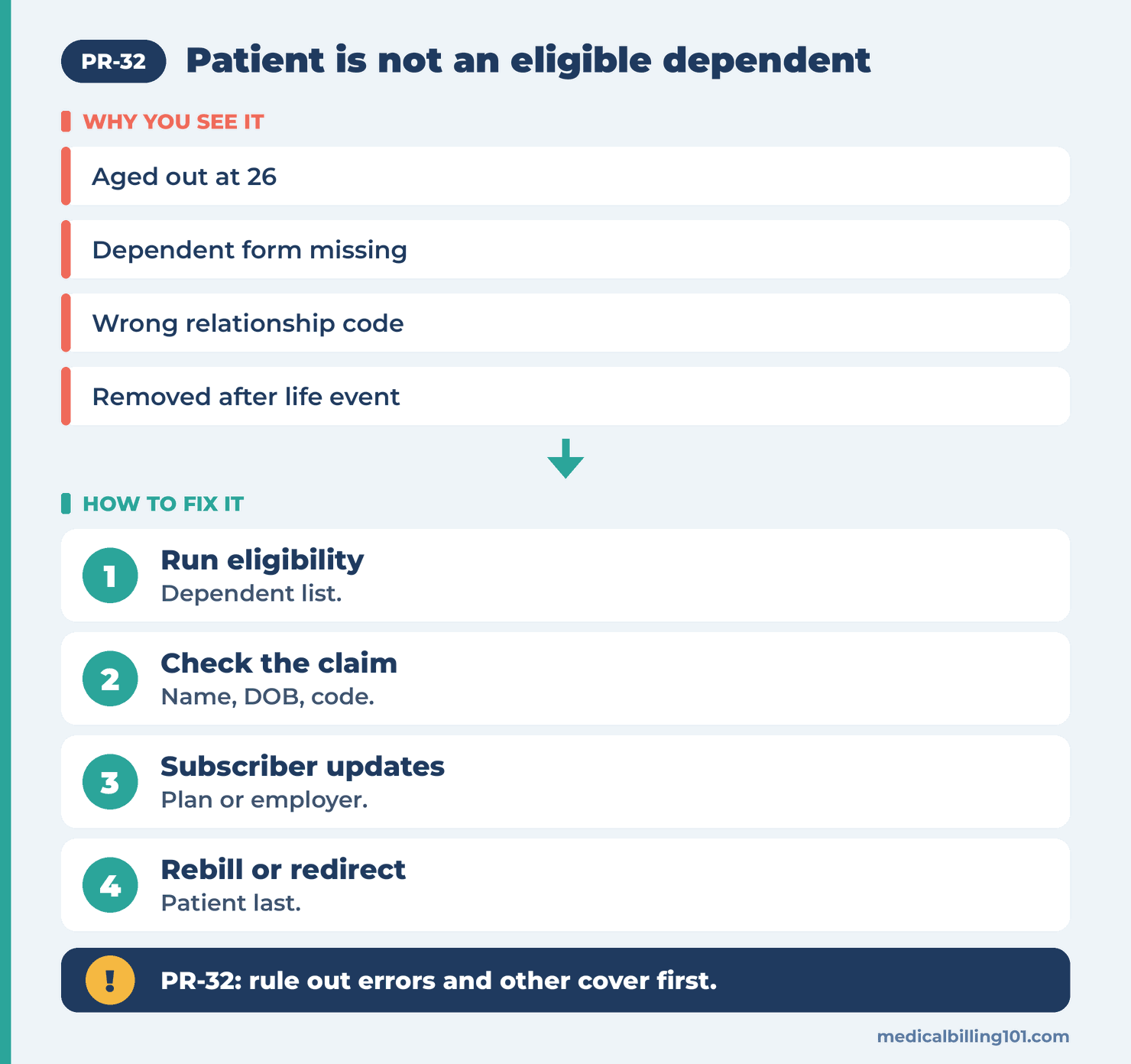
- Run eligibility for the date of service. Use a 270/271 check or the payer portal. Look at the dependent list, not just the subscriber.
- Check the claim’s patient loop. Name, birth date, member ID suffix and the relationship code must match the plan’s file.
- Ask the subscriber. Did anything change, such as a divorce, a new job or a missed student or disability form?
- Get the record fixed. Payers usually take changes from the subscriber or employer, not the provider.
- Rebill or redirect. Once eligibility is fixed, ask for reprocessing. If the patient has other coverage, bill it.
- Bill the patient last. Only when the patient truly wasn’t covered and no other payer applies.
Dependents and the age 26 rule
A dependent is a spouse, child or other family member covered under the subscriber’s policy.
Under federal law, plans that offer dependent coverage must allow children to stay on a parent’s plan until age 26 (HealthCare.gov). After that birthday, PR-32 is common. Some plans keep disabled adult children covered past 26 with proof of disability, which is often what a questionnaire is asking for.
Appeal approach
Most PR-32 denials are fixed through eligibility updates, not appeals. Appeal when the plan’s file is wrong and the subscriber has already asked for a fix. Send:
- proof of the relationship, such as a birth or marriage certificate, if the plan asks for it;
- the completed eligibility questionnaire or disability form;
- the employer’s enrollment confirmation;
- the corrected claim details.
Questions to ask the payer about a PR-32
- Which dependents are on the policy for the date of service?
- What relationship and birth date do you have for this patient?
- Is a dependent questionnaire or proof outstanding?
- Once the subscriber updates the file, will you reprocess, or do I resubmit?
- Is there any other coverage on file for this patient?
Worked example (illustrative)
A 26-year-old visits urgent care and gives a parent’s insurance card. The remit shows CAS*PR*32*185.00 with remark N30. The biller checks eligibility and sees the dependent coverage ended at the end of the month the patient turned 26. The patient has a new job with its own plan that started that week. The biller gets the new card, bills the new plan and the claim pays. No patient bill was needed.
Prevention checklist
- [ ] Run eligibility for every visit, checking the dependent list.
- [ ] Ask about life events at check-in: new job, marriage, divorce, new baby.
- [ ] Flag patients turning 26 on a parent’s plan.
- [ ] Copy the front and back of the card at every visit.
- [ ] Track PR-32 by payer to find plans with slow file updates.
Related denial codes
- CO-31: the patient can’t be identified as the payer’s insured.
- CO-27: expenses incurred after coverage terminated.
- CO-26: expenses incurred before coverage began.
- PR-200: expenses incurred during a lapse in coverage.
- CO-22: care may be covered by another payer.
- Denial codes hub for the full list.
Key takeaways
PR-32 means the payer’s file doesn’t show the patient as an eligible dependent on that date. Check eligibility, the relationship code and the patient details, and have the subscriber fix the plan’s records if they’re wrong. Look for other coverage before you bill the patient.
FAQ
What does denial code PR-32 mean?
It means the payer’s records show the patient isn’t an eligible dependent on the subscriber’s policy, and the payer assigned the balance to the patient.
Can I bill the patient for PR-32?
Yes, the PR group allows it. First confirm there’s no error in the claim or the plan’s file and no other coverage.
What is the difference between PR-32 and CO-31?
CO-31 means the payer can’t identify the patient at all. PR-32 means it found the policy but doesn’t list the patient as an eligible dependent.
How does the age 26 rule affect PR-32?
Plans with dependent coverage must cover children to age 26. After that, many PR-32 denials are for young adults who need their own plan.
Who can fix the plan’s dependent records?
Usually the subscriber or the employer. Providers can’t change a member’s enrollment.
Can PR-32 be reversed?
Yes. Once the plan’s file is fixed for the date of service, ask for reprocessing or send a corrected claim.
Sources
How we checked: every code quote on this page was compared word for word with the X12 CARC and RARC lists on 20 October 2026.
- X12, Claim Adjustment Reason Codes (CARC 32). Accessed 20 Oct 2026.
- X12, Remittance Advice Remark Codes (N30, N375, MA60, N197). Accessed 20 Oct 2026.
- HealthCare.gov, Coverage for young adults under 26. Accessed 20 Oct 2026.
- CMS, Medicare Claims Processing Manual, Ch. 22, §60.1 Group Codes. Accessed 20 Oct 2026.
Last updated: 20 October 2026 · This page is educational and doesn’t replace payer contracts or coding rules.