
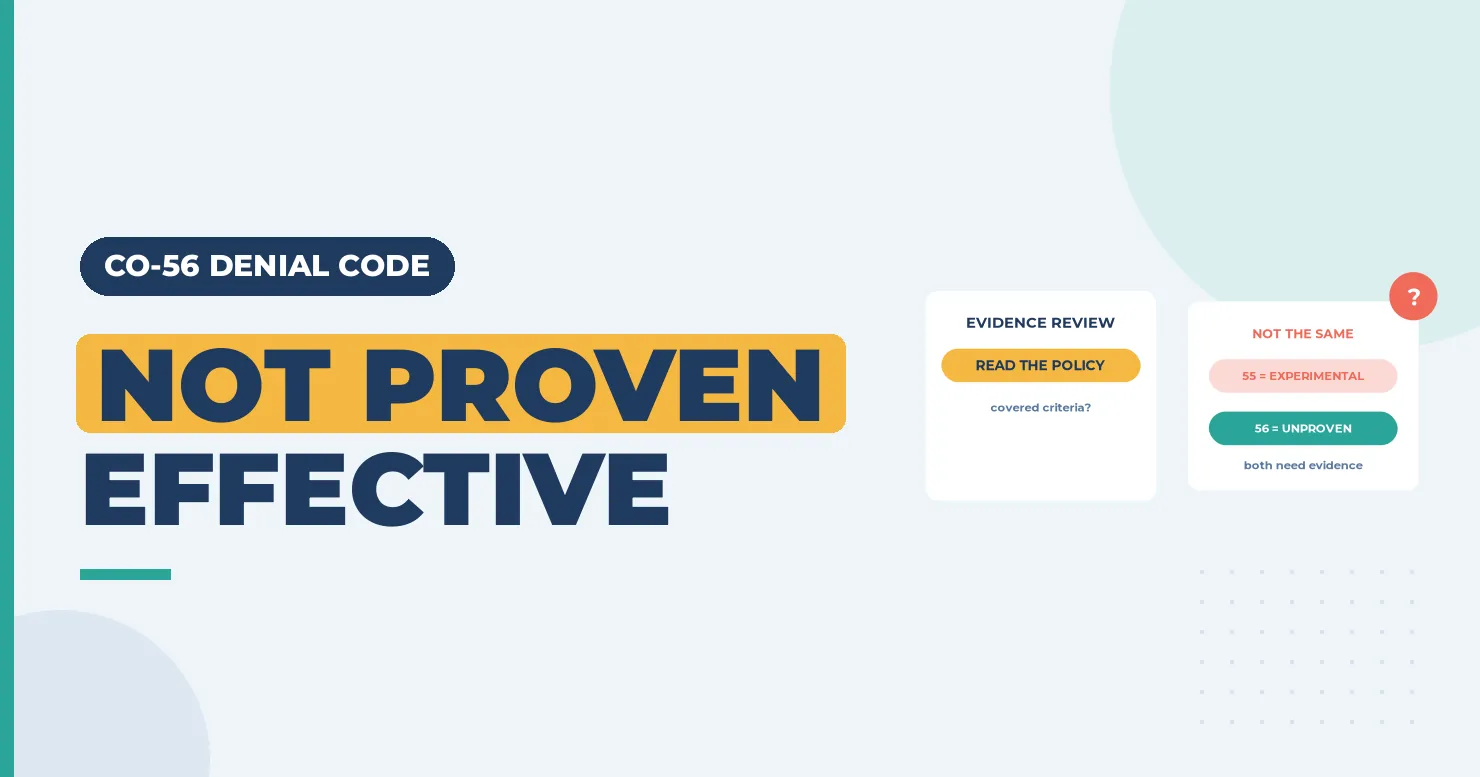
CO-56 means the payer thinks the treatment hasn’t been shown to work well enough to pay for it. It’s a call about the evidence, not a coding error. The payer’s policy says the studies don’t yet prove the service helps patients with this problem. To win, you need to show one of two things. Either the patient fits the rules the policy does cover, or the proof is stronger than the policy says. (Primary source: X12 Claim Adjustment Reason Codes).
In brief: CO-56 means “Procedure/treatment has not been deemed ‘proven to be effective’ by the payer.” Get the payer’s medical policy named in the 835 REF segment. Check whether the patient meets any covered criteria. If they do, appeal with records. If they don’t, build an evidence appeal with guidelines and peer-reviewed studies, ask for a peer-to-peer review, and use external review where the plan allows it.
Part of our denial codes library. Written by Manikandan J, CPC, CRCR, who has prepared medical policy appeals for payers and billing companies. Published 20 October 2026. Last updated: 20 October 2026. Code wording is quoted word for word from X12.
X12 record for CARC 56
| Field | Official X12 text |
|---|---|
| Description | “Procedure/treatment has not been deemed ‘proven to be effective’ by the payer.” |
| Usage | “Refer to the 835 Healthcare Policy Identification Segment (loop 2110 Service Payment Information REF), if present.” |
| Start | 01/01/1995 |
| Last modified | 07/01/2017 |
Source: X12 Claim Adjustment Reason Codes, checked 20 October 2026.
Denial code 56, CARC 56 and reason code 56
Denial code 56, CARC 56 and reason code 56 are the same X12 code seen in different places. With the CO group, your contract keeps the amount with the provider. If the patient signed a valid waiver before the service, some plans allow PR-56 instead. Check your contract before billing anyone.
CO-56 vs CO-55 vs CO-50
These three codes look alike, but they make different claims about the service.
| Code | What the payer is saying | Typical service |
|---|---|---|
| CO-50 | Not medically necessary for this patient | Covered test ordered without the right diagnosis |
| CO-55 | Experimental or investigational | Device or drug still in trials |
| CO-56 | Not proven to be effective | Approved service with weak outcome evidence for this use |
A medical policy is the payer’s written rule for a service. It says when the plan pays, when it doesn’t, and which studies it used. An evidence review is the payer’s look at the studies to decide if a service helps patients. CO-56 usually means that review went against the service.
Services that often get CO-56
- Newer uses of approved treatments, such as a nerve block for a pain type outside the policy.
- Some lab tests, for example genetic panels with limited proof they change treatment.
- Complementary therapies under plans that cover only proven care.
- Remote monitoring or digital tools without outcome data the payer accepts.
- Repeat treatment courses when the policy limits evidence to a first course.
A related remark is N623, “Not covered when deemed unscientific/unproven/outmoded/experimental/excessive/inappropriate.” Wording is from the X12 RARC list.
How to work a CO-56 denial
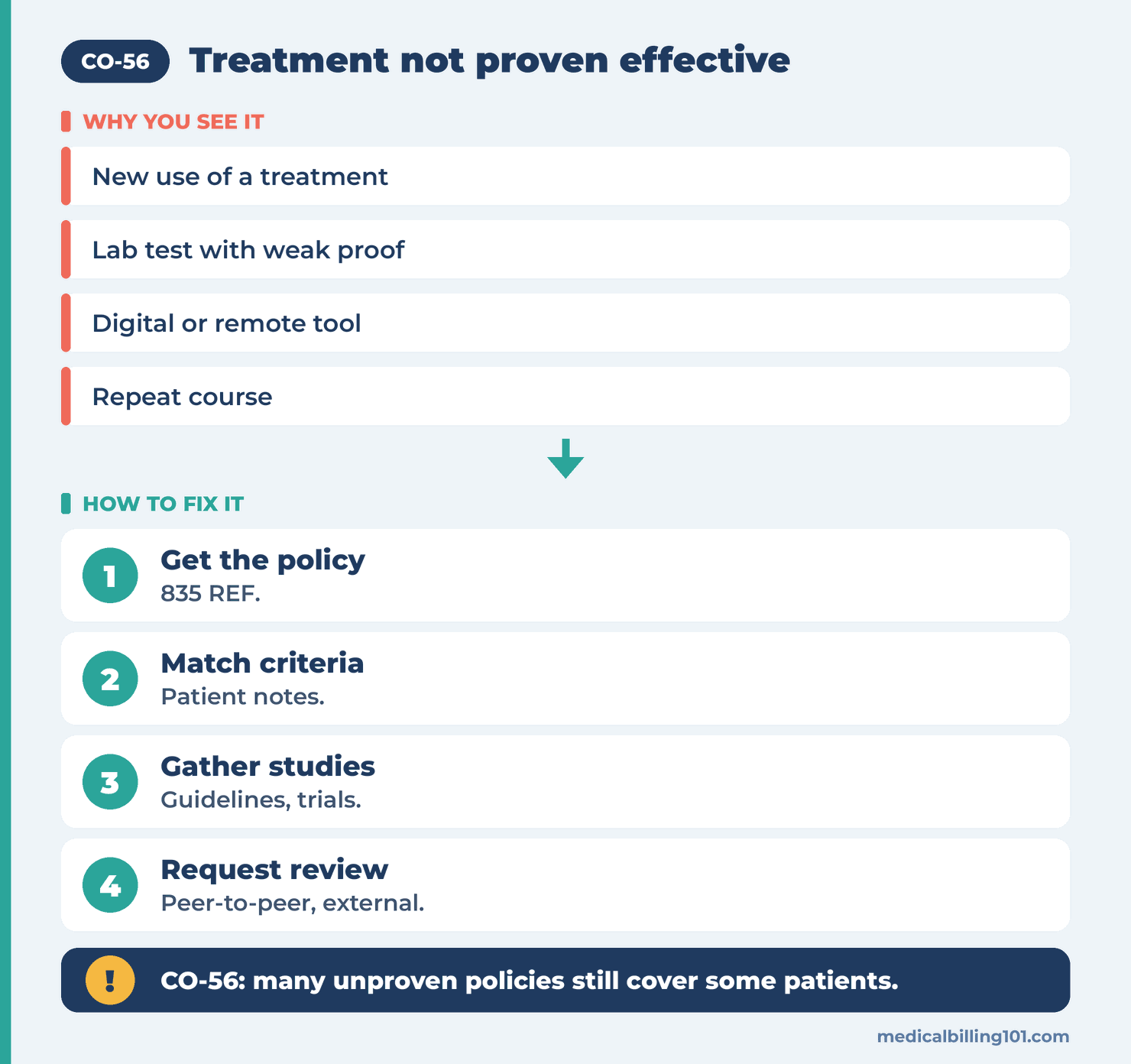
- Get the policy. The 835 REF segment in loop 2110 may name it. If not, ask for the policy number and version date.
- Read the covered rules. Many of these policies still pay for some diagnoses, or after other treatments fail.
- Match the patient. Pull notes that show the criteria are met, such as failed earlier treatments.
- Gather evidence if the patient doesn’t fit: clinical guidelines, peer-reviewed trials and specialty society statements.
- Ask for a peer-to-peer discussion between the treating doctor and the plan’s medical director.
- File the appeal, then request external review if the internal appeal is denied and the plan allows it.
Building an evidence appeal
A strong appeal reads like a short summary of the research, not a complaint. Include:
| Element | What to add |
|---|---|
| Policy citation | Policy number, version date and the exact sentence you’re disputing |
| Guidelines | Current guideline from the relevant specialty society |
| Studies | Two to four peer-reviewed trials, with outcomes in plain words |
| Patient facts | Why other options failed or aren’t safe for this patient |
| Request | Coverage for this patient, and a policy review if the evidence is new |
Most plans under the Affordable Care Act must offer an outside review by a reviewer the plan doesn’t control. HealthCare.gov explains how it works. It covers denials based on medical judgment and on whether a treatment is experimental.
Worked example (illustrative)
A neurologist treats a patient with chronic migraine. The payer’s policy lists the treatment as unproven for this type of headache. The remit shows CAS*CO*56*1150.00 with N623. The biller gets the policy. It does cover the treatment after two other drugs have failed. The notes show the patient tried three. The appeal quotes the policy’s own rule and adds the notes, and the payer pays. If the patient hadn’t met the rule, the biller would have sent research and asked for outside review.
Prevention checklist
- [ ] Check medical policies before scheduling newer or high-cost services.
- [ ] Request prior authorization, even when not required, for services flagged as unproven.
- [ ] Document failed treatments clearly in the notes.
- [ ] Keep a shared library of guidelines and key studies by service.
- [ ] Track CO-56 by payer and policy to spot outdated policies.
Related denial codes
- CO-55: experimental or investigational.
- CO-50: not deemed a medical necessity.
- CO-96: non-covered charges.
- CO-167: diagnosis not covered.
- CO-197: precertification or authorization absent.
- Denial codes hub for every code we cover.
Key takeaways
CO-56 is the payer’s call that a treatment isn’t proven to work. Start with the policy, since many of these policies still cover some patients. Appeal with notes when the patient fits. Send research when they don’t. Use a peer-to-peer call and outside review to push further.
FAQ
What does CO-56 mean?
It means the payer has decided the procedure or treatment hasn’t been proven to be effective, so it won’t cover it.
What is the difference between CO-55 and CO-56?
CO-55 says the service is experimental or investigational. CO-56 says it isn’t proven effective, even if it’s approved and in use.
Can I bill the patient for CO-56?
Not under the CO group. Some plans allow PR-56 if the patient signed a valid waiver first.
How do I appeal a CO-56 denial?
Show the patient meets the policy’s criteria, or send guidelines and peer-reviewed studies that support the treatment.
Is CO-56 eligible for external review?
Often yes. Most non-grandfathered ACA plans offer external review for denials based on medical judgment.
Which remark code comes with CO-56?
N623 is common. It says the service isn’t covered when deemed unproven or experimental, among other reasons.
Sources
How we checked: every code quote on this page was compared word for word with the X12 CARC and RARC lists on 20 October 2026.
- X12, Claim Adjustment Reason Codes (CARC 56, 55, 50). Accessed 20 Oct 2026.
- X12, Remittance Advice Remark Codes (N623). Accessed 20 Oct 2026.
- HealthCare.gov, External review. Accessed 20 Oct 2026.
Last updated: 20 October 2026 · This page is educational and doesn’t replace payer contracts or coding rules.
Related denial codes
- CO-55: Experimental or Investigational Service
- CO-61: Second Surgical Opinion Not Obtained
- CO-51: Pre-Existing Condition Not Covered
- CO-50: Not Deemed a Medical Necessity by the Payer
- PR-49: Routine or Preventive Exam Not Covered
- CO-40: Charges Don't Meet Emergent/Urgent Care Rules
- CO-96: Non-Covered Charges – Causes & Fix
- N2: Most Appropriate Course of Treatment