
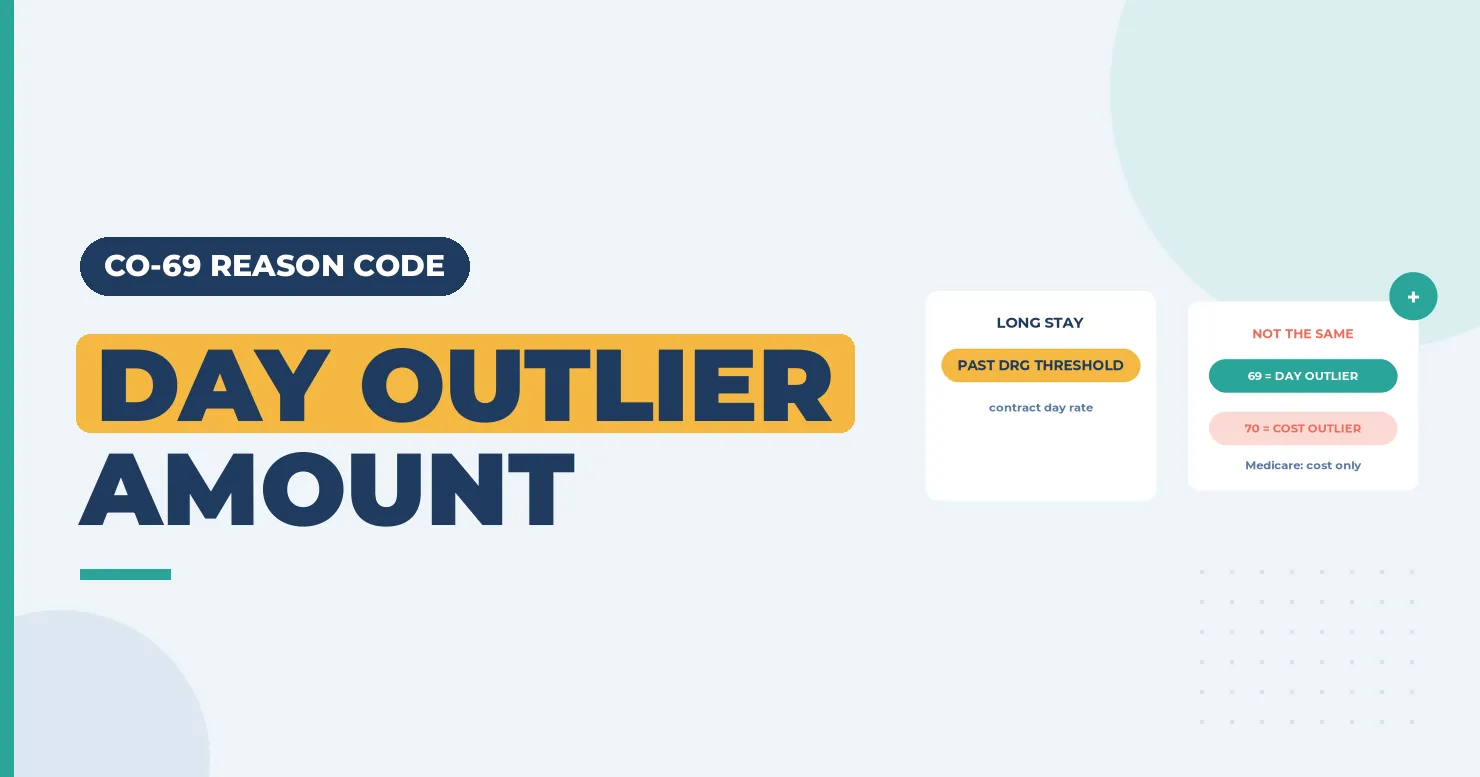
CO-69 is not a typical denial. It reports a day outlier amount, which is an extra payment (or an adjustment to one) for an inpatient stay that ran much longer than normal for its diagnosis group. On the 835, the amount can be negative, which means money was added to the base payment, or positive, which means an expected outlier was reduced. Today you’ll see it mostly from Medicaid plans and commercial payers whose contracts still pay for long stays. Original Medicare stopped paying day outliers for discharges on or after 1 October 1997. (Primary sources: X12 Claim Adjustment Reason Codes · 42 CFR 412.80).
In brief: CO-69 means “Day outlier amount.” It adjusts a DRG-based inpatient payment for a very long stay. Read the sign of the amount, find the day outlier terms in the payer contract, count the covered days past the threshold, and recalculate. Post it if it matches. Dispute it if the payer used the wrong threshold, rate or number of covered days.
Part of our denial codes library. Written by Manikandan J, CPC, CRCR, who has reconciled hospital inpatient payments for payers and billing companies. Published 20 October 2026. Last updated: 20 October 2026. Code wording is quoted word for word from X12.
CARC 69 as X12 lists it
| Field | Official X12 text |
|---|---|
| Description | “Day outlier amount.” |
| Start | 01/01/1995 |
Source: X12 Claim Adjustment Reason Codes, checked 20 October 2026.
Denial code 69, CARC 69 and reason code 69
Search terms like denial code 69, CARC 69 and reason code 69 all point to this X12 code. The CO group shows the amount comes from the contract. It isn’t something to bill the patient.
Key terms
A DRG is a diagnosis-related group, a bucket that sets one payment for an inpatient stay based on diagnoses and procedures. A day outlier is an extra payment when a stay runs past a set number of days for its DRG. A cost outlier is an extra payment when a stay’s costs run far past the DRG payment.
| Day outlier | Cost outlier | |
|---|---|---|
| Trigger | Length of stay past a day threshold | Costs past a dollar threshold |
| Original Medicare today | Ended for discharges on or after 1 Oct 1997 | Still paid |
| Where you see it now | Some Medicaid and commercial DRG contracts | Medicare and many payers |
| Common X12 reason code | 69 | Often 70, cost outlier |
The federal rule at 42 CFR 412.80 shows the change. Stays before 1 October 1997 could qualify by length of stay. Later stays qualify by cost only.
Reading the sign of the amount
| CAS amount | What it usually means | What to do |
|---|---|---|
| Negative, such as CO-69 of -2,400.00 | Day outlier added to the payment | Check the math, then post |
| Positive | Expected outlier reduced or reversed | Find out why and compare to the contract |
| Zero or missing | No day outlier applied | Check if the stay passed the threshold |
Why CO-69 lines go wrong
- Wrong threshold. The payer used last year’s day threshold for the DRG.
- Non-covered days counted. For example, days awaiting a nursing home bed were cut but still counted in the outlier, or the other way around.
- DRG changed. A DRG change after review moved the threshold, but the outlier wasn’t recalculated.
- Transfer rules. A transfer case was paid as a per-diem, and the outlier math didn’t follow.
- Contract per diem. The contract sets a day rate after the threshold, but the payer used a different rate.
How to check a CO-69 line
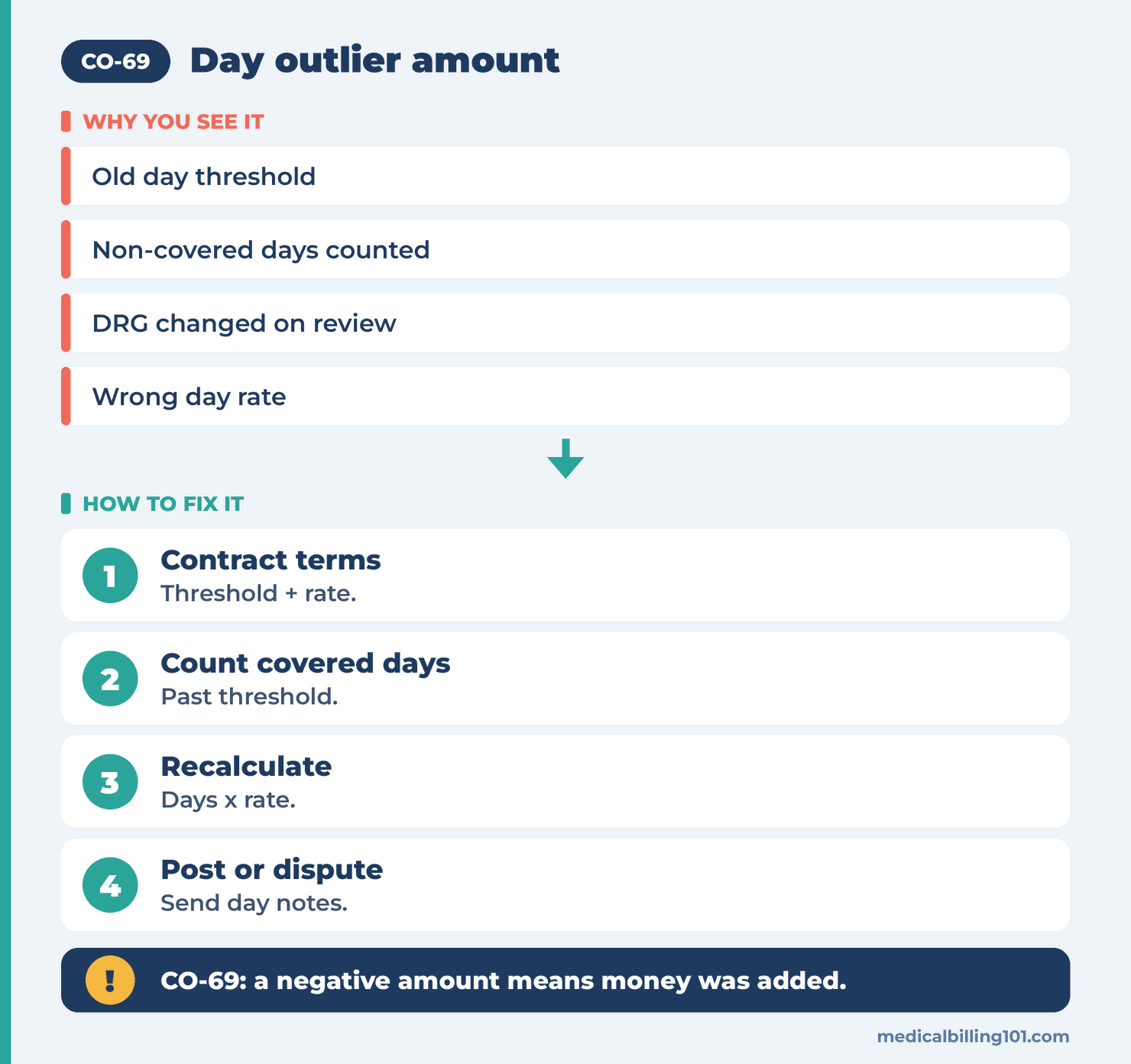
- Find the contract terms. Look for the day outlier threshold and the per-day rate.
- Confirm the DRG on the remit matches the one you billed or agreed to after review.
- Count covered days past the threshold. Leave out non-covered days.
- Recalculate the outlier: days past the threshold times the contract day rate.
- Post it if it matches, with the sign as reported.
- Dispute it in writing if the threshold, rate or day count is wrong.
Worked example (illustrative)
A state Medicaid plan pays a hospital by DRG. Its contract adds a day outlier of $850 a day for each covered day past the DRG’s threshold. A patient stays 31 days, and the threshold for the DRG is 24. The payer reports CAS*CO*69*-4250.00, which is five days. The analyst counts seven days past the threshold. She finds the payer cut two days as awaiting placement. The patient record shows those days were acute care. The hospital files a payment dispute with the day-by-day notes, and the payer adds two more outlier days.
Prevention checklist
- [ ] Load each contract’s day outlier terms into your contract-modeling tool.
- [ ] Update DRG thresholds when the payer’s new year starts.
- [ ] Flag long stays for a payment check before posting.
- [ ] Document the level of care for every day of long stays.
- [ ] Track CO-69 variances by payer.
Related codes
- CO-45: charge exceeds fee schedule or contracted amount.
- CO-59: multiple or concurrent procedure rules.
- CO-24: charges covered under a capitation agreement.
- CO-23: impact of prior payer adjudication.
- Full CARC and RARC list for code lookups.
- Denial codes hub for every code we cover.
Key takeaways
CO-69 reports a day outlier adjustment on a DRG-paid inpatient stay. It’s a payment detail, not a patient balance. Original Medicare stopped paying day outliers in 1997, so look to Medicaid and commercial contracts. Read the sign, check the threshold and covered days, recalculate, and dispute any gap.
FAQ
What does CO-69 mean?
It means the payer reported a day outlier amount for a long inpatient stay.
Is CO-69 a denial?
Usually not. A negative amount adds money to the payment. A positive amount reduces an expected outlier.
Does Medicare still pay day outliers?
No. Original Medicare ended day outliers for discharges on or after 1 October 1997. It still pays cost outliers.
Can I bill the patient for CO-69?
No. It’s a contract payment adjustment, not a patient share.
How do I check a day outlier payment?
Find the contract threshold and day rate, count covered days past the threshold, and recalculate.
What is the difference between CARC 69 and CARC 70?
CARC 69 is a day outlier amount. CARC 70 is a cost outlier, an adjustment based on costs, not days.
Sources
How we checked: every code quote on this page was compared word for word with the X12 CARC list on 20 October 2026.
- X12, Claim Adjustment Reason Codes (CARC 69, 70). Accessed 20 Oct 2026.
- eCFR, 42 CFR 412.80, Outlier cases: General provisions. Accessed 20 Oct 2026.
- CMS, Acute Inpatient PPS. Accessed 20 Oct 2026.
Last updated: 20 October 2026 · This page is educational and doesn’t replace payer contracts or coding rules.