
CO-107 is a link problem. Some services only pay when a second claim or service backs them up. Think of an add-on code that needs its base code, or care that needs a qualifying hospital stay. When the payer can’t find that partner on the claim, it denies the line with CARC 107. The CO group means the patient isn’t billed. (Primary sources: X12 Claim Adjustment Reason Codes · X12 Remittance Advice Remark Codes · CMS Medicare Claims Processing Manual, Ch. 22).
In brief: CO-107 means “the related or qualifying claim/service was not identified on this claim.” Find out which service the line depends on. Then check that it was billed, on the same claim if the payer needs that, with matching dates, provider and patient data. Rebill both together or add the link. Under CO, don’t bill the patient.
Part of our denial codes library. Written by Manikandan J, CPC, CRCR, who has more than 10 years of US medical billing and revenue cycle experience. Published 20 October 2026. Last updated: 20 October 2026. Code wording is quoted word for word from X12.
CARC 107 in X12’s own words
| Field | Official X12 text |
|---|---|
| Description | “The related or qualifying claim/service was not identified on this claim.” |
| Usage | “Refer to the 835 Healthcare Policy Identification Segment (loop 2110 Service Payment Information REF), if present.” |
Source: X12 Claim Adjustment Reason Codes, checked 20 October 2026. Start: 01/01/1995. Last Modified: 07/01/2017.
Two words do the work here. A related service is one that must be billed with this one, such as a base procedure for an add-on. A qualifying service is one that must come first to make this one payable, such as a hospital stay before skilled care. The key phrase is “on this claim.” The payer looked at the claim it got and didn’t see the partner.
Denial code 107, reason code 107, CARC 107
These are the same code. Billing staff often say denial code 107 or reason code 107 during payer calls, but on the remittance advice it always appears together with a group code, so you’ll see CO-107, PR-107 or OA-107. The group identifies who carries the financial responsibility, not the underlying reason.
Group codes with CARC 107
| Code | Who pays | What it tells you |
|---|---|---|
| CO-107 | Provider | The payer won’t pay, and the contract bars billing the patient. Fix the link and rebill. |
| PR-107 | Patient | Unusual. Check with the payer before you send a bill. |
| OA-107 | No one assigned yet | Often seen on crossover or secondary lines. Read the remark. |
| PI-107 | Provider, by payer reduction | Non-Medicare only. Treat it like CO. |
Causes of CO-107, the remark code you may see, and the fix
Remark wording below is quoted from the X12 RARC list. Payers pick their own pairings, so this is a guide, not a rule.
| Cause | Typical RARC | Fix |
|---|---|---|
| Add-on code billed without its base code | N122 | Bill the add-on on the same claim as the base code. Check the add-on’s listed base codes. |
| A service that needs a first service, and that first one isn’t on file | N674 | Bill the earlier service first, or show where it was billed. |
| Skilled care with no qualifying hospital stay dates | N173 | Add the stay dates (occurrence span code 70 on the UB-04 for SNF claims). |
| Corrected claim sent without the payer’s original claim number | M47 | Add the original claim number (REF F8) and the right frequency code. |
| Related claim billed by another provider not yet processed | N674 | Wait for the other claim, then ask for reprocessing. |
| Base service denied, so the add-on loses its partner | N122 | Fix the base service denial first. The add-on follows. |
How to fix a CO-107 denial
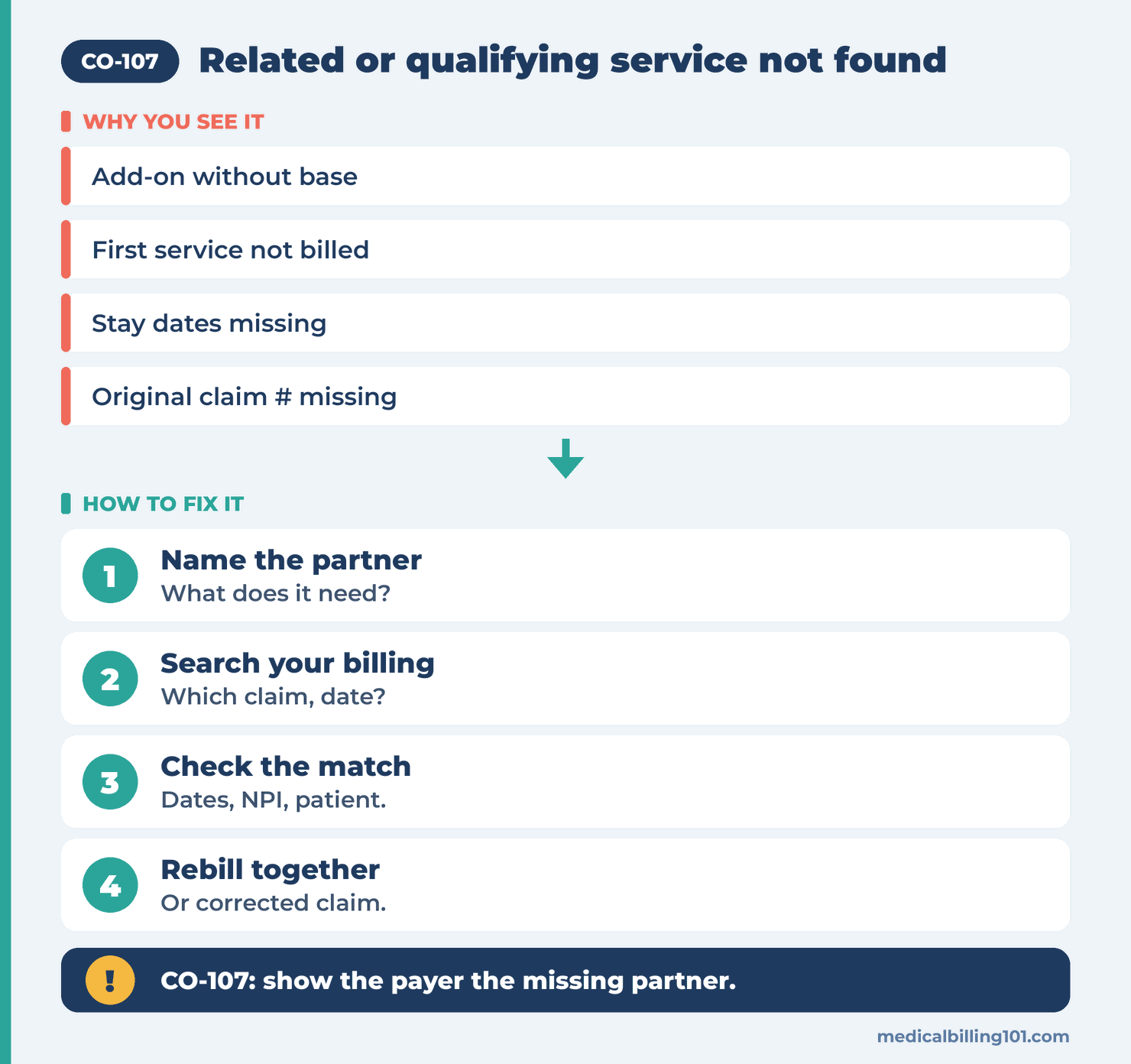
- Name the partner. Determine which related or qualifying service this line depends on. For example, CPT add-on codes list their base codes in the code book.
- Search your own billing. Was the partner billed? On which claim, which date, under which NPI?
- Check the match. Dates, patient ID, rendering provider and place of service should line up.
- Rebill the right way. Put the add-on and its base on one claim, or send a corrected claim with the link the payer needs.
- If another provider owns the partner, call them. Their claim may be pending or denied.
- If the partner was paid and the link is clear, ask for a reconsideration with both remits.
When to appeal, and when not to
Most CO-107 denials are resolved through a corrected claim rather than a formal appeal. Appeal only if the partner service is clearly on the claim, or was paid on a claim the payer can see, and the payer still denied.
Your appeal should show: – the denied line and its remark code; – the partner service, its claim number and its payment date; – why the two belong together, such as the add-on’s base code list.
Keep the letter to a single page when possible, because a concise, clearly documented connection between the two services is easier for a reviewer to accept.
Questions to ask the payer about a CO-107
- Which related or qualifying service were you looking for?
- Does it need to be on the same claim, or just on file?
- Do you see the partner claim? What is its status?
- Should I send a corrected claim or a new claim?
- What is the time limit for the correction?
Worked example (illustrative)
A surgeon bills a laparoscopic repair on one claim and, a day later, an add-on code for extra work on a second claim. The remit shows CAS*CO*107*180.00 with remark N122 on the add-on. The base code is on the first claim, so the payer’s edit didn’t see it. The billing team voids the second claim and sends a corrected first claim with both lines. The add-on pays at the same time as the base.
Medicare notes
Skilled nursing. Medicare Part A coverage of skilled nursing facility care generally requires a qualifying inpatient hospital stay of at least three consecutive days, which institutional claims report with occurrence span code 70. When those dates are missing, expect a qualifying-stay remark.
Add-on codes. CMS publishes add-on codes and their eligible primary codes in the NCCI add-on code edit tables, and an automated claim edit that cannot locate an eligible primary procedure will deny the add-on.
Prevention checklist
- [ ] Hold add-on codes in the charge queue until the base code is on the same claim.
- [ ] Add a scrubber edit for add-on codes with no listed base code.
- [ ] Capture qualifying stay dates at SNF admission.
- [ ] Put the original claim number on every corrected claim.
- [ ] Track CO-107 by cause each month to find the gap in your workflow.
Related denial codes
- CO-B15: the qualifying service hasn’t been received or adjudicated. The closest sibling to 107.
- CO-97: the service is bundled into another one already paid.
- CO-236: the procedure pair isn’t compatible under NCCI.
- CO-16: the claim lacks information.
- CO-4: procedure and modifier don’t match.
- Denial codes hub for the full list.
Key takeaways
CO-107 indicates the payer couldn’t locate the service this line depends on. Identify the partner, confirm it was billed with consistent information, and resubmit them together. Most of these are fixed with a corrected claim. The patient isn’t billed under CO.
FAQ
What does denial code CO-107 mean?
It means the related or qualifying claim or service wasn’t found on the claim, so the payer won’t pay the line. CO puts the amount on the provider.
What is the difference between CO-107 and CO-B15?
Both point to a missing partner service. CO-107 says the partner wasn’t identified on this claim. CO-B15 says the qualifying service hasn’t been received or adjudicated yet.
Does CO-107 apply to add-on codes?
Often, yes. An add-on code billed without its base code can draw CARC 107, sometimes with remark N122.
Can I bill the patient for CO-107?
No. Under the CO group the amount is a provider adjustment. Fix the claim instead.
Should I appeal CO-107?
Usually not first. A corrected claim that links the services fixes most of them. Appeal if the partner was clearly billed and paid.
How fast should I fix CO-107?
Check your payer’s corrected claim time limit. Many are shorter than the first filing limit.
Sources
How we checked: every code quote on this page was compared word for word with the X12 CARC and RARC lists on 20 October 2026.
- X12, Claim Adjustment Reason Codes (CARC 107, B15). Accessed 20 Oct 2026.
- X12, Remittance Advice Remark Codes (N122, N173, N674, M47). Accessed 20 Oct 2026.
- CMS, NCCI add-on code edits. Accessed 20 Oct 2026.
- CMS, Medicare Claims Processing Manual, Ch. 22, §60.1 Group Codes. Accessed 20 Oct 2026.
Last updated: 20 October 2026 · This page is educational and doesn’t replace payer contracts or coding rules.