
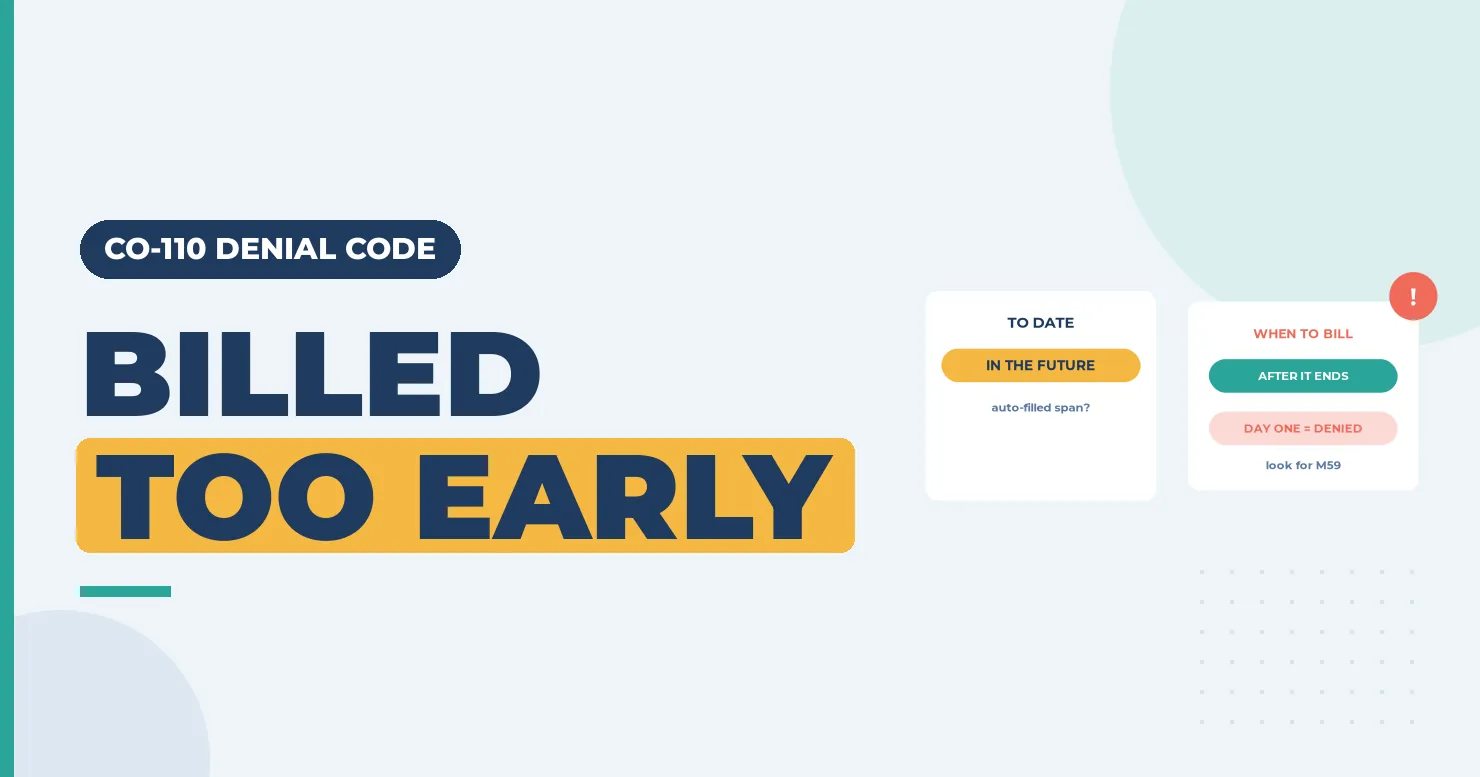
CO-110 means you sent the claim before the service happened, at least by the dates on the claim. The payer compares the date you billed with the dates of service. If any service date falls after the billing date, the line fails. It’s a timing error, not a coverage determination, and it usually originates in a practice management system that populates end dates automatically, or with staff who submit multi-day services before the period is complete. The CO group means you can’t bill the patient. The fix is to bill again with real dates once the service is complete. (Primary source: X12 Claim Adjustment Reason Codes)
In brief: CARC 110 reads “Billing date predates service date.” Check the end dates on each line. Wait until the service period ends, then send a corrected claim with the real dates. Turn off any setting that fills end dates in advance.
Part of our denial codes library. Written by Manikandan J, CPC, CRCR, who has cleaned up claim date rules in practice management systems. Published 21 October 2026. Last updated: 21 October 2026. Code wording is quoted word for word from X12.
CARC 110 as X12 defines it
| Field | X12 text |
|---|---|
| Code | 110 |
| Description | “Billing date predates service date.” |
| Start | 01/01/1995 |
Source: X12 Claim Adjustment Reason Codes, checked 21 October 2026.
Example scenario (fictional names), part 1
CO-110 Denial Example: What Happened
Jonah Whitaker bills for Pinecrest Heart Associates. Dr. Amara Lewis ordered a 30-day event monitor for a patient with palpitations (R00.2). Pinecrest billed 93268 to Oakmont Health Plan, a fictional commercial plan, the day after the patient got the device.
The 835 came back fast: CAS*CO*110 with remark LQ*HE*M59. Jonah checked the claim. The start date was the day the monitor went on. The end date was 29 days in the future.
Who put a future date on a claim that nobody typed by hand? Keep reading, or jump to how the CO-110 denial was resolved.
Where CO-110 comes from
A service date span is the start and end dates reported on a claim line. A billing date is the date the claim was created or transmitted to the payer. CO-110 appears when the span ends after the billing date, because the payer’s adjudication system cannot pay for a service that, according to the claim, hasn’t happened yet.
- Automatically populated end dates. Some systems calculate a 30-day span for cardiac monitors, equipment rentals or therapy authorizations.
- Billing a series early. For example, a monthly service billed mid-month with the month-end date.
- Wrong year. A typo, such as 2027 for 2026, puts the service in the future.
- Pre-scheduled charges. A charge created during scheduling is transmitted before the appointment occurs.
The CMS-1500 rules for dates in Item 24A are in the Medicare Claims Processing Manual, Chapter 26. Many commercial plans follow the same form rules.
Remark codes you may see
| RARC | X12 wording |
|---|---|
| M59 | “Missing/incomplete/invalid ‘to’ date(s) of service.” |
| M52 | “Missing/incomplete/invalid ‘from’ date(s) of service.” |
Check the X12 RARC list for the full wording.
Step-by-step fix for CO-110
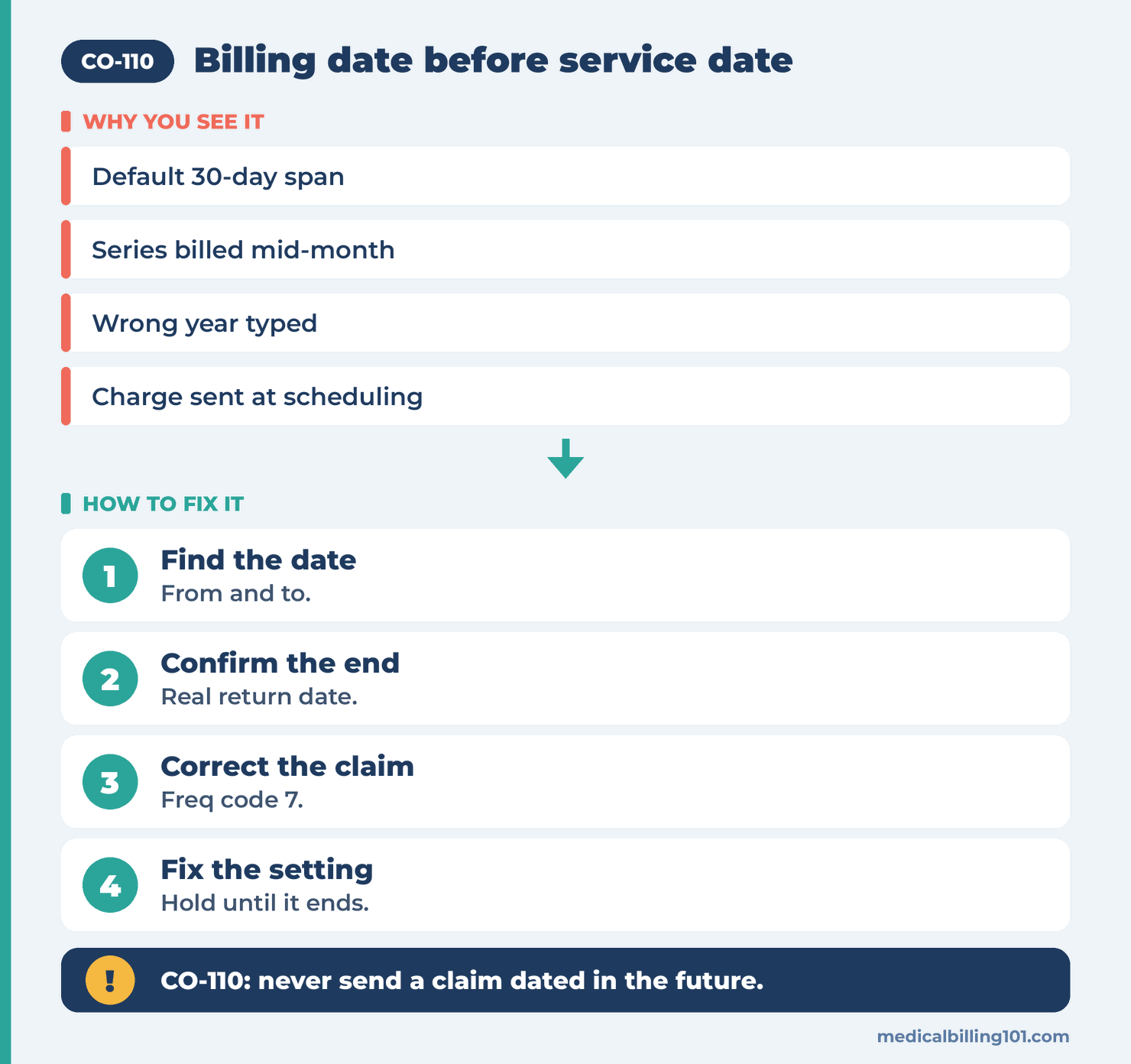
- Find the future date. Check each line’s start and end dates against the date the claim was sent.
- Confirm when the service ended. For a monitor or rental, use the real return or end date.
- Wait if needed. Don’t send the claim again until the service is complete.
- Send a corrected claim. Use frequency code 7, the original claim number and the real dates. Some payers want a new claim for denied lines; check their rules.
- Fix the configuration. Disable automatically calculated end dates, or add a billing hold until the end date passes.
- Add a scrubber rule. Stop any claim whose end date is after the send date.
Example scenario (fictional names), part 2
How the CO-110 Denial Was Resolved
Jonah found the cause in the charge setup. M59 pointed at the end date. The 93268 code had a default 30-day span, so the end date was filled the moment the charge was entered. The monitor was actually returned after 21 days.
Fix: once the device was back, Jonah sent a corrected claim with frequency code 7. It showed the real 21-day span ending on the return date.
Outcome: Oakmont paid the claim on the next cycle. Jonah removed the default span and added a hold on monitor charges until the device is returned.
Names and details are illustrative; no real patient data.
Worked example (illustrative)
A home infusion pharmacy bills a month of supplies on the 15th, with the month-end date as the end date. The remit shows CARC 110 on every line. The billing lead moves the claim run for monthly services to the first business day of the next month. Then she sends corrected claims with the same dates, which are now in the past.
Quick checklist
- [ ] No claim leaves with a end date after today.
- [ ] Multi-day services bill only after the last day.
- [ ] Default date spans are off, or held until they pass.
- [ ] The year field gets a sanity check in the scrubber.
- [ ] CARC 110 denials are tracked by charge code to find the setup at fault.
Related codes
- CO-16: claim lacks information or has billing errors.
- CO-29: the time limit for filing has expired.
- CO-18: exact duplicate claim or service.
Key takeaways
CO-110 means a claim was transmitted before the service dates it reports. It’s almost always a configuration or submission-timing problem rather than a clinical or coverage issue. Find the future date, wait for the service to end, and send a corrected claim with the real dates. Then fix the setting that caused it, so it doesn’t happen on every claim of that type.
FAQ
What does CO-110 mean?
It means “Billing date predates service date.” The claim was sent before the date of service on it.
Can I bill a 30-day service on day one?
Not with a future end date. Bill after the service period ends, using the real dates.
What does M59 mean with CARC 110?
M59 means “Missing/incomplete/invalid ‘to’ date(s) of service.” The end date is the problem.
Should I send a corrected claim or a new claim?
Many payers accept a corrected claim with frequency code 7. Some want a new claim for denied lines. Check the payer’s rules.
Can a wrong year cause CO-110?
Yes. A typo that puts the date in a future year triggers it.
Can I bill the patient for CO-110?
No. The CO group makes it a provider issue to fix.
Sources
How we checked: each code quote on this page was compared word for word with the X12 CARC and RARC lists on 21 October 2026.
- X12, Claim Adjustment Reason Codes (CARC 110, 16, 18, 29). Accessed 21 Oct 2026.
- X12, Remittance Advice Remark Codes (M59, M52). Accessed 21 Oct 2026.
- CMS, Medicare Claims Processing Manual, Chapter 26. Accessed 21 Oct 2026.
Last updated: 21 October 2026 · This page is educational and doesn’t replace payer billing rules.