
CO-117 is an ambulance denial or cut. The payer says it only covers transport to the closest facility that can give the care the patient needs. If your crew drove past a nearer hospital, the payer may pay only the mileage to that nearer one, or deny the trip. The words that matter are “that can provide the necessary care.” A nearer hospital that can’t treat the patient’s condition isn’t the right destination. Your run report has to show that. (Primary source: X12 Claim Adjustment Reason Codes)
In brief: CARC 117 reads “Transportation is only covered to the closest facility that can provide the necessary care.” Check the run report for why the crew chose that destination. If a nearer hospital couldn’t treat the patient, appeal with proof. If it could, accept the mileage cut.
Part of our denial codes library. Written by Manikandan J, CPC, CRCR, who has worked ambulance claims and appeals for EMS billing teams. Published 21 October 2026. Last updated: 21 October 2026. Code wording is quoted word for word from X12.
X12 definition of CARC 117
| Field | X12 text |
|---|---|
| Code | 117 |
| Description | “Transportation is only covered to the closest facility that can provide the necessary care.” |
| Start | 01/01/1995 |
| Last modified | 09/30/2007 |
Source: X12 Claim Adjustment Reason Codes, checked 21 October 2026.
Example scenario (fictional names), part 1
CO-117 Denial Example: What Happened
Aaron Fields bills for Northstar EMS. A crew answered a call for a patient with sudden weakness and slurred speech, later diagnosed as a stroke (I63.9). They drove past a small community hospital to a larger center farther away. Northstar billed A0427 for the advanced life support run and A0425 for the miles to Crescent Health Plan, a fictional commercial plan.
The 835 cut the mileage with CAS*CO*117 and remark LQ*HE*N157. The plan paid miles only to the small hospital.
Did the crew break the rule, or follow it? Keep reading, or jump to how the CO-117 denial was resolved.
What the closest appropriate facility means
The destination rule limits payment to the nearest facility able to treat the patient’s condition. An appropriate facility is one with the staff, equipment and services the patient needs, such as a stroke center, a trauma center or a burn unit. For Medicare, the rules are in 42 CFR 410.40 and the Medicare Benefit Policy Manual, Chapter 10. Many commercial plans use the same idea.
| Situation | Usual result |
|---|---|
| Nearer hospital could treat the patient | Mileage paid only to that hospital (CO-117) |
| Nearer hospital lacked needed care | Full trip covered, with proof |
| Patient or family chose a farther hospital | Extra miles often not covered by the plan |
| Hospital on diversion | Next nearest open facility is appropriate, with proof |
Remark codes paired with CARC 117
| RARC | X12 wording |
|---|---|
| N157 | “Transportation to/from this destination is not covered.” |
| N746 | “Incomplete/invalid Ambulance Report.” |
| N745 | “Missing Ambulance Report.” |
Full list: X12 RARC codes.
How to work a CO-117 adjustment
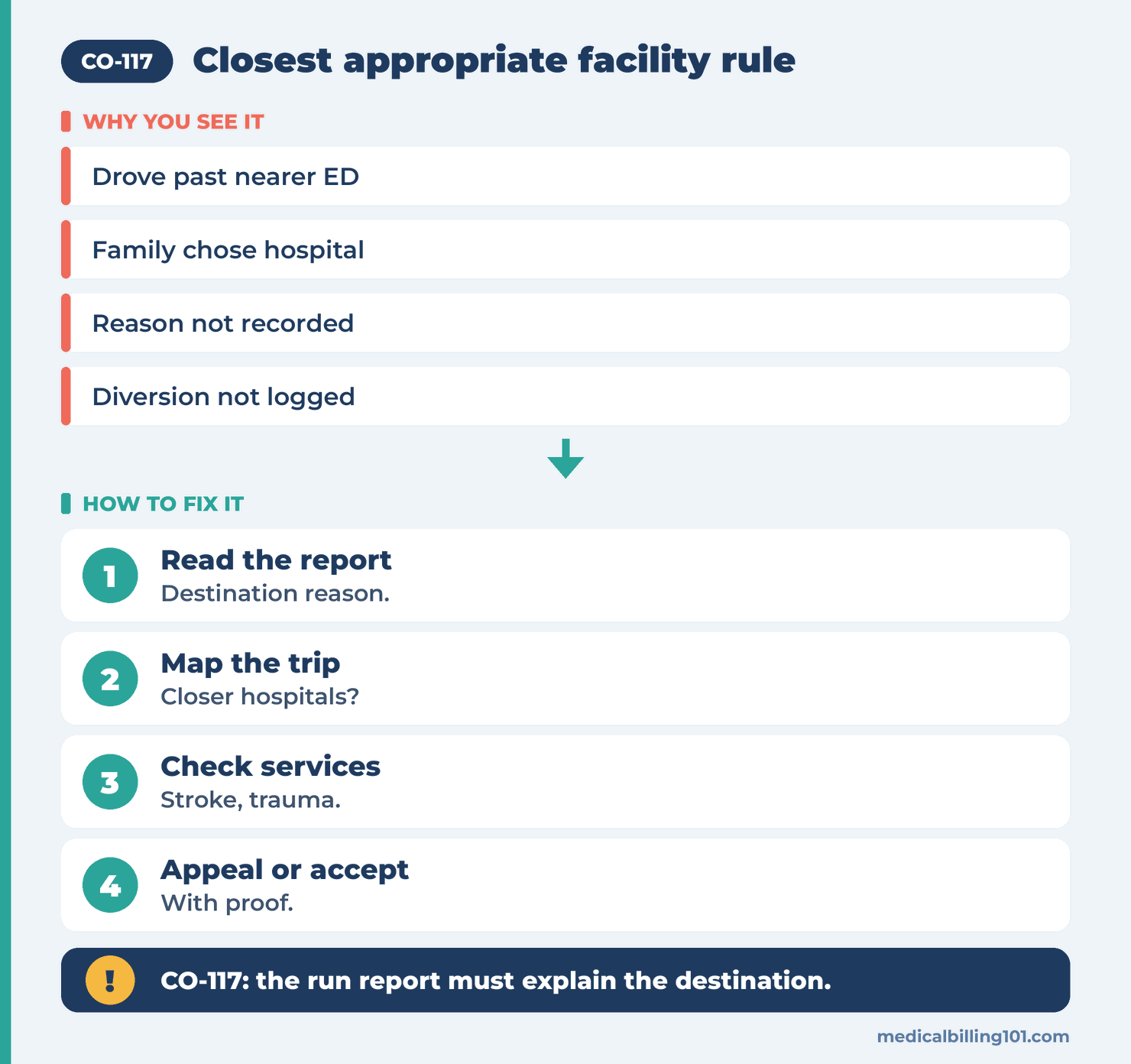
- Read the run report. Find the stated reason for the destination.
- Map the trip. List the hospitals closer than the one used.
- Check their services. Could the nearer hospital treat this condition at that time?
- Gather proof. Stroke or trauma center status, diversion logs, or medical control orders.
- Appeal when the destination was right. Explain why the nearer hospital couldn’t give the care, with the proof attached.
- Accept the cut when it wasn’t. If a nearer hospital could treat the patient, the CO amount is a write-off.
Example scenario (fictional names), part 2
How the CO-117 Denial Was Resolved
Aaron pulled the run report. N157 told him the plan judged the destination, not the transport. The crew noted that stroke signs had started within the hour and that medical control had sent them to the stroke center. The small hospital had no stroke team or clot-removal service.
Fix: Aaron filed an appeal with the run report, the medical control order and the state’s stroke center listing. His letter explained that the small hospital couldn’t give the needed care.
Outcome: Crescent paid the full mileage. Northstar now asks crews to write the destination reason in a set field on every run report.
Names and details are illustrative; no real patient data.
Worked example (illustrative)
A crew takes a patient with a minor fall to a hospital across town because the family asks. The nearest hospital could have treated the patient. The plan pays mileage only to the nearest hospital with CARC 117. The billing team accepts the cut. It also reviews its policy on telling patients about costs when they ask for a farther hospital.
Documentation that prevents CO-117
- Write the destination reason on every run, for example nearest stroke center, or nearest open ED because a closer one was on diversion.
- Record medical control orders and who gave them.
- Keep a list of local facility services, such as stroke, trauma, burn and pediatric.
- Log diversion status with times.
- Note when a patient or family picked the hospital.
Related codes
- CO-50: not deemed a medical necessity.
- CO-16: claim lacks information, such as a missing run report.
- CO-4: procedure code inconsistent with the modifier, including origin and destination modifiers.
Key takeaways
CO-117 limits ambulance payment to the closest facility that can treat the patient. The run report decides the outcome. When a nearer hospital couldn’t give the needed care, appeal with proof. When it could, accept the mileage cut and look at how destinations get chosen.
FAQ
What does CO-117 mean?
It means “Transportation is only covered to the closest facility that can provide the necessary care.”
Does CO-117 deny the whole ambulance trip?
Often it only cuts the mileage beyond the nearest appropriate facility. Some payers deny more; read the remit.
What counts as an appropriate facility?
One that can treat the patient’s condition, such as a stroke or trauma center when that care is needed.
What does N157 mean?
N157 means “Transportation to/from this destination is not covered.”
Can I bill the patient for a CO-117 amount?
No. The CO group makes it a provider write-off.
What proof helps a CO-117 appeal?
The run report, medical control orders, facility service listings and diversion logs.
Sources
How we checked: each code quote on this page was compared word for word with the X12 CARC and RARC lists on 21 October 2026.
- X12, Claim Adjustment Reason Codes (CARC 117, 4, 16, 50). Accessed 21 Oct 2026.
- X12, Remittance Advice Remark Codes (N157, N745, N746). Accessed 21 Oct 2026.
- eCFR, 42 CFR 410.40, Coverage of ambulance services. Accessed 21 Oct 2026.
- CMS, Medicare Benefit Policy Manual, Chapter 10. Accessed 21 Oct 2026.
Last updated: 21 October 2026 · This page is educational and doesn’t replace payer policies or Medicare rules.