
CO-134 shows up when you billed a service as if you supplied everything, and the payer decided you didn’t. It paid only the professional part and removed the technical fee. This happens most with imaging, EKGs, sleep studies and other tests done in a hospital, where the facility owns the equipment and bills the technical side itself. The CO group means you can’t move the removed amount to the patient. (Primary source: X12 Claim Adjustment Reason Codes)
In brief: CARC 134 reads “Technical fees removed from charges.” Check where the test was done and who owns the equipment. If it was a facility setting, rebill with modifier 26. If you really own the equipment and did the test in your office, appeal with proof.
Part of our denial codes library. Written by Manikandan J, CPC, CRCR, who has billed radiology and cardiology reads for hospital-based groups. Published 21 October 2026. Last updated: 21 October 2026. Code wording quoted word for word from X12.
What the X12 list says about reason code 134
| Field | X12 text |
|---|---|
| Code | 134 |
| Description | “Technical fees removed from charges.” |
| Start | 10/31/1998 |
Source: X12 Claim Adjustment Reason Codes, checked 21 October 2026.
Global, professional and technical: three ways to bill one test
Many diagnostic codes split into two parts. The professional component is the doctor’s reading and written report. The technical component is the equipment, supplies and staff that produce the image or tracing. A global service is both parts billed together by one provider.
| How you bill | CPT example | Who should bill it |
|---|---|---|
| Global (no modifier) | 93306 | A provider who owns the equipment and reads the study |
| Professional only | 93306-26 | The reading physician when a facility owns the equipment |
| Technical only | 93306-TC | The owner of the equipment, when someone else reads |
Medicare’s rules for these split codes sit in Chapter 13 of the Medicare Claims Processing Manual. Each code’s indicator in the physician fee schedule relative value files tells you whether it splits at all.
Example scenario (fictional names), part 1
CO-134 Denial Example: What Happened
Darnell Okafor bills for Riverside Heart Specialists. Dr. Lena Brandt read a transthoracic echo, 93306, for a patient admitted with heart failure (I50.22). The study was done in the hospital’s echo lab. Darnell’s system sent it as a global service with no modifier.
The remit from Summit Valley Health, a fictional commercial plan, paid only part of the line. It showed CAS*CO*134 with remark LQ*HE*M96. The paid amount looked like a professional fee, but nobody had billed one.
Was the payment right, and what should the claim have said? Keep reading, or jump to how the CO-134 denial was resolved.
Remark codes that explain the removal
| RARC | X12 wording |
|---|---|
| M96 | “The technical component of a service furnished to an inpatient may only be billed by that inpatient facility. You must contact the inpatient facility for technical component reimbursement. If not already billed, you should bill us for the professional component only.” |
| N194 | “Technical component not paid if provider does not own the equipment used.” |
| N13 | “Payment based on professional/technical component modifier(s).” |
The full list is on the X12 RARC page. M96 points to the setting. N194 points to equipment ownership.
How to fix a CO-134 adjustment
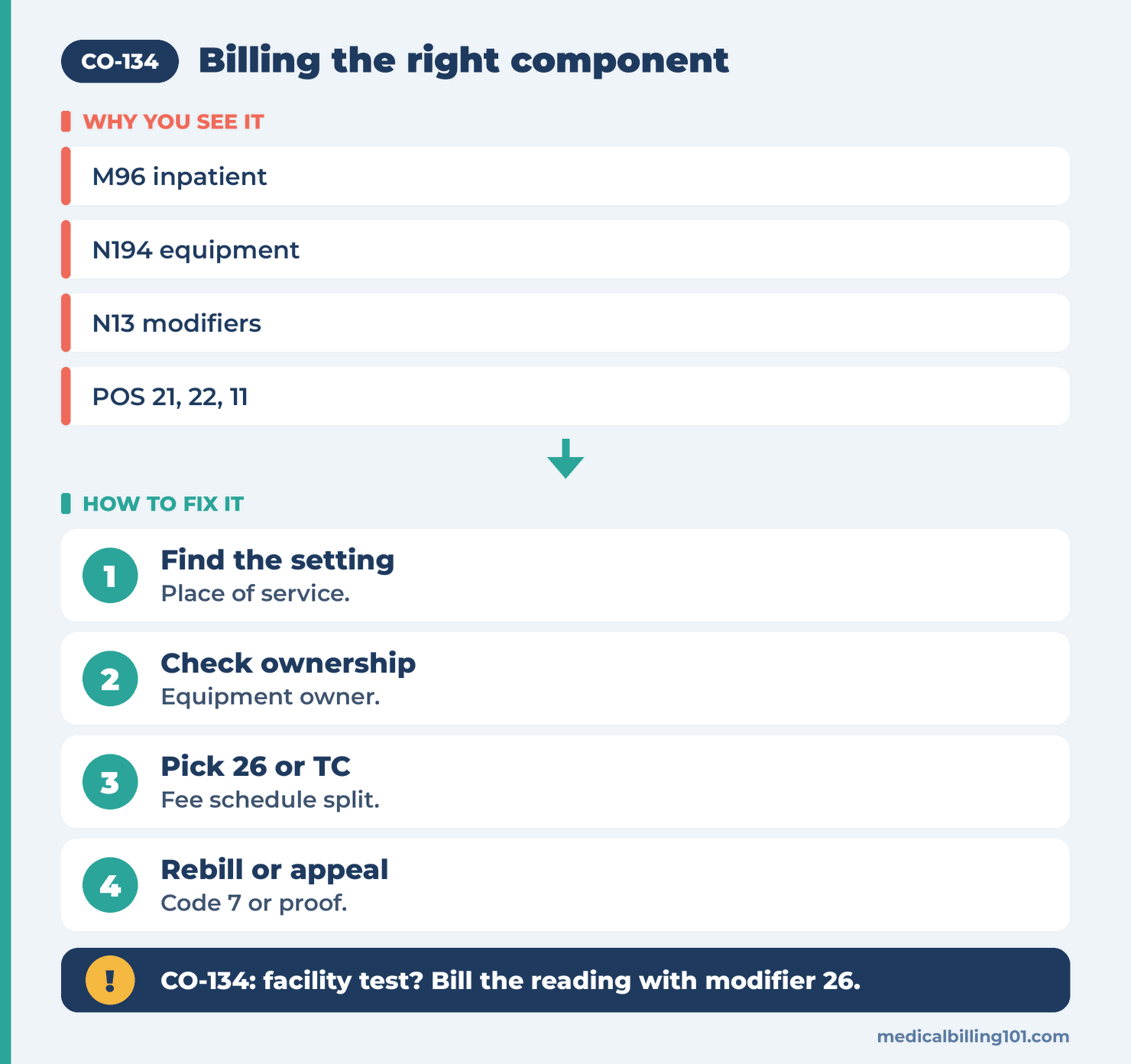
- Find the place of service. Inpatient, outpatient hospital and many facility settings mean the facility owns the technical side.
- Confirm who owns the equipment. For example, a mobile unit, a leased scanner or a hospital lab each change who may bill the technical part.
- Check the code splits. Use the fee schedule indicator before adding 26 or TC.
- Rebill the right part. Send a corrected claim with frequency code 7 and modifier 26 on the reading.
- Appeal only with proof. If you own the equipment and did the test in your office, send the lease or ownership papers and the place-of-service record.
- Fix the charge master. Map hospital locations to professional-only billing so the next claim goes out right.
Example scenario (fictional names), part 2
How the CO-134 Denial Was Resolved
Darnell pulled the encounter. The place of service was 21, inpatient hospital, and the echo machine belonged to the hospital. M96 was telling him exactly that.
Fix: he sent a corrected claim with frequency code 7, billing 93306-26 with place of service 21. He left the technical part for the hospital.
Outcome: the payer reprocessed the line as professional only. The amount barely changed, but the claim now matched what really happened. Darnell then set a rule that adds modifier 26 to any read from a hospital location.
Names and details are illustrative; no real patient data.
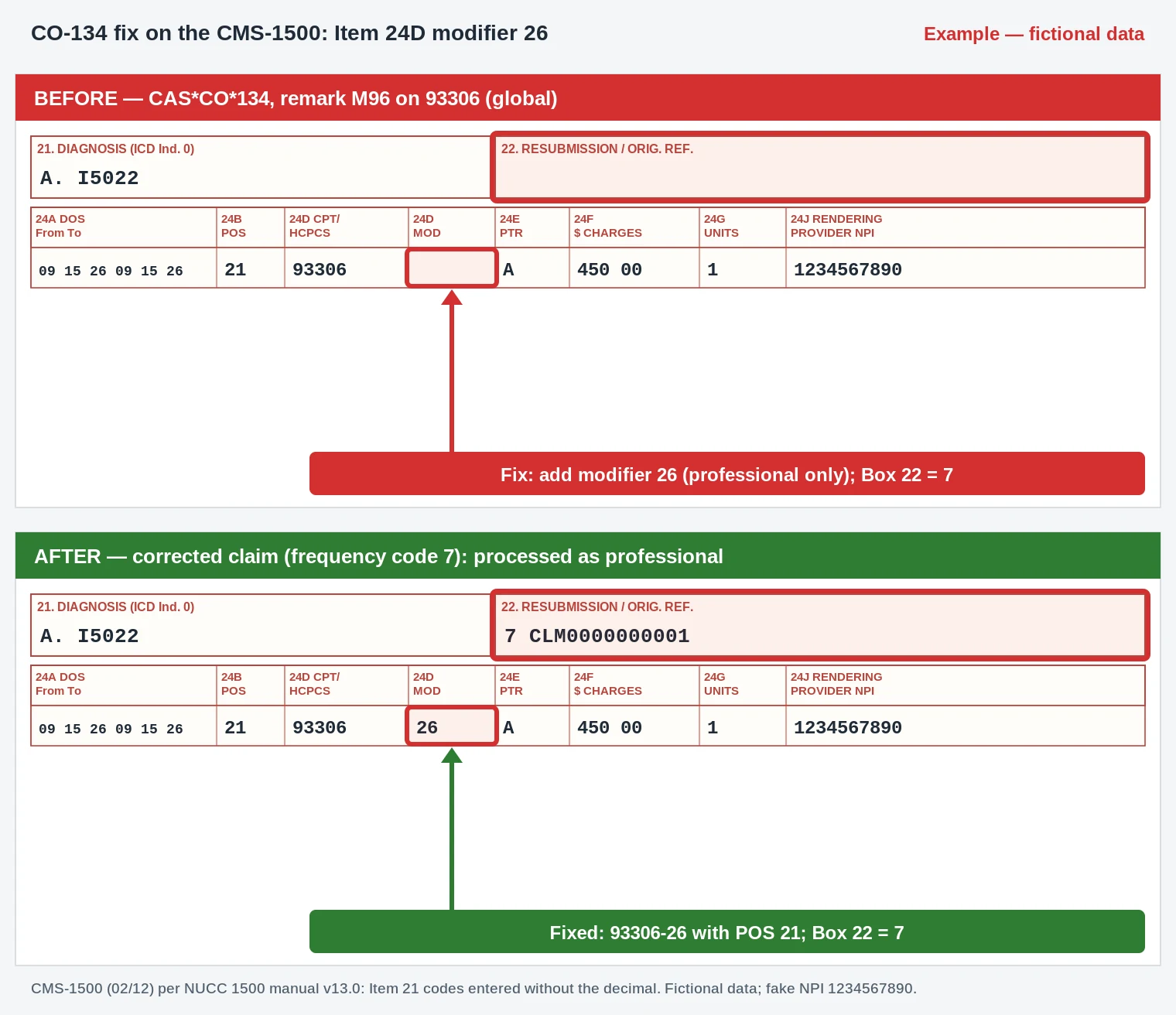
UB-04 not shown: the hospital bills the technical part of the echo on its own UB-04, and that claim needs no change.
- Box 24D: 93306 sent as global changed to 93306-26 (professional component only).
- Box 24B: place of service 21, inpatient hospital, stays as is.
- Box 22: resubmission code 7 plus the original claim number.
- Box 21A: I50.22, entered as I5022, is unchanged.
Worked example (illustrative)
Consider a sleep medicine group that owns home sleep test units. It bills 95806 globally for a test the patient took home from the office. The plan removes the technical fee with N194 because its file lists the group as reading-only. The group sends its equipment invoices and asks for a review. Once the plan updates its file, it pays the global service.
When CO-134 is not the real problem
- Wrong place of service. If you entered 22 or 21 by mistake for an office test, fix the place of service, not the modifier.
- Duplicate technical claims. If the hospital already billed the technical part, a global claim from you will keep failing.
- Codes that don’t split. Some services have no 26 or TC option. Adding one causes a modifier denial such as CO-4.
Related codes
- CO-4: procedure code inconsistent with the modifier, or a required modifier is missing.
- CO-5: procedure code or bill type inconsistent with the place of service.
- CO-45: charge exceeds the fee schedule.
- CO-97: payment included in another service.
Key takeaways
CO-134 means the payer kept the technical part of your fee because you weren’t entitled to it. Most of the time the test was done in a facility, and the fix is a corrected claim with modifier 26. When you truly own the equipment, appeal with proof of ownership and setting.
FAQ
What does denial code CO-134 mean?
The payer removed the technical fee from your charge. It reads “Technical fees removed from charges.”
Can I bill the patient for the removed amount?
No. It’s a CO adjustment, so the amount is written off unless an appeal changes it.
Should I bill modifier 26 or TC?
Use 26 for the doctor’s reading when a facility owns the equipment. Use TC only when you own the equipment and someone else reads.
What does M96 mean with CARC 134?
The patient was an inpatient, so only the hospital can bill the technical part. Bill the professional part only.
Why did I get CO-134 for an office test?
The plan may not know you own the equipment, or the place of service was wrong. Check both, then appeal or correct.
Is CO-134 the same as CO-97?
No. CO-97 means the service was bundled into another one. CO-134 removes only the technical fee.
Sources
How we checked: each code quote on this page was matched word for word with the X12 CARC and RARC lists on 21 October 2026.
- X12, Claim Adjustment Reason Codes (CARC 134, 4, 5, 45, 97). Accessed 21 Oct 2026.
- X12, Remittance Advice Remark Codes (M96, N194, N13). Accessed 21 Oct 2026.
- CMS, Medicare Claims Processing Manual, Chapter 13. Accessed 21 Oct 2026.
- CMS, PFS relative value files. Accessed 21 Oct 2026.
Last updated: 21 October 2026 · Educational content; not legal advice.