
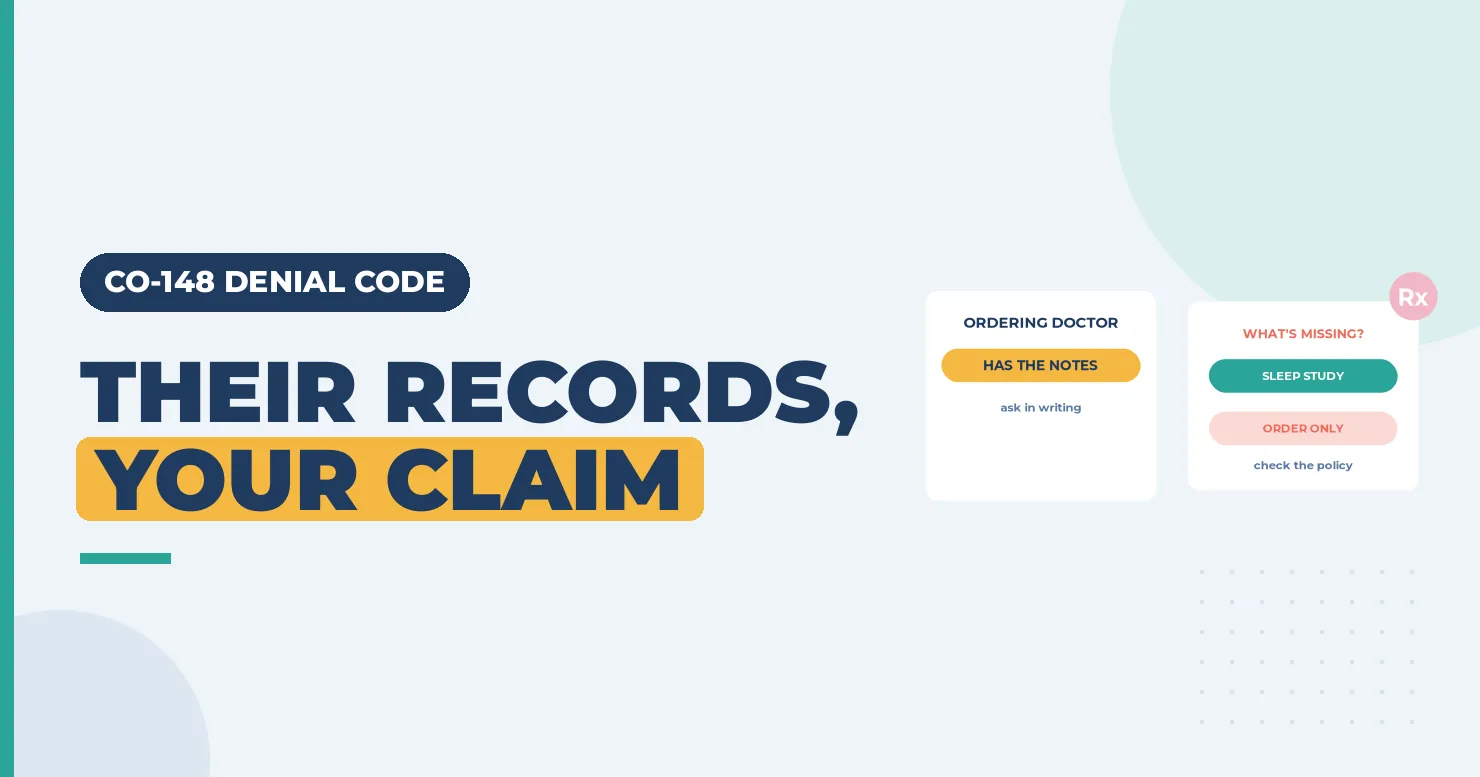
CO-148 hits the provider who billed the claim, but the missing piece sits with someone else. The payer wanted records or details from another provider involved in the care, and they never arrived or didn’t answer the question. That’s common for suppliers, labs, imaging centers, home health agencies and assistants at surgery, who all depend on an ordering or treating doctor’s notes. You can’t fix this alone. You have to get the other provider’s information and send it in. (Primary source: X12 Claim Adjustment Reason Codes)
In brief: CARC 148 reads “Information from another provider was not provided or was insufficient/incomplete.” Read the remark code, find out exactly what the payer wants from the other provider, get it, and send it with a reconsideration or corrected claim.
Part of our denial codes library. Written by Manikandan J, CPC, CRCR, who has worked documentation denials for DME, lab and imaging billing teams. Published 21 October 2026. Last updated: 21 October 2026. Code wording quoted word for word from X12.
The X12 entry for reason code 148
| Field | X12 text |
|---|---|
| Code | 148 |
| Description | “Information from another provider was not provided or was insufficient/incomplete. At least one Remark Code must be provided (may be comprised of either the NCPDP Reject Reason Code, or Remittance Advice Remark Code that is not an ALERT.)” |
| Start | 06/30/2002 |
| Last modified | 09/20/2009 |
Source: X12 Claim Adjustment Reason Codes, checked 21 October 2026. Because a remark code is required, the RARC on the line is your best clue.
Who the “other provider” usually is
An ordering provider is the clinician who orders a test, item or service for the patient. A rendering provider is the one who actually performs it. A supplier is a company that provides equipment or supplies, such as a CPAP machine or diabetic test strips.
| You are | The other provider is often | What the payer may want |
|---|---|---|
| DME supplier | The ordering physician | Visit notes, test results, a signed order |
| Imaging center or lab | The ordering clinician | The reason for the test, a signed order |
| Home health agency | The certifying physician | The face-to-face encounter note |
| Assistant at surgery | The primary surgeon | The operative report |
Example scenario (fictional names), part 1
CO-148 Denial Example: What Happened
Rachel Dominguez bills for Clearwind Home Medical, a medical equipment supplier. Clearwind delivered a CPAP device, E0601, to a patient with obstructive sleep apnea (G47.33). The order came from Dr. Victor Lindgren at a sleep clinic across town.
The remit from Pinecrest Health Plan, a fictional commercial plan, denied the line with CAS*CO*148 and remark LQ*HE*N181, “Additional information is required from another provider involved in this service.” Clearwind had sent the signed order, but nothing else.
What did the plan need, and who had it? Keep reading, or jump to how the CO-148 denial was resolved.
Remark codes that travel with CARC 148
| RARC | X12 wording |
|---|---|
| N181 | “Additional information is required from another provider involved in this service.” |
| N264 | “Missing/incomplete/invalid ordering provider name.” |
| N265 | “Missing/incomplete/invalid ordering provider primary identifier.” |
See the X12 RARC page for more. N264 and N265 point to the claim fields, not to the records.
How to fix a CO-148 denial
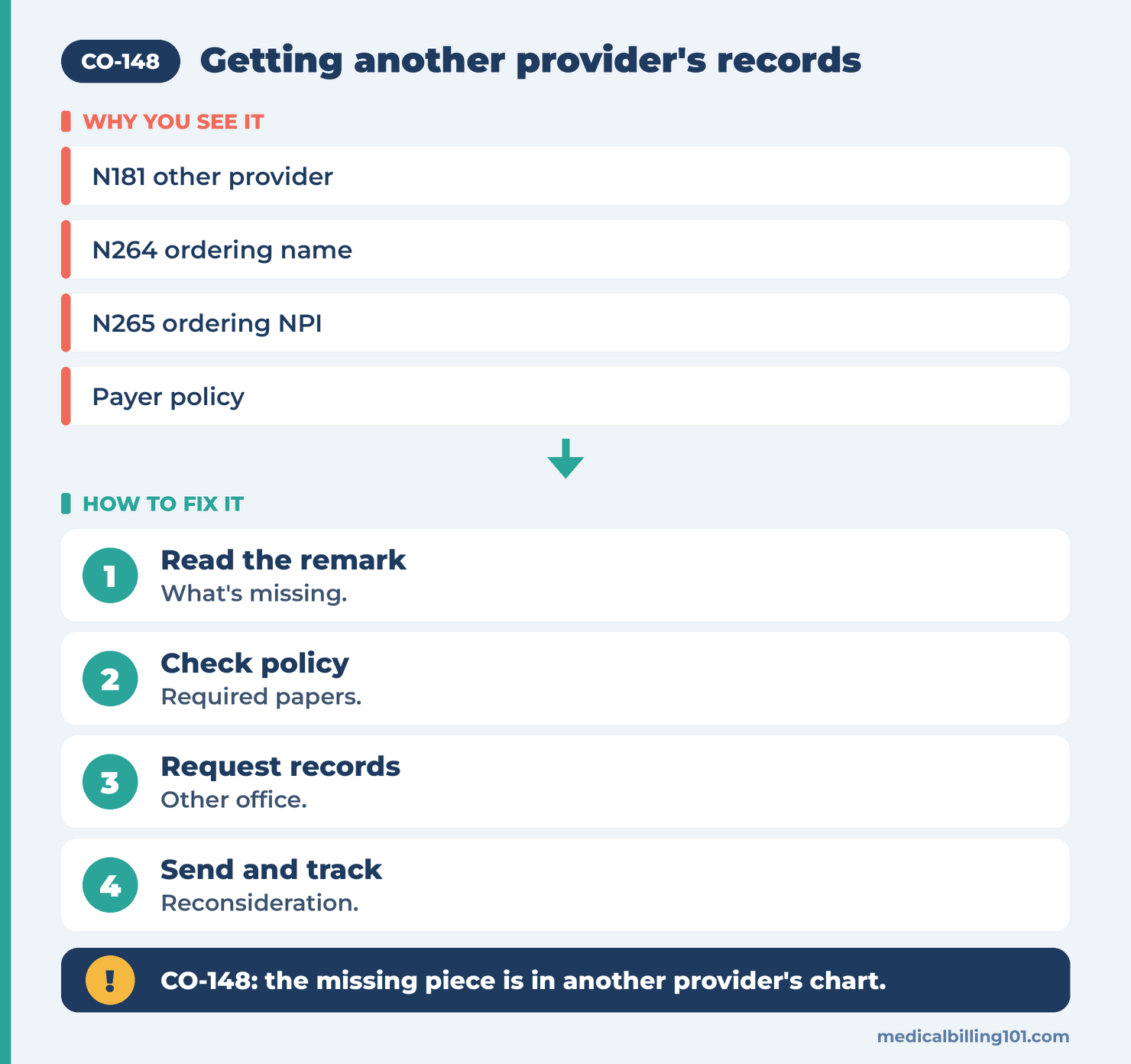
- Read the remark and any letter. Find out exactly what is missing, such as a sleep study, a visit note or an operative report.
- Check the payer’s policy. For example, Medicare’s CPAP coverage rules in NCD 240.4 list the exact papers needed.
- Ask the other provider in writing. Name the patient, date of service and the exact items. Give a due date.
- Review what comes back. Make sure it answers the payer’s question before you send it.
- Send it in the right way. Use the payer’s reconsideration or records upload route, or a corrected claim if the payer asks for one.
- Track the deadline. Appeal and reconsideration windows keep running while you wait.
- Fix your intake. Collect the needed records before you deliver or perform the service.
Example scenario (fictional names), part 2
How the CO-148 Denial Was Resolved
Rachel read Pinecrest’s CPAP policy. It needed the sleep study result and a visit note from before the order. Clearwind’s file had neither. She faxed Dr. Lindgren’s office a request listing both items and the date of service.
Fix: the clinic sent the sleep study and the visit note within a week. Rachel checked that both supported the diagnosis, then sent them with a reconsideration request.
Outcome: the plan reversed the denial and paid the first rental month. Clearwind now won’t schedule delivery until the sleep study and visit note are on file.
Names and details are illustrative; no real patient data.
Worked example (illustrative)
Consider an independent lab that runs a genetic test ordered by an oncologist. The payer denies with CO-148 and N181 because it needs the oncologist’s note on family history and treatment plans. The lab asks the oncologist’s office for the note, checks that it meets the payer’s test policy, and sends a reconsideration. Without the note, the lab has no way to prove the test met the policy.
Mistakes that keep CO-148 claims denied
- Rebilling with no new records. The same claim will deny again.
- Sending records that don’t answer the question. Read them before you send them.
- Billing the patient. It’s a CO adjustment, so the patient doesn’t owe it.
- Waiting too long on the other office. Set a due date and follow up.
Related codes
- CO-16: claim lacks information needed for adjudication.
- CO-252: an attachment or other documentation is required.
- CO-50: not deemed a medical necessity by the payer.
- CO-197: precertification or authorization absent.
Recap
CO-148 means the payer needs something from another provider involved in the care. Read the remark code, check the payer’s policy, ask the other provider in writing for exactly what’s missing, review it and send it with a reconsideration. Then collect those records before the next service.
FAQ
What does denial code CO-148 mean?
The payer needs information from another provider involved in the care. It reads “Information from another provider was not provided or was insufficient/incomplete.”
Who is the other provider in a CARC 148 denial?
Often the ordering or treating doctor, such as the physician who ordered equipment or a test.
Can I bill the patient for CO-148?
No. It’s a CO adjustment. Get the records and work the claim with the payer.
How do I fix reason code 148?
Find out what’s missing, get it from the other provider, and send it with a reconsideration or corrected claim.
Is a remark code always included with CARC 148?
Yes. X12 requires at least one remark code with this reason code.
How do I prevent CO-148 denials?
Collect the needed records from the ordering provider before you deliver or perform the service.
Sources
How we checked: each code quote on this page was matched word for word with the X12 CARC and RARC lists on 21 October 2026.
- X12, Claim Adjustment Reason Codes (CARC 148, 16, 50, 197, 252). Accessed 21 Oct 2026.
- X12, Remittance Advice Remark Codes (N181, N264, N265). Accessed 21 Oct 2026.
- CMS, NCD 240.4, CPAP therapy for obstructive sleep apnea. Accessed 21 Oct 2026.
Last updated: 21 October 2026 · Educational content; not legal advice.