
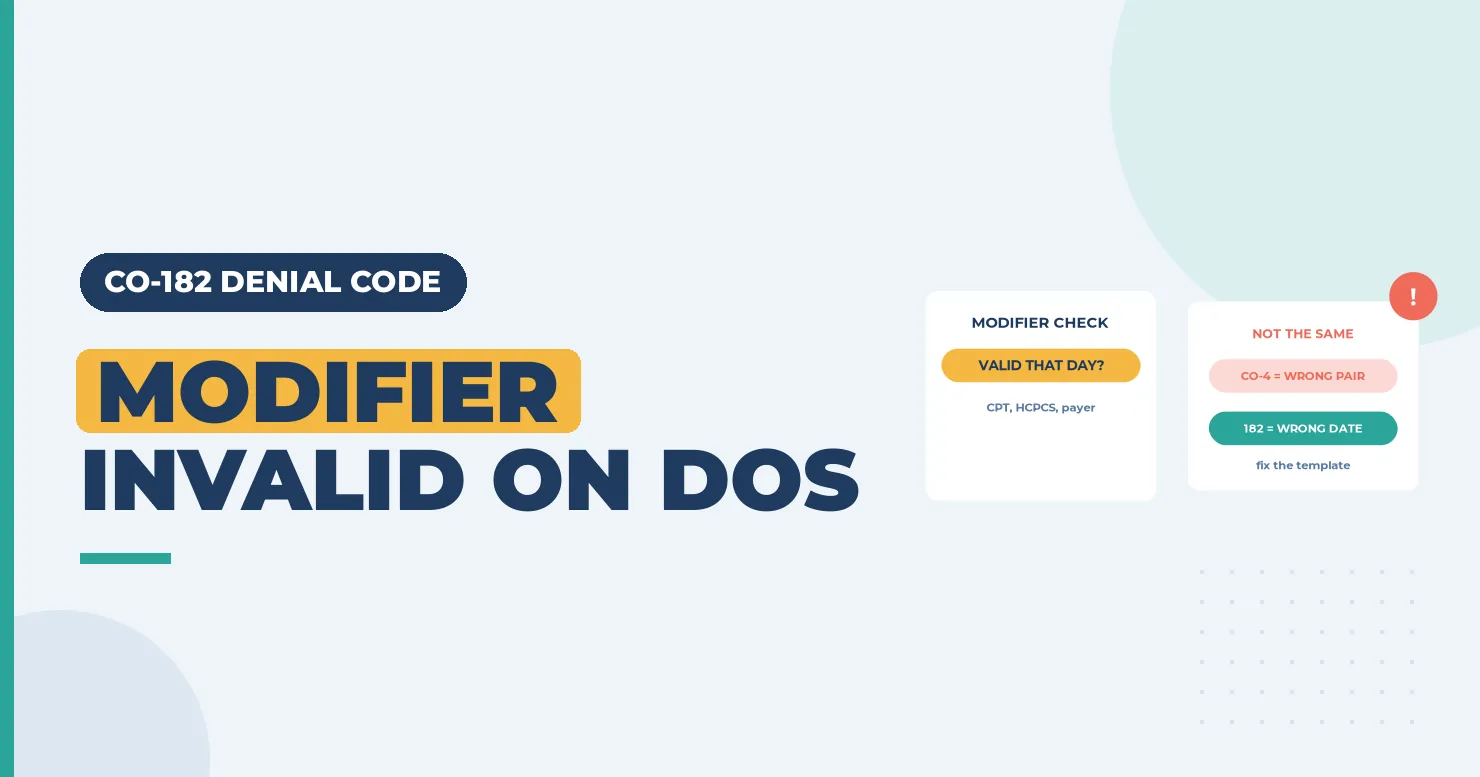
CO-182 is a modifier denial. It points at the two characters after the procedure code. The payer says one of the modifiers on the line wasn’t a valid modifier on the date of service. Maybe it hadn’t been created yet, had been retired, wasn’t one the payer recognizes, or was simply mistyped. The procedure itself may be fine. Fix the modifier, resubmit, and the line usually pays. (Primary sources: X12 Claim Adjustment Reason Codes · X12 Remittance Advice Remark Codes · CMS HCPCS Quarterly Update).
In brief: CO-182 means “procedure modifier was invalid on the date of service.” Check each modifier on the line against the CPT and HCPCS lists in force on that date and against the payer’s own modifier rules. Replace or remove the bad one and send a corrected claim. Don’t bill the patient, and save appeals for cases where the modifier really was valid.
Part of our denial codes library. Written by Manikandan J, CPC, CRCR, who has more than 10 years of US medical billing and revenue cycle experience. Published 20 October 2026. Last updated: 20 October 2026. Code wording is quoted word for word from X12.
CARC 182: official wording
| Field | Official X12 text |
|---|---|
| Description | “Procedure modifier was invalid on the date of service.” |
| Start | 06/30/2005 |
| Last modified | 09/30/2007 |
Source: X12 Claim Adjustment Reason Codes, checked 20 October 2026. No usage note and no remark code rule apply to CARC 182.
A procedure modifier is a two-character code that adds detail to a CPT or HCPCS code, such as which side of the body, whether a service was distinct, or who performed it. CPT modifiers come from the AMA. HCPCS Level II modifiers, the letter pairs, come from CMS and change in the quarterly updates.
Denial code 182, CARC 182, reason code 182
All three refer to the same X12 code. You’ll see denial code 182 in billing team notes and reason code 182 in payer portals. The remit adds a group code, nearly always CO, because a modifier error is on the billing side.
CO-182 vs CO-4: which modifier problem is it?
| CO-182 | CO-4 | |
|---|---|---|
| The problem | The modifier wasn’t valid on that date | The modifier doesn’t fit this procedure |
| Typical example | A retired modifier still in the system | A laterality modifier on a code that has no sides |
| What to check | Modifier lists for that date | Code-modifier pairing rules |
| Usual fix | Swap for the current modifier | Remove or change the modifier |
Who pays: group code table
| Group + CARC | Who carries it | What to do |
|---|---|---|
| CO-182 | Provider | Correct the modifier and resubmit. |
| PR-182 | Patient | Not expected. Check with the payer before billing. |
| OA-182 | Not assigned | Often on a secondary line. Fix the primary claim. |
| PI-182 | Provider (non-Medicare) | Treat like CO. |
Causes, remark codes and fixes
Remark wording is from the X12 RARC list. Pairings differ by payer.
| Cause | Typical RARC | Fix |
|---|---|---|
| Modifier retired or replaced in a HCPCS update | N823 | Use the current modifier, or drop it if no longer needed. |
| New modifier used before its effective date | N823 | Use the modifier valid on the date of service. |
| Modifier the payer doesn’t accept, even if it’s valid nationally | N823 | Check the payer’s modifier list and use its accepted equivalent. |
| Two modifiers that can’t appear together | N519 | Remove the conflict. For example, don’t pair two modifiers that describe the same thing differently. |
| Typo, such as a letter O for a zero | N823 | Re-key from the charge ticket. |
| Modifier in the wrong position for the payer’s pricing | N823 | Put pricing modifiers first if the payer requires it. |
How to fix CO-182
A corrected claim is a replacement of the original claim, sent with frequency code 7 and the payer’s claim number.

- Read the remark code to see whether the issue is a single modifier or a combination.
- Check every modifier on the line against the CPT and HCPCS lists for the date of service.
- Check the payer’s rules. Some payers don’t accept certain national modifiers, or want modifiers in a set order.
- Fix the line. Replace, reorder or remove the modifier. Make sure the documentation supports whatever you keep.
- Send a corrected claim with frequency code 7 if the payer requires it.
- Update templates. Fix the charge master and EHR macros that added the bad modifier.
Appeal approach
Appeal only if the modifier was valid on that date for that payer. Attach the modifier listing with its effective date and the payer’s own policy, if it lists the modifier. Most CO-182 denials are faster to fix with a corrected claim.
Questions to ask the payer about a CO-182
- Which modifier on the line failed?
- Do you accept this modifier, or a different one, for this service?
- Do you need modifiers in a set order?
- Should I send a corrected or a new claim?
Worked example (illustrative)
A therapy clinic’s billing system adds a payer-specific modifier that the plan retired in its last policy update. Claims for the following week come back with CAS*CO*182*68.00 and remark N823. The biller checks the payer’s bulletin, finds the replacement modifier, updates the charge rule and sends corrected claims for every affected visit. Claims after the fix pay normally.
Prevention checklist
- [ ] Read CMS quarterly HCPCS update notes for modifier changes.
- [ ] Read payer bulletins for modifier policy changes.
- [ ] Review charge rules that add modifiers automatically after each update.
- [ ] Add a scrubber edit for invalid and conflicting modifier pairs.
- [ ] Track CO-182 by payer and modifier.
Related denial codes
- CO-4: the procedure code is inconsistent with the modifier used.
- CO-181: the procedure code was invalid on the date of service.
- CO-146: the diagnosis was invalid for the date of service.
- CO-236: procedure or modifier combination not compatible under NCCI.
- CO-16: the claim lacks information or has billing errors.
- Denial codes hub for every code we cover.
Key takeaways
CO-182 means a modifier on the line wasn’t valid on the date of service, for that payer or at all. Check each modifier against the lists for that date and the payer’s rules, fix it and send a corrected claim. Then fix the template that added it. The patient isn’t billed.
FAQ
What does denial code CO-182 mean?
It means a procedure modifier on the line wasn’t valid on the date of service, so the payer denied it. CO puts the amount on the provider.
What’s the difference between CO-182 and CO-4?
CO-182 means the modifier itself wasn’t valid on that date. CO-4 means the modifier doesn’t fit the procedure code.
Which remark code comes with CO-182?
It varies, but N823, “Incomplete/Invalid procedure modifier(s),” is a common match. N519 can appear when two modifiers conflict.
Can I bill the patient for CO-182?
No. It’s a provider billing error under the CO group.
Can I appeal a CO-182 denial?
Yes, if the modifier was valid for that payer on that date. Otherwise, a corrected claim is faster.
Where do I check modifier changes?
For HCPCS Level II, check the CMS quarterly update files. For CPT modifiers, check the current CPT book. For payer rules, check the payer’s bulletins.
Sources
How we checked: every code quote on this page was compared word for word with the X12 CARC and RARC lists on 20 October 2026.
- X12, Claim Adjustment Reason Codes (CARC 182, 4). Accessed 20 Oct 2026.
- X12, Remittance Advice Remark Codes (N823, N519). Accessed 20 Oct 2026.
- CMS, HCPCS Quarterly Update. Accessed 20 Oct 2026.
- CMS, Medicare Claims Processing Manual, Ch. 22, §60.1 Group Codes. Accessed 20 Oct 2026.
Last updated: 20 October 2026 · This page is educational and doesn’t replace payer contracts or coding rules.