

CO-186 means the payer changed the level of care on the claim and paid for a lower one. The classic case is an inpatient stay the payer treats as observation. It also shows up when a skilled nursing or rehab stay is paid at a lower level than billed. The claim isn’t fully denied. The payment is reduced to what the payer thinks the care supported. (Primary source: X12 Claim Adjustment Reason Codes)
In brief: CARC 186 reads “Level of care change adjustment.” Compare the level billed with the level ordered and authorized. If the claim was wrong, rebill at the approved level. If the record supports the higher level, appeal with the physician order, the clinical notes and the payer’s criteria.
Part of our denial codes library. Written by Manikandan J, CPC, CRCR, who has worked inpatient and observation status disputes for hospital billing teams. Published 22 October 2026. Last updated: 22 October 2026. Code wording quoted word for word from X12.
Official CARC 186 description
| Field | X12 text |
|---|---|
| Code | 186 |
| Description | “Level of care change adjustment.” |
| Start | 06/30/2005 |
| Last modified | 09/30/2007 |
Source: X12 Claim Adjustment Reason Codes, checked 22 October 2026.
X12 gives no usage note for this code, so the remark code and the payer’s letter matter more than usual.
Level of care: the terms you need
- Inpatient is a formal admission ordered by a physician. It’s billed on an inpatient type of bill (011X) with room and board revenue codes.
- Observation is an outpatient service used to decide whether a patient needs admission. It’s billed on an outpatient type of bill (013X) with revenue code 0762.
- Authorized level is the level the payer approved during its utilization review, such as observation, acute inpatient or skilled nursing.
Example scenario (fictional names), part 1
CO-186 Denial Example: What Happened
The people
- Grace Whitfield, patient accounts at Millbrook Community Hospital
- Dr. Samuel Adeyemi, the hospitalist
- Cobalt Ridge Health, a fictional commercial plan
The claim
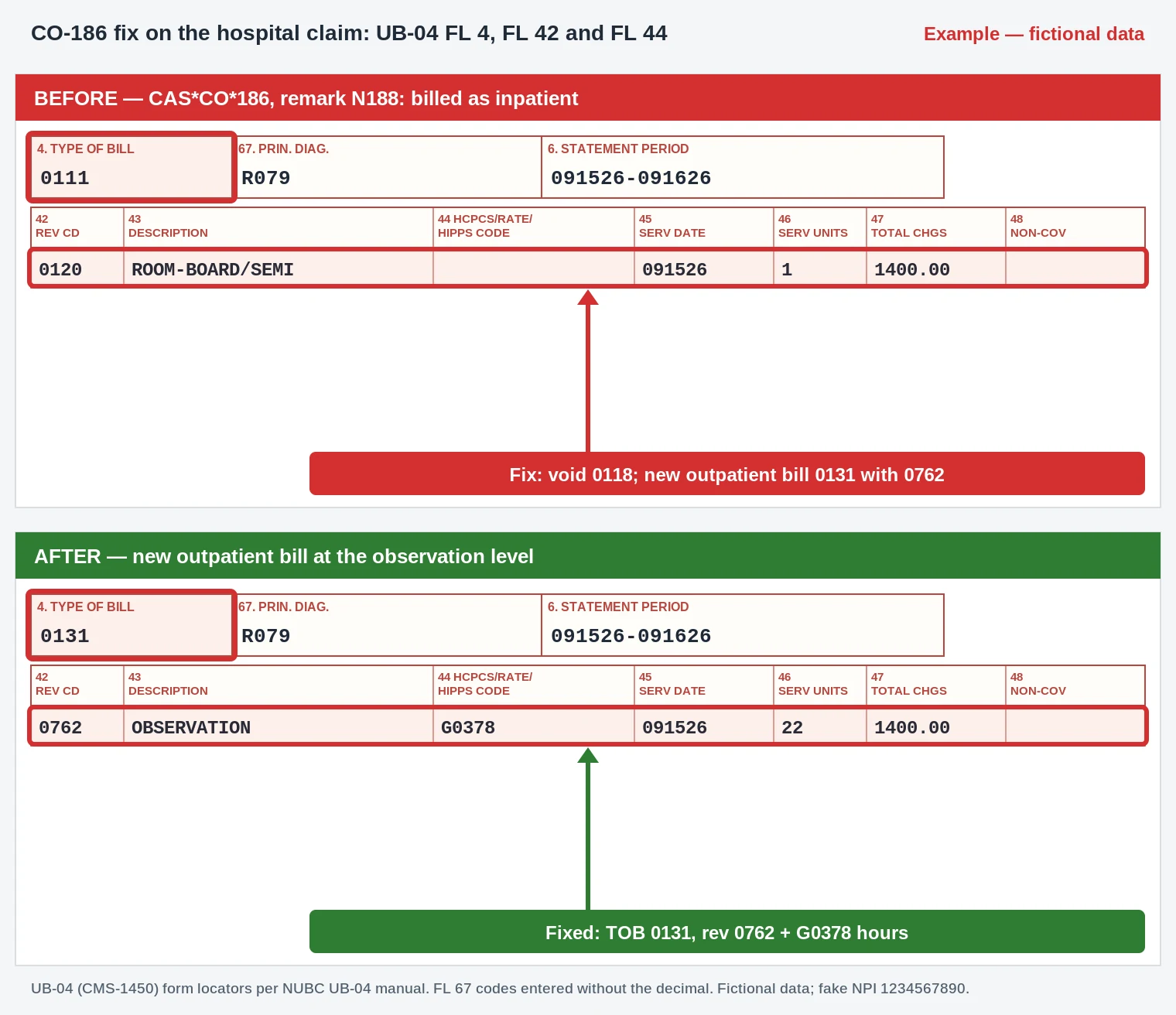
- An inpatient bill (type of bill 0111) for a one-night stay for chest pain (R07.9)
- Dr. Adeyemi’s professional claim for 99222 with place of service 21
The 835
CAS*CO*186on the room and board line, with remarkLQ*HE*N188, “The approved level of care does not match the procedure code submitted.”
Was the reduction a payer error, or did the claim describe care that was never ordered? Keep reading, or jump to how the CO-186 denial was resolved.
Why payers apply reason code 186
- Status mismatch. The physician order said observation, but the claim went out as inpatient.
- Authorization limits. The payer approved a lower level, for example observation hours or a lower rehab level.
- Utilization review. The payer’s reviewer decided the record didn’t meet inpatient or skilled criteria.
- Stepped-down care. The patient moved to a lower level during the stay, but the claim billed the whole stay at the higher one.
How to fix a CO-186 adjustment
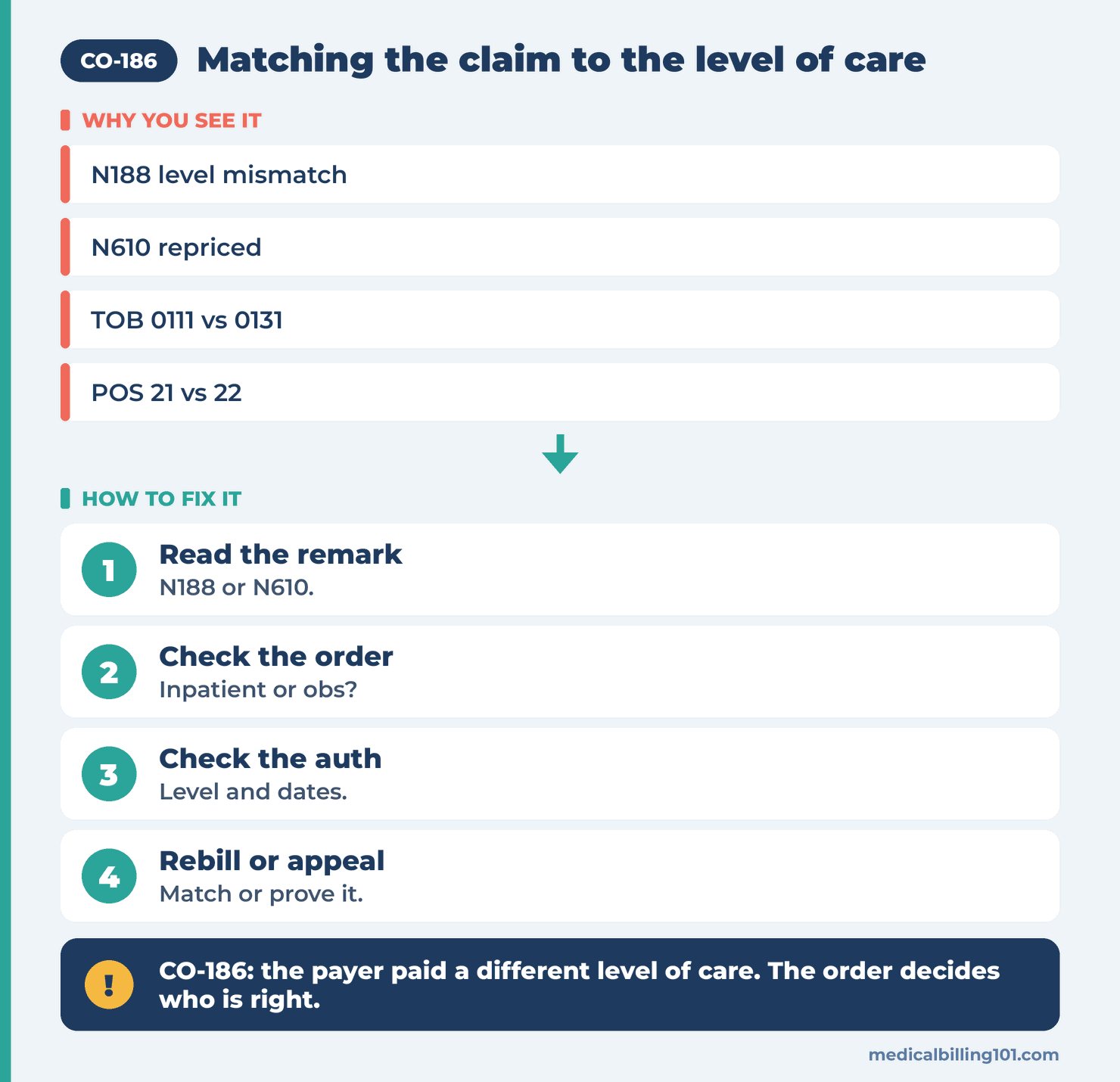
- Read the remark and the letter. N188 means the approved level and the billed codes don’t match. N610, “Alert: Payment based on an appropriate level of care.” means the payer has already repriced.
- Check the order. The physician’s order sets the status. An inpatient bill without an inpatient order can’t stand.
- Check the authorization. Compare the approved level and dates with the claim.
- If the claim was wrong, void the inpatient bill (frequency 8) and send a new outpatient bill with observation lines. Fix the physician’s place of service too.
- If the record supports the higher level, appeal with the order, the clinical notes and the criteria the payer uses. Ask for a peer-to-peer review if the plan offers one.
- Watch the professional claim. Physician claims use place of service 21 for inpatient and 22 for an outpatient hospital stay such as observation.
Example scenario (fictional names), part 2
How the CO-186 Denial Was Resolved
What Grace found
- The hospitalist had ordered observation status. No inpatient order was ever written.
- Cobalt Ridge had authorized observation, not an inpatient stay.
- Registration had set the account to inpatient by mistake.
The fix
- Grace voided the inpatient bill and sent a new outpatient bill (type 0131) with revenue code 0762 and G0378 for the observation hours.
- The practice sent a corrected professional claim with Box 22 code 7 and place of service 22.
Outcome: both claims processed at the observation level with no further adjustments. Registration now checks the status against the signed order before the account is finalized.
Names and details are illustrative; no real patient data.
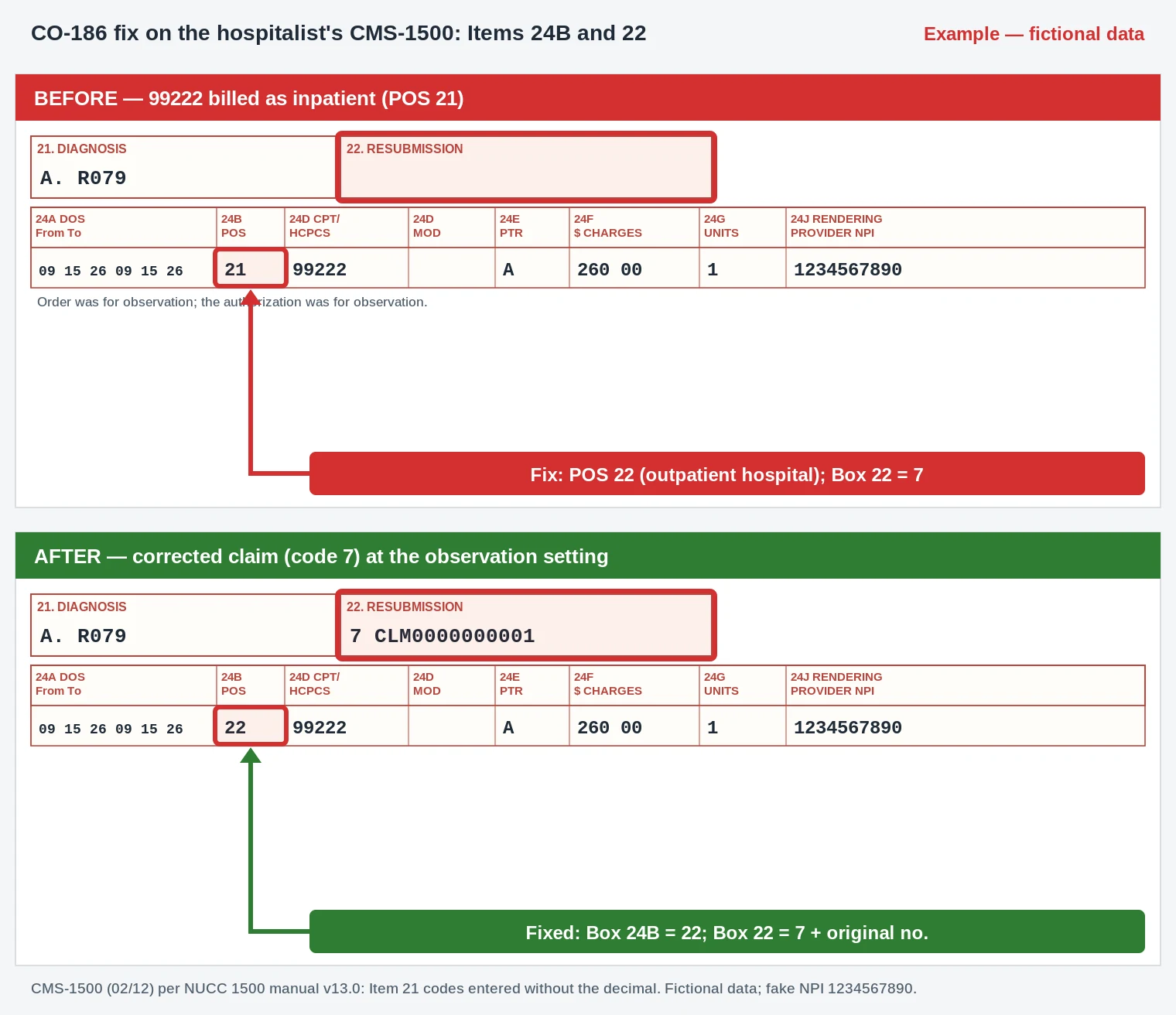
- Box 24B: place of service 21 (inpatient) changed to 22 (outpatient hospital) on the hospitalist’s corrected claim, with Box 22 code 7.
- FL 4: inpatient bill 0111 voided (frequency 8, 0118) and replaced with a new outpatient bill, type 0131.
- FL 42 / FL 44 / FL 46: room and board 0120 replaced with observation 0762, HCPCS G0378 and the observation hours (placeholder 22).
- Box 21 / FL 67: R07.9, entered as R079, is unchanged.
Reason code 186 vs related codes
| Code | Meaning | Key difference |
|---|---|---|
| CO-186 | Level of care change adjustment | Paid at a lower level |
| CO-50 | Not medically necessary | Service not covered at all |
| CO-197 | Precertification/authorization absent | No authorization on file |
| CO-150 | Payer deems the information doesn’t support this level of service | Usually an E/M or service level, not a stay level |
Prevention checklist
- Match the account status to the signed physician order before billing.
- Compare the authorized level and dates with the claim on every stay.
- Split the claim when the patient changed level during the stay, if the payer allows it.
- Keep the physician’s place of service in step with the facility’s status.
Recap
CO-186 means the payer paid at a different, usually lower, level of care. Check the order, the authorization and the claim. Rebill at the approved level when the claim was wrong. Appeal with the record when the higher level was ordered and supported.
FAQ
What does CO-186 mean on an 835?
The payer adjusted the payment because it changed the level of care, for example from inpatient to observation.
Is CO-186 a denial?
It’s an adjustment. The claim is paid, but at the level the payer accepts.
Can I appeal a CO-186 adjustment?
Yes, when the order and the record support the level billed. Send the order, the clinical notes and the payer’s criteria.
Does CO-186 affect the physician’s claim?
It can. Physician claims for an observation stay use place of service 22, not 21.
Can the hospital bill the patient for the difference?
No. Group code CO keeps the difference with the provider.
Which revenue code is used for observation?
Revenue code 0762, usually with HCPCS G0378 for the hours.
Sources
How we checked: each code quote on this page was matched word for word with the X12 CARC and RARC lists on 22 October 2026.
- X12, Claim Adjustment Reason Codes (CARC 186, 50, 197, 150). Accessed 22 Oct 2026.
- X12, Remittance Advice Remark Codes (N188, N610). Accessed 22 Oct 2026.
- CMS, Medicare Claims Processing Manual, Chapter 4 (outpatient hospital). Accessed 22 Oct 2026.
- CMS, Place of Service code set. Accessed 22 Oct 2026.
- NUBC, UB-04 data specifications. Accessed 22 Oct 2026.
Last updated: 22 October 2026 · Educational content; not legal advice.