
CO-216 tells you a person, not just a computer edit, looked at the claim. A review organization or the payer’s own reviewers studied the records and decided the claim should be denied or reduced. Your appeal has to answer their findings, so the first job is to find out exactly what they found. (Primary source: X12 Claim Adjustment Reason Codes)
In brief: CARC 216 reads “Based on the findings of a review organization or the payer’s findings.” Get the written review findings, compare them with the chart line by line, and appeal with the records that answer each point. Ask for a peer-to-peer talk when the issue is a clinical judgment.
Part of our denial codes library. Written by Manikandan J, CPC, CRCR, who has written review-based appeals for hospital and surgical billing teams. Published 23 October 2026. Last updated: 23 October 2026. Code wording quoted word for word from X12.
What X12 says, and what changed in 2025
| Field | Value |
|---|---|
| Code | 216 |
| Description | “Based on the findings of a review organization or the payer’s findings.” |
| Start | 01/27/2008 |
| Last modified | 03/01/2025 |
Source: X12 Claim Adjustment Reason Codes, checked 23 October 2026.
The 2025 change added “or the payer’s findings.” The code now covers a payer’s internal clinical review, not only outside groups.
A review organization is an outside body that checks care against standards. For Medicare, that is often a Quality Improvement Organization (QIO), a CMS contractor that reviews things such as short inpatient stays and discharge appeals. CMS explains their role on its QIO program page.
Remarks that come with CO-216
The remark tells you what kind of review it was:
- N10: “Adjustment based on the findings of a review organization/professional consult/manual adjudication/medical advisor/dental advisor/peer review.”
- N421: “Claim payment was the result of a payer’s retroactive adjustment due to a review organization decision.”
- N939: “Alert: You may contact us for a peer-to-peer review.”
N939 is an open door. For example, a surgeon can often explain a judgment call in a ten-minute call that a records packet cannot.
Example scenario (fictional names), part 1
CO-216 Denial Example: What Happened
Leah Morrison is the denials lead at Northfield Regional Hospital. A one-night stay for chest pain (R07.9) came back from a Medicare Advantage plan with CAS*CO*216 and remark N10. The plan’s nurse reviewer decided the stay should have been observation, not inpatient.
The hospitalist’s note said admit to rule out acute coronary syndrome. The cardiology consult and the troponin trend were filed in a different part of the chart.
What did the reviewer never see? Keep reading, or jump to how the CO-216 denial was resolved.
Building a review-based appeal
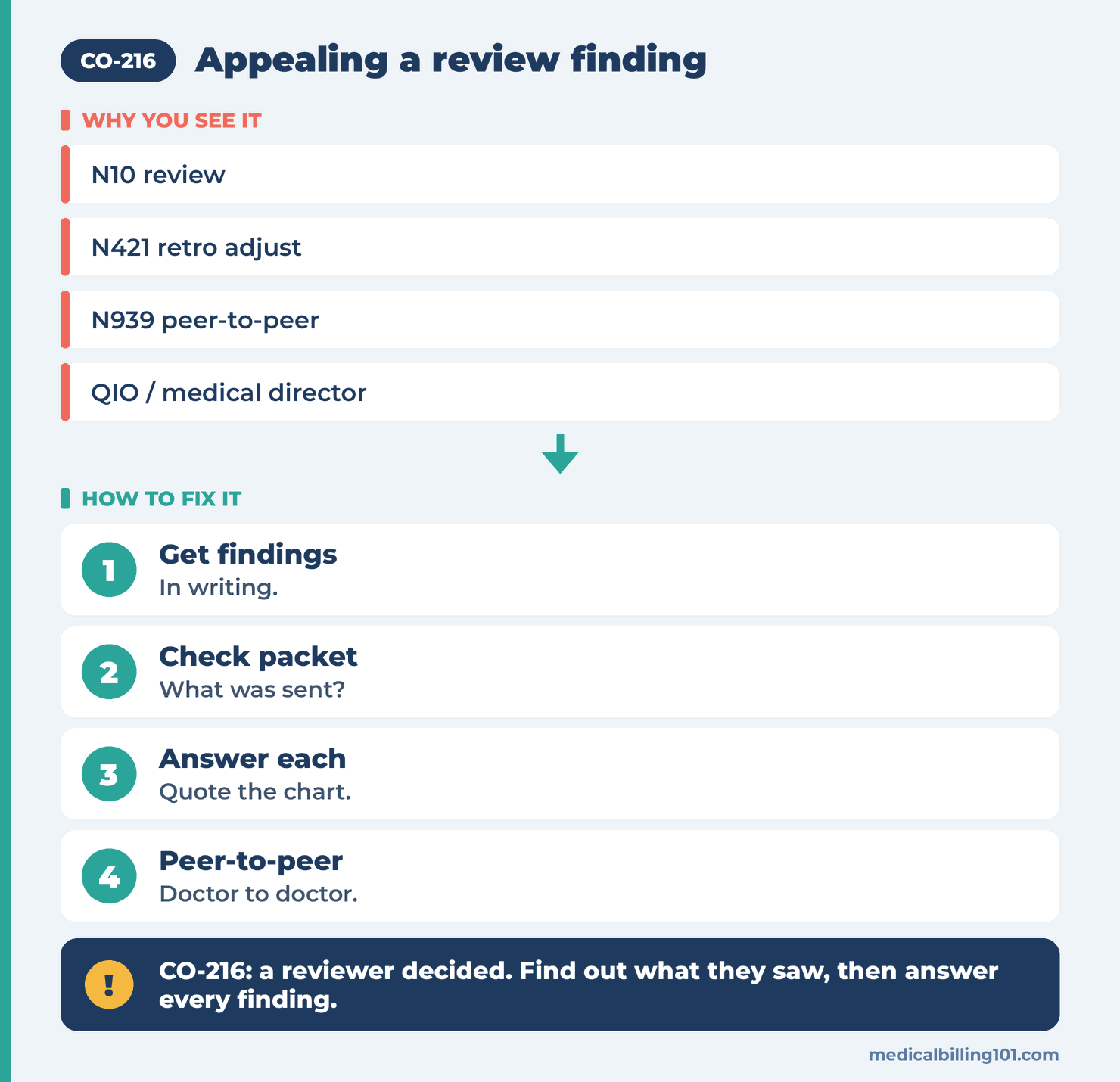
- Get the findings in writing. Ask for the review rationale and the criteria used, such as a named guideline.
- Check what was sent. Compare the pages the reviewer had with the full chart. Missing pages are the most common reason.
- Answer each finding. Quote the chart for each point, with page numbers.
- Ask for a peer-to-peer when the dispute is about medical judgment.
- File on time. Review denials often have shorter appeal windows. Use our timely filing calculator to check dates.
There is no claim form correction here. The claim fields were accurate; the dispute is clinical.
Example scenario (fictional names), part 2
How the CO-216 Denial Was Resolved
Leah found the problem fast. The records packet sent to the plan held only the hospitalist’s admission note and the discharge summary.
Fix: She filed a first-level appeal with the full chart, including the cardiology consult, serial troponins and the overnight telemetry events. She also asked for a peer-to-peer call, which the hospitalist joined.
Outcome: The plan’s medical director reversed the finding and paid the inpatient stay. The hospital changed its records request process so consults are always included.
Names and details are illustrative; no real patient data.
CO-216 vs similar review codes
| Code | Who decided | Typical fix |
|---|---|---|
| CO-216 | Review organization or payer reviewer | Appeal answering the findings |
| CO-50 | Payer: not medically necessary | Necessity appeal |
| CO-56 | Payer: not proven effective | Evidence appeal |
| CO-151 | Payer: frequency not supported | Records showing need |
| CO-197 | Payer: no authorization | Retro auth or appeal |
For the documentation side, read what payers actually look for in medical necessity documentation. The Medicare appeal guide covers each level.
FAQ
What does CO-216 mean?
The claim was denied or reduced based on the findings of a review organization or the payer’s own review.
What is remark N10?
It says the adjustment came from a review organization, professional consult, manual adjudication, medical or dental advisor, or peer review.
Can I ask for a peer-to-peer review?
Often yes, especially when remark N939 is present. Ask quickly, since the window can be short.
Do I send a corrected claim for CO-216?
No. The claim data is not the problem. You appeal the findings with records.
Can the patient be billed?
No. Group code CO keeps the amount with the provider.
Sources
How we checked: each code quote on this page was matched word for word with the X12 CARC and RARC lists on 23 October 2026.
- X12, Claim Adjustment Reason Codes (CARC 216). Accessed 23 Oct 2026.
- X12, Remittance Advice Remark Codes (N10, N421, N939). Accessed 23 Oct 2026.
- CMS, Quality Improvement Organizations. Accessed 23 Oct 2026.
- CMS, Internet-Only Manuals. Accessed 23 Oct 2026.
Last updated: 23 October 2026 · Educational content; not legal advice.