
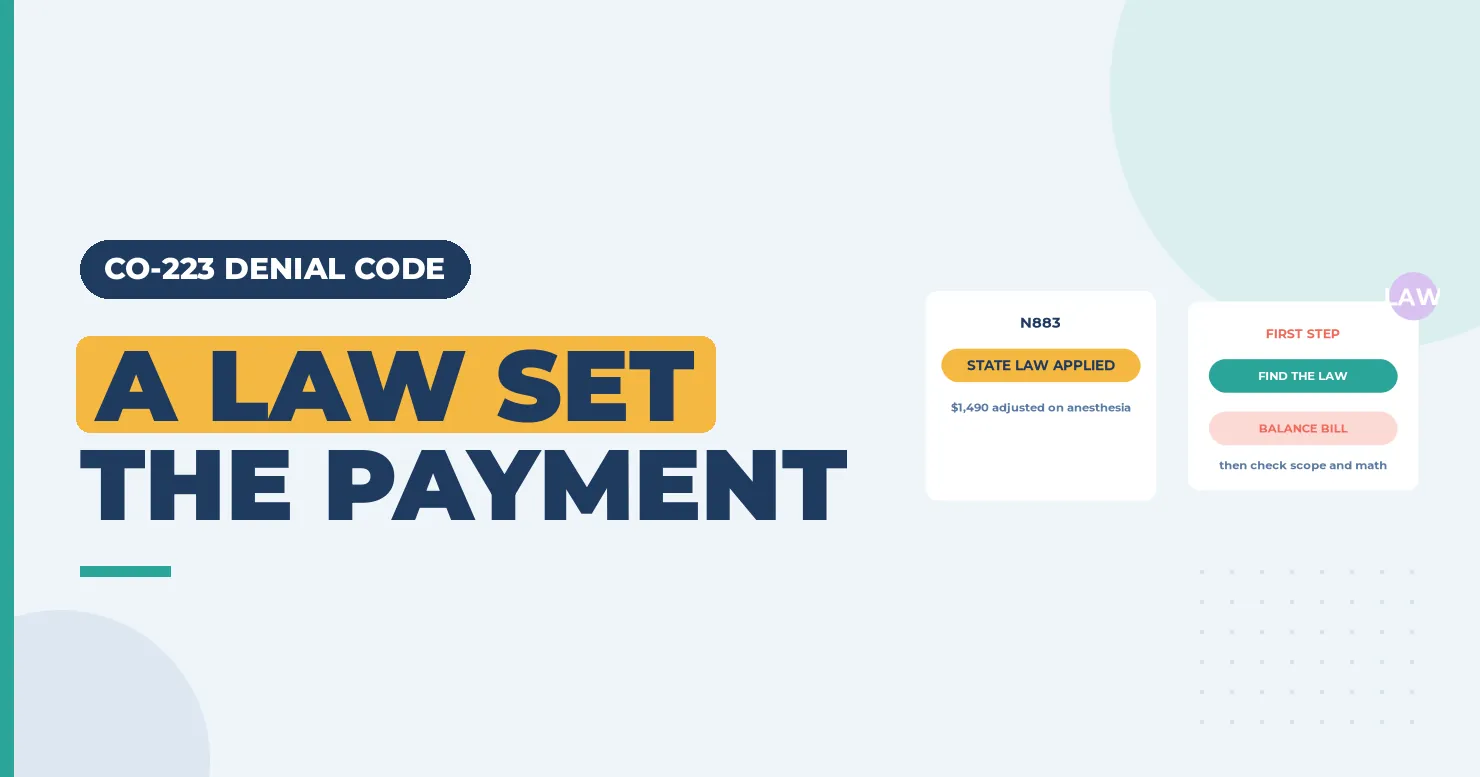
Laws change faster than code lists. When a new federal, state or local rule forces a payer to adjust claims and X12 has no specific code for it yet, payers use CO-223 as a placeholder. The adjustment can be correct, but you will not know until you find out which law the payer applied. (Primary source: X12 Claim Adjustment Reason Codes)
In brief: CARC 223 reads “Adjustment code for mandated federal, state or local law/regulation that is not already covered by another code and is mandated before a new code can be created.” Ask the payer which law it applied, check the payment math against that law, and use the law’s own dispute process if you disagree. Do not balance bill the patient.
Part of our denial codes library. Written by Manikandan J, CPC, CRCR, who has worked out-of-network and state-mandate adjustments for anesthesia and emergency groups. Published 23 October 2026. Last updated: 23 October 2026. Code wording quoted word for word from X12.
Reading the code
| Field | Value |
|---|---|
| Code | 223 |
| Description | “Adjustment code for mandated federal, state or local law/regulation that is not already covered by another code and is mandated before a new code can be created.” |
| Start | 06/01/2008 |
Source: X12 Claim Adjustment Reason Codes, checked 23 October 2026.
Three phrases matter. Mandated means the payer says it had no choice. Not already covered by another code means more specific codes should be used first. And before a new code can be created means CO-223 is meant as a stopgap, not a permanent home.
Where you see CO-223 most
- State surprise billing laws. For example, a state law that sets out-of-network payment for emergency or hospital-based doctors. Remark N883 reads “Alert: Processed according to state law”.
- Federal No Surprises Act cases. Here payers often add N-series alerts such as N871: “Alert: This initial payment was calculated based on a specified state law, in accordance with the No Surprises Act.” CMS explains the federal rules on its No Surprises Act page.
- Local or state mandates such as a required fee cap or new benefit rule that took effect before X12 added a code.
Example scenario (fictional names), part 1
CO-223 Denial Example: What Happened
Daniel Kim is the revenue cycle manager for Lakeshore Anesthesia Partners, which is out of network with one large commercial plan. The group billed $2,400 for anesthesia during a knee replacement at an in-network hospital.
The plan paid $910. The remit showed CAS*CO*223 for $1,490 with remark N883. There was no other explanation, and the front desk asked whether to bill the patient the difference.
Should the patient get a bill for $1,490? Keep reading, or jump to how the CO-223 denial was resolved.
The key terms
An out-of-network rate is the amount a law or agreement says a non-contracted provider gets paid. Balance billing is charging the patient the difference between the charge and what the plan paid; surprise billing laws ban it in many settings. Independent dispute resolution (IDR) is the federal process for payment disputes under the No Surprises Act; some states run their own.
How to work CO-223

- Identify the law. Read the remark codes, then call or write the payer and ask which law and section it applied.
- Check the scope. Confirm the law covers this plan type, setting and service. Self-funded employer plans, for instance, are often governed by federal rules rather than state law.
- Check the math. Recalculate the payment using the law’s method.
- Hold the patient balance. If a balance billing ban applies, the patient owes only in-network cost sharing.
- Dispute on time. Use the payer’s appeal, then the state or federal process. Federal IDR has strict windows; see the CMS IDR portal.
The claim itself was accurate. There is no claim form fix, so the work is legal scope and payment review.
Example scenario (fictional names), part 2
How the CO-223 Denial Was Resolved
Daniel asked the plan which law it used. The plan cited the state’s surprise billing statute for hospital-based providers. Daniel checked the employer behind the patient’s coverage: it was a fully insured state-regulated plan, so the state law did apply.
Fix: Daniel told the front desk not to bill the patient beyond the in-network cost sharing. He then compared the $910 with the state’s payment method, found it was below the state’s benchmark, and filed the state’s dispute form.
Outcome: The state dispute process awarded a higher payment. Lakeshore now flags N883 claims for a scope and math check before any patient statement goes out.
Names and details are illustrative; no real patient data.
CO-223 vs similar adjustments
| Code | Meaning | Patient billable? |
|---|---|---|
| CO-223 | Mandated law, no specific code | Usually no |
| CO-45 | Charge exceeds fee schedule | No |
| CO-97 | Bundled into another service | No |
| PR-1, PR-2, PR-3 | Deductible, coinsurance, copay | Yes |
For the patient side of a remit, see how to read an explanation of benefits.
FAQ
What does CO-223 mean?
The payer adjusted the claim because a federal, state or local law required it, and no more specific code exists yet.
Can I bill the patient after CO-223?
Usually not. Group code CO and most surprise billing laws keep the amount off the patient’s bill.
How do I find which law applied?
Read the remark codes, such as N883, then ask the payer in writing for the law and section.
Can CO-223 be appealed?
Yes. Start with the payer’s appeal, then use the state process or the federal IDR process, whichever applies.
Is CO-223 a denial?
It is an adjustment. The claim may be paid in part, with CO-223 explaining the reduction.
Sources
How we checked: each code quote on this page was matched word for word with the X12 CARC and RARC lists on 23 October 2026.
- X12, Claim Adjustment Reason Codes (CARC 223). Accessed 23 Oct 2026.
- X12, Remittance Advice Remark Codes (N871, N883). Accessed 23 Oct 2026.
- CMS, No Surprises Act. Accessed 23 Oct 2026.
- CMS, Federal IDR portal. Accessed 23 Oct 2026.
Last updated: 23 October 2026 · Educational content; not legal advice.