
Some code pairs describe the same work two ways. Think of a complete exam and a limited one. You can do one or the other in a session, not both. Bill both, and the payer may pay one and deny the other with CO-231. It may not pick the one you want. (Primary source: X12 Claim Adjustment Reason Codes)
In brief: CARC 231 reads “Mutually exclusive procedures cannot be done in the same day/setting.” Read the report to see which procedure was really done, bill only that code on a corrected claim, and use a distinct-service modifier only when the two services truly happened at separate sessions or sites and the payer’s edit allows it.
Part of our denial codes library. Written by Manikandan J, CPC, CRCR, who has coded radiology and women’s health claims and audited their NCCI edits. Published 23 October 2026. Last updated: 23 October 2026. Code wording quoted word for word from X12.
What does the CO-231 denial code mean?
| Field | Value |
|---|---|
| Code | 231 |
| Description | “Mutually exclusive procedures cannot be done in the same day/setting.” |
| Usage | “Refer to the 835 Healthcare Policy Identification Segment (loop 2110 Service Payment Information REF), if present.” |
| Start | 07/01/2009 |
| Last modified | 07/01/2017 |
Source: X12 Claim Adjustment Reason Codes, checked 23 October 2026.
CO-231 is the claim adjustment reason code payers use when two billed services can’t both happen. Mutually exclusive procedures are services that can’t be done on the same patient in the same session. The reason may be the code definitions or the anatomy. NCCI (the National Correct Coding Initiative) is the CMS edit set that lists these pairs as procedure-to-procedure edits; see the CMS NCCI PTP edits page. A modifier indicator on each pair says whether a modifier such as 59 or XS can ever bypass it.
Common remarks: N20 reads “Service not payable with other service rendered on the same date.” M80 reads “Not covered when performed during the same session/date as a previously processed service for the patient.”
Common causes of CO-231
- Complete vs limited. For example, a complete and a limited ultrasound of the same area.
- Different approaches to one goal. Such as an open and a laparoscopic version of the same repair.
- Initial vs subsequent. Codes that describe the first and later units in incompatible ways.
Example scenario (fictional names), part 1
CO-231 Denial Example: What Happened
Olivia Grant codes for Meadowbrook Women’s Imaging. A pelvic ultrasound visit was billed with two lines: 76856, the complete transabdominal pelvic exam, and 76857, the limited or follow-up exam. The diagnosis was abnormal uterine bleeding (N93.9, entered as N939).
The payer paid 76857 and denied 76856 with CAS*CO*231 and remark N20. So the center got the lower rate. Yet the report showed every structure a complete exam needs.
Which code should have been on the claim? Keep reading, or jump to how the CO-231 denial was resolved.
How to fix a CO-231 denial
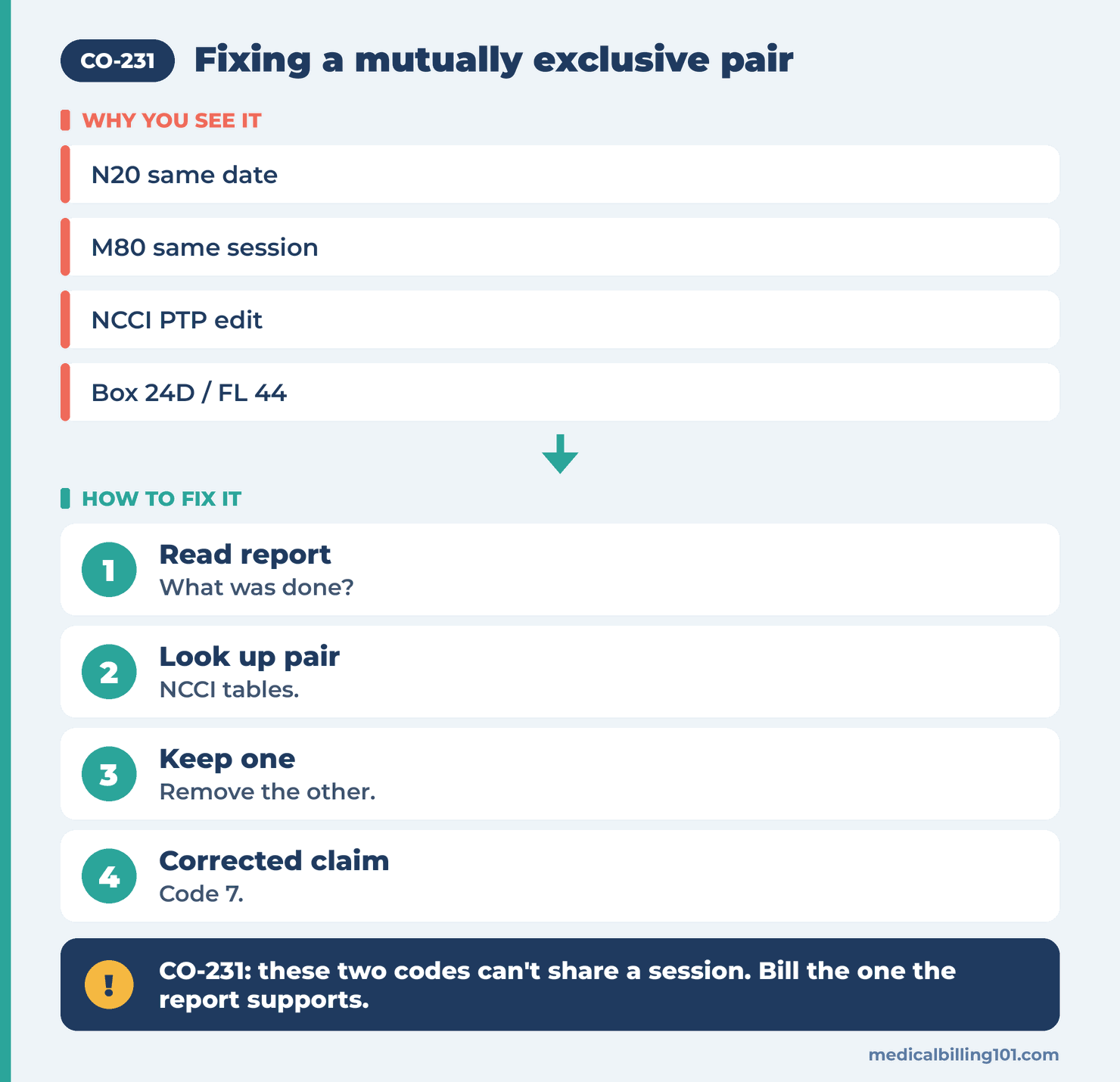
- Read the report. Decide which service was actually done.
- Look up the pair. Use the NCCI PTP tables to find the column 1 and column 2 codes and the modifier indicator.
- Bill the right code only. Remove the code that was not truly performed.
- Use a modifier only when true. If the services were at different sessions or sites and the indicator is 1, append 59 or an X modifier to the column 2 code, with notes that show it.
- Send a corrected claim with frequency code 7.
The claim form section below shows the line change.
Example scenario (fictional names), part 2
How the CO-231 Denial Was Resolved
Olivia read the report. It covered the uterus, endometrium, both ovaries and the adnexa. That is a complete exam. It said nothing about a separate follow-up.
Fix: She sent a corrected claim with frequency code 7 and only 76856, removing the 76857 line. The order template that added both codes was fixed.
Outcome: The payer paid 76856 at the complete rate. It then took back the 76857 payment. Meadowbrook added a scrubber edit for the pair using clearinghouse NCCI scrubbing.
Names and details are illustrative; no real patient data.
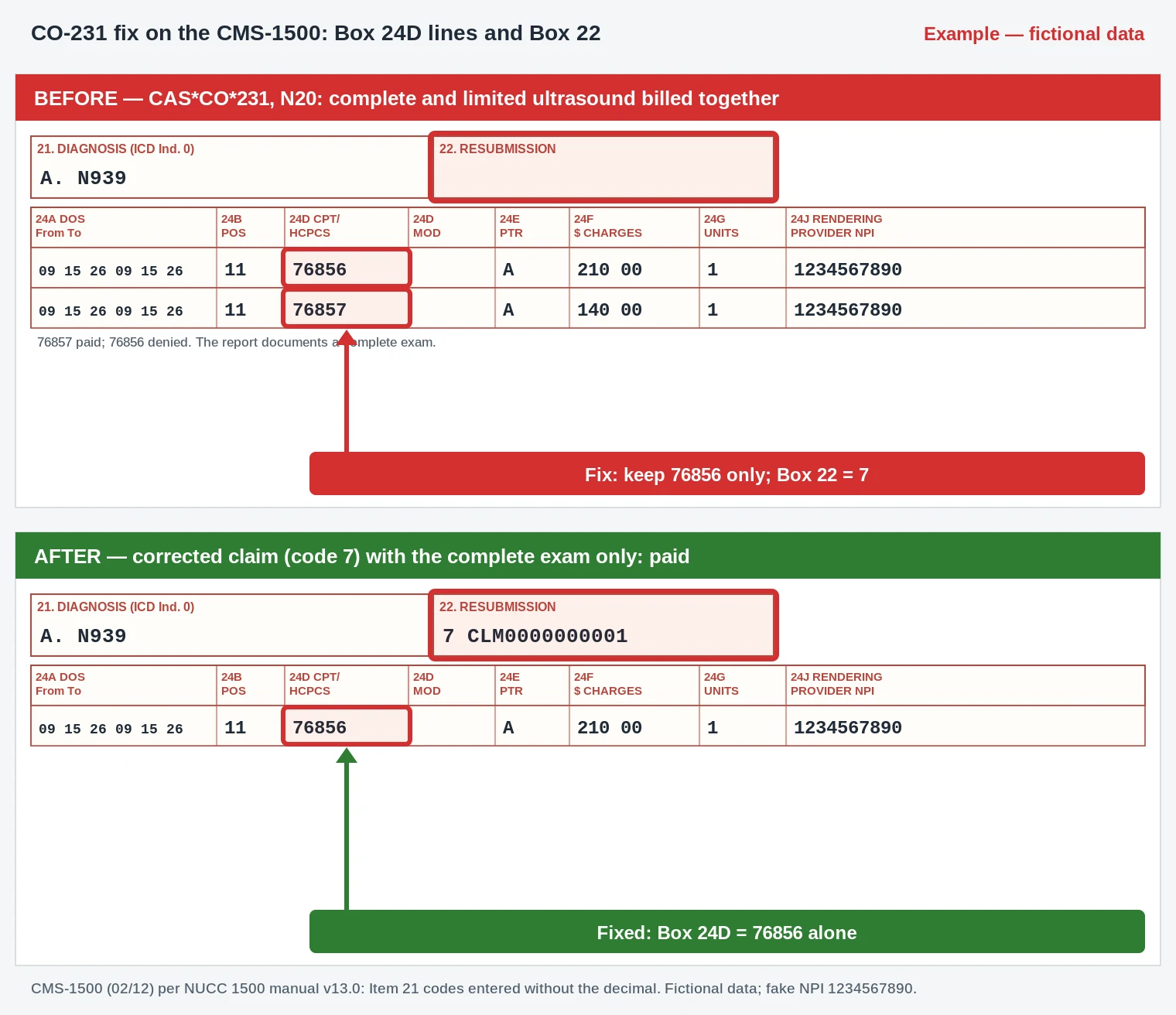
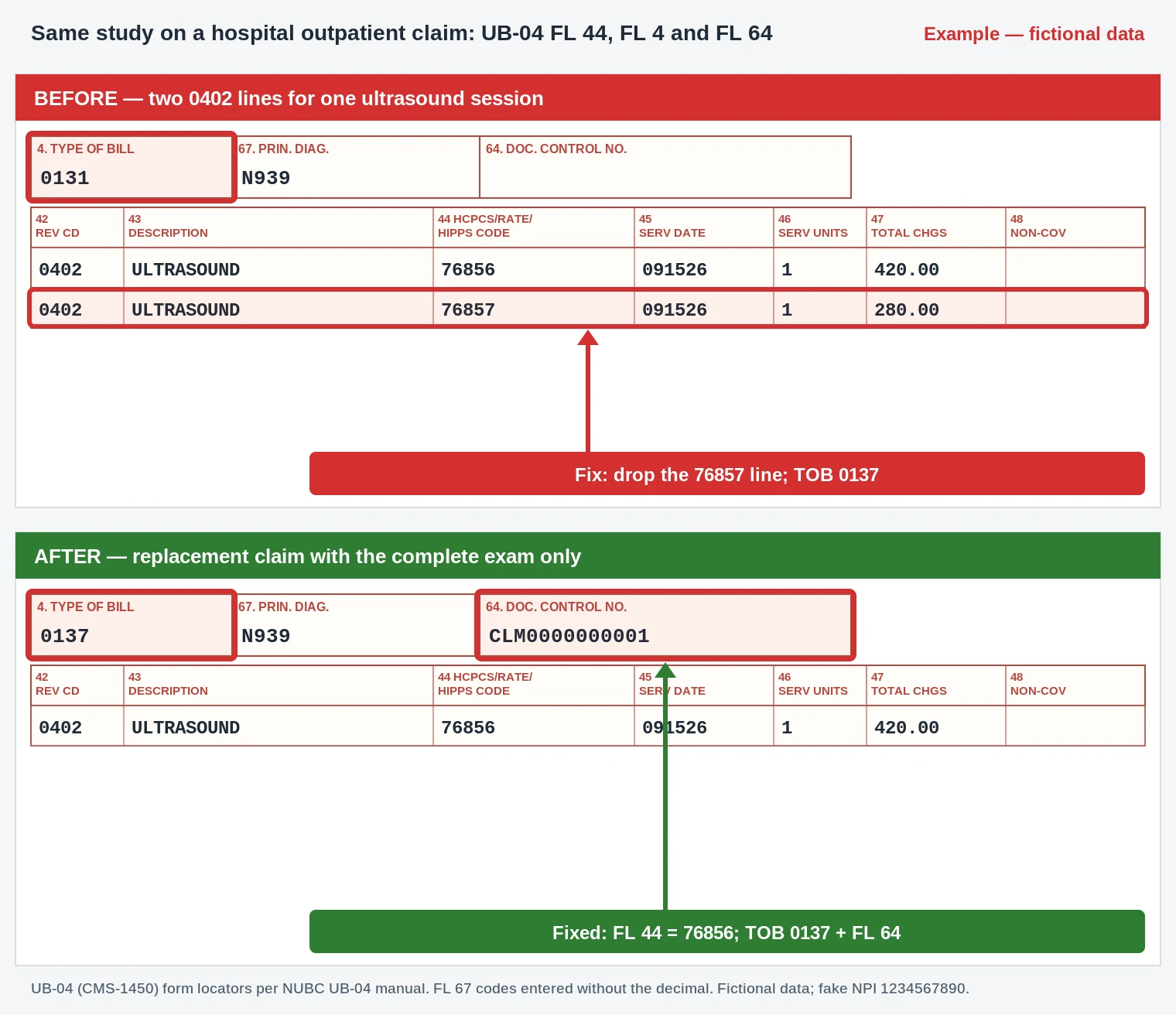
- Box 24D / FL 44: limited pelvic ultrasound 76857 removed; complete exam 76856 kept, as the report supports.
- Box 22 / FL 4 + FL 64: frequency code 7 with the original claim number (type of bill 0137).
- Box 21 / FL 67: N93.9 (entered as N939) is unchanged.
CO-231 vs CO-97 and others
| Code | Meaning | Fix |
|---|---|---|
| CO-231 | Can’t be done together | Bill the one done |
| CO-97 | Included in another service | Bundle or modifier |
| CO-234 | Not separately payable | Remove or modifier |
| CO-236 | Not compatible combination | Check NCCI |
| CO-4 | Modifier mismatch | Fix the modifier |
FAQ
What does CO-231 mean?
The two procedures are mutually exclusive and cannot be done in the same day or setting.
Can modifier 59 fix CO-231?
Only if the services truly were separate and the NCCI modifier indicator allows it. Do not add 59 just to get paid.
Which code does the payer pay?
Often the column 1 code or the first processed line, which may not be the one you did.
Can I bill the patient?
No. Group code CO keeps the denied amount with the provider.
Where do I check the pair?
The CMS NCCI procedure-to-procedure edit tables.
Sources
How we checked: each code quote on this page was matched word for word with the X12 CARC and RARC lists on 23 October 2026.
- X12, Claim Adjustment Reason Codes (CARC 231). Accessed 23 Oct 2026.
- X12, Remittance Advice Remark Codes (N20, M80). Accessed 23 Oct 2026.
- CMS, Medicare NCCI Procedure-to-Procedure Edits. Accessed 23 Oct 2026.
- NUCC, 1500 Claim Form Instructions. Accessed 23 Oct 2026.
Last updated: 23 October 2026 · Educational content; not legal advice.
Related denial codes
- CO-234: Procedure Not Paid Separately
- CO-236: Procedure Not Compatible Under NCCI
- CO-59: Processed Under Multiple or Concurrent Procedure Rules
- CO-240: Diagnosis Does Not Match Birth Weight
- CO-203: Discontinued or Reduced Service
- CO-261: Inconsistent With Patient History
- CO-199: Revenue Code and Procedure Code Do Not Match
- CO-189: Unlisted or NOC Code Billed When a Specific Code Exists