
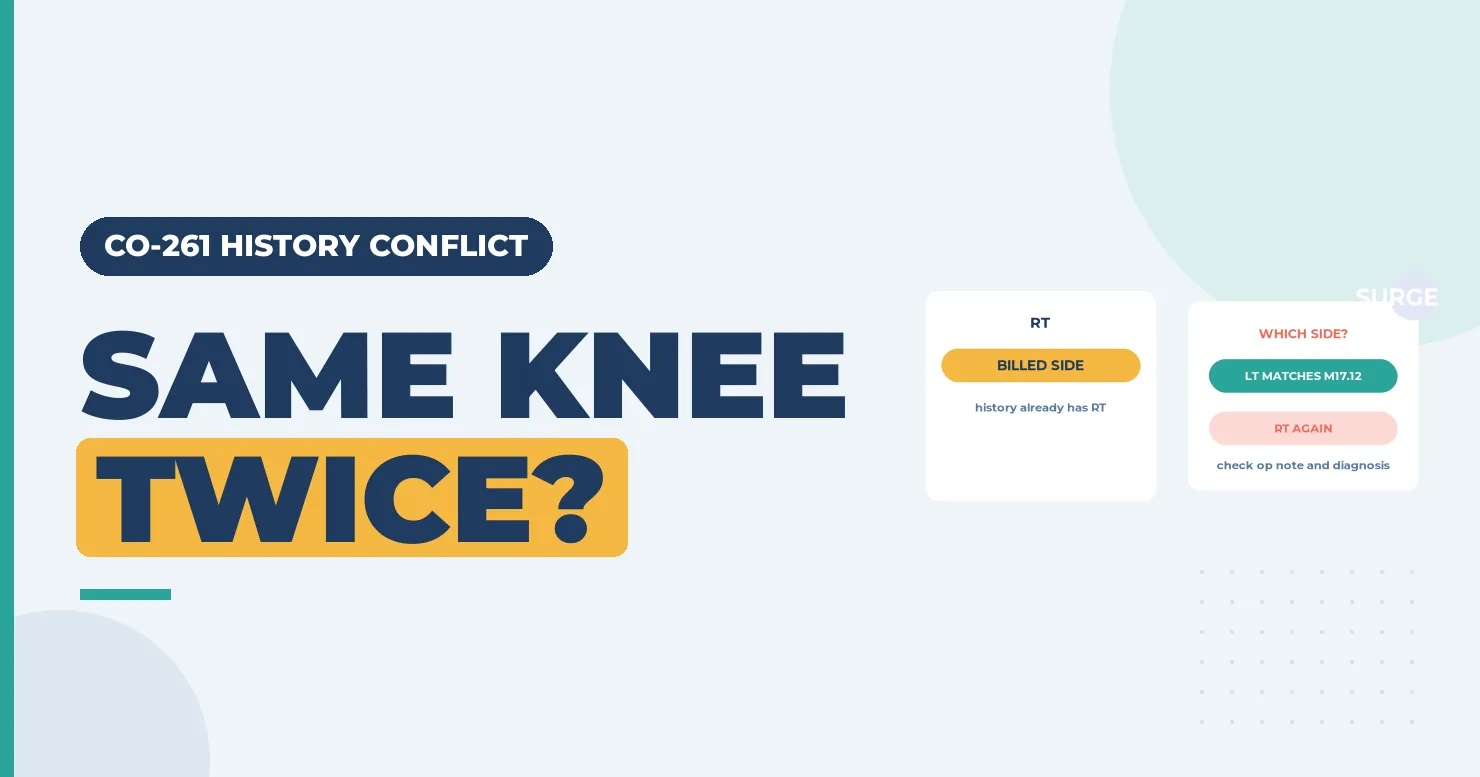
CO-261 means the payer compared this claim with the patient’s past claims and found a conflict. A knee is replaced twice on the same side. An organ that was removed shows up again. A one-time service is billed a second time. Often the patient’s history is fine and the new claim has a coding slip, such as the wrong side. (Primary source: X12 Claim Adjustment Reason Codes)
In brief: CARC 261 reads “The procedure or service is inconsistent with the patient’s history.” Pull the patient’s prior claims, find the conflict, and fix the side, code or date that caused it. If the claim was right, appeal with records that explain the history.
Part of our denial codes library. Written by Manikandan J, CPC, CRCR, who has corrected laterality and history edits on orthopedic and surgical claims. Published 24 October 2026. Last updated: 24 October 2026. Code wording quoted word for word from X12. Read about the author and our editorial policy, or contact us to report an error.
What the code says
| Field | Value |
|---|---|
| Code | 261 |
| Description | “The procedure or service is inconsistent with the patient’s history.” |
| Start | 06/01/2014 |
Source: X12 Claim Adjustment Reason Codes, checked 24 October 2026.
Key terms: A CARC is a Claim Adjustment Reason Code from the X12 list, and it says why a line was paid differently than billed. A RARC is a Remittance Advice Remark Code that adds detail to the CARC. The group code is the two-letter prefix on the adjustment; CO means contractual obligation: the provider owns the balance and it cannot be billed to the patient. An electronic remittance advice (ERA) is the ANSI X12 835 transaction that carries these codes from the payer to the provider; its paper equivalent is the remittance notice or explanation of benefits.
Methodology: the code wording above is copied from the X12 list, and each fix step below links to the payer or CMS page it comes from.
Payers run history edits against earlier paid claims. The edit does not read the chart. It sees codes, modifiers and dates. That is why a single wrong modifier can trigger CO-261.
Example scenario (fictional names), part 1
CO-261 Denial Example: What Happened
Nadia Cole bills for Summit Joint Surgeons, a fictional orthopedic group. A patient had a right total knee replacement, CPT 27447 with modifier RT, in 2025. In September 2026 the surgeon replaced the left knee.
The new claim went out as 27447-RT. The diagnosis was M17.12, osteoarthritis of the left knee. The payer denied it with CAS*CO*261.
What caused the conflict, and how should Nadia fix the claim? Keep reading, or jump to how the CO-261 denial was resolved.
What triggers CO-261
- Wrong side. RT or LT does not match the procedure history or the diagnosis.
- Removed organ. For example, a screening for an organ that the history shows was removed.
- Once-per-lifetime service. A service that can only be done once is billed again.
- Wrong patient history. Another patient’s claim was posted to this member.
- Real repeat. A revision or redo procedure that needs a different code or records.
Correcting a CO-261 claim
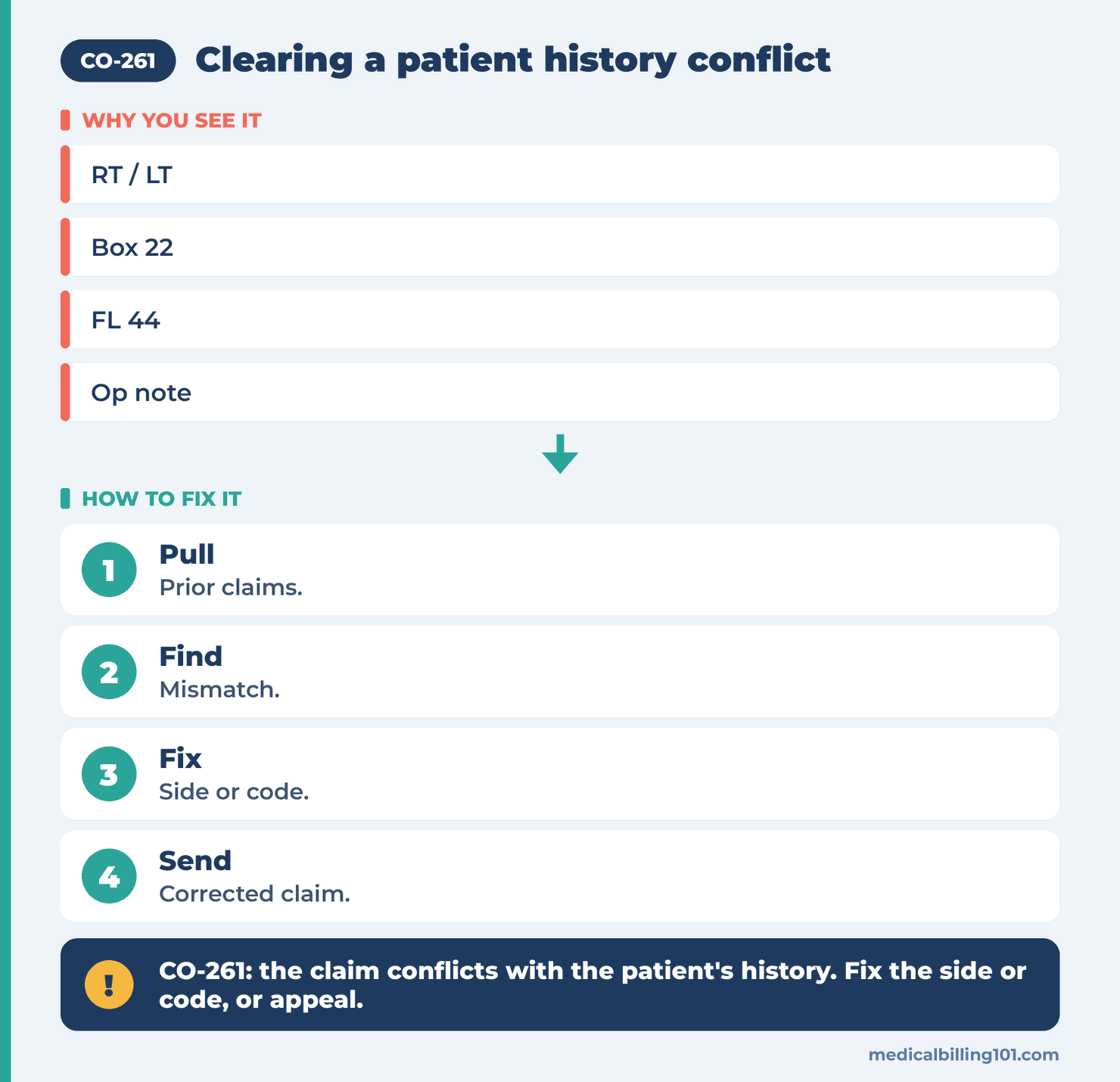
- Pull the history. Review the patient’s previous claims for the same procedure code or anatomical site.
- Find the mismatch. Compare the side, the code and the diagnosis with the history and the op note.
- Fix the coding error. Change the modifier or code to match the record. Check the diagnosis side matches too.
- Send a corrected claim. Use frequency code 7 in Box 22 with the original claim number, per the NUCC instructions. A hospital uses type of bill 0137 and FL 64.
- Appeal true repeats. If the service really was repeated, send the records that show why.
Modifier errors of other kinds are covered on our CO-4 page.
Example scenario (fictional names), part 2
How the CO-261 Denial Was Resolved
Nadia checked the operative note: it documented the left knee, and the diagnosis code also specified the left knee, so only the modifier was wrong.
Fix: She sent a corrected claim with 27447-LT and code 7 in Box 22. The hospital’s billing office sent a replacement outpatient bill with 27447LT in FL 44.
Outcome: Both claims paid. The group added a pre-bill check that flags RT or LT when it does not match the diagnosis side.
Names and details are illustrative; no real patient data.
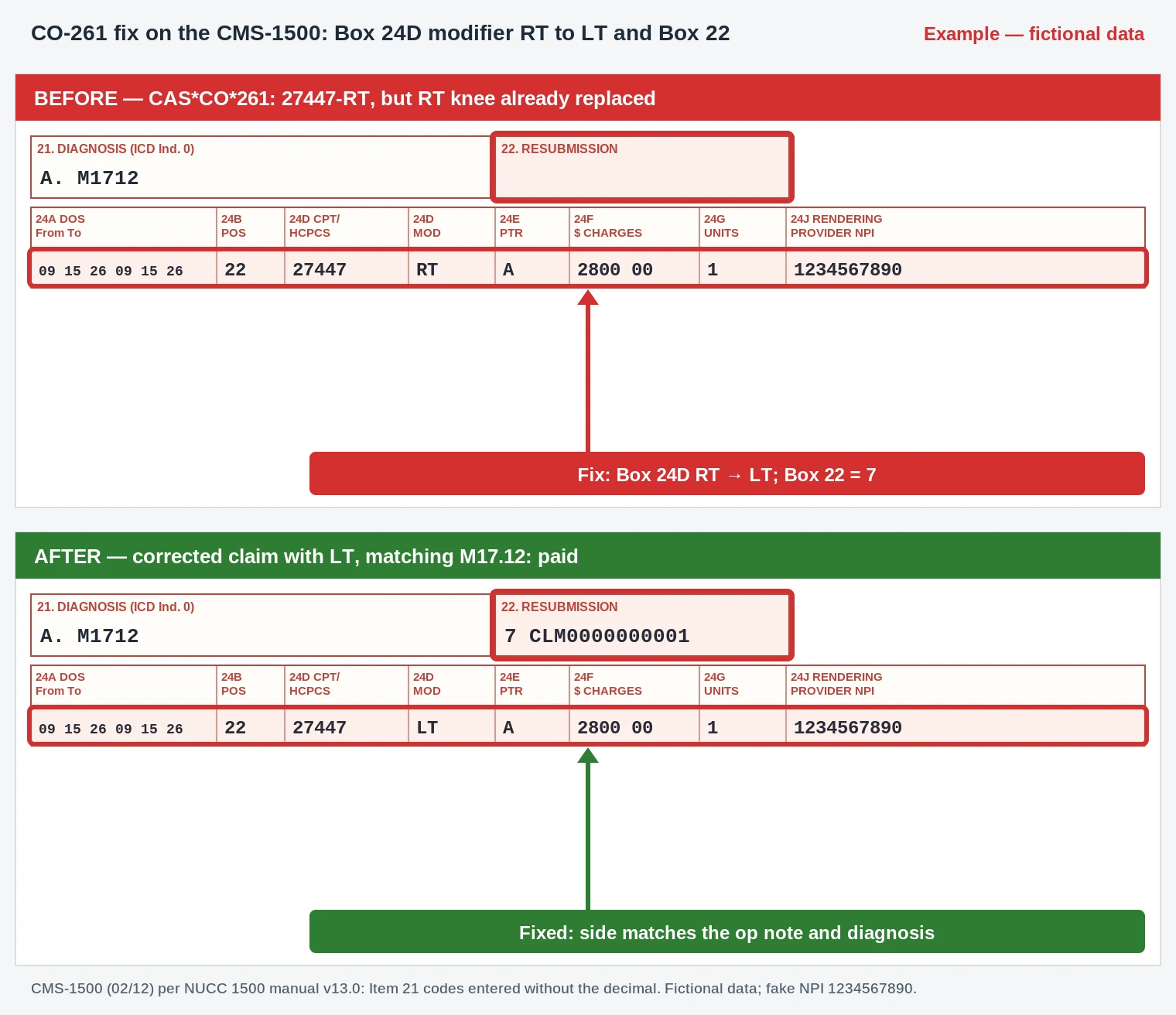
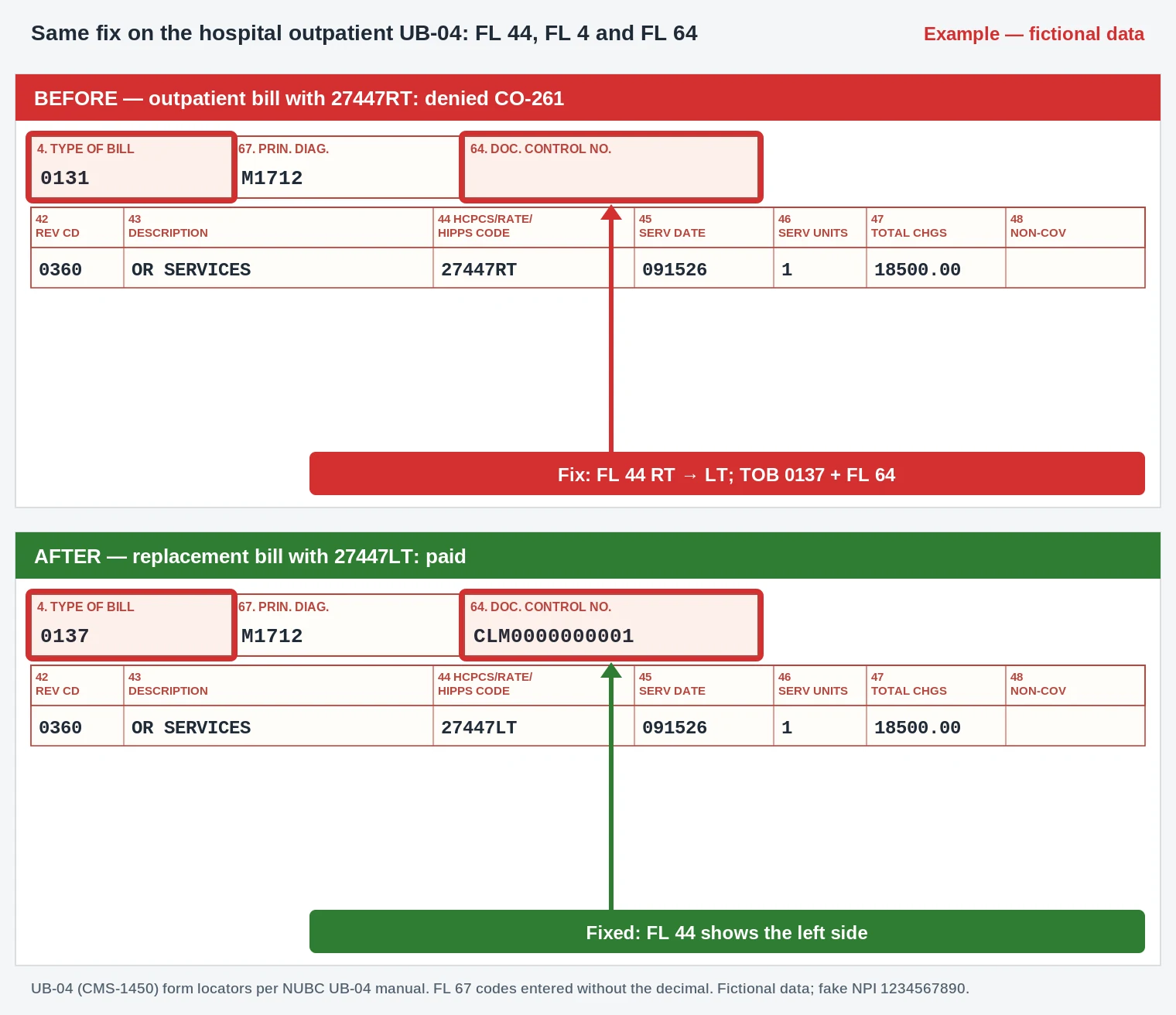
- Box 24D / FL 44: modifier RT changed to LT for 27447 (left knee, per the op note).
- Box 21 / FL 67: M17.12 (entered as M1712), left knee, is unchanged; it was already right.
- Box 22 / FL 4 + FL 64: code 7, or type of bill 0137, with the original claim number.
- Box 24F / FL 47: charges are unchanged.
- Box 24B: place of service 22, outpatient hospital, is unchanged.
CO-261 compared with similar edits
| Code | What the payer saw | Fix |
|---|---|---|
| CO-261 | Conflict with prior claims | Fix side or code, or appeal |
| CO-4 | Modifier wrong or missing | Correct the modifier |
| CO-11 | Diagnosis does not fit procedure | Correct the diagnosis |
| CO-18 | Exact duplicate | Check the first claim |
FAQ
What does CO-261 mean?
The service on the claim conflicts with the patient’s claim history, such as a second right knee replacement.
Is CO-261 always a coding error?
No. Often it is, but a real repeat or revision can trigger it too. Then you appeal with records.
What is the most common cause?
A wrong RT or LT modifier is one of the most frequent causes in surgery claims.
Do I send a new claim or a corrected claim?
A corrected claim, with code 7 in Box 22 and the original claim number.
Can the patient be billed for CO-261?
No. It is a provider adjustment under the CO group.
Sources
How we checked: the code quote on this page was matched word for word with the X12 CARC list on 24 October 2026.
- X12, Claim Adjustment Reason Codes (CARC 261). Accessed 24 Oct 2026.
- NUCC, 1500 Claim Form instructions. Accessed 24 Oct 2026.
- NUBC, National Uniform Billing Committee. Accessed 24 Oct 2026.
- CMS, Medicare Claims Processing Manual, chapter 12. Accessed 24 Oct 2026.
Last updated: 24 October 2026 · Educational content; not legal advice.
Related denial codes
- CO-251: Incomplete or Deficient Documentation
- CO-240: Diagnosis Does Not Match Birth Weight
- CO-236: Procedure Not Compatible Under NCCI
- CO-234: Procedure Not Paid Separately
- CO-231: Mutually Exclusive Procedures
- CO-216: Denied on Review Findings
- CO-203: Discontinued or Reduced Service
- CO-199: Revenue Code and Procedure Code Do Not Match