

CO-251 says the right kind of record arrived but fell short. Pages were missing, a signature was absent, or the dates did not cover the service. The claim stays on hold until the gap is filled. Most of these holds are fixed with a careful second packet. (Primary source: X12 Claim Adjustment Reason Codes)
In brief: CARC 251 reads “The attachment/other documentation that was received was incomplete or deficient. The necessary information is still needed to process the claim.” Find what was missing from the remark and letter, complete the record, and resend the whole packet before the deadline.
Part of our denial codes library. Written by Manikandan J, CPC, CRCR, who has rebuilt records packets for therapy and surgical claims. Published 24 October 2026. Last updated: 24 October 2026. Code wording quoted word for word from X12. Read about the author and our editorial policy, or contact us to report an error.
CO-251 at a glance
| Field | Value |
|---|---|
| Code | 251 |
| Description | “The attachment/other documentation that was received was incomplete or deficient. The necessary information is still needed to process the claim. At least one Remark Code must be provided (may be comprised of either the NCPDP Reject Reason Code, or Remittance Advice Remark Code that is not an ALERT).” |
| Start | 09/30/2012 |
Source: X12 Claim Adjustment Reason Codes, checked 24 October 2026.
Key terms: A CARC is a Claim Adjustment Reason Code from the X12 list, and it says why a line was paid differently than billed. A RARC is a Remittance Advice Remark Code that adds detail to the CARC. The group code is the two-letter prefix on the adjustment; CO means contractual obligation: the provider owns the balance and it cannot be billed to the patient.
Methodology: the code wording above is copied from the X12 list, and each fix step below links to the payer or CMS page it comes from.
Compare it with CO-250, where the payer got the wrong document altogether. With CO-251 the document type was right, but it did not do the job.
Example scenario (fictional names), part 1
CO-251 Denial Example: What Happened
Priya Nair handles billing for Riverbend Physical Therapy, a fictional outpatient clinic. A payer asked for the plan of care behind twelve therapy visits.
The clinic sent the first page of the plan. It had no signature and no dates. The claim came back with CAS*CO*251.
What does a complete packet look like for this request? Keep reading, or jump to how the CO-251 denial was resolved.
What payers treat as deficient
| Gap | Example | What fixes it |
|---|---|---|
| Missing pages | Page 1 of a 3-page plan | Send every page, numbered |
| No signature | Unsigned plan or order | Signed copy, or the payer’s attestation form |
| Dates do not match | Plan dated after the visits | Records covering the billed dates |
| Illegible copy | Faxed scan too faint | A clean copy |
| Missing pieces | For example, an op note without the implant log | The missing parts named in the letter |
How to resolve CO-251
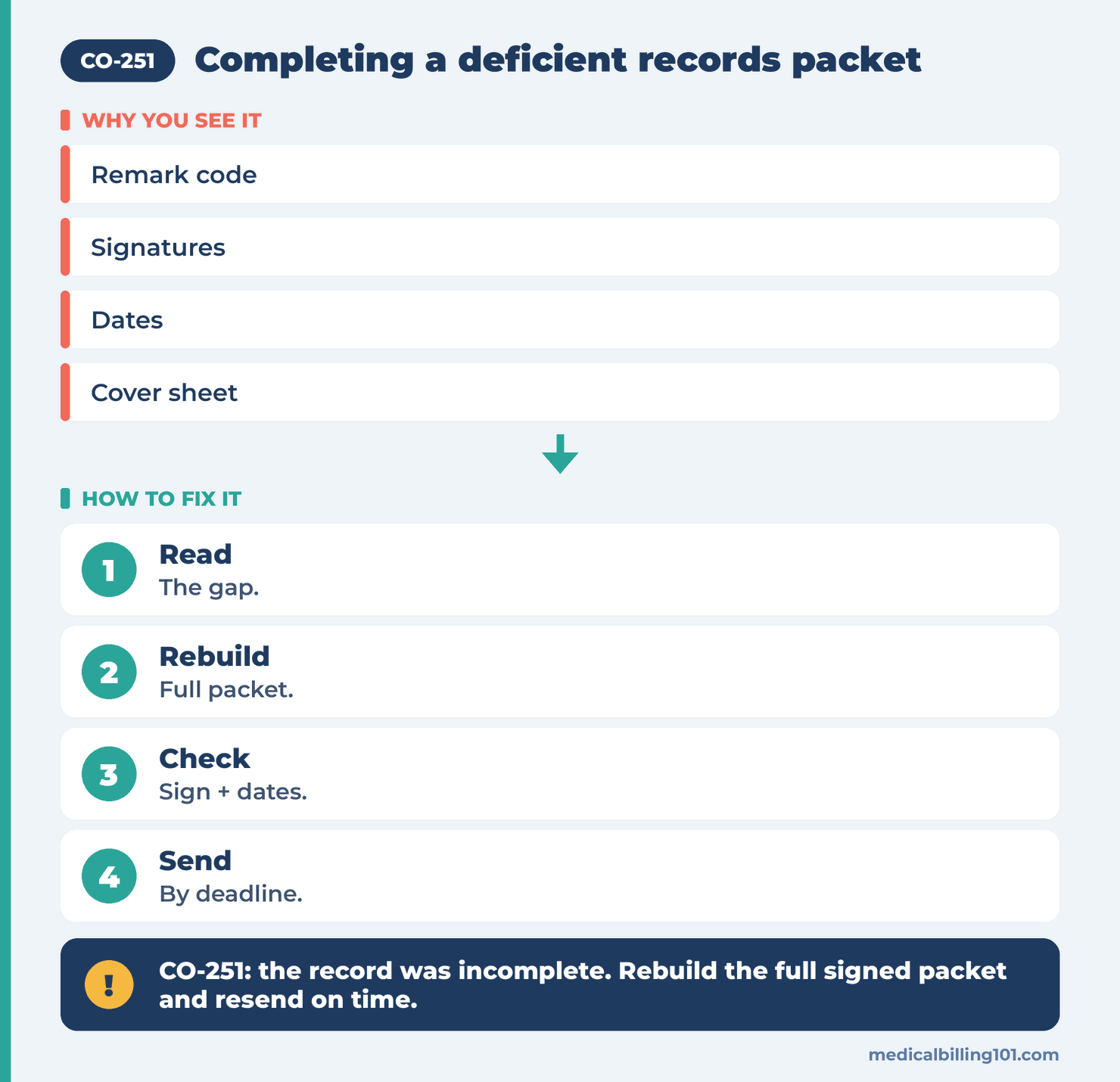
- Read the gap. The remark code and letter say what was missing. If not, call and ask.
- Rebuild the full packet. Include every page, not only the missing one, so the reviewer sees the whole record.
- Check signatures and dates. Each record should be signed and cover the dates of service billed.
- Add a cover sheet. List the claim number, dates of service and each document in the packet.
- Send by the deadline. Use the route on the request letter and keep proof of sending.
For electronic submission to Medicare contractors, see CMS esMD. Our guide to medical necessity documentation explains what reviewers look for first.
Example scenario (fictional names), part 2
How the CO-251 Denial Was Resolved
Priya pulled the full three-page plan of care and the signed certification. She also added the progress notes for the twelve visits.
Fix: She sent one packet with a cover sheet listing each document and the dates of service.
Outcome: The payer reviewed the packet and paid the visits. The clinic now runs a signature and page check before any records go out.
Names and details are illustrative; no real patient data.
CO-251 compared with related codes
| Code | Situation | Next step |
|---|---|---|
| CO-251 | Right record, incomplete | Send the complete packet |
| CO-250 | Wrong record | Send the record named |
| CO-252 | Record still needed | Send the requested record |
| CO-50 | Reviewed, not necessary | Appeal with support |
FAQ
What does CO-251 mean?
The payer got the type of record it asked for, but it was incomplete or deficient, so the claim cannot be processed yet.
Is CO-251 a final denial?
Not usually. It is a hold until the full record arrives, but a missed deadline can make it final.
Should I resend only the missing page?
Resend the whole packet. Reviewers often need to see the full record in one place.
Can I sign a record after the fact?
Follow the payer’s signature rules. Many accept a signature attestation; do not alter the original note.
Can the patient be billed for CO-251?
No. The CO group means the provider resolves it.
Sources
How we checked: the code wording on this page was matched word for word with the X12 CARC list on 24 October 2026.
- X12, Claim Adjustment Reason Codes (CARC 251). Accessed 24 Oct 2026.
- X12, Remittance Advice Remark Codes. Accessed 24 Oct 2026.
- CMS, Electronic submission of medical documentation (esMD). Accessed 24 Oct 2026.
Last updated: 24 October 2026 · Educational content; not legal advice.
Related denial codes
- CO-252: An Attachment or Other Documentation Is Required
- CO-250: Wrong Attachment Received
- CO-261: Inconsistent With Patient History
- PR-227: Information Requested from the Patient Was Not Provided
- CO-226: Requested Information Not Provided
- CO-216: Denied on Review Findings
- N290: Missing, Incomplete or Invalid Rendering Provider Identifier
- CO-206: NPI Missing on the Claim