
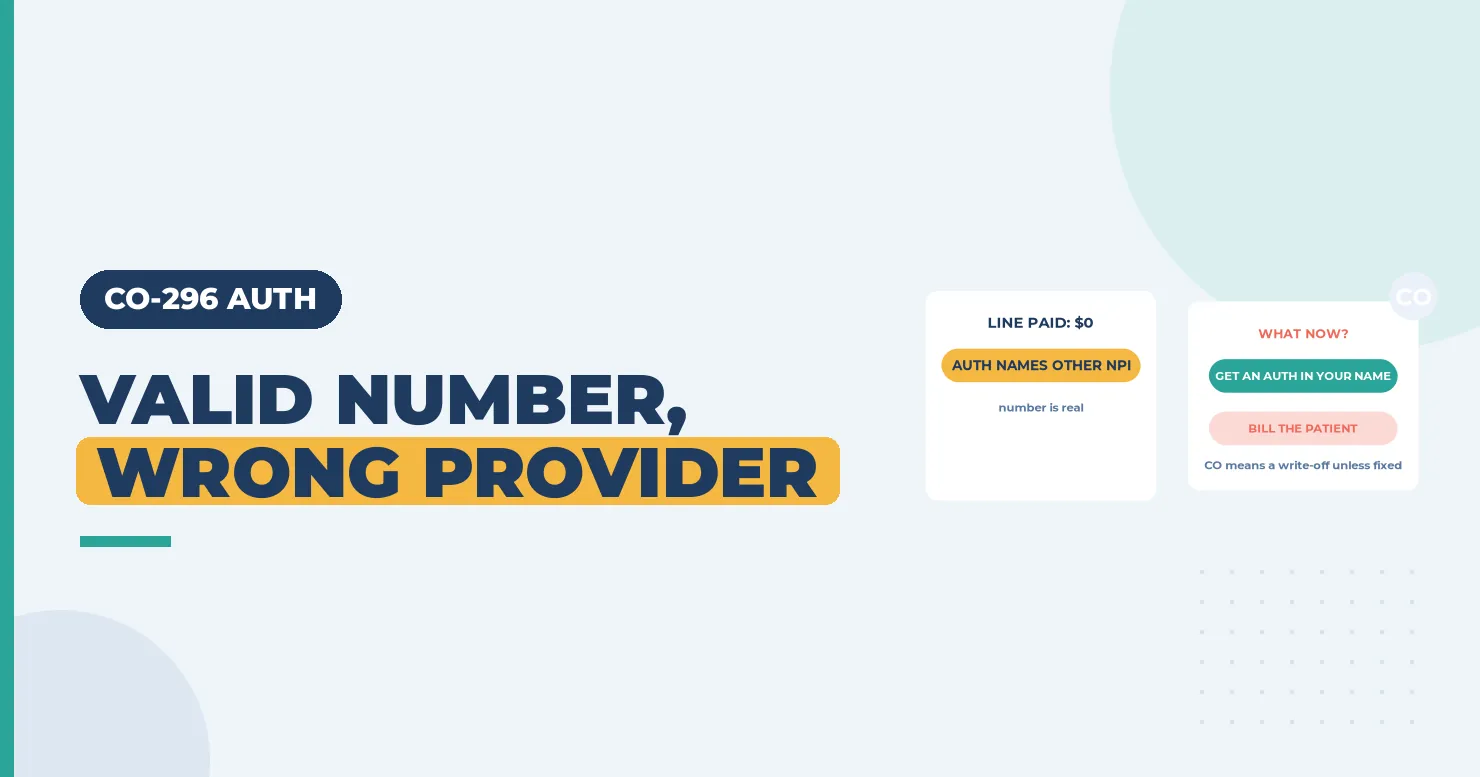
The CO-296 denial code means the authorization number on your claim is real, but the payer issued it to another provider. The fix is to get an approval in your own name, or have the plan move the existing one to you. Then send a corrected claim with the right number. (Primary source: X12 Claim Adjustment Reason Codes)
In brief: CARC 296 is a provider mismatch on the approval. The service may be fine, and the number may be valid. It just belongs to a different clinic, doctor or facility. Do not bill the patient for a CO-296 balance.
Part of our denial codes library. Written by Manikandan J, CPC, CRCR, who has worked authorization mismatches for therapy, imaging and surgery practices. Published 15 November 2026. Last updated: 15 November 2026. Code wording quoted word for word from X12. Read about the author and our editorial policy, or contact us to report an error.
What does denial code CO-296 mean?
Denial code CO-296 means the payer found the approval, but it names a different provider. Reason code 296 points at who performed or billed the care, not at the care itself. The plan will not pay you under someone else’s approval.
| Field | Value |
|---|---|
| Code | 296 |
| Description | “Precertification/authorization/notification/pre-treatment number may be valid but does not apply to the provider.” |
| Group codes | No X12 group restriction; CO is the usual choice |
| Start | 07/01/2018 |
| History | Replaced part of retired CARC 15, which stopped on 05/01/2018 |
Source: X12 Claim Adjustment Reason Codes, checked 15 November 2026.
Methodology: the code wording is copied from the X12 list, and the claim form steps follow the NUCC instructions cited below.
Key terms: A prior authorization is the plan’s approval before care. The servicing provider is the clinic or doctor named on that approval. CO is the contractual obligation group code.
CO-296 vs OA-296: what is the difference?
CO-296 puts the loss on your contract. The plan says your agreement requires an approval in your name, so you write it off unless you fix it. OA-296 reports the same mismatch without naming who owns the balance.
| Version | Who carries the balance | What to do |
|---|---|---|
| CO-296 | The provider, under the contract | Get a matching approval, then correct the claim |
| OA-296 | No owner stated on the remit | Call the plan, then follow the same fix |
In both cases, the patient does not owe the amount.
Why does an authorization not apply to my provider?
An authorization fails CARC 296 when the provider on the claim differs from the provider on the approval. Common causes include a referral sent to one clinic and care given at another, such as a sister location. A partner may see the patient instead of the approved surgeon. A new group NPI may also replace the one the plan approved.
X12 split old CARC 15 into two codes in 2018. CO-284 covers an approval that does not fit the billed service. CO-296 covers an approval that does not fit the provider. Check the X12 list when a remit still shows the retired code.
Example scenario (fictional names), part 1
CO-296 Denial Example: What Happened
Dana Whitlock handles front desk and billing at Riverbend Physical Therapy. A patient arrived for knee therapy after a meniscus repair. The patient’s surgeon had sent an approval letter, and Dana copied its number into Box 23.
She billed 97110-GP and 97140-GP with Z4789 on a CMS-1500. The rendering therapist was Tomas Reyes, PT.
The fictional commercial plan returned an 835 with CAS*CO*296 on both lines and remark code N54. That remark reads “Claim information is inconsistent with pre-certified/authorized services.”
If the number was real, why did the plan refuse it? Keep reading, or jump to how it was resolved. Keep reading, or jump to how the CO-296 denial was resolved.
How do I fix a CO-296 denial?
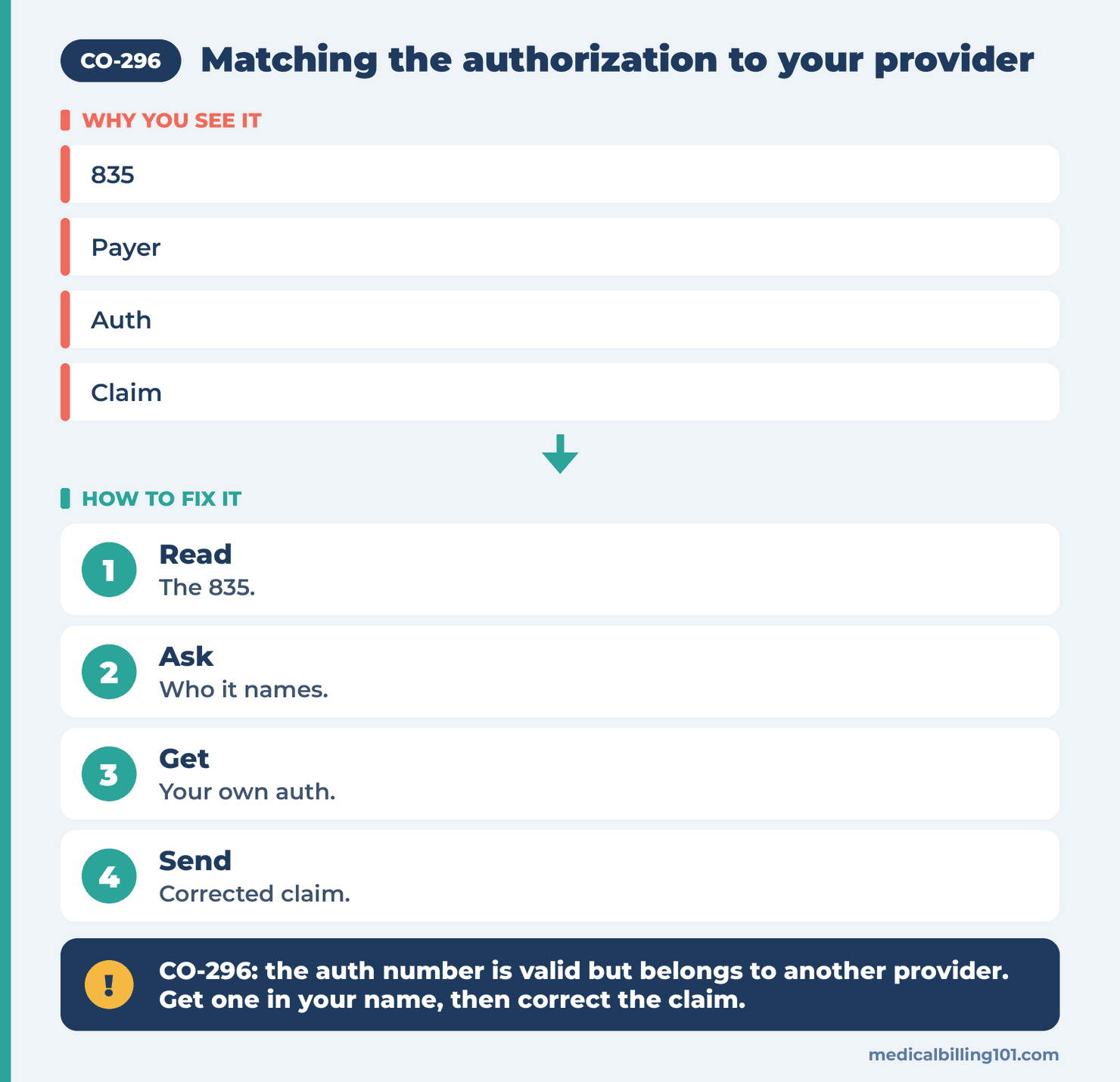
To fix a CO-296 denial, match the approval to the provider who did the work. Call the plan and read back the number. Ask which provider and NPI it names. Then ask the plan to update it, or request a new one for your clinic. Send a corrected claim with that number.
| Step | What to do | What to record |
|---|---|---|
| 1. Read the 835 | Note the CARC, the remark code and the lines | Claim number and date |
| 2. Call the plan | Ask which provider and NPI the approval names | Rep name and call reference |
| 3. Fix the approval | Ask for an update, or a new approval for your NPI | New or updated number |
| 4. Correct the claim | Box 23 and FL 63 with the matching number, frequency code 7 | Resubmission date |
| 5. Prevent it | Verify the servicing NPI on every approval at intake | Intake checklist entry |
Example scenario (fictional names), part 2
How the CO-296 Denial Was Resolved
Dana called the plan and read back the number. The rep said it named the surgeon’s practice, not Riverbend. The surgeon’s office had asked for therapy approval under its own group NPI, by mistake.
Fix: Dana asked the plan for a therapy approval naming Riverbend. The plan issued a new number covering the same visits. She sent a corrected claim with frequency code 7 and the new number in Box 23.
Outcome: both lines paid on the next remit. Dana now checks the provider name on every approval letter before the first visit.
Names and details are illustrative; no real patient data.
Names and details are illustrative; no real patient data.
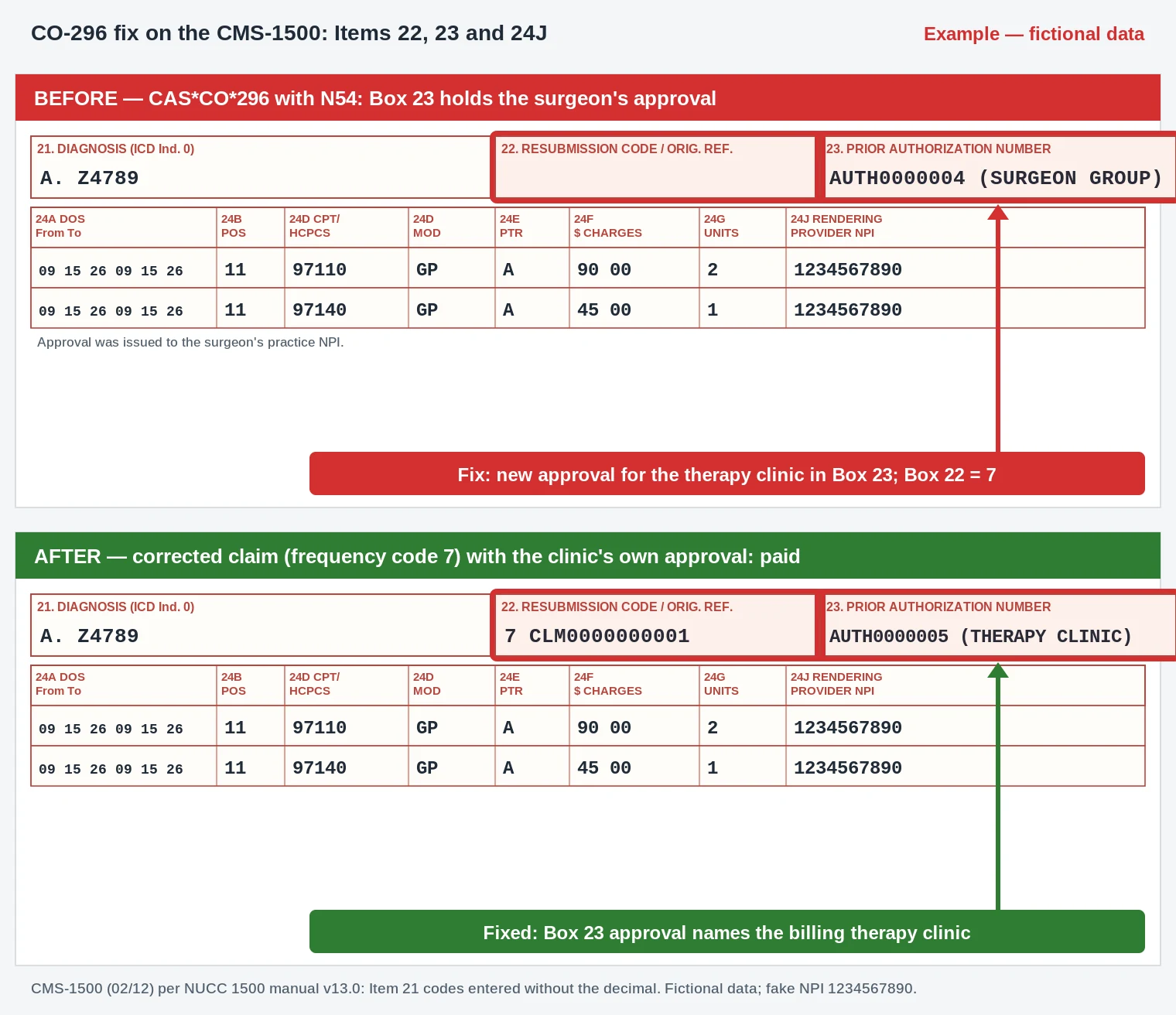
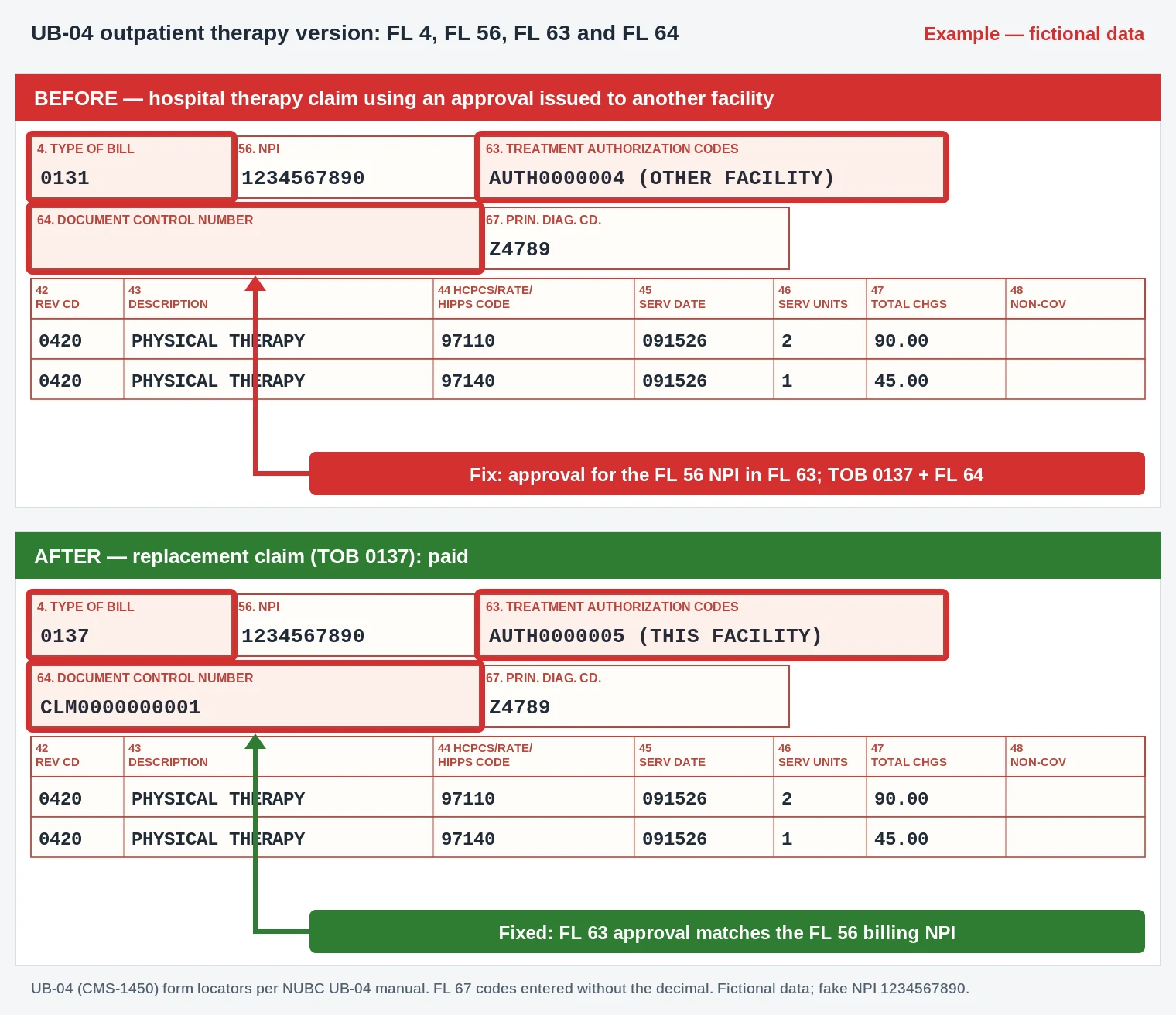
- Box 23 / FL 63: the approval issued to the surgeon’s practice was replaced with a new approval naming the therapy clinic.
- Box 24J / FL 56: the rendering and billing NPIs stay the same; the approval was changed to match them, not the other way round.
- Box 22 / FL 4 + FL 64: frequency code 7 with the original claim number (bill type 0137 on the UB-04).
- Box 21 / FL 67: Z47.89 (entered as Z4789) and 97110-GP / 97140-GP are unchanged.
Can I bill the patient for CO-296?
No. CO-296 is a contractual adjustment, so the patient is not responsible for that balance. The approval error sits between the providers and the plan. Fix the approval instead. The NUCC 1500 instructions show where the number goes in Box 23.
What if the plan will not move the approval?
If the plan refuses to update the approval, ask for a new one for your provider. Some plans allow a retro request within a short window. If the plan still refuses, file an appeal with the approval letter, the referral and the visit notes. For example, ask whether the plan accepts a retro request for therapy visits. Medicare’s prior authorization models show how approvals tie to a provider.
Related codes
| Code | Meaning |
|---|---|
| CO-284 | Authorization number does not apply to the billed services |
| CO-197 | Precertification or authorization absent |
| CO-15 | Retired authorization code that CARC 296 partly replaced |
| CO-198 | Precertification or authorization exceeded |
FAQ
What does CO-296 mean?
The approval number is valid, but the plan issued it to a different provider.
Is CO-296 the same as CO-284?
No. CO-284 means the approval does not cover the billed service. CO-296 means it does not cover the provider.
Can I use another clinic’s approval number?
No. Each approval names a provider, so get one in your own clinic’s name.
Which group code comes with CARC 296?
X12 sets no restriction. CO is the usual choice, because the contract requires a matching approval.
Does the patient owe a CO-296 amount?
No. It is a contractual adjustment, so fix the approval instead.
Sources
How we checked: the CARC 296 quote was matched word for word with the X12 CARC list on 15 November 2026, and N54 with the X12 RARC list.
- X12, Claim Adjustment Reason Codes (CARC 296, 284, 15). Accessed 15 Nov 2026.
- X12, Remittance Advice Remark Codes (N54). Accessed 15 Nov 2026.
- NUCC, 1500 claim form instructions. Accessed 15 Nov 2026.
- CMS, Medicare Claims Processing Manual, Chapter 25 (UB-04). Accessed 15 Nov 2026.
- CMS, prior authorization and pre-claim review initiatives. Accessed 15 Nov 2026.
Last updated: 15 November 2026 · Educational content; not legal advice.