
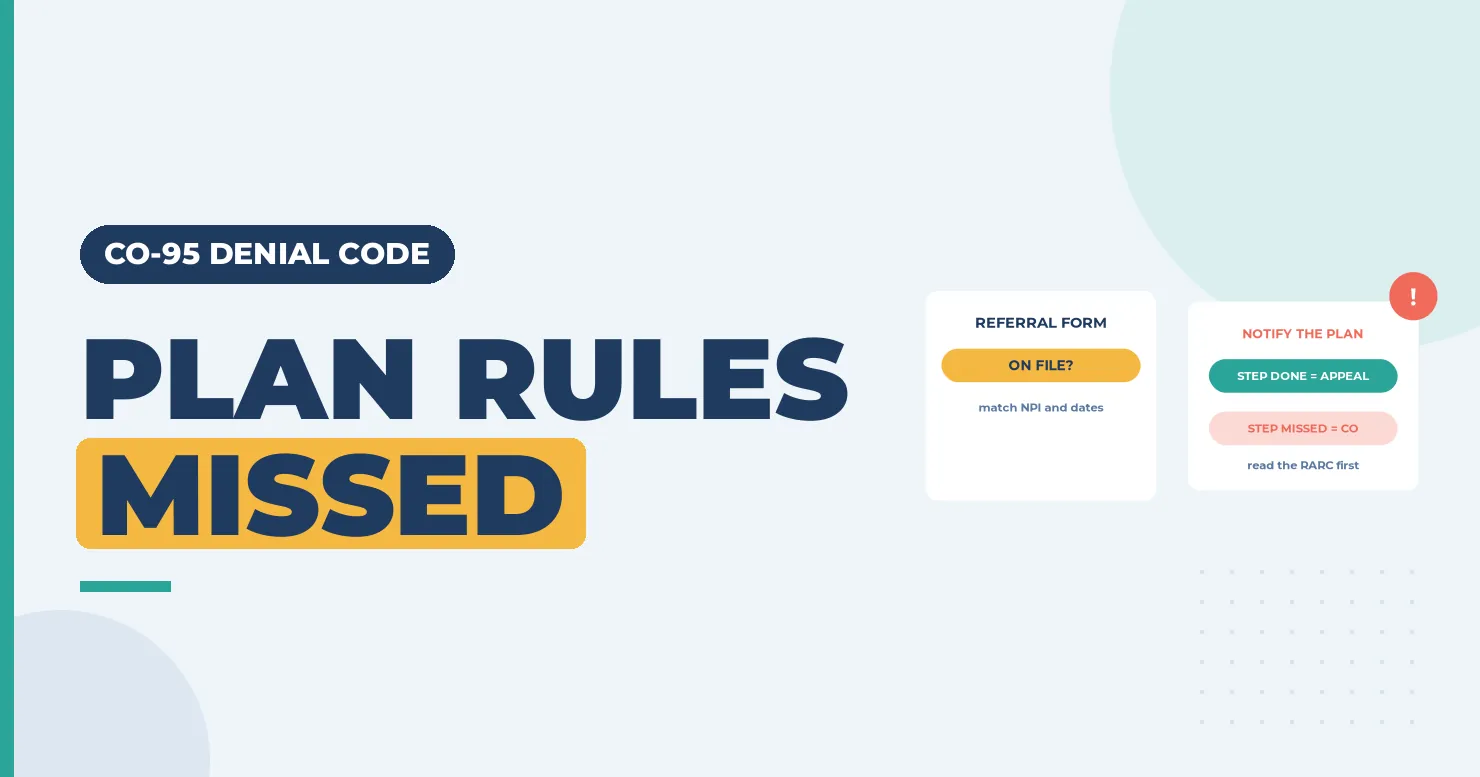
CO-95 means the payer says a plan procedure wasn’t followed. The service itself may be covered. The problem is a process step: a referral, a notification, a second opinion, or a rule about where the care happens. The CO group tells you the contract puts the loss on the provider, so you can’t bill the patient for it. Your job is to find out which procedure the payer means. Then you either prove you followed it or fix the gap. (Primary source: X12 Claim Adjustment Reason Codes)
In brief: CARC 95 reads “Plan procedures not followed.” It’s a process denial, not a coverage or coding denial. Read the remark code, name the missed step, and check your records. If you did follow the step, appeal with proof. If you didn’t, check whether the plan allows a late fix.
Part of our denial codes library. Written by Manikandan J, CPC, CRCR, who has worked payer-side and provider-side denials. Published 21 October 2026. Last updated: 21 October 2026. Code wording is quoted word for word from X12.
Official X12 wording for CARC 95
| Field | X12 text |
|---|---|
| Code | 95 |
| Description | “Plan procedures not followed.” |
| Start | 01/01/1995 |
| Last modified | 09/30/2007 |
Source: X12 Claim Adjustment Reason Codes, checked 21 October 2026. The wording is short on purpose. The remark code and the plan’s own rules tell you which procedure is meant.
Example scenario (fictional names), part 1
CO-95 Denial Example: What Happened
Dana Whitfield runs billing for Cedar Ridge Physical Therapy. Therapist Marco Ilves saw a patient for low back pain (M54.50) and billed 97110 for two units and 97140 for one unit. The payer was Brightway Health Plan, a fictional commercial plan that asks therapy clinics to notify it after the first visit.
The clinic’s notes said the notification went in on time. Even so, the 835 came back with CAS*CO*95 on every line and remark LQ*HE*N130. That’s a CO-95 denial code on care the plan never said was wrong.
So who missed the step: the clinic, or the plan’s own records? Keep reading, or jump to how the CO-95 denial was resolved.
What “plan procedures” usually means
CARC 95 is a catch-all for rules in the member’s plan or your contract. The most common ones are:
- A referral is a primary care doctor’s written OK for specialist care. An HMO-style plan may need one on file before the visit.
- A notification is a notice to the plan that care started, such as an admission or a course of therapy. No approval is needed, but the deadline still counts.
- Site-of-care rules. A plan may require a lab test, drug or scan to go through a named vendor or setting.
- Second-opinion rules. Some plans ask for a second opinion before certain elective surgeries.
- Program rules. Care management, step programs or network steering rules written into the contract.
For Medicare Advantage plans, CMS explains what plans must tell members about these rules in Chapter 4 of the Medicare Managed Care Manual. Missing prior approval usually gets its own code, such as CO-197. Payers use 95 when the rule broken is a process step rather than an approval.
CO-95 vs PR-95 vs OA-95
The group code tells you who carries the amount.
| Group | What it signals | Can you bill the patient? |
|---|---|---|
| CO-95 | Your contract makes the provider responsible for the missed step | No |
| PR-95 | The member broke a plan rule, such as skipping a needed referral where the plan puts that on the member | Yes, if plan terms and state law allow and you told the patient first |
| OA-95 | Other adjustment; often a secondary payer echoing a prior payer’s process rule | Read the primary remit first |
If you think the group is wrong, ask the payer to correct it. Don’t move a CO amount to the patient on your own.
Remark codes you will often see with CARC 95
The RARC narrows down the rule. These are real, active X12 remarks that often travel with 95:
| RARC | X12 wording | What to check |
|---|---|---|
| N130 | “Consult plan benefit documents/guidelines for information about restrictions for this service.” | The plan’s member rules for this benefit |
| N54 | “Claim information is inconsistent with pre-certified/authorized services.” | Dates, codes and provider on the notification or approval |
| N575 | “Mismatch between the submitted ordering/referring provider name and the ordering/referring provider name stored in our records.” | The referral on file vs. Box 17 on the claim |
Check the wording on the X12 RARC list each time, since payers sometimes pair codes in their own way.
How to fix a CO-95 denial
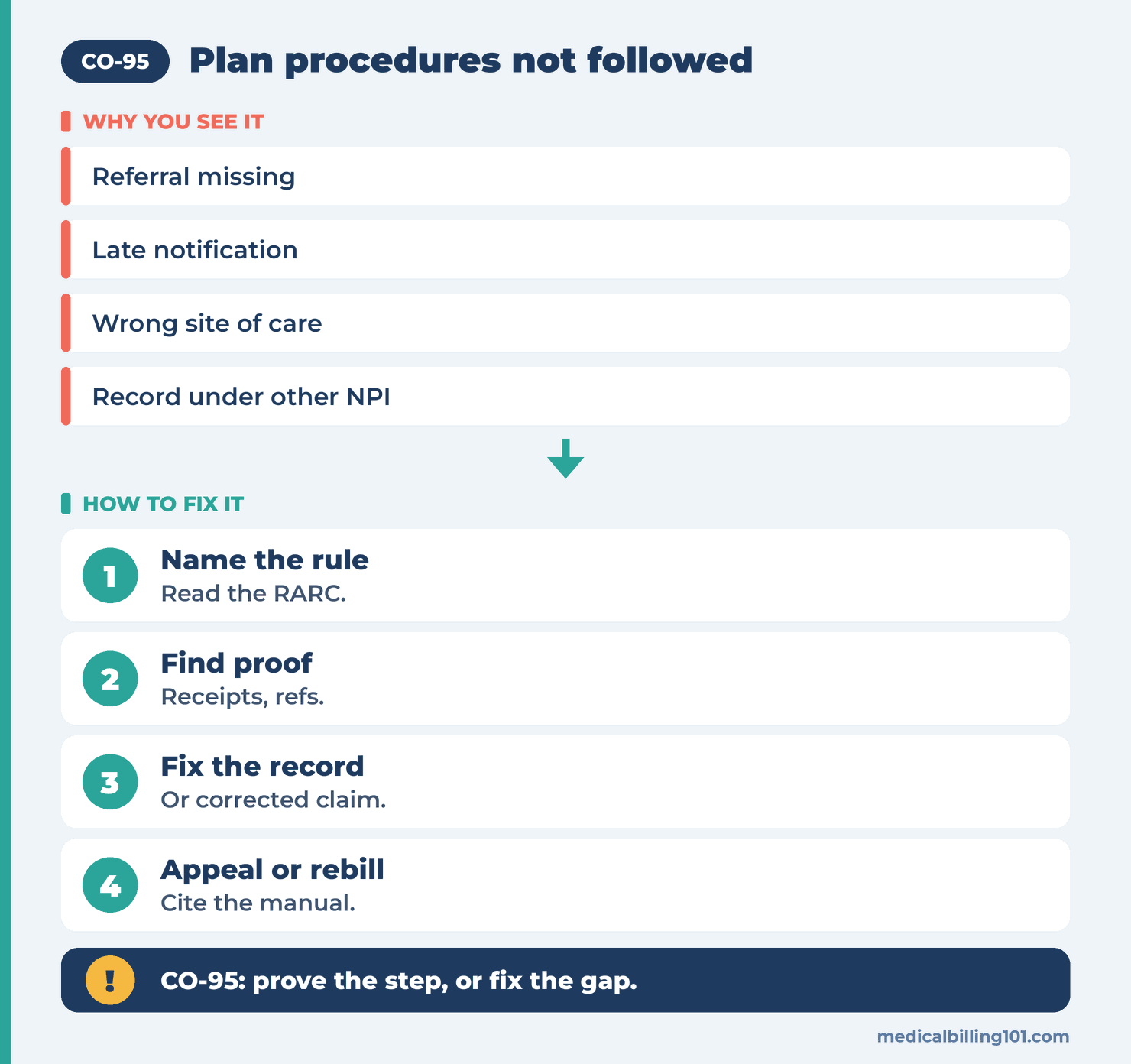
- Name the rule. Read the RARC, then search the payer’s provider manual for the benefit. Write down the exact procedure, such as a notice deadline after the first visit.
- Find your proof. Look for portal confirmations, fax receipts, call reference numbers and referral numbers. Match the dates, NPI and codes to the claim.
- Ask the payer what it has on file. One call often shows the record sits under another NPI, location or member ID.
- Fix the gap. If the plan’s record is wrong, ask it to update the record and reprocess. If your claim is wrong, send a corrected claim with frequency code 7.
- Appeal when you followed the rule. Attach the proof and quote the manual section. Keep it to one page.
- Write off when you didn’t. If the step was missed and the plan allows no late fix, the CO amount is a contractual write-off.
Example scenario (fictional names), part 2
How the CO-95 Denial Was Resolved
Dana started with the remark. N130 sent her to the plan’s therapy rules, so she checked the notification itself. The portal receipt was there, dated the day after the first visit. But it listed the clinic’s second location NPI, not the one on the claim.
Fix: she called the plan with the receipt number. The plan moved the notification to the right NPI and reprocessed the claim, so no corrected claim was needed.
Outcome: all three lines paid on the next remit. Dana then added a check to the intake sheet: the NPI on the notification must match the billing NPI.
Names and details are illustrative; no real patient data.
Worked example (illustrative)
A cardiology group bills a stress echo for a member of an HMO-style plan. The remit shows CAS*CO*95 with N575. The biller compares Box 17 with the referral on file. The referral named the patient’s former primary care doctor. The current doctor sends a new referral, and the plan allows a referral dated before the visit to be added. The group sends a corrected claim with the right referring provider and gets paid.
Prevention checklist
- [ ] Keep a one-page “plan steps” sheet per major payer: referral, notification and site-of-care rules.
- [ ] Check referral and notification status at scheduling, not at billing.
- [ ] Match the NPI, location and codes on every notification to what you will bill.
- [ ] Save portal receipts and call reference numbers in the patient account.
- [ ] Track CARC 95 by payer and rule, so repeat gaps show up fast.
Related codes
- CO-197: precertification, authorization or notification absent.
- CO-15: retired authorization code and what replaced it.
- CO-50: not deemed a medical necessity.
- CO-96: non-covered charges.
Key takeaways
CO-95 is about process, not coverage. Read the remark code to learn which plan step the payer means. Then compare its record with your proof. Most of these denials come down to a record that’s missing, filed under the wrong NPI or tied to the wrong dates. When you did follow the rule, appeal with proof. When you didn’t, don’t bill the patient for a CO amount.
FAQ
What does CO-95 mean on an EOB?
It means “Plan procedures not followed.” The payer says a plan step, such as a referral or notification, was missed.
Is CO-95 the same as a missing prior authorization?
Not quite. Missing prior authorization usually gets CARC 197. CARC 95 is for other plan steps, such as notification or referral rules.
Can I bill the patient for CO-95?
No. The CO group means the contract makes the provider responsible. Only a PR group lets you bill the patient.
How do I appeal a CO-95 denial?
Send proof that you followed the step, such as a portal receipt, and cite the plan manual section. Ask the payer to reprocess.
Which remark codes come with CARC 95?
N130, N54 and N575 are common. The remark tells you which rule the payer is pointing to.
Can a corrected claim fix CO-95?
Yes, when the claim itself was wrong, such as the wrong referring provider. Use frequency code 7.
Sources
How we checked: each code quote on this page was compared word for word with the X12 CARC and RARC lists on 21 October 2026.
- X12, Claim Adjustment Reason Codes (CARC 95, 197). Accessed 21 Oct 2026.
- X12, Remittance Advice Remark Codes (N130, N54, N575). Accessed 21 Oct 2026.
- CMS, Medicare Managed Care Manual, Chapter 4. Accessed 21 Oct 2026.
Last updated: 21 October 2026 · This page is educational and doesn’t replace payer contracts or plan manuals.