

You will mostly see OA-209 on a Medicare remittance for a patient who also has Medicaid. OA-209 is an adjustment code, not a denial in the usual sense. The payer is telling you that a rule or agreement stops you from collecting this amount from the patient. The same amount can still go to the next payer in line. If the patient already paid it, you owe them a refund. (Primary source: X12 Claim Adjustment Reason Codes)
In brief: CARC 209 says the provider cannot collect the amount from the patient, may bill a subsequent payer, and must refund the patient if collected. It is used only with group code OA. Stop patient statements on that balance, refund any copay taken, and make sure the claim crosses over to Medicaid or the secondary plan.
Part of our denial codes library. Written by Manikandan J, CPC, CRCR, who has posted dual-eligible remits and QMB refunds for therapy and primary care groups. Published 23 October 2026. Last updated: 23 October 2026. Code wording quoted word for word from X12.
The official wording, line by line
X12 gives CARC 209 a long description: “Per regulatory or other agreement. The provider cannot collect this amount from the patient. However, this amount may be billed to subsequent payer. Refund to patient if collected. (Use only with Group code OA)”. It started on 07/09/2007 and was last changed on 07/01/2013 (X12, checked 23 October 2026).
| Part of the text | What it means for your team |
|---|---|
| “Per regulatory or other agreement” | A law, a program rule or a contract sets the limit |
| “cannot collect this amount from the patient” | No statement, no collections, no card on file charge |
| “may be billed to subsequent payer” | Medicaid or another secondary can still be billed |
| “Refund to patient if collected” | Money already taken must go back |
| “Use only with Group code OA” | You will not see it as CO-209 or PR-209 |
Where OA-209 shows up most
The classic case is a QMB patient. A Qualified Medicare Beneficiary (QMB) is a person with Medicare whose state Medicaid program covers Medicare premiums and cost sharing. Federal law bars providers from billing QMB patients for Medicare deductibles, coinsurance and copays. CMS explains this in its QMB program billing guidance. Medicare often pairs the adjustment with an alert remark:
- N781: “Alert: Patient is a Medicaid/ Qualified Medicare Beneficiary. Review your records for any wrongfully collected deductible. This amount may be billed to a subsequent payer.”
- N782: the same alert for coinsurance.
- N783: the same alert for copayment.
Other uses are rarer. For example, a state program or a contract can create the same rule: no patient billing, but the next payer may be billed.
Example scenario (fictional names), part 1
OA-209 Denial Example: What Happened
Marcus Bell runs the front desk at Stonebridge Physical Therapy, a three-clinic practice in a mid-size town. A 71-year-old patient paid a $40 copay at each of six visits in March. Her Medicare remits came back with CAS*OA*209 on the coinsurance amount and remark N782 on every line.
Marcus’s billing system read OA as “other” and left the balance on the patient account. A statement for the remaining coinsurance was already queued for Friday.
What should Marcus do with the $240 and that statement? Keep reading, or jump to how the OA-209 denial was resolved.
Step by step: working an OA-209 line
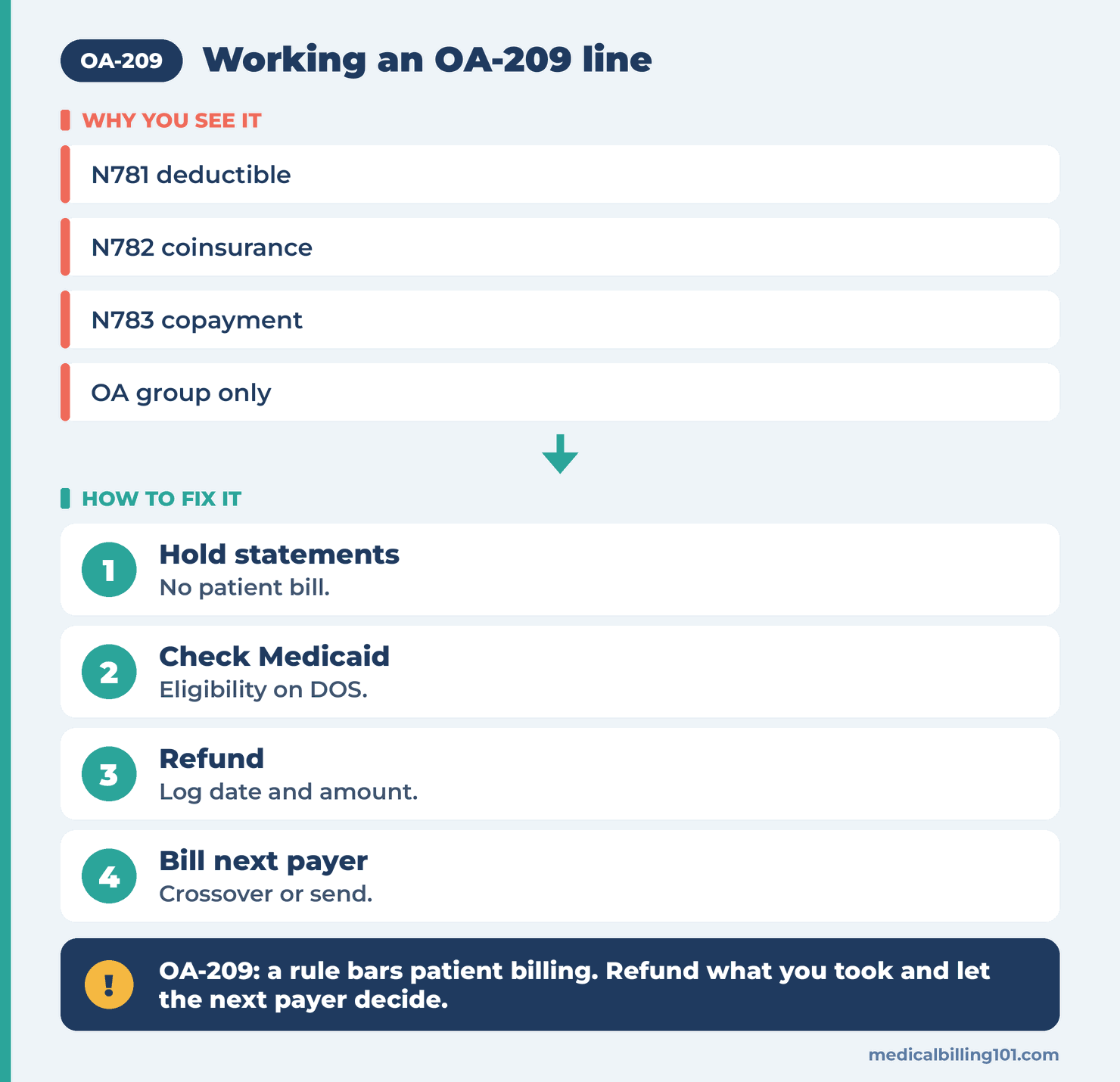
- Stop patient billing on that balance. Put a hold on the statement before it goes out.
- Check the patient’s Medicaid or secondary coverage. Run eligibility for the date of service.
- Refund what was collected. Track the refund date and amount on the account.
- Let the claim cross over or bill it. A crossover is the automatic hand-off of a processed Medicare claim to Medicaid or a supplemental plan. Many Medicaid programs get Medicare claims by automatic crossover. If yours did not, send the claim with the Medicare remit attached.
- Post the Medicaid result. Whatever Medicaid does not pay is written off, not billed to the patient.
- Flag the account. Mark the patient as QMB so the front desk does not collect next time.
There is no claim form correction for OA-209. The original Medicare claim was right. The work happens in posting, refunds and the patient record.
Example scenario (fictional names), part 2
How the OA-209 Denial Was Resolved
Marcus pulled the statement from Friday’s run and checked eligibility. The patient had full Medicaid as a QMB.
Fix: He refunded the $240 in copays by check and logged the refund on the account. He then confirmed Medicaid had received the crossover claims. Medicaid paid a small part of the coinsurance under its own rate, and the rest was written off.
Outcome: The patient got her money back with a letter. The clinic added a QMB flag in registration that blocks copay collection at check-in.
Names and details are illustrative; no real patient data.
Common mistakes with this code
- Treating OA as patient responsibility. OA means other adjustment. It never means the patient owes it.
- Waiting for the patient to ask. The refund is owed when you see the code, not when someone complains.
- Writing off before Medicaid answers. You may lose a payment Medicaid would have made.
- Collecting copays at the next visit. For instance, a QMB patient asked for a copay at check-in is a repeat problem. Without a registration flag, the cycle repeats.
OA-209 compared with related codes
| Code | Meaning in plain words | Bill the patient? |
|---|---|---|
| OA-209 | Rule bars patient billing; next payer may pay | No |
| PR-1 / PR-2 / PR-3 | Deductible, coinsurance, copay | Yes, unless QMB |
| OA-23 | Impact of prior payer adjudication | Depends on the next payer |
| CO-45 | Charge exceeds fee schedule | No |
| PR-242 | Services not provided by network providers | Yes, per plan |
For help reading the full remit, see how to read an explanation of benefits. If you are sorting out a primary and secondary order, our guide to coordination of benefits denials helps.
FAQ
What does OA-209 mean?
A regulation or agreement stops the provider from collecting the amount from the patient. A subsequent payer may be billed, and any amount collected must be refunded.
Can CARC 209 be used with CO or PR?
No. X12 says to use it only with group code OA.
Do I refund the patient if Medicaid has not paid yet?
Yes. The refund duty applies to what you collected from the patient, whatever Medicaid later pays.
Is there a corrected claim for OA-209?
Usually no. The claim was processed correctly, so the work is posting, refunds and billing the next payer.
Which remark codes come with OA-209?
Medicare often sends N781, N782 or N783 for QMB patients.
Sources
How we checked: each code quote on this page was matched word for word with the X12 CARC and RARC lists on 23 October 2026.
- X12, Claim Adjustment Reason Codes (CARC 209). Accessed 23 Oct 2026.
- X12, Remittance Advice Remark Codes (N781, N782, N783). Accessed 23 Oct 2026.
- CMS, Qualified Medicare Beneficiary program. Accessed 23 Oct 2026.
Last updated: 23 October 2026 · Educational content; not legal advice.